

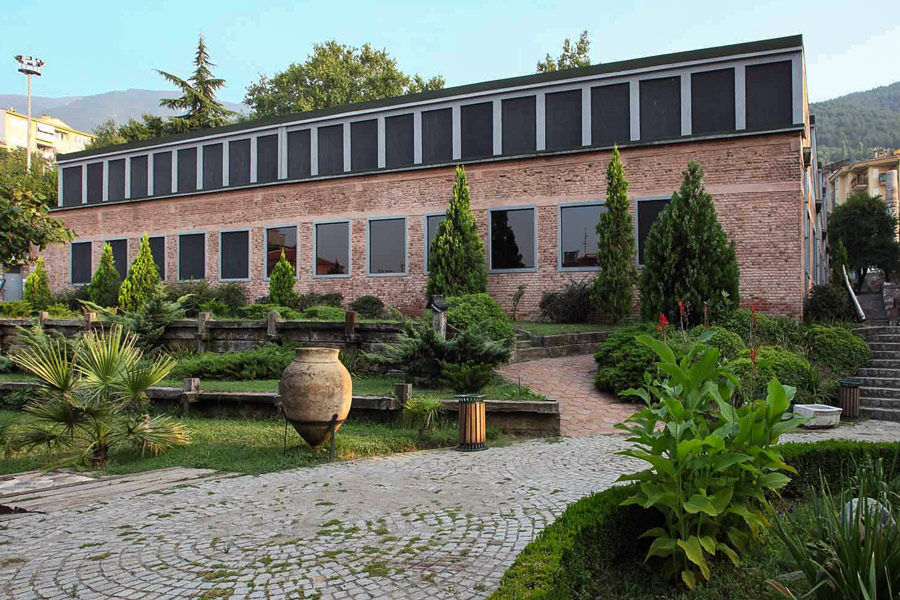
Photo source: www.tofasanadoluarabalarimuzesi.com
Address: Umurbey Mahallesi, Kapıcı Caddesi No: 9/1, 16360 Yıldırım, Bursa
Location: Google Maps
Telephone: +90 (224) 329 39 41 (museum office)
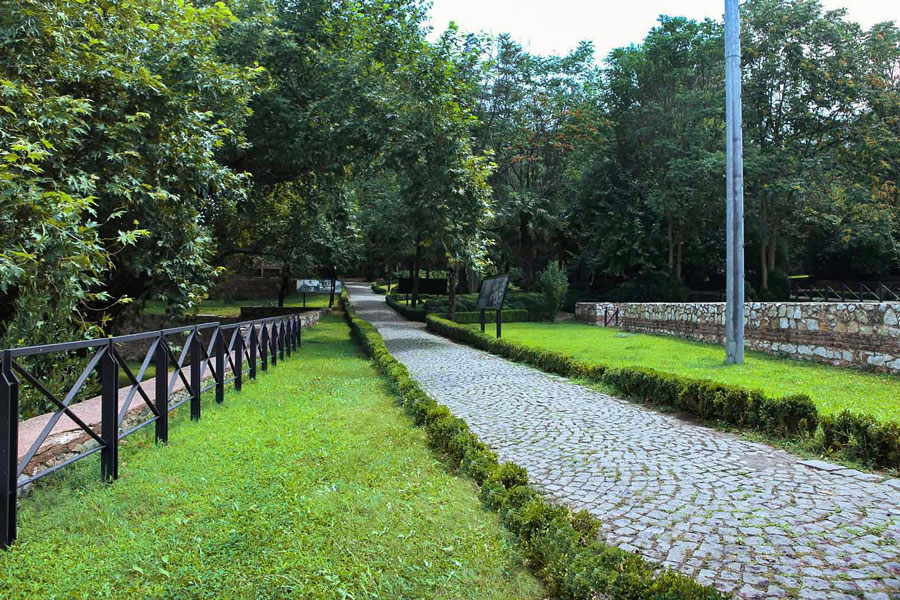
Opened by the carmaker Tofaş in 2002, the Tofaş Museum of Anatolian Carriages fills a nineteenth-century silk factory in Umurbey, a hillside quarter of Bursa. A wall of rough stone, laced with courses of brick, runs along the lane to an iron gate. Above it rises the factory’s slender chimney, built in bands of stone and brick. Inside, cobbled paths wind through a garden of some fifty kinds of plant, under a plane tree nearly four centuries old. Beside the door of the main hall, a cartwheel is fixed to the wall.
Among the historical sites in Bursa, this is the one that links the city’s old crafts to the cars it builds today. It is the company’s own museum, in the city where it has built cars since 1971. Yet most of what stands inside was pulled by oxen and horses, and its real subject is the craftsmen who made those carts by hand.
History of the Tofaş Museum of Anatolian Carriages
The factory came first. Bursa had traded silk for centuries, and in the nineteenth century steam-powered mills began to reel the thread on an industrial scale, some ninety of them by the 1860s. This one was founded around 1850 by the Köleyan family, according to the museum, and later belonged to the İpeker family. Bursa’s cocoons changed hands at Koza Han, in the bazaar below. At the mill, the fresh cocoons were stifled with steam and dried on wooden racks behind shuttered windows. They were then softened in hot water so that their filament could be wound onto reels. Cheap imported silk from the Far East ended the trade around 1980, and by 2003 most of the city’s surviving silk mills stood empty.
Cars arrived in the meantime. In 1968 the industrialist Vehbi Koç founded Tofaş in Bursa, and its first model went into production on 12 February 1971. A Turkish-built version of the Fiat 124, it was named after Murad I, the third Ottoman sultan, who ruled from Bursa. In its first year the Bursa plant turned out 7,835 of them.
In 1998 three men set out to bring the two stories together. They were Jan Nahum, a former Tofaş executive, the architect Naim Arnas and Önder Küçükerman, a professor of industrial design. Their starting point, the museum explains, was Bursa’s long tradition of cart-making. The Bursa Metropolitan Municipality leased them the empty silk factory, and Arnas restored it. Carts and carriages were gathered from villages and towns across Anatolia, then measured and drawn one by one. The drawings showed how sound the old solutions were, and how many of their principles still turn up in modern cars. The museum opened in June 2002 as a tribute to the cartwrights – a thank-you from the new masters to the old. More than 2.6 million visitors have come through its gate since then.
Highlights
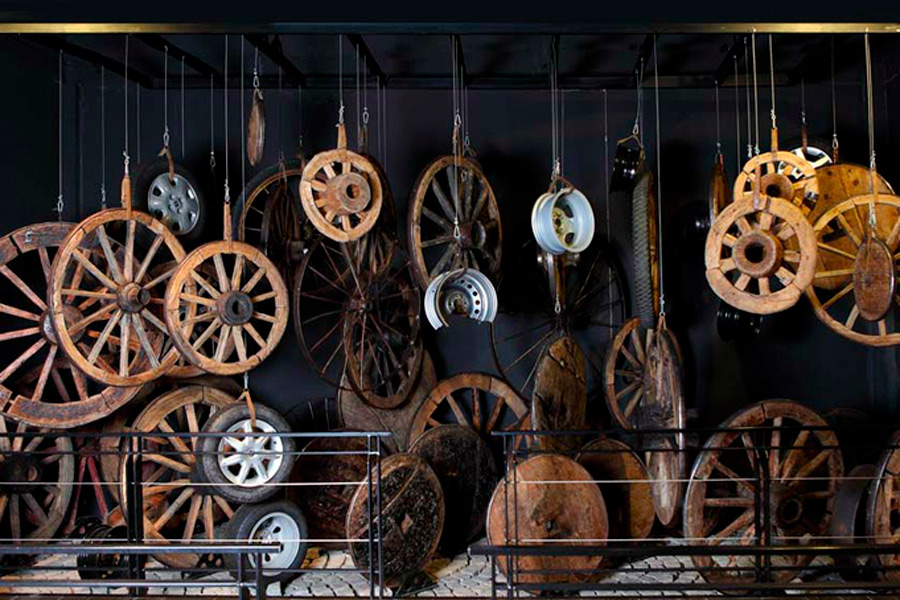
The route through the main hall runs in date order, from the oldest wheel to the newest car, and ends outside in the garden.
The Tomb at the Entrance
The first room opens on a burial chamber. A skeleton lies on a stone bench, and two great spoked wheels rest against the wall beside it. It recreates a tomb that roadworks uncovered in a burial mound at Üçpınar, near Balıkesir. Backlit photographs beside it show the dig. The tomb held the remains of a wooden cart of the sixth century BC, and the original finds went to the Bursa Archaeological Museum. In 1998 and 1999 Bursa craftsmen built a full-size replica of the cart, and the whole museum unfolds from it. Nearby is a copy of a toy cart found at Kızıltepe, near Mardin, which the museum dates to between 5500 and 3000 BC. Tofaş’s own workshop made it from 3D scans of the original, which stays in the Mardin Museum. Wheels were turning in this land thousands of years before the Üçpınar cart was buried.
The Cartwright’s Workshop
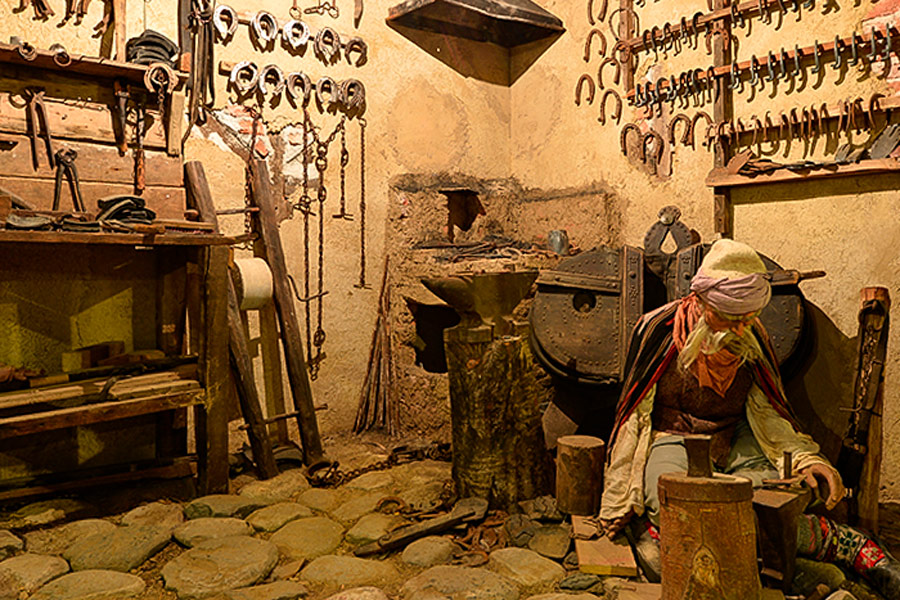
Next comes a complete carriage workshop, built by local craftsmen in the style of the nineteenth century. Its walls are a timber frame filled with brick and plastered with mud and straw, over an earth floor and under a tiled roof. A painted board over the door announces phaeton making, and a life-size cartwright bends over his bench among wheels, spokes and half-shaped timbers. The tools came from the shop of Mustafa Babik, a Bursa cartwright whose father and grandfather followed the same trade. Panels explain how a single horse carriage could take months to finish. Smaller workshops nearby belong to the nalbant, the farrier who shod the horses; the semerci, who made pack saddles; and the saraç, who cut and stitched harness. Together they show how many hands one vehicle needed before it could leave the yard.
The Carts and Carriages
Thirty-four horse- and ox-drawn vehicles fill the main hall, between walls of bare brick lit by tall, many-paned windows. Some of the lighter carriages hang overhead, wheels and all. The ox carts come from Yozgat, Çorum, Bursa and Balıkesir, and the carriages from Edirne, Eskişehir, Manisa, Konya and Istanbul as well as Bursa. The heaviest is the kağnı, an ox cart on solid wooden wheels whose axles creaked as they turned. During the Turkish War of Independence, women drove carts like these over the Küre Mountains, carrying ammunition from the Black Sea port of İnebolu to the front. Each region fitted out its vehicles for its own roads and weather, and the later carriages added leather fittings and canvas covers against the rain. A long wall of measured drawings sets the vehicles side by side, as the founders recorded them. Among the rarer pieces are a horse-drawn sledge, a Tatar cart, a cannon carriage and a britzka, the light travelling carriage of Eastern Europe. There is also a red fire cart with a hand pump, once hauled through the streets by the Ottoman volunteer firemen known as tulumbacı.
The Cars
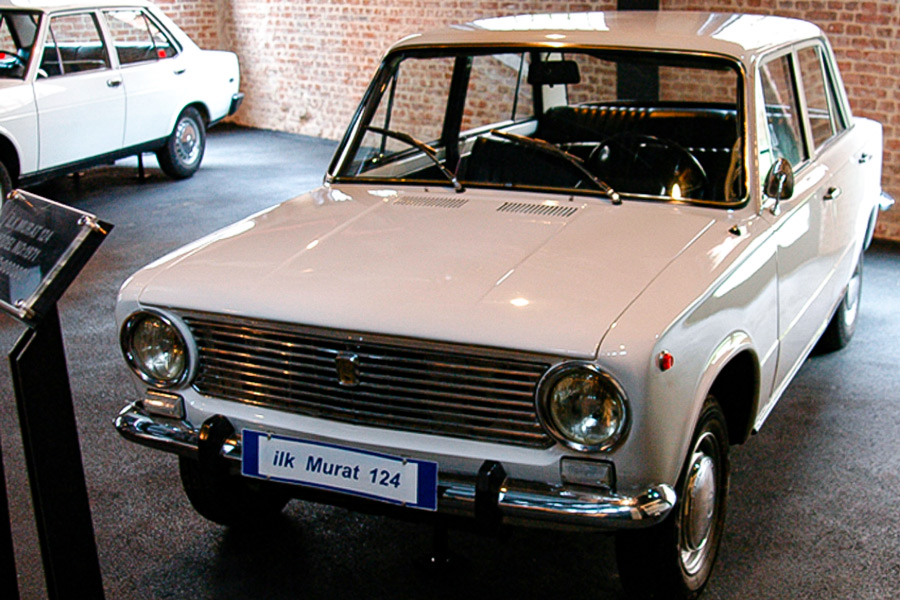
Twelve cars made at the Tofaş plant close the indoor route. First in line is a white Murat 124 with chassis number 0000001, built in 1971 and known affectionately as Hacı Murat. Beside it wait the first Murat 131, of 1976, and a dark blue Murat 131 Kartal of 1983. Further on come the 1994 Tempra that was the company’s millionth vehicle, the Palio Go that reached two million in 2004 and the Fiorino that made four million. A four-wheel-drive Doblò, built for the 2002 Dakar Rally, sits among the family cars, and so does the Doblò the models first run in Bursa. Tofa 23 years, from 2000 until 2023, when production moved to Stellantis’s plant in Vigo, Spain. The van is now coming home: under an agreement signed in September 2025, Stellantis and Koç Holding are bringing it back to the Tofa in Bursa. A white Palio in Fiat racing colours recalls the rally years, with the company’s trophies close by. In one room a red Fiat hangs in mid-air, pulled apart so that doors, bumpers and a wheel float free of the body. Seen straight after the ox carts, the row makes one thing plain. Car-making in Anatolia is little more than half a century old.
The Garden and the Umur Bey Bath
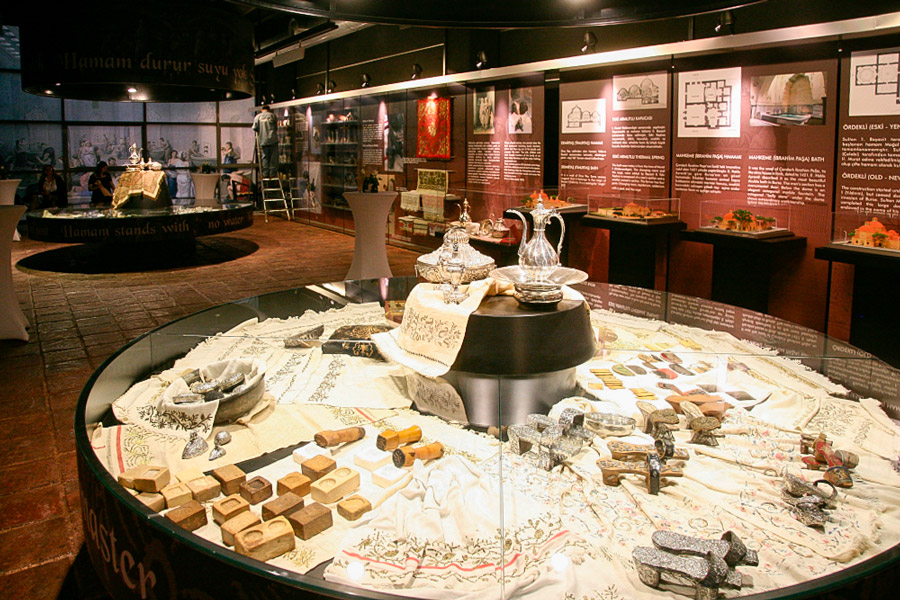
Outside, the paths pass beneath the great plane tree and a black mulberry about two hundred years old. The chimney rises from roofless stone walls, with steps climbing beside it. Two more of the factory’s buildings survive nearby: the kozaklık, where cocoons were dried, and the mancınıkhane, the reeling house, now used for exhibitions. The Umur Bey Hamamı, a public bath dated 1430, is also within the grounds. It is credited to Umur Bey, son of the early Ottoman vizier Kara Timurtaş Pasha; Umur Bey’s own mosque lies just beyond the museum wall. A foundation deed of 1455 lists the bath among the endowments of that mosque. Restored with help from the Vehbi Koç Foundation in 2008, the bath now serves as the Tofaş Art Gallery. Its roof has gone, and photographs on black steel frames are set between brick arches, over a floor of hexagonal terracotta tiles. Shows here have ranged from antique clocks to scales and weights. On a training track in the grounds, marked out with kerbs and painted lanes, five- and six-year-olds learn road safety at the wheel of small Fiat 500s.
Practical Information
Opening hours: Tuesday to Sunday, 10:00–17:00. The museum is closed on Mondays.
Admission: Free, including the art gallery.
Facilities: The Fayton Café stands in the garden. A free museum app offers audio tours for adults and for children.
Parking: The museum has its own car park, free of charge.
How to Get to the Tofaş Museum of Anatolian Carriages
Tickets for local transport: A rechargeable BursaKart covers the metro, trams and city buses. It is sold at station kiosks and at outlets displaying its logo.
By tram: The heritage T3 tram runs from Çınarönü to Zafer Plaza and stops at Gökdere/Panorama, 14 minutes from the museum on foot. The walk crosses the Gökdere by the Irgandı Bridge, then climbs Sakal Döken Caddesi to Kapıcı Caddesi. The red T1 line calls at Heykel, also 14 minutes away, by Ünlü Caddesi and the Setbaşı road bridge.
By metro: The nearest Bursaray station is Demirtaşpaşa, north-west of the museum. The walk takes about 18 minutes and joins the tram route at the Irgandı Bridge.
By bus: Many city routes stop at Setbaşı, about five minutes’ walk downhill from the museum. Route numbers change, so it is worth checking the Moovit app.
On foot: From the Ulu Cami, the walk takes about 19 minutes through the lanes south of the bazaar, partly along Akbıyık Caddesi. From the Irgandı Bridge it takes eight minutes, by Nakşi Çelebi Sokak and Sakal Döken Caddesi. Signs point the way from the Setbaşı road bridge.
By taxi: Metered taxis wait across the centre and can drive in to the museum car park. From Heykel the ride takes about five minutes, longer at rush hour.
From the intercity bus terminal: Bursa Otogar sits about 10 km north of the centre. The T2 tram reaches Kent Meydanı from the terminal in about 25 minutes. From there the T1 continues round the centre to Heykel. A taxi takes about 30 minutes, or up to 45 in heavy traffic.
From Istanbul by ferry: Fast boats cross the Sea of Marmara to Mudanya or Güzelyalı in about 2 hours. From Güzelyalı a connecting bus runs to the Bursaray terminus at Emek, and the metro then continues to Demirtaşpaşa. From Mudanya, bus 1/M covers the same route.
From Istanbul by road: The drive over the Osmangazi Bridge takes about 2.5 hours, and coaches to the Otogar run throughout the day.
Tips for an Optimal Visit
Recommended duration. The indoor route takes about 45 minutes. Allow an hour or more with the garden and the gallery.
Best time of day. Late afternoon is the calmest time on most days, once the morning school parties have left. Groups are asked to book ahead, so a call to the museum can confirm whether one is due.
Photography. The vehicles stand close together, so a wide-angle lens helps indoors. Flash is best kept away from the painted carriages.
Accessibility. The approach from Setbaşı is uphill, so visitors with limited mobility may prefer a taxi or car to the museum’s own car park.
Combine with. Umur Bey himself is buried in the courtyard of his mosque. The Irgandı Bridge is on the way back towards the bazaar, and the Green Mosque and Green Tomb lie 11 minutes away on foot by Sakal Döken Caddesi. Koza Han and the Ulu Cami are each about 20 minutes west. In the same quarter, the city’s Umurbey Silk Production and Design Centre has brought silk weaving back to a 1940s mill.
When Tofaş chose a name for its first car, the shortlist included Koza, the cocoon. It lost to a sultan. Half a century later the car has ended up among the cocoons after all. Hacı Murat stands in an old silk factory, a few steps from the house where they were once dried.