

Address: 1, Amir Temur Avenue, Tashkent
Telephone: (+998 71) 232-02-12
Opening Hours: Tuesday-Sunday, 10:00–17:00; Closed on Mondays
The Amir Timur Museum in Tashkent offers more than a portrait of a single ruler. Reopened after reconstruction, it now offers a refreshed introduction to the wider world of the Timurid era – its politics, dynastic ties, scholarship, architecture, and art. Among the exhibits are footage from the opening of Amir Timur’s tomb at the Gur-Emir Mausoleum in Samarkand on 21 June 1941, along with artefacts recovered during the expedition. The following day, the Great Patriotic War began, and in Uzbekistan those two events remain linked through the legend of the Curse of Tamerlane. For travellers interested in history and culture, the museum is one of the most rewarding stops on Uzbekistan tours. Seen through manuscripts, objects, reconstructions, and archival material, it is as much about the age that formed around Timur as about the man himself.
Amir Timur and the Timurid Dynasty
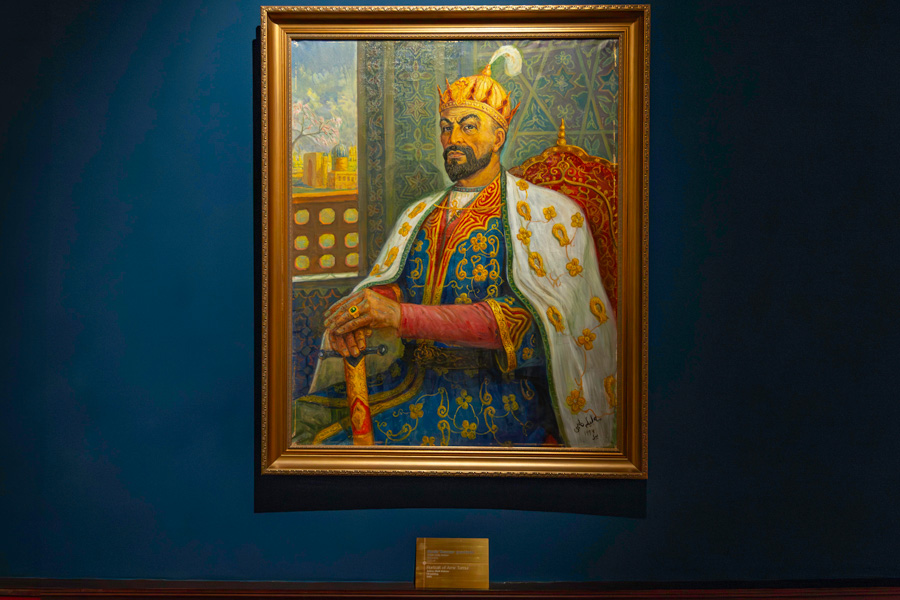
Few medieval rulers left a legacy as tangled as Timur's: conqueror and patron, feared destroyer and tireless builder – sometimes within the same campaign.
Amir Timur (1336–1405) ruled a region of Central Asia known in the Middle Ages as Maverannahr. He assembled a vast empire, drawing together dozens of states from Central Asia to the Middle East. Samarkand became his capital – a city where monumental mosques and mausoleums rose, crafts flourished, and eminent scholars gathered.
His famous maxim, 'strength lies in justice', reflects a conception of power grounded in order and law. The phrase remains a guiding symbol in Uzbekistan to this day.
Among his most celebrated descendants was Mirzo Ulugbek, who ruled in Samarkand and earned lasting renown as an astronomer. Hussein Baykara, ruler of Herat (in present-day Afghanistan), was equally significant – a devoted patron of the arts and literature. The poet and philosopher Alisher Navoi worked at his court, shaping the course of Turkic literary tradition. The Timurid dynasty maintained its hold over Mawarannahr until the 16th century.
From that point, members of the line ruled in India. Timur's great-great-grandson, Zahiruddin Muhammad Babur, founded the Mughal Empire. It endured until 1857, when the last ruler, Bahadur Shah II, was deposed by the British. One of the most celebrated figures in that long lineage was Shah Jahan, under whom the Taj Mahal was completed in the 17th century.
In Uzbekistan, the ruler is known as Amir Temur; in Europe, as Tamerlane. His image has captivated artists, writers, and composers for centuries. Notable interpretations include George Frideric Handel's opera Tamerlano (1724). A modern staging by director Stefano Poda was performed in Tashkent in 2024 and at the Dubai Opera in 2026. More recent work includes the Uzbek-Kazakh film Tamerlane (2026), directed by Jacob Schwartz.
The Building and Its History
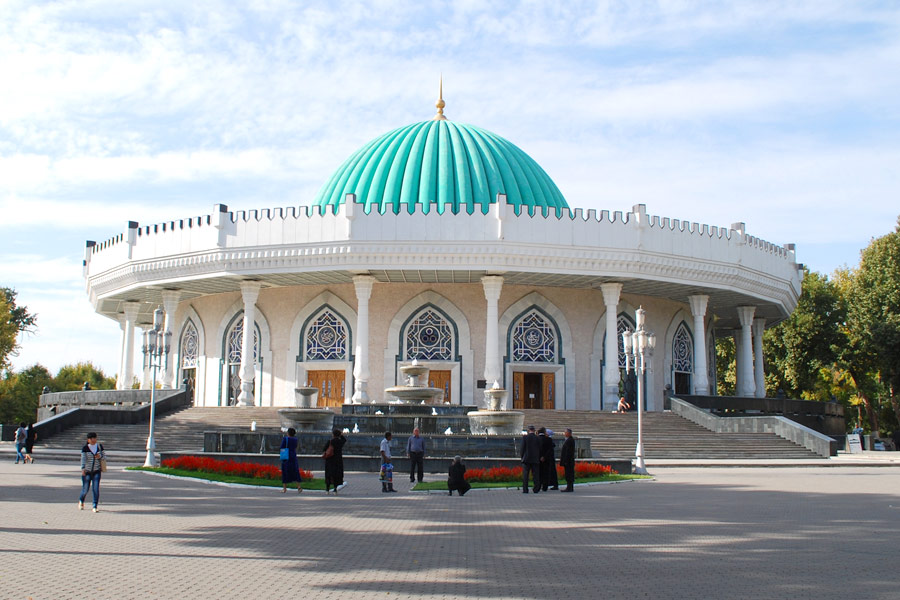
The building itself is part of what the museum communicates – a deliberate fusion of medieval form and late Soviet ambition. State Museum of the History of the Timurids, was inaugurated on 18 October 1996. It opened on the initiative of Uzbekistan’s first president, Islam Karimov, to mark the 660th anniversary of Tamerlane’s birth. Over time, it has become one of Tashkent’s most recognisable landmarks and even appeared on the 2001 edition of the 1,000-sum banknote.
Its architecture draws on medieval forms while clearly belonging to its own time. A circular structure beneath a broad ribbed turquoise dome, it takes its cue from the celebrated dome of the Gur-Emir Mausoleum in Samarkand. The façades are articulated with columns, arches, and niches, while the entrance opens onto a terrace-iwan. Above the arches, Timur’s tamga – a seal depicting three circles – occupies the most prominent position. The symbol is variously read as denoting sovereignty over three parts of the world or, in esoteric interpretation, as an emblem of peace. Ceramic detailing, stylised Arabic inscriptions, and intricate ornament complete the exterior. The massive wooden doors are carved in the elaborate tradition of Uzbek woodcraft, whose roots reach far into the pre-Islamic past.
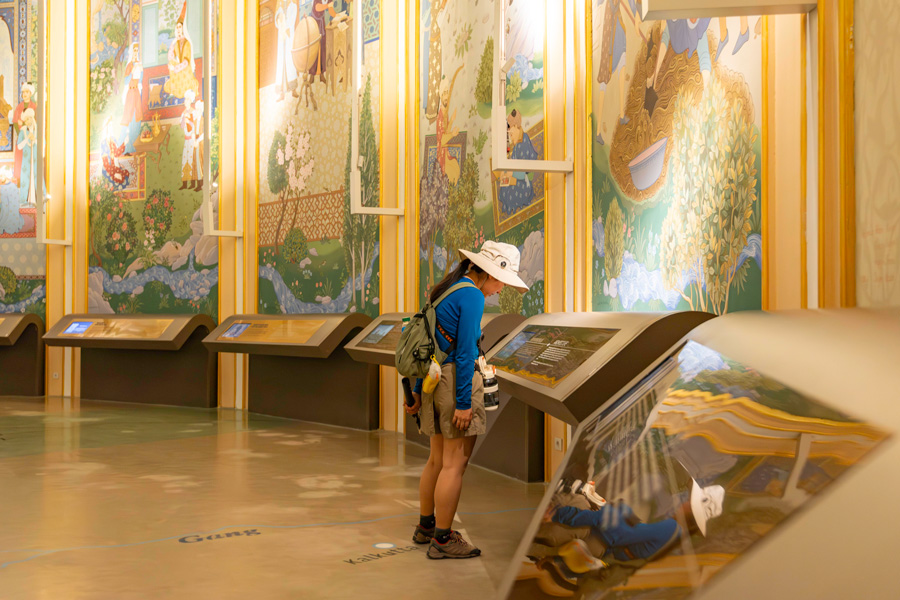
After its recent reconstruction, the museum was fitted with modern equipment and its displays were expanded, including exhibits acquired from overseas collections. On the ground floor, a new section titled The Great Sahibqiran – Founder of the Second Renaissance places Amir Timur within a broader narrative of power, legacy, and historical memory. Upstairs, interactive displays on the era of Amir Timur and the Timurids use artificial intelligence, smart technologies, 3D exhibits, and geographical maps to present the period in a more immediate way.
Inside the Museum
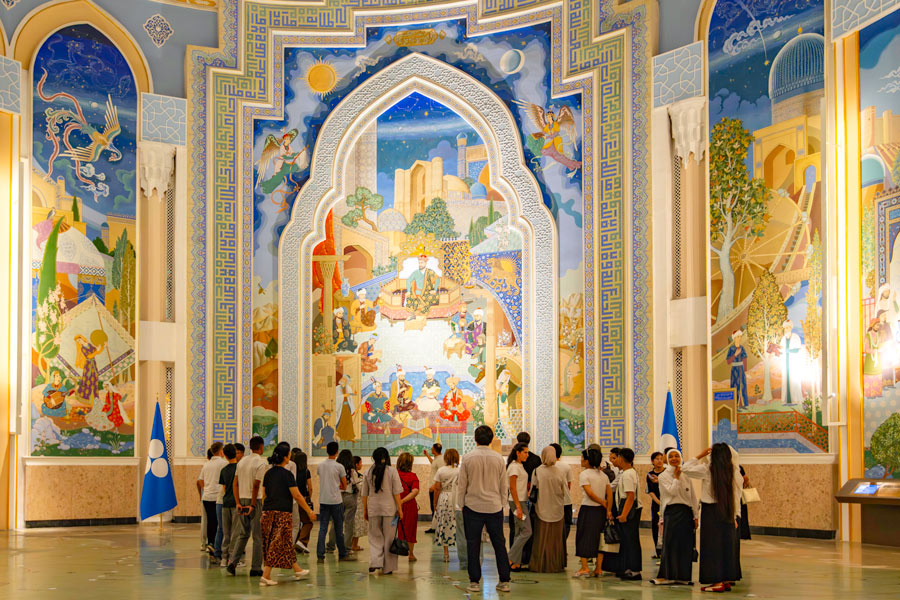
Several dozen kilograms of gold leaf are said to have gone into the interior – an indication of the ambition behind the design.
Marble and wall painting cover the surfaces of the Amir Timur Museum, and gold leaf catches the light throughout. The central hall is striking in its proportions. Its principal exhibit is a copy of the Uthmanic Quran, produced in St Petersburg in 1905 from an ancient manuscript. The original is held at the Centre for Islamic Civilisation in Tashkent. A crystal chandelier hangs above – approximately 8 metres high, weighing close to 3 tonnes – its scale matched to the solemnity of the space.
One wall carries a fresco triptych covering roughly 200 m². The first panel marks Timur's birth alongside a falling star. This is a reference to his title, 'Sahibkiran', meaning 'born under a lucky star'. The second depicts his reign: architectural achievements, great monuments, the extent of his reach. The third addresses his death and what he left behind. Together, the three panels read as a compressed life.
The displays are arranged across two floors in a circular route. Visitors move through the collection without retracing their steps – a small but considered courtesy.
The Permanent Collection
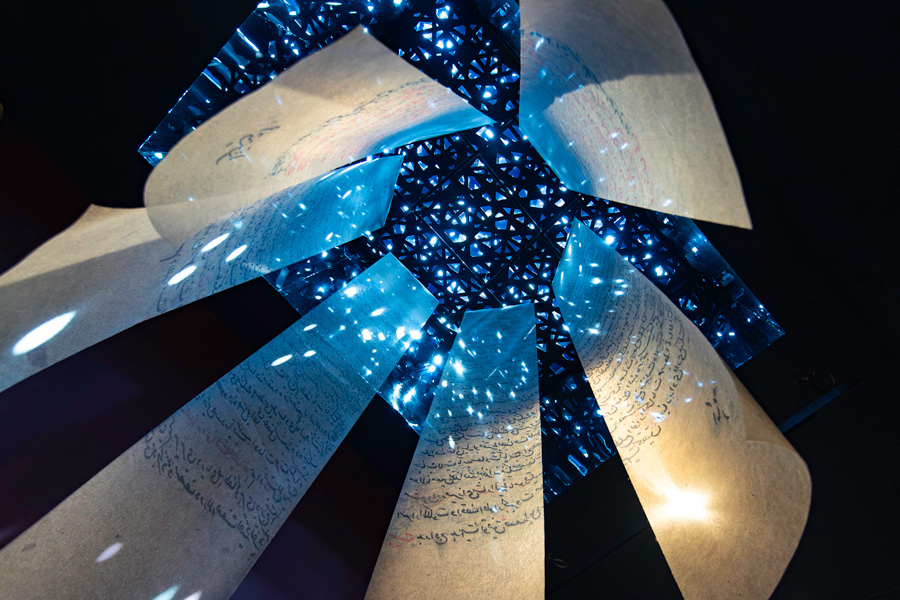
More than 7,500 exhibits are held here, ranging from historical artefacts and ancient manuscripts to contemporary maps, architectural models, and paintings. Together, they convey the breadth of the Timurid world.
Artefacts, Manuscripts, and Burial Objects
Material from the 14th to 17th centuries forms the core of the display – documents, objects, and fragments that carry the texture of the period.
The medieval manuscripts are among the most significant items. These include the Code of Timur – a body of laws governing administration of the state. The Zafar-name ('Book of Victories') by Sharafuddin Ali Yazdi is another central work. It chronicles the conqueror's campaigns in considerable detail.
Several items connect directly to the 1941 tomb opening – the event that gave rise to the legend of the 'Curse of Tamerlane'. These include fragments of the ruler's hair, cloth, and elements of his burial shroud bearing preserved Quranic verses. The remains were later examined in Moscow, then reinterred with full honours at Gur-Emir in November 1942.
A fragment of the belt belonging to Timur's grandson Ulugbek is also displayed, recovered from the same tomb. He had been buried there alongside other members of the family. Ulugbek is remembered as a scholar – founder of an observatory and a madrasah. His end was shaped by the political and religious conflicts of his time. He was killed by his own son in a struggle for power. His life has since inspired significant literary and musical work – among them Maksud Sheykhzoda's drama and Alexei Kozlovsky's Uzbek opera Ulugbek.
Jewellery from the mausoleum of Bibi-Khanum – Timur's eldest and most favoured wife – is included in the display. She was of Chingizid descent, and the marriage conferred on the commander the honorary title of 'guragan', meaning 'the khan's son-in-law'. Her name is most widely associated today with her mosque in Samarkand, the construction of which is the subject of a well-known popular legend.
One hall displays the metal armour of Tamerlane's warriors, showing how his forces were equipped. Musical instruments form a separate grouping. On campaign, they relayed orders, set the pace of movement, and unsettled opponents – as well as marking celebrations. A numismatic section brings together several hundred silver and copper coins spanning the Timurid period.
Applied arts complement the broader survey: copper-embossed work alongside Uzbek ceramics in various styles, including original cladding fragments from buildings in Samarkand and Bukhara. The glazes on those fragments have held their colour across several centuries.
Maps, Scale Models, and the Timurid Empire
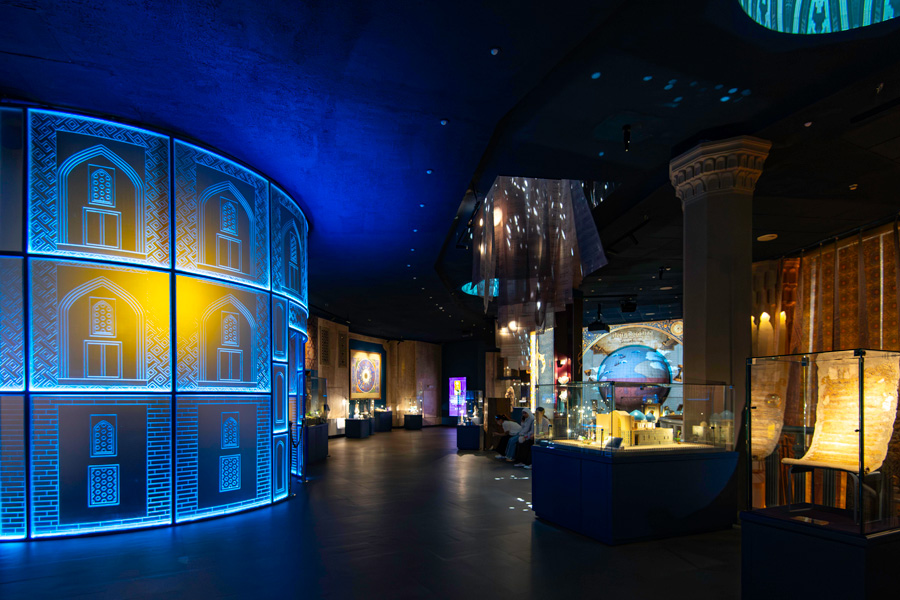
Several large maps serve as orientation points within the galleries, placing the dynasty's history in geographical context.
One traces the Silk Road, marking Samarkand as a junction between East and West – a node for the exchange of goods, learning, and ideas. A second map shows Timur's empire at its greatest reach: across Central Asia, Iran, Afghanistan, and the Middle East. Cities such as Bukhara, Herat, Shiraz, and Damascus all fell within its compass. At various points, the boundaries reached as far as India and Asia Minor, bringing the empire into direct conflict with the Ottoman sultanate.
Timur's family tree takes up a substantial section of the exhibition. Divided into four branches – corresponding to the number of his sons – it traces the dynasty's reach across several generations.
Architecture occupies a prominent place in this part of the collection. Models and visual materials represent the Gur-Emir Mausoleum, the Bibi-Khanum Mosque, and the Registan complex in Samarkand. Also included are the Mausoleum of Ahmed Yassawi in Turkestan (Kazakhstan), along with monuments from Mughal India. These structures illustrate how building on a monumental scale expressed both political authority and cultural ambition.
Portraits and Paintings
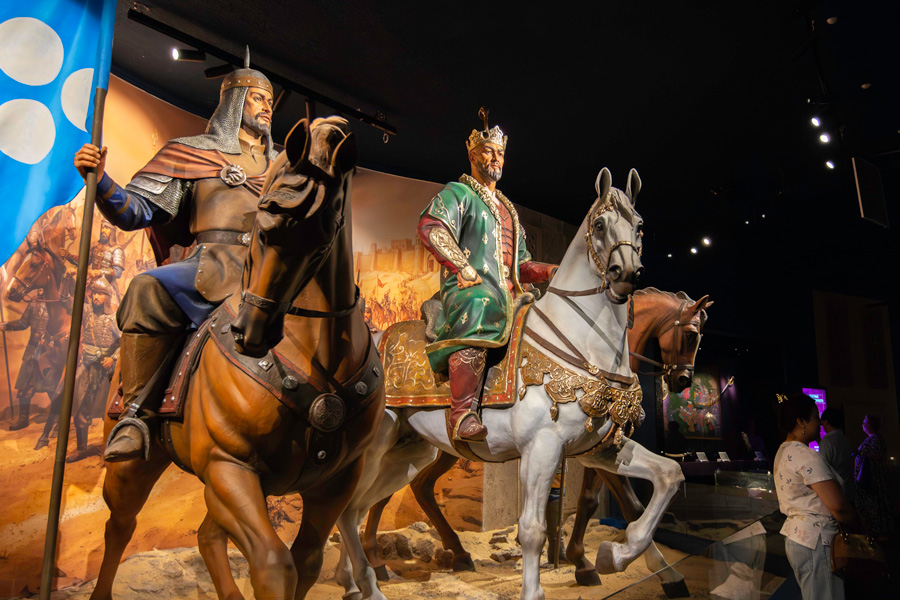
The portrait of the commander rewards careful attention – its basis is forensic science rather than artistic convention.
His appearance was reconstructed through anthropological research by Mikhail Gerasimov, who worked from the skull and skeleton. Those findings placed him at around 170–172 cm – tall for his period. He had a strong build, broad shoulders, a beard, and hair with a reddish cast. He also had a pronounced limp, which gave rise to the European name 'Tamerlane', from the Persian Temur-i lang, meaning 'Lame Timur'.
A series of contemporary Uzbek paintings depicting episodes from the ruler's life is also part of the display. Portraits, domestic scenes, and battle compositions trace key historical moments through the eyes of modern artists.