

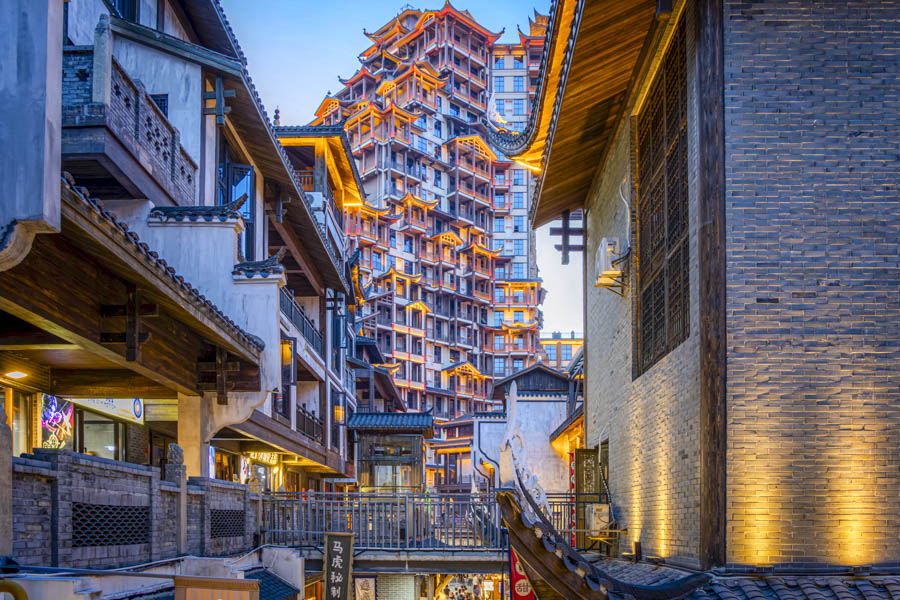
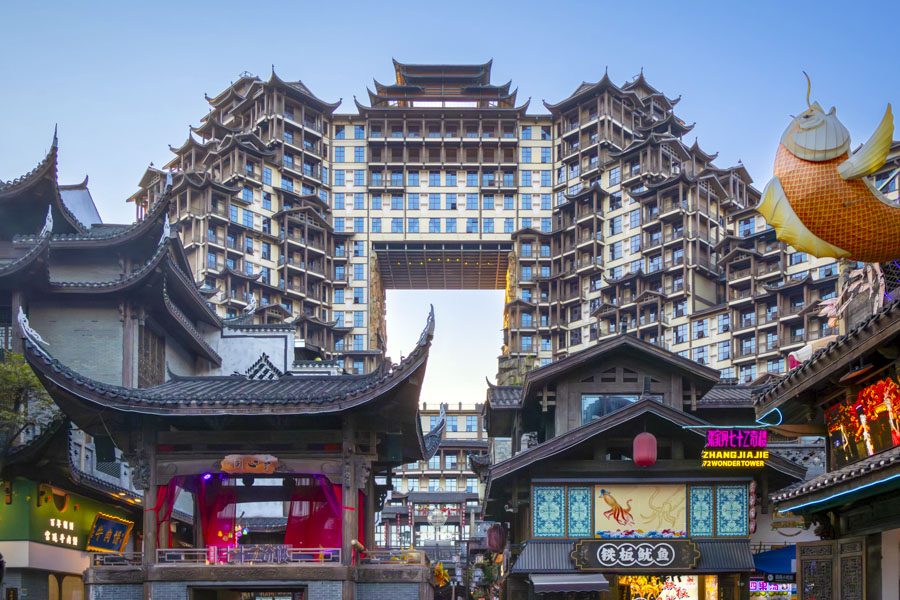
The 72 Wonder Tower, also known as the 72 Strange Buildings or 72 Qilou (张家界七十二奇), is a large cultural and entertainment complex in the historic centre of Zhangjiajie. Inspired by the Tujia heritage, the architecture resembles a stepped mountain settlement rising above the city, with traditional stilt houses stacked one above another to form a distinctive terraced silhouette.
The central tower is particularly eye-catching, with a large opening measuring 38 by 28 metres (125 by 92 feet). Its shape echoes the natural arch at Heaven’s Gate on nearby Tianmen Mountain, creating a visual link between Zhangjiajie’s built environment and its dramatic landscape. Inside, the complex brings together shopping arcades, craft workshops and restaurants, making it easy to spend several hours here.
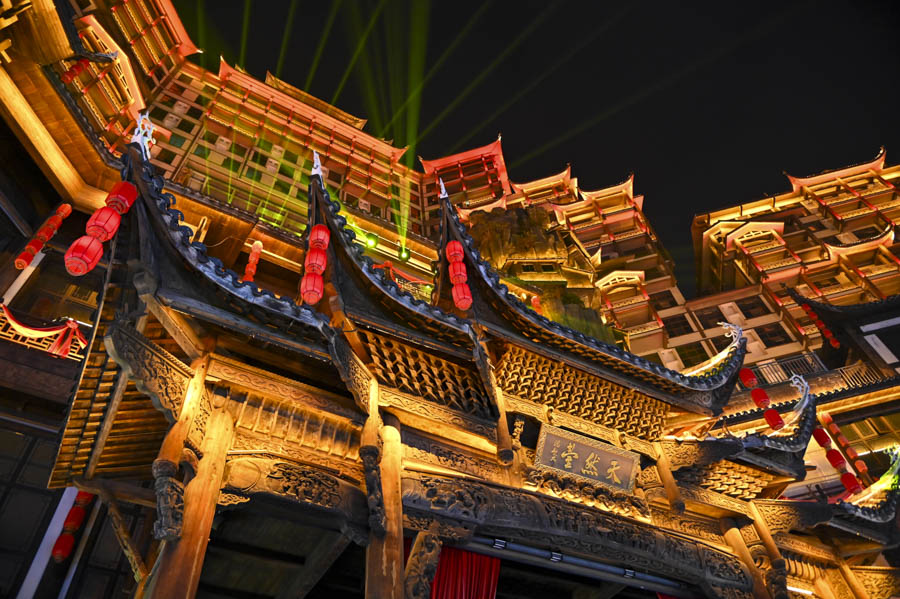
After sunset, the 72 Wonder Tower becomes one of Zhangjiajie’s most lively evening destinations. Thousands of lights illuminate the façades, while the lanes and small squares come alive with crowds, music and open-air performances. Many visitors come not just for a single sight but for the atmosphere: a vibrant, busy evening where local traditions, live shows, street food and everyday city life come together in one place.
The 72 Wonder Tower Tours
Explore the culture of western Hunan on the 14-day China Heritage Tour: Stone & Water, a route linking China’s major historical landmarks with regional traditions and landscapes. After visiting Beijing’s imperial monuments and the ancient city walls of Xi’an, the itinerary continues to Zhangjiajie, renowned for its dramatic mountain scenery and distinctive ethnic heritage.
An evening visit to the 72 Wonder Tower brings a completely different pace to the journey. After dark, the complex is lit by thousands of lights, while its towers, lanes and open spaces become a backdrop for dance, theatre and open-air performances. Expect a bright bustling atmosphere, with local stories, live music, street food and stage effects unfolding around the terraced architecture.
The 72 Wonder Tower is included only in this itinerary, but it can also be added to a tailor-made China travel programme on request.
Practical Information
Location: No. 1 Wuling Mountain Avenue, Yongding District, Zhangjiajie, Hunan Province, China
Opening Hours
The 72 Wonder Tower is open daily, though opening times vary by season and day of the week.
April to September:
- Monday to Thursday: 10:00 to 23:00
- Friday to Sunday: 09:30 to 00:30
October to March:
- Monday to Thursday: 10:30 to 23:00
- Friday to Sunday: 10:00 to 23:30
Recommended visit duration: around 3 hours.
Tickets and Admission Fees
Ticket prices depend on the time of your entry:
- if you enter before 16:30, the price is CNY/RMB 48 (approximately $6.70, €5.80, £5.00),
- if you enter after 16:30, the price is CNY/RMB 88 (approximately $12.30, €10.60, £9.10).
A day ticket allows you to remain on the premises until closing time, so visitors can see the evening shows and the illuminated displays without having to buy a separate evening ticket.
Prices and visiting conditions are subject to change, so it is worth checking the latest information before you go.
History and Legend of the 72 Wonder Tower
Legends Behind the Number 72
The name “72 Wonder Tower” refers to the legends and symbolic language of Western Hunan. In local tradition, the number 72 is rarely taken as an exact count of buildings. Instead, it points to abundance: many towers, many settlements and the many strange sights associated with this mountainous region.
The phrase is often linked to the old saying: “Nine Bows, Eighteen Stockades, Seventy-Two Strange Towers” (九弓十八寨七十二奇楼), which describes the fortified villages and tall towers of the Tujia people across the Wuling Mountains.
One local legend tells of a vast tower that once stood in the area. According to the story, each generation added a new storey until the building reached seventy-two levels above the ground. This is folklore rather than documented history, but it helped shape the image that later inspired the complex.
Inspiration from Tujia Culture and Architecture
The main architectural inspiration for the 72 Wonder Tower is the traditional Tujia stilt house, or diaojiaolou (吊脚楼), which has been built for centuries on the steep slopes of western Hunan.
The designers did not aim to copy one specific historic building. Instead, they created a larger impression of a Xiangxi mountain settlement, using multi-tiered roofs, projecting eaves, brickwork, wooden galleries and layered silhouettes to evoke the region’s architecture. The modern complex was built on the site of two ancient buildings, including the Zhuangyuan building (状元楼) dating from the Jiaqing period of the Qing dynasty and the Dafu Di (大夫第) also from the Qing period.
A New Landmark of Zhangjiajie
The complex was developed as a new cultural landmark for Zhangjiajie. Even before it opened, the 72 Wonder Tower gained international attention: in 2019, its main structure was entered into Guinness World Records as the tallest building modelled on a traditional Tujia stilt house.
Here, Xiangxi motifs are blended with modern technology, while craft spaces, themed streets and performance areas are brought together into one integrated visitor complex. The 72 Wonder Tower officially opened in August 2022.
Things to Do at the 72 Wonder Tower
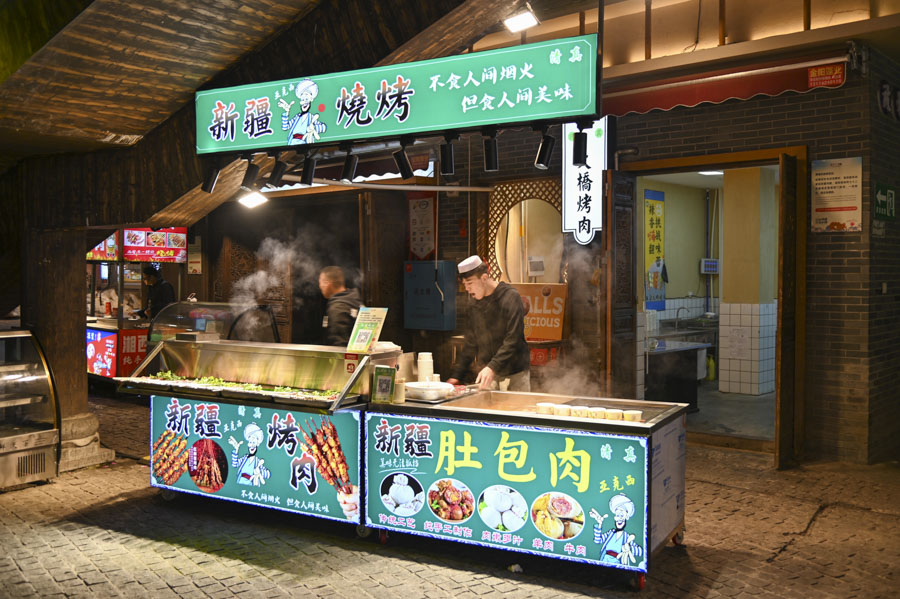
Take time to walk through the streets and squares of the 72 Wonder Tower, pausing to admire the architectural details and the quieter corners that give the complex its character.
Places to Visit at the 72 Wonder Tower
Start at Welcome Plaza, the main public space within the complex. From here, you can see the full outline of Tian Gong Qi Lou (天宫奇楼). The central tower stands at 109.9 metres high (305.6 feet), flanked by eighteen traditional wooden houses. Their façades reflect the region’s long carpentry traditions, with layered roofs, timber galleries and understated decorative details.
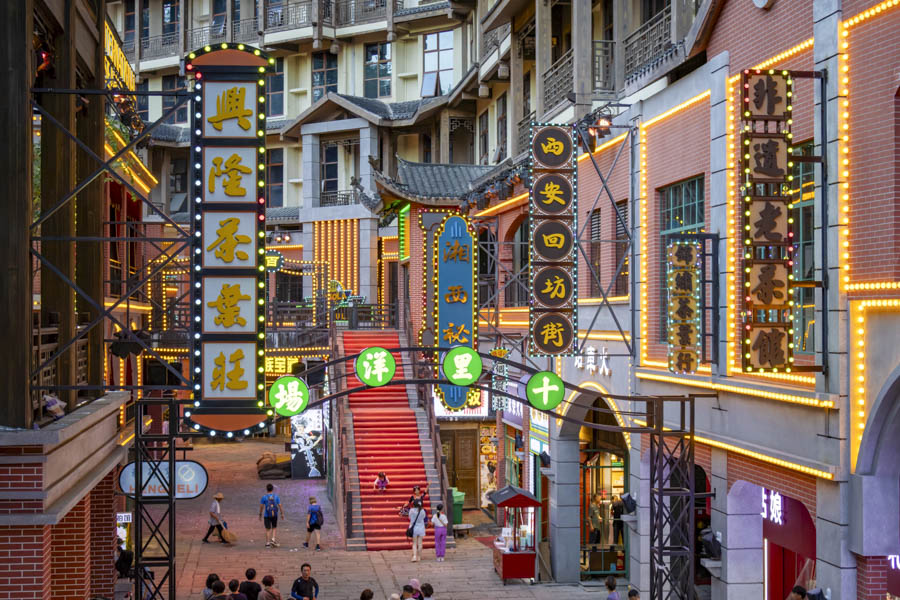
Next, continue along Yanhuo Old Street (烟火老街), where local eateries, shops and street performances bring the complex a lively, everyday feel. Xiangxi Market Street is known for regional produce and gifts, while Hui Minority Snack Street, also known as the Muslim Quarter, is famous for halal food. Republic-era Movie Street recreates the atmosphere of early 20th-century China, while Guochao Photography Street is designed for staged photo backdrops and picture spots. For a quieter pause, the Intangible Cultural Heritage Tea House features traditional interiors inspired by a classic Chinese teahouse.
The 72 Qizhai Folk Village (七十二奇寨) showcases Tujia cultural heritage through craft workshops and themed exhibitions focused on the traditions and daily life of Xiangxi. Nearby are the Dafu Di (大夫第) and the Zhuangyuan Buildings (状元楼).
Other areas of the complex are also well worth including in your route. Bonfire Square hosts festive events and ethnic performances, while the Phoenix Tail Waterfall adds movement and sound to the setting.
72 Wonder Tower Museums
The Unique Stone Museum displays naturally formed stones with unusual shapes.
The Chenwanggong Museum is dedicated to the Tujia folk culture, with collections of historical artefacts.
Symbolism and Philosophy
Wood is one of the defining materials of the 72 Wonder Tower. Across its facades, galleries and traditional-style houses, the subdued colour palette and minimal carving allow the texture of the timber to remain visible, rather than covering the buildings with excessive decoration.
This approach reflects the architectural traditions of western Hunan, where wood has long been central to local building culture. Natural materials, layered structures and open spaces also echo a wider theme in Chinese aesthetics: architecture should not stand apart from the landscape but respond to it.
Entertainment and Shopping
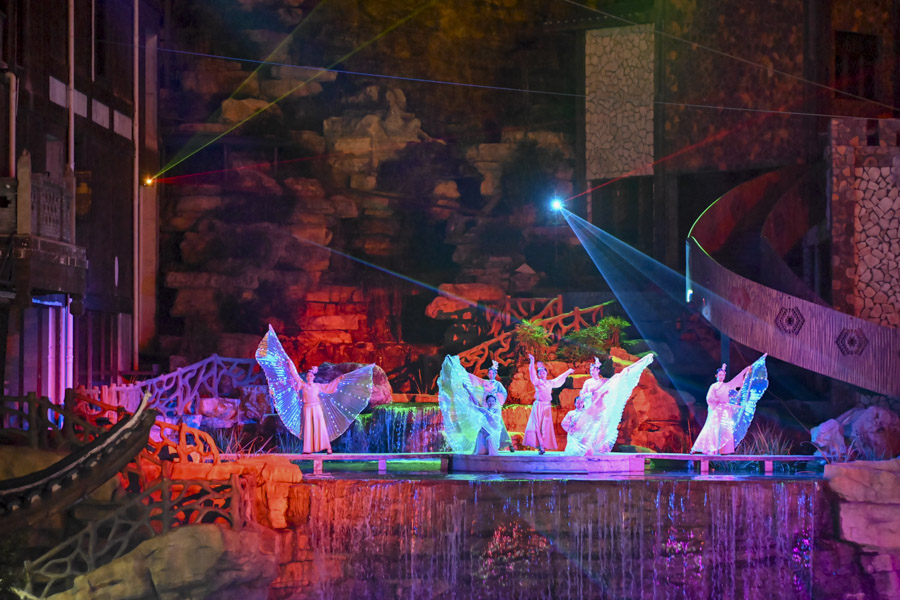
After exploring the architecture of the 72 Wonder Tower, allow time for the evening programme, when performances, light displays and shopping streets give the complex a different pace.
Entertainment at the 72 Wonder Tower
As the sun goes down, the 72 Wonder Tower becomes much livelier. More than 36,000 RGBW lights illuminate the façades, while 7D holographic projection technology creates changing light displays across the complex. RGBW means the lights can produce four colours: red, green, blue and white, making it possible to create a wide range of colours and effects.
The evening programme features around 20 performances staged across different areas, many drawing on legends, music, dance and traditions from Western Hunan.
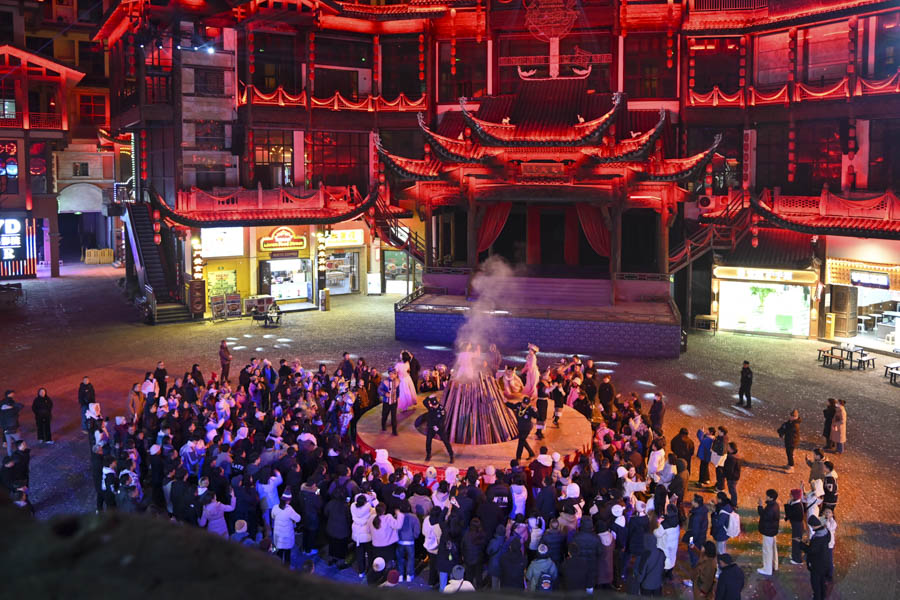
One of the main shows is Festive Lantern, inspired by the Chinese Lantern Festival and built around dance, light and colourful stage imagery. Street Martial Arts focuses on Chinese martial arts, with performers demonstrating strength, speed and traditional techniques. Love of One’s Life tells a love story through music and dance, while Mysterious Xiangxi blends ethnic melodies with atmospheric stage design. Tujia People in a Painting uses songs and traditional costumes to depict scenes from daily life in the mountain settlements of western Hunan. The evening often ends with the Bonfire Party, a lively finale set against the glow of open flames.
Shopping at the 72 Wonder Tower
Set aside time to browse the shopping streets, where the focus is on local crafts and regional products.
Look out for Tujia brocade, a traditional textile known for its bright geometric patterns. You may find decorative panels, bags, scarves and other small items made from this fabric. Miao embroidery is also worth noticing, especially on accessories and homeware, where dense patterns and bold colours showcase the makers’ skill.
Some workshops display traditional woodcarving, with decorative panels, figurines and ornaments inspired by folk legends and symbols from western Hunan.
Food stalls are a handy stop as well. Local tea, Tujia rice wine, mountain honey, dried mushrooms and other Xiangxi specialities are often sold here, many made by small local producers and suitable as gifts.
Food at the 72 Wonder Tower
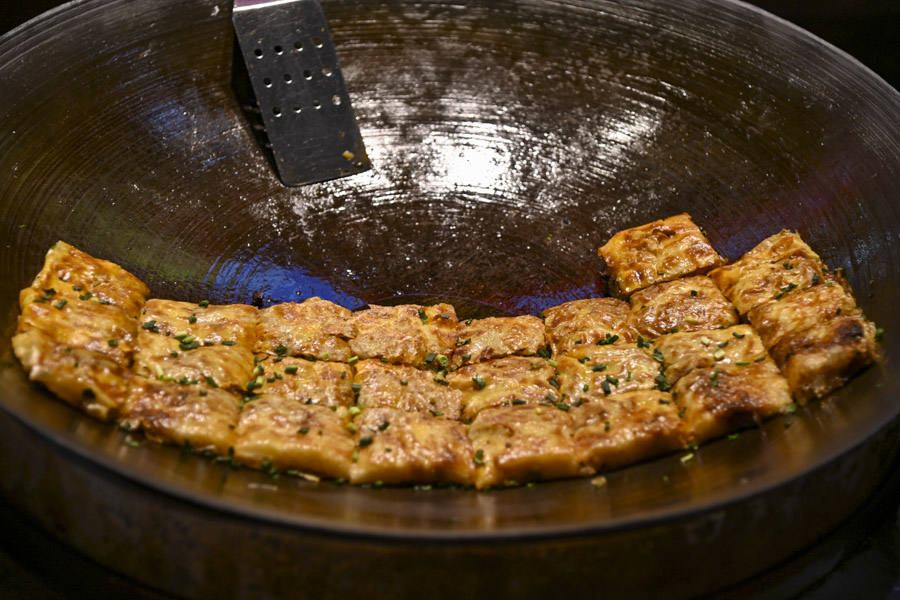
Discover the flavours of western Hunan at the 72 Wonder Tower, where restaurants and food streets bring together local specialities and well-known dishes from across China.
Chinese Cuisine
The food streets of the 72 Wonder Tower let you have a chance to sample both Xiangxi specialities and well-known dishes from other parts of China.
Start at the Hui Minority Snack Street, also known as the Muslim Quarter, where halal dishes are prepared according to traditional recipes. Yangrou paomo (羊肉泡馍), a hearty lamb soup with flatbread soaked in rich broth, is one of the local favourites. You can also try hand-pulled beef noodles topped with fresh herbs.
In the evening, Chinese-style Bar Street becomes busy with people stopping for a drink and something to eat. Look out for snacks such as garlic and chilli crayfish tails (香辣虾尾) and grilled squid skewers (烤鱿鱼串) you'll see them on almost every menu.
Xiangxi Market Street is a good place to try regional cooking. Sample larou (湘西腊肉), smoked pork cured over wood fires, or Tujia Sanxiaguo (土家三下锅), a traditional hotpot in which meat, tofu and vegetables are cooked together with spices.
On Yanhuo Old Street, you will find food stalls serving dishes from across China. You can stop for roujiamo (肉夹馍), often described as a Chinese-style meat burger, xueba ya (血粑鸭), duck cooked with blood rice cakes, or Xinjiang-style lamb skewers (新疆烤串), a popular street-food classic.
Vegetarian Restaurants
There are no dedicated vegetarian restaurants within the 72 Wonder Tower complex, but vegetarian dishes are easy to find. Most cafés and restaurants offer dishes such as fried tofu, seasonal vegetables, aubergines in garlic sauce, vegetable fried rice and vegetable noodles. Many places will also prepare meals without meat on request. If you follow a strict vegetarian diet, it is worth asking whether meat stock or other animal products are used before ordering.
Tea Houses, Bakeries, and Patisseries
Cafés, tea houses and drink stalls are scattered throughout the complex, providing plenty of places to stop for a break between sightseeing and performances. Fruit teas, lemonade and bubble tea with tapioca pearls are all widely available.
If you have a sweet tooth, look for local pastries, rice-based desserts and traditional snacks. A favourite is ciba (糍粑), soft glutinous rice cakes coated with sesame seeds or crushed peanuts.
How to Get to the 72 Wonder Tower?
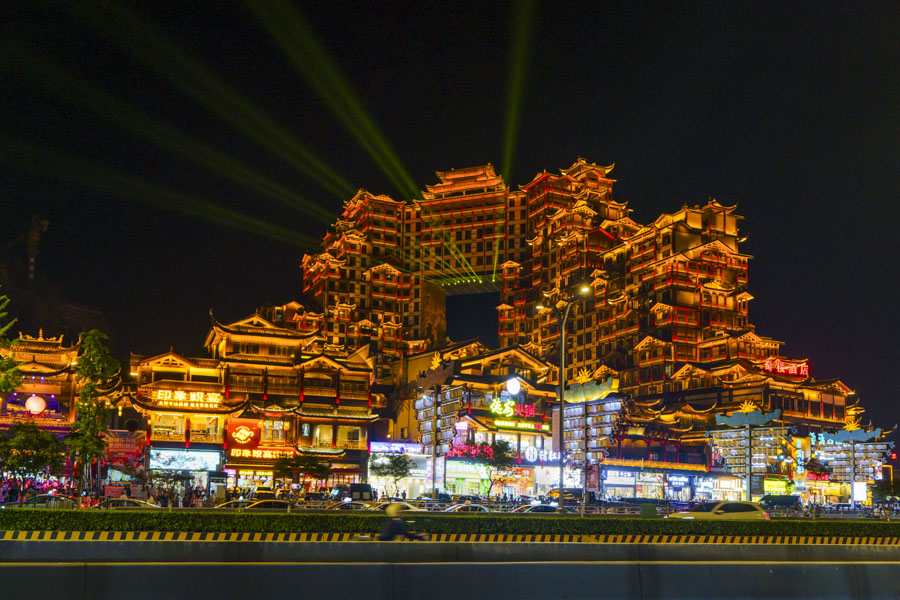
The complex is situated in the northern part of Wulingshan Avenue, where it meets Shadi Avenue, on the main road linking central Zhangjiajie with Zhangjiajie National Forest Park.
| From | Approximate Distance | Approximate journey time | Taxi fares |
| Zhangjiajie West Railway Station |
4 kilometres (2.5 miles) |
10 minutes |
CNY/RMB 12–15 ($1.7–$2.1, €1.6–€1.9, £1.4–£1.6) |
| Zhangjiajie Railway Station |
8 kilometres (5.0 miles) |
20 minutes |
CNY/RMB 20–25 ($2.8–$3.5, €2.6–€3.3, £2.2–£2.9) |
| Hehua International Airport |
7 kilometres (4.3 miles) |
15 minutes |
CNY/RMB 20–25 ($2.8–$3.5, €2.6–€3.3, £2.2–£2.9) |
Public Transport
City buses No. 7, 16 and 17 stop at Qilou Plaza (奇楼广场), with fares of around CNY/RMB 2.
Route No. 17 is particularly convenient because it runs directly between Tianmen Mountain Cable Car Station and the 72 Qilou, so you can travel between the two without changing buses.
By Car
If you are travelling by hire car, use South Gate Car Park (南门停车场). Parking costs around CNY/RMB 5 per hour.
Tips for an Optimal Visitor Experience
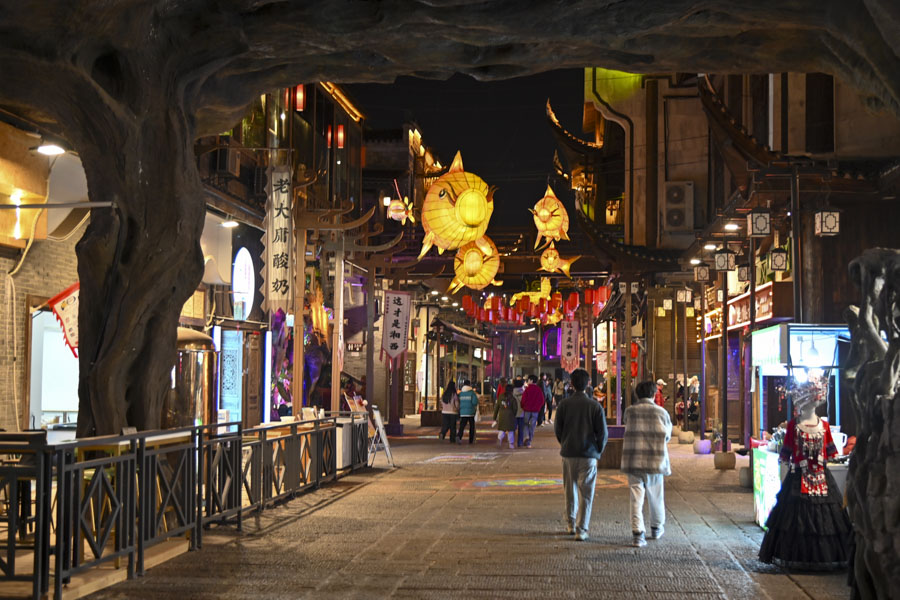
For the liveliest experience, plan your visit around the evening programme.
Arrive in the Late Afternoon
Aim to arrive at around 16:00. This gives you time to buy a day ticket, explore the architecture, themed streets and food courts at a relaxed pace, and then enjoy the evening performances.
Save Money on Your Return Journey
After your visit, avoid taking a taxi directly from the main entrance, where fares can be higher when many visitors are leaving at the same time. Walk about 500 metres and book a ride via the DiDi app instead; the fare is usually lower.
Follow the Sound of the Music
Some performances start in nearby streets and squares, so let the music lead you.
Keep Your Camera Ready
As you move around, another performance may begin at any moment.