

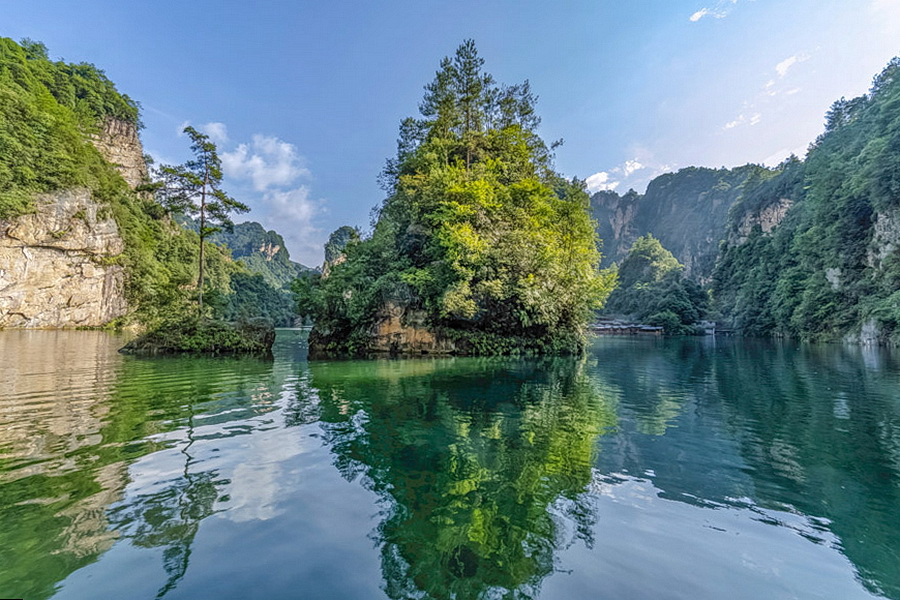
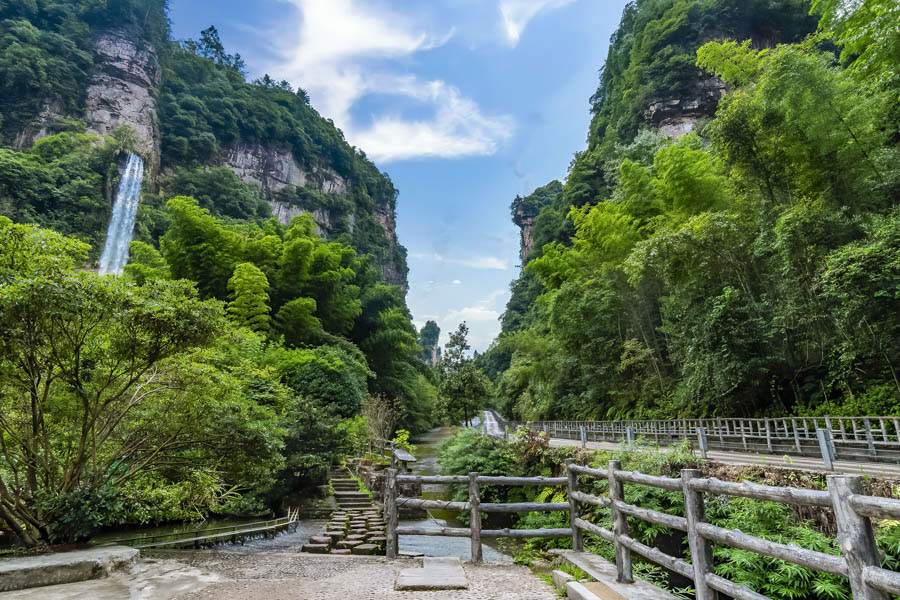
Baofeng Lake (宝峰湖, Bǎofēng Hú) is a scenic lake near Zhangjiajie National Forest Park, 34 kilometres (21 miles) from Zhangjiajie city and just 1.5 kilometres (0.9 miles) from Wulingyuan District. Known for its emerald water, boat cruises and steep forested cliffs, it offers a quieter, more relaxed contrast to the high viewpoints and dramatic sandstone peaks of Zhangjiajie.
In Chinese landscape aesthetics, the expression 山水相映 (shān shuǐ xiāng yìng) describes the way mountains and water are perceived as a single, unified scene. Baofeng Lake gives this idea a clear visual form. Its calm surface reflects the surrounding cliffs until water, rock and forest seem to belong to one view. Beyond the viewing platforms, the pace slows: the gentle motion of a boat, sunlight flashing on karst rock, and birdsong drifting across the water. The scene is peaceful rather than dramatic, and that quieter quality gives the lake its appeal.
Baofeng Lake Tours
Discover the beauty of the lake and its surroundings on a four-day journey through the region.
You will see numerous natural attractions alongside remarkable feats of engineering in dramatic settings: the Glass Bridge over the Zhangjiajie Grand Canyon and the Bailong Elevator, with sweeping views of the distinctive “stone forest”. This itinerary brings the region together as a cohesive whole, allowing you to appreciate the landscape from different perspectives.
Baofeng Lake is one of the principal natural sites near Zhangjiajie. Much of the route runs almost directly alongside sheer mountain slopes, encouraging visitors to take in the full composition of the scenery again and again.
Best Time to Visit Baofeng Lake
Baofeng Lake can be visited year-round, though each season impacts the lake’s appearance and atmosphere. For most visitors, the best time to visit Baofeng Lake is from April to May and from September to October, when the weather is pleasant and visibility is especially good.
Seasons and Weather
Spring (March to May) is one of the most pleasant seasons at Baofeng Lake. Temperatures usually range from 10 to 20°C (50 to 68°F), making it ideal for walking, boat trips and photography. In April and May, the lake surface is often calm, with the green slopes clearly reflected in the water. From late March to mid-April, trees and shrubs begin to bloom on the hillsides.
Summer (June to August) brings the fullest greenery and waterfalls. Thanks to the surrounding forest, Baofeng Lake stays cooler than the city, typically around 25 to 28°C (77 to 82°F). June and July often see sudden showers and short afternoon thunderstorms.
Autumn (September–October) is another excellent period to visit Baofeng Lake. Temperatures generally sit around 20 to 25°C (68 to 77°F), rainfall is lower, and visibility is generally good. After light rain, mist often gathers around the peaks, giving the lake a softer, more atmospheric appearance. Please note that during national holidays and the Golden Week, from 1 to 7 October, hotel prices rise sharply and visitor numbers increase significantly.
Winter (December to February) is the quietest season at Baofeng Lake. Temperatures drop to about 5 to 10°C (41 to 50°F), and occasional snow may settle on the peaks. With fewer tourists, the area feels more open and peaceful. After snowfall, paths can become slippery as ice may form on the stone steps.
Opening Hours
Baofeng Lake opening hours vary slightly by season:
– April to November: 07:00 to 18:00
– December to March: 07:00 to 17:30
Most visitors arrive between 10:30 and 14:00; in high season, this can mean queues at the ticket office and pier and heavier boat traffic that disturbs the lake surface. If you want to photograph Baofeng Lake with clear mirror-like reflections, aim to arrive early in the morning, close to opening time, when the light is softer and there are fewer visitors.
Cultural Festival at Baofeng Lake
Around the middle of the third lunar month (usually mid-April) Baofeng Lake hosts a traditional Tujia Folk Song Festival. Young men and women gather by the lake in traditional dress and take turns singing folk songs while riding on bamboo rafts, keeping alive a form of local cultural expression of the Tujia people.
Practical Additional Information
Tickets and Admission Fees
Standard admission is usually around CNY 96–110 (approximately $14–16 / €12–14 / £10–12), depending on season and ticket type. ($16, €14.00, £12.00).
The ticket includes a boat trip and a shuttle bus transfer between the entrance and the lake and back.
Discounts and Free Admission
Certain visitors may enter the lake area free of charge:
- people over 70
- children under 1.30 m (approx. 4 ft 3 in)
A concession ticket costing CNY 55 ($8, €7.00, £6.00) is available for:
- visitors aged 60 to 70 inclusive
- children taller than 1.30 m (approx. 4 ft 3 in)
- students under 24 years of age
To obtain a discount or free ticket bring supporting documents to purchase them at the ticket office.
Address: No. 8, Baofeng Road, Suoxiyu Town, Wulingyuan District, Zhangjiajie City (张家界市武陵源区索溪镇宝峰路8号)
History of Baofeng Lake
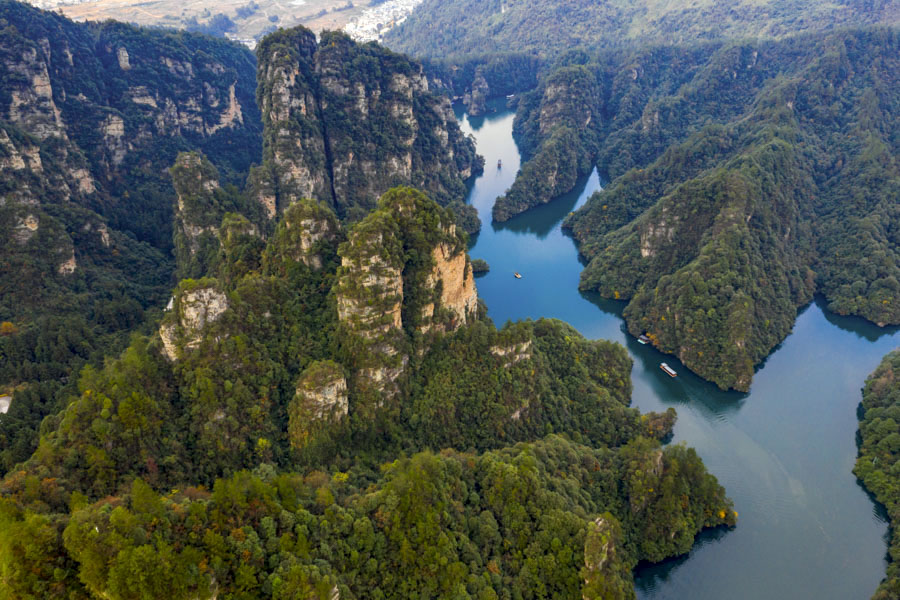
Baofeng Lake is a man-made lake, which gives it an unusual place within the Zhangjiajie landscape.
Until the second half of the 20th century, the site was a narrow mountain gorge, enclosed by rock and woodland. In the 1970s, local residents dammed the gorge to meet essential needs: water storage and electricity generation. The resulting reservoir, 2.5 kilometres (1.5 miles) long and 72 metres (236 feet) wide, was originally called Shijiayu Reservoir. Over time, it was renamed Baofeng Lake after the mountain beyond its shores: bao (宝), meaning “jewel”, and feng (峰), meaning “peak”.
When the valley filled, the surrounding landscape acquired a new atmosphere. Sheer slopes, narrow passages and vertical rock formations were drawn together by the lake, which became the unifying element of the scene.
This human intervention, however, was only the final stage of a far longer geological story. The rock formations around the lake were shaped over vast periods by water, erosion and tectonic movement. Around 380 million years ago the area subsided and was covered by the sea. Over time, the quartz sandstone of the nearby columnar formations was weathered and exposed, creating the distinctive scenery now associated with Zhangjiajie.
Baofeng Lake opened to visitors in 1984, as the Zhangjiajie region developed as a tourist destination. In 1992 the site was included on the UNESCO World Heritage List as part of the Wulingyuan Scenic and Historic Interest Area.
Baofeng Lake is designated a National 5-A Tourist Attraction.
Things to Do at Baofeng Lake
Pause for a moment and listen to the quiet that settles over the water. Walk along the shore and watch how the rock faces change with the light. Explore the lake by boat or on foot.
Cruise the Lake
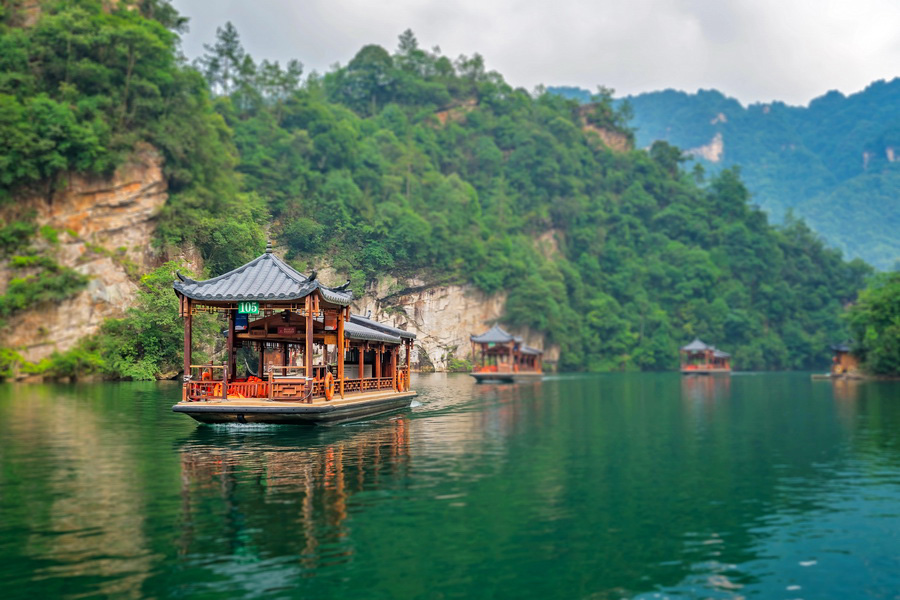
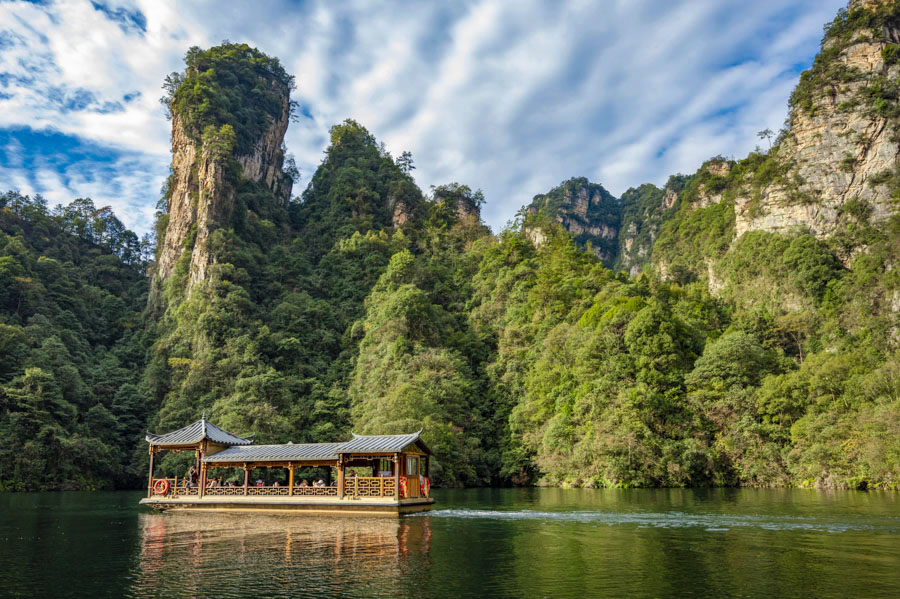
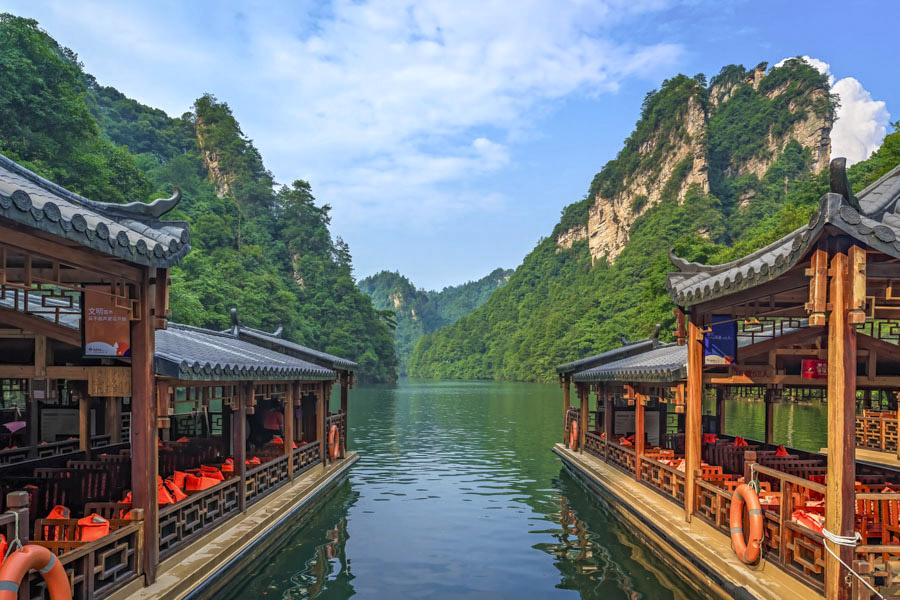
A boat trip is the classic way to experience Baofeng Lake. For around 25 minutes, a traditional wooden sightseeing boat glides between karst peaks, with the cliffs taking on different profiles as the route unfolds.
Rock Formations with Poetic Names
A cruise around Baofeng Lake brings the landscape close. Candle Peak, God-Travel Peak and Pagoda Peak rise above the jade-green water, giving the lake its steep, enclosed character.
Several unusually shaped rock formations appear along the way. Fairy at the Mirror (仙女照镜, Xiānnǚ Zhào Jìng), also called Baofeng Goddess, is a slender rock rising directly from the water; its outline is said to resemble a woman leaning towards her reflection. In spring, rhododendrons bloom around its summit. Golden Toad Holding the Moon (金蟾含月, Jīnchán Hán Yuè) is best seen around the Mid-Autumn Festival, when the moon appears to sit within the rock’s opening. Other named formations include Crocodile Rock (鳄鱼岩, Èyú Yán), Lovers’ Tryst (情人幽会, Qíngrén Yōuhuì), Peacock Spreading Its Tail (孔雀开屏, Kǒngquè Kāipíng) and Half-Faced Pig (半脸八戒, Bànliǎn Bājiè), and many others.
Fishermen with Cormorants
One of the first sights on the lake is fishermen in traditional boats, with cormorants perched along the sides. These dark-plumed birds, with long necks and sharp beaks, have long been used for fishing for more than a thousand years: trained to dive for fish and then return to the boat.
The fishermen also cast bright orange nets that flash against the calm surface. Dressed in traditional Tujia clothing with wide dark-blue trousers, coarse-cloth shirts and conical straw hats (斗笠, dǒulì), they create a vivid picture of local life, where the lake’s quiet rhythm is broken only by the sweep of nets and the gentle drift of boats – a moment that invites you to pause and take it in.
Cultural Performance over the Lake
At certain points along the route, the boat slows beside small wooden platforms fixed to the cliff. A woman appears on one platform and a man on another; they sing to one another across the water. Their voices drift through the gorge, the cliffs holding and amplifying the sound.
For the Tujia, singing has long been a way of courting and expressing feeling; here, the brief performance offers visitors a poignant glimpse of that tradition, set against cliffs and glassy water.
Traditional Boats as Floating Architecture
The wooden boats on Baofeng Lake follow a circular route. Their covered decks and gabled roofs recall elements of local Tujia architecture, particularly the traditional stilt houses (吊脚楼, diàojiǎolóu) found in the region. Carved fish motifs often appear along the sides, symbolising prosperity, fidelity and family happiness. The result is a boat that feels less like a simple vehicle and more like a small floating extension of the shore.
Wildlife at Baofeng Lake
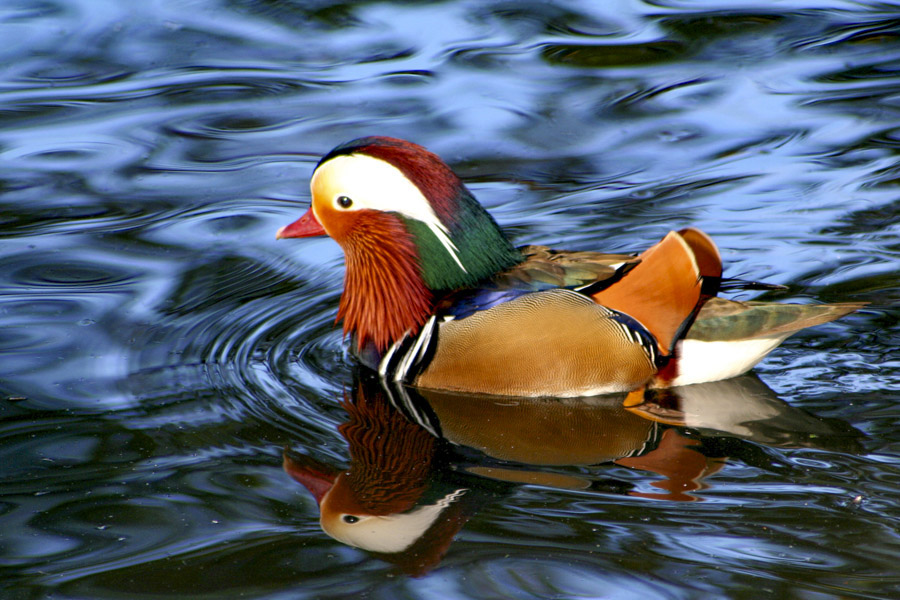
Throughout the route, you may see mandarin ducks (鸳鸯, yuānyāng) gliding across the water, often in pairs. They sometimes alight on one of the three Mandarin Duck Islands, where tall green pines grow. In Chinese culture, mandarin ducks are traditionally associated with love and devotion.
The forests above the lake are also home to many other bird species. Chinese copper pheasants and bamboo partridges inhabit the wooded slopes, while grey cranes, hawks and golden eagles may be seen soaring higher. Herons often stand along the rocky shore, and swallows build their nests in sheltered caves.
The giant salamander was introduced to Baofeng Lake in recent years.
Officials released specimens into the lake to bolster local conservation and tourism efforts. The species, native to nearby river networks, now inhabits the lake’s cooler, shaded inlets. Sightings are rare and usually brief.
Hike the Best Trails
Trail to Eagle Nest Village (Yingwo Village)
- Route: Baofeng Lake jetty → Thin Strip of Sky → Baofeng Chan Temple → Yingwo Village summit → return via same route
- Distance: 4 kilometres (2.5 miles) one way
- Duration: about 3 hours round trip
- Difficulty: Moderate
- Route type: Out and back
When the boat reaches the shore, most visitors head straight back to the entrance. Those who keep walking discover a very different side of Baofeng.
Stone steps rise from the water into a quiet wood of pines and broadleaf trees. The path is ancient, worn smooth by pilgrims and locals long before tourist boats appeared; moss clings to every surface.
Through the Thin Strip of Sky. The trail soon squeezes through Yīxiàntiān (一线天), a gorge about 200 metres (656 feet) long where the rock walls close in on both sides. The passage narrows to single file in places, and the cliff faces soar more than 100 metres (328 feet). Look up and you'll see why it’s called the Thin Strip of Sky: only a sliver of sky remains overhead. Even on bright afternoons, the light below is dim and cool. Then the steps climb again, and the gorge gives way to a startling sight: a vast boulder seemingly suspended above the path, as if held there by intention. Locals say that couples who walk beneath it side by side will share an unbreakable bond.
The Temples Among the Trees. After about an hour, the path reaches Baofeng Chan Temple (宝峰寺, Bǎofēng Sì). The site dates back to the Song Dynasty (907–1279) as a Taoist retreat and was later rebuilt during the Qing period (1644–1911). Incense burns here most days, and two stone guardian lions flank the entrance, their features smoothed by centuries of hands. Nearby, a mountain stream threads through the rocks. Its steady murmur and unhurried flow are perhaps the gentlest of welcomes.
The View from the Top. From the summit above Yingwo Village, named after a local legend of bandits watched over by circling eagles, the lake lies immediately below, enclosed by slopes on all sides. On clear days you can make out the ridgeline of Tianzi Mountain in the distance: a view that you cannot get from the water.
The Long Way Round – For Those Who Want More
- Distance: 15.1 kilometres (9.4 miles)
- Duration: about 5 to 6 hours
- Difficulty: Strenuous
- Route type: Loop
Most hikers turn back at the summit. But Baofeng Lake has more to offer if you keep going.
From the peak above Yingwo Village, a second path goes onwards rather than doubling back, tracing a wide loop through the surrounding hills and valleys. This 15-kilometre route has, above all, a lot of steps. It demands steady legs, stamina, a full water bottle, and a willingness to lose sight of the lake for a while before discovering it again from a completely different angle.
The reward is a Baofeng that few visitors see: quieter trails, denser forest, and the slow satisfaction of a landscape earned rather than merely glimpsed.
Top Attractions at Baofeng Lake
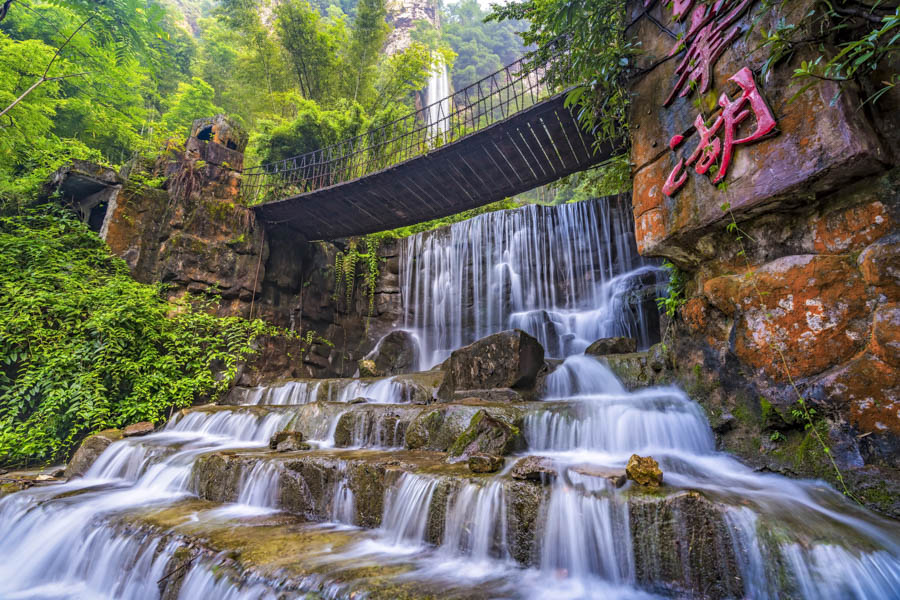
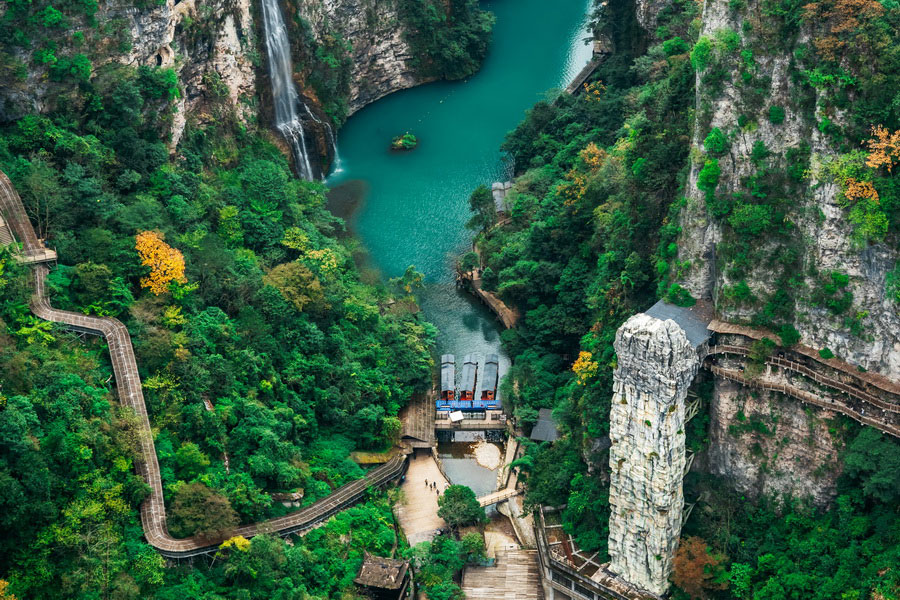
Baofeng Lake is often visited together with nearby sights. One of the most striking is Baofeng Waterfall (宝峰飞瀑, Bǎofēng Fēipù), which drops from a rocky ledge more than 100 metres high. Step closer and the spray is immediately noticeable: thousands of fine droplets fill the air, and on sunny days a rainbow often appears in the dense mist beside the falls.
This was one of the filming locations for the 1986 television series Journey to the West (西游记, Xīyóu Jì). The rocks and drifting spray formed the setting for the legendary Flower Fruit Mountain and Water Curtain Cave. A statue of Sun Wukong, the Monkey King, marks the spot.
Another worthwhile stop is the Chinese Giant Salamander Biotechnology Museum (中国大鲵生物科技馆, Zhōngguó Dàní Shēngwù Kējìguǎn), dedicated to one of the oldest living amphibian species. The Chinese giant salamander (大鲵, dàní) appeared long before the dinosaurs and has changed very little over time, often described as a living relic. Locally, it is nicknamed the “baby fish”, as its call is said to resemble an infant’s cry. The museum is home to Benben, a 1.8-metre-long salamander believed to be more than a hundred years old.
The museum is at No. 8 Baofeng Road in Wulingyuan District (武陵源区宝峰路8号), and it opens daily from 08:00 to 18:00.
*Note: Opening hours may change without notice.
How to Get to Baofeng Lake?
Buses and shuttles
From Zhanjiajie city
Take the scenic area tourist shuttle from the bus station to Wulingyuan; the journey takes about 40 minutes.
From central Wulingyuan District to the entrance
The entrance is reached from Wulingyuan Bus Station (武陵源汽车站) at the junction of Guihua Road and Weiyang Road (29.35015, 110.54609). Opening hours are 06:30 to 18:30.
Take bus no. 2. The distance is roughly 2 kilometres (1.2 miles), and the ride takes about 10 minutes; the fare is CNY 2.
Alternatively, a Didi taxi costs about CNY 10 (approximately $1.45 / €1.25 / £1.10).
From the entrance to the lake by shuttle bus
An eco-shuttle bus takes 10 minutes to reach the lake; queues at the boarding area are common in high season.
Walking route from the entrance
A footpath from the entrance winds through dense greenery. It starts with the Cloud Ladder (云梯), a long staircase uphill, then levels at Happiness Bridge (幸福桥), also known as Chain Bridge, which spans a narrow section of the valley. The route then climbs Hero’s Slope (好汉坡), after which the first views of the lake appear. The lake reveals itself intermittently through the trees, offering panoramic views many visitors miss.
Before You Go: Tips for a Smooth Visit
Although Baofeng Lake is a compact area, the terrain and typical route make a little preparation useful. These are the main points to keep in mind before you go.
Facilities nearby
- There are restaurants, gift shops and a visitor centre near the entrance. Beyond the jetty and along the route to Yingwo Village, there are no shops or eateries. Food near the park is more expensive than in town.
- Hotels and guesthouses of various standards, suitable for both individual travellers and larger groups, are within walking distance.
On the Water
- Avoid leaning over the side of the boat when taking photos, as the railings on traditional wooden boats are low.
- Bring a raincoat or an umbrella. Mountain weather can change quickly, and the covered deck offers only partial protection.
Hiking Gear
- If you plan to hike, prepare more carefully than for a short walk. Paths are mossy and slippery after rain, so shoes with non-slip soles are essential.
- Pack a light jacket for windy viewpoints and sun cream, sunglasses and a hat.
- Take water and a light snack with you.
- Keep your equipment dry with waterproof covers.
- Power banks or spare camera batteries are also useful.
Communication and Navigation
- Mobile signal may weaken further from the entrance; download offline maps in advance.
Baofeng Lake is rarely the sole reason to visit Zhangjiajie and is often left until the end of the trip as a quieter, slower stop after the high viewpoints and wide panoramas. Yet it is often this place that lingers in the memory: the sky reflected in still water, wind moving through the gorge, and the copper light of sunset on the green stone ledges.