


Chinese mythology and legends have long formed the bedrock of culture, tradition, and collective identity across the Middle Kingdom. Passed down through oral storytelling, theatrical performance, literature, visual art, and religious practice, these narratives weave together history, philosophy, and folklore.
From creation stories to intimate encounters between gods and mortals, the timeless myths of China carry the imprint of Taoism, Buddhism, and Confucianism. They offer lessons in heroism, honour, resilience, harmony, and duty – values that have shaped both personal conduct and the broader cultural imagination for centuries.
Eternal Beings and Deities in Chinese Mythology
Spirituality and religion hold a central place in Chinese custom, enriching the stories of epic warriors and their extraordinary deeds. From the Jade Emperor (玉皇大帝) – supreme ruler of heaven, hell, and the human world – to heroic figures such as the immortal archer Hou Yi (后羿), who shot down nine suns to save humanity, and Yu the Great (大禹), the legendary king who tamed the floods and shaped China’s waterways, Chinese myths revolve around deities and immortal beings. They serve as enduring symbols within cultural identity, celebrated as the architects and guardians of the human world.
Creation Myths of China: Pangu, Nüwa, and the Birth of Humanity
Long before the rise of the Xia dynasty – well before written records or the first porcelain vessels – the universe was said to be a shapeless void known as Hundun (混沌). From this primordial chaos emerged the cosmic giant Pangu (盘古), who broke free from a cosmic egg symbolising Taiji and separated Yin and Yang, raising the heavens and pressing down the earth. Upon his death, his breath became the wind, his eyes the sun and moon, his blood the rivers, and, in some versions, the mites on his body turned into humans.
An alternative tradition credits the creation of humankind to the Mother Goddess Nüwa (女娲). She is said to have repaired the broken Pillar of Heaven and shaped the first people from yellow clay, imbuing them with intelligence and life. Some versions suggest she formed certain individuals from refined clay and others from ordinary mud – offering a mythical explanation for social differences.
Closely associated with her is Fuxi, a civilising deity depicted either as Nüwa’s brother or husband. In one tale, they choose to become partners, crafting humans from clay and breathing life into them. Alongside Shennong, the god of agriculture, they are known as the “Three Sovereigns” – though the figures included in this triad vary across sources.
The Moon Goddess (嫦娥奔月): Immortality, Love, and Harvest
This story begins with the legendary archer Hou Yi (后羿), who saved the world by shooting down nine of the ten suns blazing in the sky – sons or grandsons of the Jade Emperor, depending on the version. As a reward, the Queen Mother of the West, a deity associated with immortality, gifted him an elixir of eternal life. Hou Yi, however, loved his wife Chang’e (嫦娥) too deeply to imagine eternity without her and chose not to drink it.
He entrusted the elixir to Chang’e for safekeeping, but when his apprentice Pang Meng tried to steal it, she drank it to keep it from falling into his hands. In an instant, she rose toward the heavens and settled on the moon, choosing it as her new home so she could remain close to her beloved. When Hou Yi returned and learnt what had happened, grief overcame him, and he laid out her favourite fruits and cakes in the garden as offerings.
The Mid-Autumn Festival (中秋节), usually held from mid-September to early October, traces its origins to this enduring legend.
The Eight Immortals (八仙): Wisdom, Strength, and Longevity
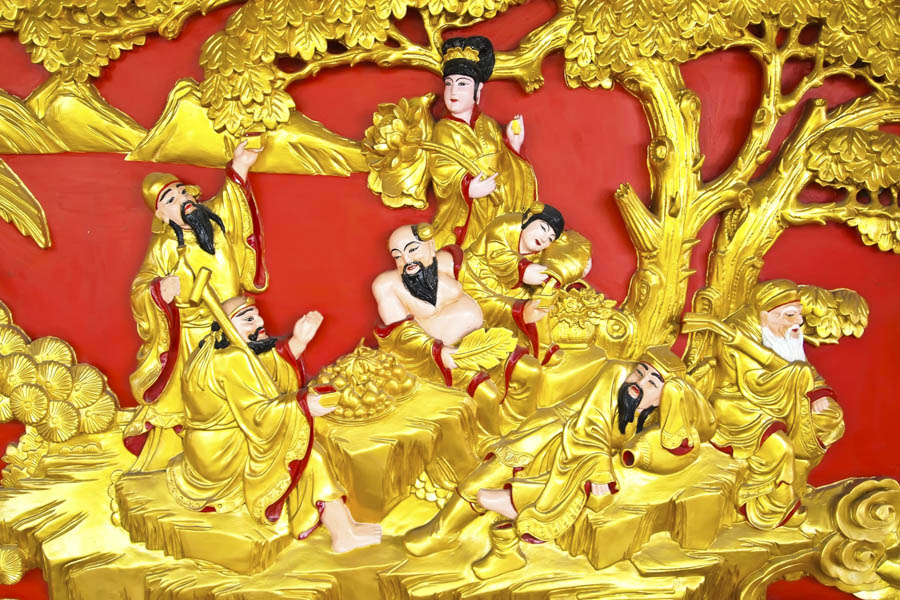
The Eight Immortals (八仙, Bāxiān) are key figures in Taoist legend and Chinese folk religion, embodying both mythic feats and enduring moral ideals. They represent all walks of life – scholars, nobles, mystics, and commoners – illustrating that spiritual transcendence is open to everyone. Their stories blend legend with allegory, symbolising wisdom, resilience, and the triumph of virtue over adversity.
- Zhongli Quan (汉钟离), the eldest, carries a fan said in legend to revive the dead and turn stones into silver. He symbolises prosperity, protection, and benevolence.
- Lü Dongbin (吕洞宾), a Tang dynasty scholar and Zhongli’s disciple, wields a demon-slaying sword. His tales reflect the pursuit of enlightenment and mastery of the self, making him the group’s most revered figure.
- Li Tieguai (李铁拐), with his iron crutch and medicine gourd, is said to have taken over a beggar’s body after a celestial journey. He personifies endurance and compassion, healing the sick and aiding the poor.
- Zhang Guolao (张果老), the eccentric sage, rides a white mule backwards and carries a bamboo drum. His legend of dying and returning to life makes him a cultural symbol of longevity and unorthodox wisdom.
- Cao Guojiu (曹国舅), a disgraced court official seeking redemption, withdrew from worldly affairs to pursue spiritual purity. His image in court robes with jade tablets marks him as a symbol of justice, integrity, and noble conduct.
- Han Xiangzi (韩湘子), the flute-playing mystic and grandnephew of the poet Han Yu, is said to make flowers bloom with music. He represents creative inspiration and harmony with nature.
- He Xiangu (何仙姑), the sole female immortal, lived on powdered mica after a divine vision and ascended to heaven. Her lotus flower symbolises purity, healing, and feminine spiritual power.
- Lan Caihe (蓝采和), the androgynous wanderer with a basket of flowers, sings carefree songs about life’s impermanence. Their figure reflects joy, freedom from attachment, and the transcendence of gender and status.
The Four Celestial Symbols: Protectors of the Middle Kingdom
The Four Celestial Symbols (四象, Sì Xiàng) – the Azure Dragon (青龙) of the East, Vermilion Bird (朱雀) of the South, White Tiger (白虎) of the West, and Black Tortoise (玄武) of the North – form a cornerstone of ancient Chinese cosmology. Each is associated with a season, direction, and elemental force: the Azure Dragon with spring and growth, the Vermilion Bird with summer and fire, the White Tiger with autumn and protection, and the Black Tortoise – with its entwined serpent – with winter, endurance, and wisdom.
Together with the Yellow Dragon of the Centre (黄龙), these four creatures correspond to the Five Directions and the philosophy of the Five Elements (五行, Wǔ Xíng), which describe the cyclical generation (xiāng shēng, 相生) and restraint (xiāng kè, 相剋) of natural energies. This system underlies key fields of Chinese thought – from feng shui and traditional medicine to music, cosmology, and governance – reflecting the pursuit of harmony between nature and human life.
Mythical Creatures in Chinese Legends
Dragons (龙, Lóng) – revered symbols of power and prosperity – embody cosmic strength, rainfall, and imperial authority. The dragon served as the emblem of the Emperor, the “Son of Heaven,” and remains a protective force tied to natural balance.
Elephants (大象, Dàxiàng), though rare in early Chinese mythology, became sacred symbols after Buddhism’s arrival. Associated with jíxiáng (auspiciousness), they represent wisdom, stability, and divine protection, appearing as messengers of deities in art and temple architecture.
The Yellow Dragon (黄龙, Huánglóng) represents the Centre and the Earth element, embodying harmony and balance. Traditionally, its appearance heralded virtuous emperors and prosperity, serving as a cosmic symbol of rightful rule.
The Qilin (麒麟), a scaled, antlered creature, is the bringer of peace and a harbinger of sages. It appears during times of prosperity and good governance, embodying benevolence, wisdom, and longevity.
Pixiu (貔貅), a fierce lion-like creature, guards wealth and repels misfortune. Folk legend tells that the Jade Emperor cursed it to consume treasure without expelling it, making it a symbol of abundance and financial luck.
The Phoenix (凤凰, Fènghuáng), empress of all birds, represents virtue, renewal, and conjugal harmony. Once symbolising the union of male and female forces, it became a singular emblem of feminine grace and imperial dignity.
Xingtian (刑天), the headless warrior, defied the Yellow Emperor and continued to fight after decapitation. A figure of indomitable will and defiance, he symbolises courage and perseverance against insurmountable odds.
Heroes of the Land: Legends that Inspire
Chinese legends form a bridge between mythology and history. While myths explain how the world came into being, legends show how to live within it. Often centred on real or semi-historical figures – poets, generals, and scholars whose deeds transcended mortality – these stories embody ideals of virtue, loyalty, and moral strength. For centuries, such tales have shaped how the Chinese understand duty, righteousness, and the meaning of a life remembered with honour.
The Cowherd and the Weaver Girl (牛郎织女): A Celestial Romance
The Cowherd and the Weaver Girl (牛郎织女) is one of China’s most beloved tales of celestial romance. In one version, Zhinü (织女), the celestial weaver of clouds, marries Niulang (牛郎), the heavenly cowherd. When their love distracts them from their duties, the Jade Emperor – or, in other tellings, the Queen Mother of the West – separates them across the Milky Way. The lovers are allowed to meet just once a year, on the seventh day of the seventh lunar month.
In another version, Zhinü is a goddess who descends to earth and marries Niulang, a mortal. They live happily and raise two children until the Queen Mother of the West discovers their union. She creates the Milky Way to keep them apart, but her heart softens, and she permits them to reunite annually when magpies form a celestial bridge across the stars.
The Legend of the Dragon Gate (龙门传说)
The Legend of the Dragon Gate (鲤鱼跳龙门) is a timeless Chinese tale of ambition and transformation. It tells of carp that swim upstream to the Dragon Gate, a treacherous gorge on the Yellow River, where a powerful waterfall blocks their path. According to legend, any carp brave and strong enough to leap over the falls is rewarded by the heavens, transforming into a mighty dragon.
While countless carp attempt the climb, most are swept away by the current. Some falter, while others face trials from spirits or predatory creatures meant to test their resolve. Yet the most determined persist, gathering their strength for one final leap. Those who succeed rise into the sky as dragons – symbols of strength, wisdom, and triumph over adversity.
Today, the phrase “leaping the Dragon Gate” (鲤鱼跳龙门) lives on as a metaphor for achieving success through perseverance and hard work – whether passing exams, earning promotion, or overcoming life’s greatest challenges.
The Ballad of Hua Mulan (花木兰)
The legend of Hua Mulan (花木兰) is immortalised in the Ballad of Mulan (木兰辞), a folk poem from the Northern Wei period (4th–6th century CE). It tells of a courageous young woman who defies convention to fulfil her filial duty.
When the emperor issues a decree calling one man from each household to defend the realm from northern invaders, Mulan disguises herself as a man to take her elderly father’s place in the army. For twelve years she fights bravely, earning great distinction while concealing her true identity. After the war, the emperor offers her a high official post, but she declines, choosing to return home.
Her comrades are astonished when she removes her armour and reveals herself, prompting her to recite the famous lines:
“The male hare has heavy front paws,
The female hare tends to squint.
But when the two hares run side by side –
Who can tell the female from the male?”
Her story endures as a timeless symbol of filial piety, courage, and the belief that true virtue is measured by deeds rather than gender.
The Tale of the Red Thread (红线传说)
Long before couples exchanged vows, Chinese tradition spoke of an invisible red thread binding those destined to meet and love each other. Yue Lao (月老), the god of marriage and love – known also as Yuè Xià Lǎorén (月下老人), “the Old Man under the Moon” – is said to tie this thread around the ankles of soulmates at birth.
The red thread’s power is told through countless stories passed down through generations. In one, Yue Lao shows a young boy the girl who will one day be his wife. Doubting the old matchmaker’s words, the boy hurls a stone at her before running away. Years later, on his wedding night, he discovers a faint scar above his bride’s brow – the mark he left on her long ago. This tale serves as a reminder that destiny cannot be evaded and that life’s patterns unfold in their own mysterious way.
Later retellings added new twists. One tells of an ambitious man who tries to defy fate by ordering the death of the girl he is meant to marry, only to wed her years later, unaware of who she is until she reveals her scars. Another version recounts a girl rejected by her beloved, who meets him again in adulthood and realises they were always destined to be together.
The enduring legend of the Red Thread reflects the Chinese idea of yuanfen (缘分) – the invisible force that binds people through fate. Unlike chance or coincidence, yuanfen rests on the belief that relationships are shaped by past lives. The Red Thread, delicate yet unbreakable, symbolises the bond between two souls destined to find each other, no matter how improbable their journey may seem.
Sun Wukong – The Monkey King (孫悟空)
Sun Wukong, the Monkey King, is a legendary figure of Chinese mythology, immortalised in the 16th-century Ming-dynasty classic Journey to the West (西游记). Born from a stone egg atop the Mountain of Flowers and Fruit (花果山), he mastered the art of seventy-two transformations and wielded the Ruyi Jingu Bang – a magical staff that could shrink, expand, or multiply at will.
Seeking immortality, he crowned himself “Great Sage Equal to Heaven” (齐天大圣) and rebelled against the celestial order. He ate the peaches of immortality, consumed Laozi’s elixir pills, erased his name from the Book of Life and Death, and defeated the Jade Emperor’s armies single-handedly.
Only the Buddha could subdue him, imprisoning him beneath the Mountain of the Five Elements (五行山) for five centuries. Freed at last to accompany the monk Xuanzang on a sacred pilgrimage, Sun Wukong transformed from a rebellious immortal into a symbol of loyalty, enlightenment, and spiritual awakening – becoming one of the most beloved heroes in all of Chinese culture.
The Legend of the White Snake (白蛇传)
The Legend of the White Snake tells of Bai Suzhen (白素贞), a snake spirit who, after a thousand years of spiritual cultivation, transforms into a human woman. In her new form, she meets and marries Xu Xian (许仙), a kind-hearted apothecary from Hangzhou.
Their peaceful life is disrupted by the Buddhist monk Fahai (法海), who exposes Bai Suzhen’s true nature. During the Dragon Boat Festival, Xu Xian accidentally discovers her serpent form and dies of shock. To save him, Bai Suzhen ascends to the realm of immortals and steals the Lingzhi herb of life, restoring him to the mortal world.
When Fahai later imprisons Xu Xian in Jinshan Temple, Bai Suzhen floods the temple to free her husband. The story’s many retellings end differently, but the most cherished version concludes with Bai Suzhen’s imprisonment beneath Hangzhou’s Leifeng Pagoda. Years later, her son Xu Shilin, moved by devotion to his mother, offers sacrifices that cause the pagoda to collapse – releasing her spirit and reuniting the family.
Today, the tale remains a cornerstone of Chinese folklore, symbolising eternal love, loyalty, and the power of compassion to transcend worlds.
Cultural Echoes: Impact on Art and Society

Chinese mythology isn't confined to ancient texts – it permeates every corner of contemporary life, shaping art, architecture, celebration, and spiritual practice in ways both subtle and spectacular.
At Shanghai's South Bund Fabric Market, master tailors embroider the phoenix and dragon onto silk wedding garments, representing marital harmony. Modest jade studios near the Bell Tower keep carving beautiful Qilin figurines, each one moulded with care and respect. Jingdezhen, which has long been known as China's porcelain heartland, still makes beautiful ceramics. The Azure Dragon and White Tiger float across tea settings, adding a feeling of balance to shared moments. Even tiny red thread bracelets, worn by people for Yue Lao's blessing, tell stories that have guided individuals for hundreds of years.
Modern Chinese Art Inspired by Mythology
In the present day, artists often reimagine ancient narratives through a modern lens. We no longer see traditional scrolls; instead, we see Sun Wukong and his rebellious spirit in bold street art, murals, abstract sculptures, and digital art. The White Snake's tale of forbidden love is reflected in cinematography, while the Eight Immortals appear in mixed-media artworks that blend classical ink techniques with experimental materials.
The National Art Museum of China in Beijing (中国美术馆) often hosts exhibitions that feature contemporary artists reinterpreting mythological themes. Additionally, the Power Station of Art in Shanghai, China's first state-run contemporary art museum, has exhibited installations inspired by tales as old as time, incorporating elements from the Classic of Mountains and Seas and the Journey to the West. These venues demonstrate how mythology refuses to remain static, instead evolving alongside the society that created it, speaking to contemporary concerns through timeless archetypes.
Feng Shui and Mythical Symbols in Architecture
In Beijing, layouts of ancient Chinese structures often adhere to the principles of feng shui, with the arrangement of buildings based on cosmic principles of cardinal directions. For instance, the Forbidden City’s cardinal layout reflects traditional cosmological thinking, often interpreted through the framework of the Four Celestial Symbols – Azure Dragon to the east, White Tiger to the west, Black Tortoise to the north, and Vermilion Bird to the south.
Dragons are another common symbol of long life, strength, and perfection. The famous Nine Dragon Wall in the Forbidden City is a fine example. Additionally, Pixiu and Qilin figures were commonly used in ancient architecture. They can be seen on the roof corners of houses, halls and palaces, such as the ceramic figures decorating the Hall of Supreme Harmony at the Imperial Palace Museum, or the Qing dynasty statue of a qilin in the Summer Palace.
Modern architecture continues this tradition: the National Centre for the Performing Arts rises as an elliptical titanium dome, surrounded by an artificial lake that gives the illusion of a floating giant egg in Pangu’s creation myth – ancient philosophy guiding contemporary vision.
Chinese Festivals Inspired by Mythology
Chinese festivals transform mythology into celebrations that anyone can partake in.
During late May’s Dragon Boat Festival, dragon-headed boats race through rivers in places such as Guilin, commemorating the poet Qu Yuan, while spectators eat zongzi prepared in memory of his death.
The Qixi Festival, often called China's Valentine's Day, celebrates the love story of the Cowherd (Niulang) and the Weaver Girl (Zhinü). Each August, couples in cities like Beijing and Shanghai look up at the night sky to see Vega and Altair shining across the Milky Way.
The Mid-Autumn Festival sees families sharing mooncakes beneath the full moon, recounting the ascent of the Moon Goddess Chang'e to lunar immortality.
Dragon dancers weave through the streets during Lunar New Year, their undulating forms bringing blessings as they perform ancient mythology with contemporary joy.
Modern Adaptations of Chinese Mythology
At Beijing's Liyuan Theatre, Peking Opera brings the Legend of the White Snake to life, combining music, movement, and elaborate costumes to transform this classic Chinese myth into a vivid performance. The story has also been adapted into films, including the 2011 movie The Sorcerer and the White Snake starring Jet Li, as well as television series and illustrated children’s books.
Sun Wukong, the Monkey King from Journey to the West, remains one of China’s most iconic cultural figures. The 1986 television adaptation is a generational favourite, and the character continues to inspire global media – not always through direct retellings, but often through reinterpretations in anime, video games, and contemporary art.
The story of Mulan, originating from the Ballad of Mulan, resonates in Chinese and international cinema, its themes of courage, duty, and challenging societal expectations engaging modern audiences. These adaptations are more than entertainment; they preserve and transmit Chinese mythology, literature, and cultural heritage, inviting each generation to explore the timeless narratives of the Middle Kingdom.
Mythological Figures in Chinese Religious Practice
Chinese mythology, folklore, and spiritual practice remain deeply intertwined. Beijing's Yonghe Temple, a Tibetan Buddhist monastery, features statues of several revered figures, including Guanyin, the Goddess of Mercy, whose devotees seek compassion, protection, and blessings. Shanghai’s City God Temple (Chenghuang Miao) venerates the local city god, Chenghuang, responsible for protecting the community, alongside smaller halls for other folk deities. In Hangzhou's Lingyin Temple, one of China’s largest Buddhist monasteries, visitors can witness centuries of devotional rituals, meditation, and practices blending Buddhism with local traditions. Yue Lao temples across China welcome singles hoping to find destined love, with red ribbons tied in age-old matchmaking ceremonies.
Traditional Chinese Medicine and Mythological Roots
The cosmological ideas found in Chinese mythology also inform how people relate to the body, health, and energy – most clearly in the foundations of traditional Chinese medicine. Rooted in classical Chinese philosophy, it draws on the principles of yin and yang and the Five Elements (Wood, Fire, Earth, Metal, and Water), which together describe the cycles and balance of natural forces. Practices like Tai Chi and Qigong cultivate qi, the vital life force, through movements attuned to these rhythms of energy and transformation.
Chinese mythology is not a closed chapter of the past but a system of images, ideas, and stories that continue to evolve. Woven into everyday rituals, artistic expression, and collective memory, these narratives remain part of how China reflects on its history, understands the present, and imagines the future. Rather than standing apart from contemporary life, mythology moves with it – reshaped, retold, and quietly persistent.