

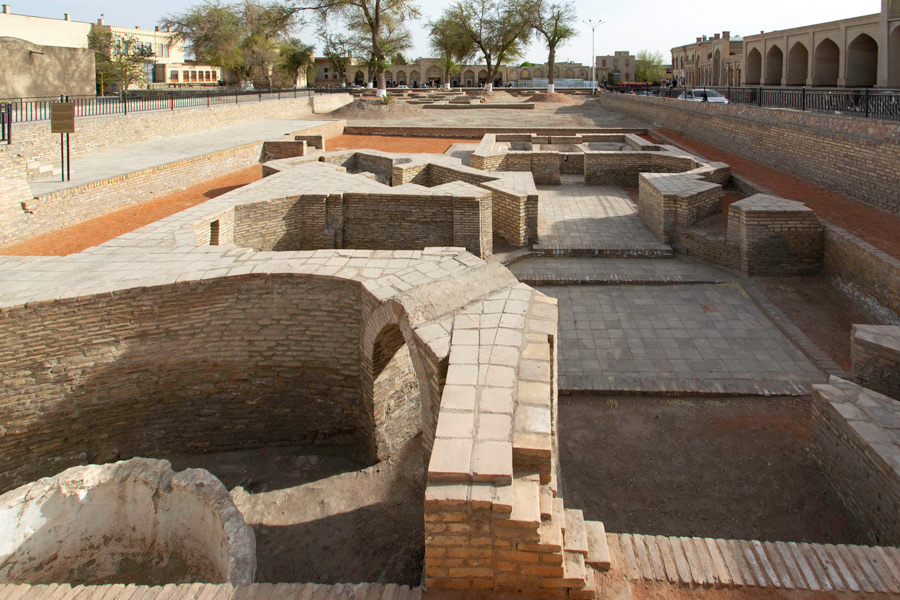
Bukhara is one of the oldest cities in Central Asia, with a documented history extending back more than two thousand years and shaped by successive waves of settlement, conquest, and cultural development. Archaeological surveys and excavations confirm the existence of an early urban centre here in antiquity, closely connected to regional trade networks and irrigated agriculture.
Like the city itself, the name “Bukhara” carries echoes of several civilisations. Its origin remains open to interpretation, though it is most often linked to the Sanskrit word vihāra, meaning a Buddhist monastery — a reference to the region’s pre-Islamic past, when Buddhism formed part of the cultural landscape of Central Asia. Alternative theories connect the name with ancient Iranian languages once spoken in the area, underscoring the layered and multicultural character of Bukhara’s early history.
During the early Middle Ages, Bukhara developed into a prominent Sogdian city, playing an important role in commerce and local governance. The Arab conquest in the 8th century marked a decisive turning point, integrating Bukhara into the Islamic world and transforming its religious and administrative life. In the centuries following the conquest, the city became a major centre of Islamic culture under the Samanids, whose rule fostered advances in architecture, science, theology, and literature. The struggle between the Samanids and the Karakhanids reflected broader political shifts in Central Asia, with Bukhara remaining a key prize due to its economic and cultural importance. Under Mongol and later Temurid rule, the city experienced periods of destruction followed by renewal and reconstruction. The epoch of Amir Temur and the reign of Ulugbek contributed to the revival of urban life, education, and monumental building. Alongside Bukhara itself, nearby Varahsha stands as evidence of the region’s earlier centres of power and artistic achievement. Today, Bukhara’s architecture preserves the material record of these successive periods, making the city a unique historical archive of Central Asian civilisation.
- The ancient city - Bukhara
- Archaeological Survey, Excavations and Exploration
- The etymology of the place name "Bukhara"
- The early Middle Ages
- Bukhara under the Arabian conquest
- Bukhara after the Arabian conquest
- Architecture in the Samanid period
- Science and Culture in the Samanid period
- Struggle between the Samanids and the Karakhanids
- Bukhara under Mongols and Temurids
- Bukhara renewal
- Amir Temur epoch
- Bukhara under Ulugbek rulling
- Varahsha city
- Bukhara architecture