


Address: 13 Amir Temur Street, Tashkent
Location: Google Maps
Opening hours: Tuesday–Sunday, 09:00–18:00; closed on Mondays.
Phone: (+998 71) 232-34-30
The Tashkent Polytechnical Museum combines automotive history with hands-on science exhibits. On the first floor, visitors can trace the development of transport and see a collection of vintage cars, from Soviet Pobeda and Chaika models to American Fords and Chevrolets.
The second floor is devoted to interactive science, with exhibits that let visitors carry out experiments, explore optical illusions and learn about basic laws of physics.
Practical Information
The museum is on Amir Temur Street in central Tashkent, about a five-minute walk from Amir Temur Xiyoboni metro station, near Amir Temur Square.
Admission for foreign visitors costs 25,000 UZS per floor, or 50,000 UZS for both floors (approximately US$4).
Several short shows are held throughout the day. The Spark Show takes place on the first floor at 11:00, 13:00 and 15:00, followed by a robot dance on the second floor. The Tesla Show is held at 12:00, 14:00 and 16:00, also on the second floor. Check the schedule at the entrance, as times may change.
It is best to visit the interactive floor with someone else, as many exhibits are designed for two or more people.
Labels and instructions on the second floor are available in Uzbek, Russian and English, so most exhibits are easy to use without assistance. Museum staff can also explain how the installations work if needed.
The second floor also has a play area for children under seven, with slides, a ball pit, a LEGO zone and a small football pitch. Entry is included in the ticket price.
Allow around two hours to explore both floors, watch the shows and try the interactive exhibits.
Exhibitions and Halls
The museum is divided into three main exhibition zones: Retro, Modern and the Interactive Workshop. The first two trace the development of transport and the automotive industry in Uzbekistan and around the world, while the third focuses on physics experiments and interactive installations.
Retro Hall
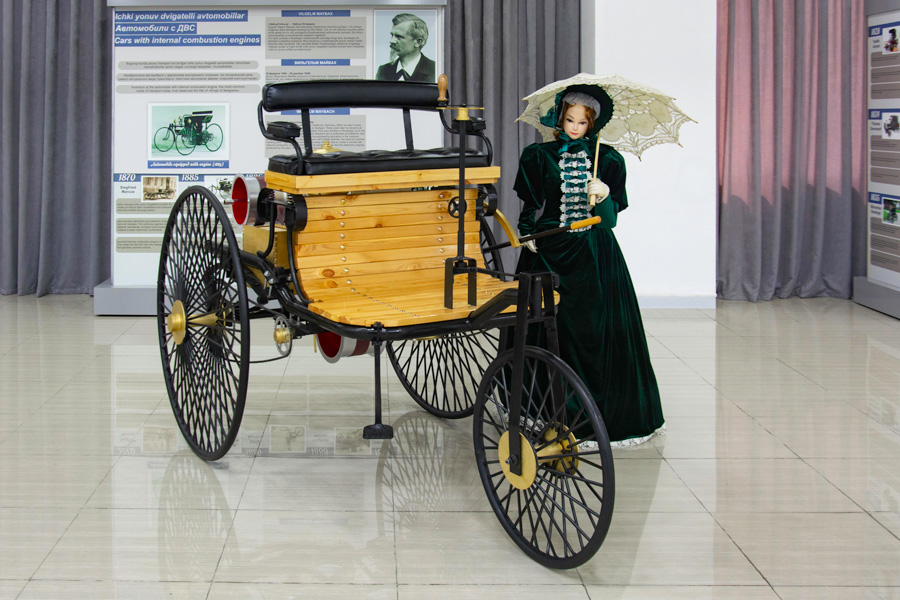
The exhibition begins with models of two early wheels, one made of stone and the other of wood, representing designs dating to around 4000 BC and 1200 BC respectively. These are followed by carts, carriages and early automobiles representing different stages in the development of transport.
The oldest original exhibit in this part of the museum is a 19th-century Khorezm arba, a traditional Central Asian cart. It shows the type of wheeled transport used in the region before cars became widespread.
The early history of the automobile is represented mainly by models, including a Ford Model T from the first quarter of the 20th century and a blue Bugatti Type 35 based on the racing car of the 1920s. The Ford’s large, narrow wheels still reflect the influence of earlier horse-drawn vehicles.

The main vintage collection comprises several dozen original cars, most of them Soviet-made. These include a GAZ-M20 Pobeda, Moskvich-407, ZAZ-965, several Zhiguli (Lada) cars and a GAZ-67. The exhibition also features the Soviet luxury cars GAZ-13 and GAZ-14 Chaika, which were used by senior Soviet officials, including leaders of the Uzbek SSR.
American and European cars are also on display. A black 1946 Ford V8 Super Deluxe and a Chevrolet Bel Air are two of the most valuable exhibits in the museum. Other notable cars include a red Chevrolet Camaro sports car and a rare East German EMW 340.
Some of the museum’s vintage cars belong to private collectors. Many have been fully restored and remain in working order, while a few are offered for sale.
Modern Hall

The Modern Hall traces the history of Uzbekistan’s automotive industry, which expanded rapidly in the 1990s through cooperation with South Korea’s Daewoo. The country subsequently established plants producing passenger cars, buses, lorries and other vehicles.
The displays include cars produced in Uzbekistan, from discontinued models such as the Tico and Matiz to later vehicles including the Orlando, Malibu 2 and Onix.
Several exhibits mark milestones in Uzbekistan’s car manufacturing history. A 2001 Matiz, displayed as a gift marking the 10th anniversary of Uzbekistan’s independence, bears the signature of the country’s first president, Islam Karimov, on its bonnet. The first Uzbek-made Spark also carries his signature, together with the date 1 September 2010. Another notable exhibit is a 2008 Lacetti, the millionth vehicle produced by Uzbekistan’s automotive industry.
The exhibition also includes detailed models of automotive plants, including GM and BYD factories. A dismantled Chevrolet Spark is displayed with its individual components laid out separately. Its body, engine, electronics and thousands of individual parts reveal the complexity of modern car construction.
Several times a day, the hall hosts the Spark Show, a short multimedia presentation using 3D projection mapping. Images are projected onto a white Chevrolet Spark, making the car appear to change colour and design over the course of a few minutes.
Interactive Workshop

This hands-on area introduces visitors to the principles of mechanics, electricity, sound, optics, inertia and balance through interactive experiments.
Watch the Tesla Show. A Tesla coil produces high-voltage electrical discharges resembling lightning. During the short show, the room is darkened and a member of staff brings coloured lamps close to the coil, where they light up without a direct electrical connection.
Take unusual photos with optical illusions. In the Ames Room, distorted perspective can make one person appear much taller than another. In the upside-down room, you can take a photo that makes it look as though you are standing on the ceiling.
Experiment with pendulums. Newton’s cradle demonstrates the conservation of momentum and energy as one metal ball strikes the others, transferring the motion through the row. Another installation has several pendulums suspended on strings of different lengths. They start moving together but gradually fall out of sync, showing how the length of a pendulum affects its rate of oscillation.
Find your way through the mirror maze. Multiple reflections create false passages in this small maze, making the correct route surprisingly difficult to spot.
Try mirror writing. You can see the paper only through a mirror, so you have to guide your hand using its reflection. It is harder than it sounds and requires an unfamiliar kind of hand-eye coordination.
Try the bed-of-nails chair. Despite its appearance, the chair is designed to distribute your body weight across many points, reducing the pressure exerted by each nail.

Listen to notes through coloured tubes. Tubes of different lengths resonate at different frequencies, producing different pitches. Put your ear to each tube to hear how the sound changes.
Try the air cannon. Hit its membrane and a strong pulse of air shoots from the opening. You cannot see it, but its effect is easy to spot when a curtain several metres away starts to move.
Learn about old units of length. Three displays introduce traditional European, Russian and Uzbek measurements, including the foot, the Russian arshin and sazhen, and the Uzbek qadam and qarich. These units predate the modern metric system, and many were originally based on the length of a step, hand or another part of the human body.
Play head football. The game works best with six people. Players put their heads through openings in the table and blow a lightweight ball towards the opposing team’s goal.
History of the Museum
The Tashkent Polytechnical Museum opened in 2015 on the initiative of Uzavtosanoat JSC, Uzbekistan’s automotive industry holding company. Established as a non-state museum, it was designed to introduce visitors to the history of car manufacturing in Uzbekistan and around the world, make science more accessible and encourage young people to study technical subjects.
Students from Turin Polytechnic University in Tashkent, which has close links to the automotive industry, helped create some of the scale models and technical exhibits. Their work included reconstructions of early forms of transport and several interactive installations.
The museum has also hosted science festivals, workshops and educational events for children and young people, including the international NAUKA 0+ science festival.