

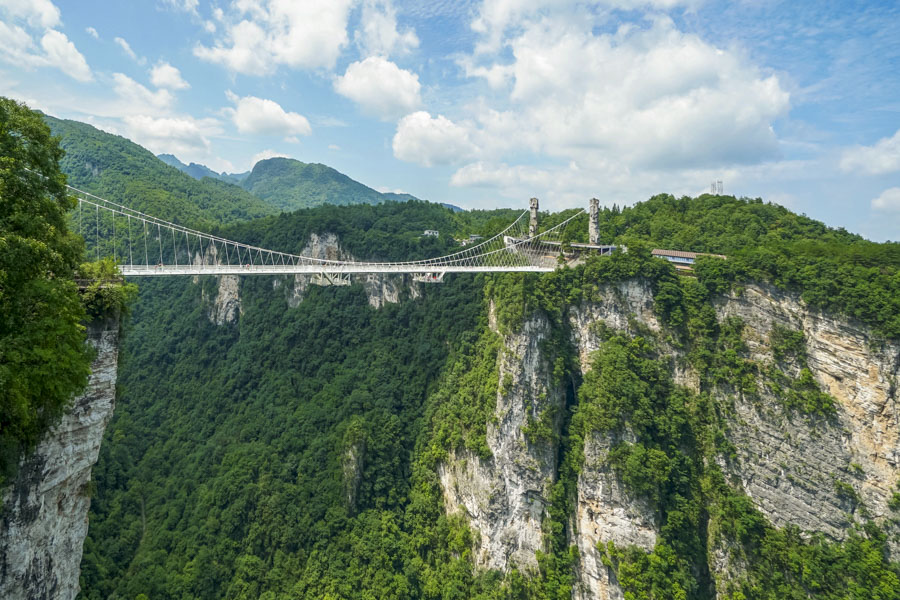
The Zhangjiajie Grand Canyon (张家界大峡谷, Zhāngjiājiè Dàxiágǔ) is a deep mountain gorge located in Sanguan Township of Cili County, Hunan Province, covering around 15 square kilometres (5.79 square miles) and lying 22 kilometres (13.67 miles) east of the Wulingyuan Scenic Area. It is one of Zhangjiajie’s principal natural attractions, famed for its sheer cliffs, clear streams, wooded slopes and the glass bridge that has become its most recognisable landmark.
The Zhangjiajie Grand Canyon Glass Bridge spans roughly 430 metres (1,410 feet) across the gorge and hangs roughly 300 metres (980 feet) above the canyon floor. On opening it was celebrated as one of the world’s longest and highest glass-bottomed footbridges. The canyon itself, however, is a natural formation whose landscape outshines that engineering feat of the bridge. Here, the mountains close in until the sky narrows to a thin ribbon. Waterfalls tumble into bright pools, and the dim, damp light of the crevices gives way to the hush of the stream below – a place where time seems slow compared with the world outside the gorge.
The Zhangjiajie Grand Canyon Tours
The Zhangjiajie Grand Canyon is often included on itineraries that showcase some of China’s most memorable landscapes. Its ancient karst valley, steep cliffs, waterfalls, and glass bridge offer a striking encounter with the country’s natural scenery.
On a four-day Zhangjiajie tour, the canyon usually provides a fitting finale. After a day among the soaring sandstone pillars of the Zhangjiajie National Forest Park, the Grand Canyon introduces a different sense of scale: a glass bridge suspended high above the gorge, quiet streams below, and rock walls rising steeply on either side.
On a 10-day China tour, the canyon appears in broader contrast. The Forbidden City, the Great Wall, and the Terracotta Army reveal the grandeur of imperial power and human craftsmanship, while the Zhangjiajie Grand Canyon shifts the emphasis to nature. Its cliffs, wooded slopes, and a deep valley were shaped long before any dynasty.
On an extended two-week itinerary, the route may run from Beijing through Xi’an to Zhangjiajie before continuing towards the gentler scenery of the Li River. Here the Zhangjiajie Grand Canyon provides a dramatic visual counterpoint to the ceremonial spaces, ancient capitals, and cultural landmarks encountered earlier.
A 15-day group tour focused on China’s natural sites often brings together the Longsheng Rice Terraces, Guilin’s karst peaks and Zhangjiajie’s dramatic terrain. In that context, the Grand Canyon frequently becomes one of the journey’s standout moments, with its sheer rock faces, suspended glass bridge, and sweeping views across Hunan’s distinctive mountains.
Best Time to Visit the Zhangjiajie Grand Canyon
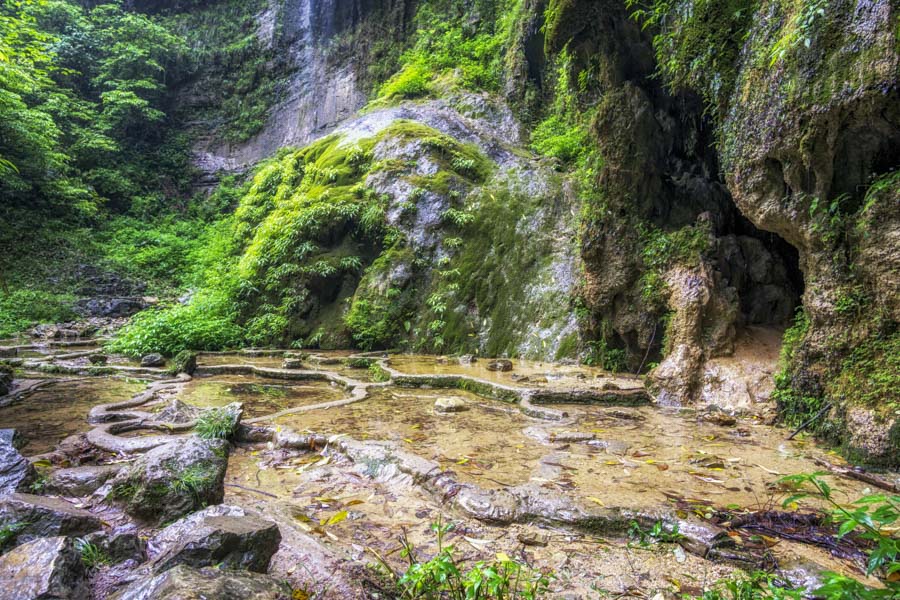
The Zhangjiajie Grand Canyon is situated within a mid-subtropical humid monsoon climate zone with a yearly average temperature of 16.8°C (62.24°F). It is beautiful all year round, but each season gives the gorge a different character.
Spring (March to May) brings fresh greenery, short mountain showers, and mist that often hangs over the cliffs after rain. Temperatures usually range from 13°C to 22°C (55°F to 72°F). Clouds can sometimes hide the deeper vistas, but the air feels fresh and carries the scent of wet grass and woodlands after rainfall.
Summer (June to August) is hot, humid, and busy, with temperatures reaching around 33°C (91°F). Heavy rain makes the slopes lush and green, while clear days reveal sharp outlines of the rock amid dense foliage. As July and August coincide with school holidays in China, it is best to arrive early in the morning to avoid the largest crowds.
Autumn (September to November) is often the finest time to visit. Temperatures generally sit between roughly 15°C and 23°C (59°F and 73°F), rainfall is less frequent, and the air is usually clear. Mid- to late October is particularly rewarding, with mild weather, excellent views, and fewer visitors.
Winter (December to February) is quiet and atmospheric. Temperatures usually range from 2°C to 12°C (36°F to 54°F), and occasional snow gives the canyon an unspoilt beauty. Visitor numbers and hotel prices tend to fall, though the glass bridge may close in icy conditions.
Opening Hours
The Zhangjiajie Grand Canyon follows seasonal opening hours, which may change because of weather or maintenance.
1 November to 14 March
Ticket sales: 09:30 to 15:00
Scenic area: 09:30 to 15:30
15 March to 14 July
Ticket sales: 08:30 to 15:30
Scenic area: 08:30 to 17:00
15 July to 31 October
Ticket sales: 07:30 to 15:30
Scenic area: 08:00 to 17:30
Last admission: 16:00
The best time of day to visit is early in the morning or late afternoon, when the crowds are lighter. Allow around three to four hours to see the main sights comfortably.
The Zhangjiajie Grand Canyon Ticket Prices
| DISCLAIMER: Ticket prices are listed in local currency and may change without prior notice. Exchange rates are provided for reference only and may fluctuate. As a tour operator, Advantour is not responsible for errors, omissions, later price changes, exchange-rate differences, or services provided by third parties. Travellers are advised to check fares, terms and conditions, availability, and booking details with official suppliers or authorised booking platforms before making a reservation. |
Combo Tickets (CNY/RMB)
| Ticketpackage | Adults | Ages 14–18 & 60–65 |
Seniors 65+ | Children under 14 |
| Canyon’s floor only | 50 ($7.35 / €6.30 / £5.51) |
25 ($3.60 / €3.15 / £2.75) |
Free | Free |
| Canyon + Glass Bridge | 175 ($26 / €22 / £19) |
88 ($13 / €11 / £10) |
63 ($9 / €8 / £7) |
|
| Canyon + Glass Bridge + experience items (choose 5 from 7 available activities) | 298 ($44 / €38 / £33) |
211 ($31 / €27 / £24) |
186 ($28 / €24 / £21) |
123 ($18 / €16 / £14) |
| Full package (Canyon + Glass Bridge + All available activities, including iron chain climbing + rock climbing) | 400 ($59 / €51 / £44) | |||
Programme Tickets (CNY/RMB)
| Activity | Price |
| Sculpture Elevator | 20 ($2.90 / €2.50 / £2.20) |
| Rainbow Lake Cruise (round trip) | |
| Sightseeing Lift | 30 ($4.40 / €3.80 / £3.30) |
| Treasure Hunt Lift | |
| Flying VR | |
| Wuwangpo Slide Way | |
| Rock Climbing | 48 ($7 / €6 / £5.30) |
| Zip Line | 50 ($7.35 / €6.30 / £5.51) |
| A Strip of Sky Slide | |
| Glass Bridge | 125 ($19 / €16 / £14) |
| Iron Chain Climbing (up & down) | 276 ($41 / €35 / £31) |
| Bungee Jumping | 1,988 ($292 / €252 / £219) |
Please note: bungee jumping is charged separately, regardless of the ticket type chosen.
It is advisable to book tickets for the Zhangjiajie Grand Canyon Scenic Area online, especially in high season. Tickets can usually be reserved and paid for via the scenic area’s official WeChat account. After booking, you will receive an e-ticket to be scanned at the entrance.
Visitors must carry their passport or another valid form of ID. If you buy a group ticket, all members should arrive at the entrance together.
Practical Information
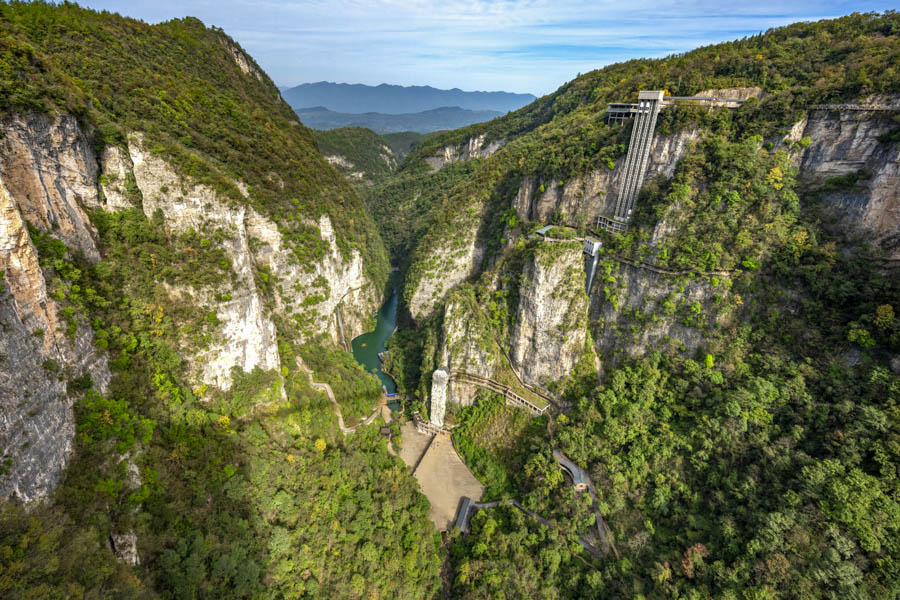
Restrooms are located near the entrance, by the Ticket Office and Bridge Reception Centre, and at several points along the visitor routes. For ease of navigation, they are marked with multilingual signs in Chinese, English, and Korean.
Lockers are available near the entrance for a small fee, usually around CNY/RMB 5 to 10. Visitors may use them to store personal items and things not permitted inside the canyon, including selfie sticks, cameras and camcorders, drones, unpackaged snacks, drinking cups, lighters, large rucksacks, and other restricted items.
For safety reasons wheelchairs are not permitted on the Glass Bridge, and the paths are not accessible either.
History and Legend of the Zhangjiajie Grand Canyon
Ancient Landscape: Land Shaped by Time and Belief
Long before tourist routes and glass walkways appeared, the area now called Zhangjiajie Grand Canyon formed part of the wider natural and cultural landscape of Wulingyuan. These mountains have long been home to the Tujia and Miao peoples, for whom stone, water, and forest were not merely scenery but elements of a living landscape shaped by spirit, memory, and natural forces.
The canyon itself was carved over millions of years, as water slowly worked through layers of quartz sandstone. Its cliffs, streams, and narrow passages are the result of weathering and erosion on a vast timescale. For local communities, such places were often understood symbolically – landscapes where the power of the mountains could still be felt.
Legends of Depth and Passage
Just like Tianmen Mountain, associated with the heavenly gate, or Baofeng Lake, often linked to fairy tales, the Zhangjiajie Grand Canyon has its own folktale.
Legend has it that the Zhangjiajie Grand Canyon has two names. Many unidentified shipwrecks once emerged from the Shenquan Stream, which is why it became known as Rotten Ship Gorge. It is also linked with the Southern Red Flag Canal. The canyon’s other name, Abundant Spring Gorge, comes from the numerous springs that run along its banks.
The secret Bandit Cave adds a layer to the myth and an adventure part to the journey.
The gorge has long marked the divide between familiar terrain and a strange, wilder and mysterious natural world. In local tradition, narrow mountain passes, hidden paths, and deep waters are often approached with caution and respect. Where cliffs close in and the light falls unevenly into the ravine, it is easy to see why such places came to be thought of as powerful, solitary, and slightly otherworldly.
From Remote Gorge to Managed Landscape
For many years, the canyon was hard to reach. Steep slopes, dense vegetation, humid conditions, and poor infrastructure kept it mainly known to locals rather than outsiders. That began to change in the late 20th and early 21st centuries, as the wider Zhangjiajie area developed into one of China’s major tourist destinations.
In 2006 it was officially renamed “Zhangjiajie Grand Canyon”. The Scenic Area opened to the public in 2009.
In 2011, the Zhangjiajie Grand Canyon Scenic Area was designated a national AAAA-level tourist attraction. The "4A" (AAAA) rating is part of China's national tourist attraction classification system; it attests to the high quality of the site, assessed according to its infrastructure, safety, cleanliness, management, and visitor services. The scale ranges from A (lowest level) to AAAAA (5A, highest level).
Its most dramatic modern addition arrived in 2016, when the glass bridge designed by Israeli architect Haim Dotan opened across the gorge. The bridge came to symbolise a new phase in the area’s development: a place where ancient rock formations meet modern engineering, giving visitors a striking new way to experience the canyon.
Things to Do at the Zhangjiajie Grand Canyon
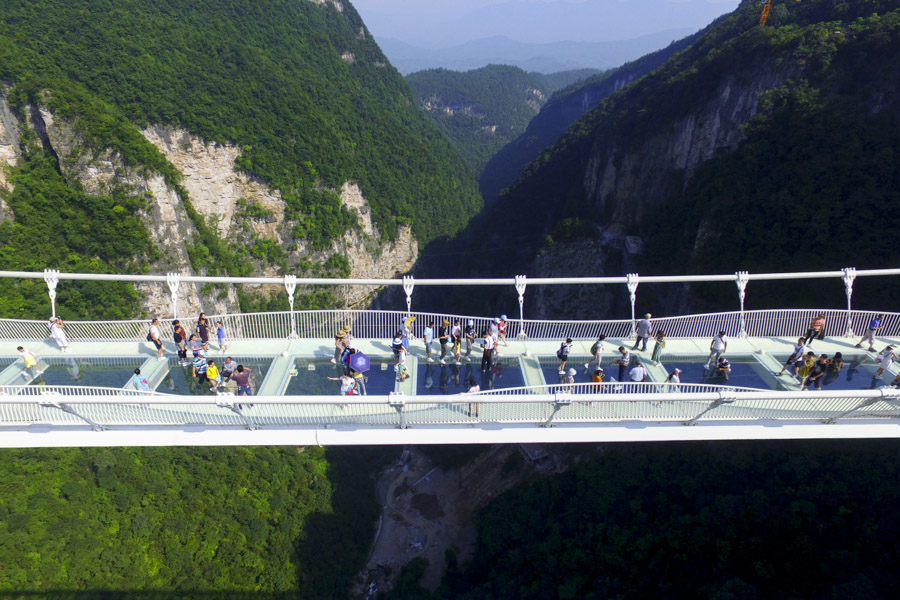
Beyond its mountain views and fresh air, the Zhangjiajie Grand Canyon offers a wide range of outdoor activities, from glass walkways and panoramic lifts to zip lines, slides, and cliff-edge adventure experiences.
Step Out Over the Abyss: the Yuntiandu Glass Bridge (玻璃桥) and Glass Plank Road (天悬栈道)
The Yuntiandu Glass Bridge (玻璃桥) is the canyon’s best-known attraction. Its polished glass floor gives glimpses of trees and rock far below, creating the startling sensation of walking on air. The adjoining Cliff Plank Road (天悬栈道) continues the experience along the rock face, offering wide views across the gorge.
Both structures use thick glass panels designed for heavy visitor use. The bridge’s glass viewing walkway crosses to the opposite side. Many visitors are moved by the height and linger to take in the view.
Fly over the canyon on the Zip Line (高空滑索)
The zip line provides a short but memorable way to see the canyon from above. Suspended high over the valley, visitors travel from one side of the gorge to the other, with the forest floor far below and the cliffs opening out on either side.
Ride the Canyon Slides
The A Strip of Sky Slide (一线天滑道) and Wuwangpo Slide Way (吴王坡滑道) offer a gentler descent through the scenic area. The former leads towards the bottom of the canyon, while the Wuwangpo Slide Way takes visitors towards Rainbow Square (彩虹广场), a resting area surrounded by rock formations.
Take a Panoramic Lift
Several lifts speed visitors between the canyon floor and the upper scenic areas, including the Sightseeing Elevator (观光电梯), Treasure Hunt Elevator (寻宝电梯), and Sculpture Elevator (雕塑电梯). In moments, the shaded gorge below opens out into broad mountain panoramas.
Try the Via Ferrata: Climb the Iron Chain
For visitors interested in a more active challenge, the Via Ferrata route, known locally as Climb the Iron Chain (飞拉达), runs along the rocky slope above the canyon. Steel handrails, footholds, and safety cables make the route accessible to those without advanced climbing experience. Perched over 300 metres above the valley floor, it has separate ascent and descent sections of roughly equal length.
Scramble Over the Stone Giants
Rock climbing is available for those seeking a more demanding challenge, with routes that bring climbers close to the canyon’s dramatic rock formations.
Try Bungee Jumping from the Glass Bridge
Bungee jumping offered from the Zhangjiajie Glass Bridge is one of the canyon’s most intense adventure options. Participants jump from the bridge into the open space above the gorge with full safety equipment and professional supervision. With its 285 metres (935 feet), it is the highest bungee jumping spot in the world. This activity is charged separately and suits visitors comfortable with heights and high-adrenaline experiences.
Experience the VR (Virtual Reality) Flight
The VR attraction simulates flight over Zhangjiajie’s mountain scenery. Wearing VR goggles, visitors glide above gorges, cliffs, clouds, and forested slopes while seated in a decorative hot-air balloon-style cabin. A personal protective eye mask is provided for comfort and hygiene.
Walk Through A Strip of Sky
At the canyon floor, the A Strip of Sky (一线天) passage runs between two tall, moss-covered rock walls. Looking up, visitors see only a narrow ribbon of sky between the cliffs, creating a strong sense of depth and enclosure...
Explore the Heart of the Canyon
The main walking route follows the canyon floor and links scenic spots such as the Twin Turtles Exploring the Stream (灵龟探溪), the Bacon Stand (腊肉炕), and the Dreams Link (帘幽梦), along with bridges, pools, waterfalls, and shaded rock passages.
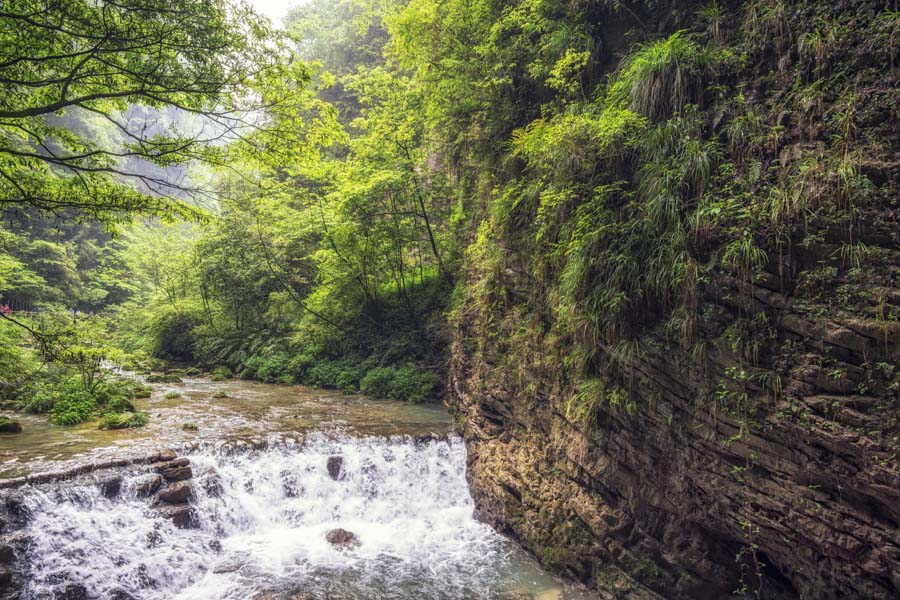
This section is quieter and more grounded than the glass bridge above. The path leads through cool air, narrow ravines, overhanging boulders and rich plant life. With its sharp peaks, caves, clear water and distinctive rock formations, the canyon is sometimes informally described as a “Zhangjiajie Landform Museum”.
| Important Information |
| Equipment, safety gear, and instructions for activities such as bungee jumping, rock climbing, cliff-edge challenges, and other aerial adventure experiences are provided at the Qiaodong Experience Centre (桥东体验中心), the main adventure hub near the Glass Bridge. |
Places to Visit at the Zhangjiajie Grand Canyon
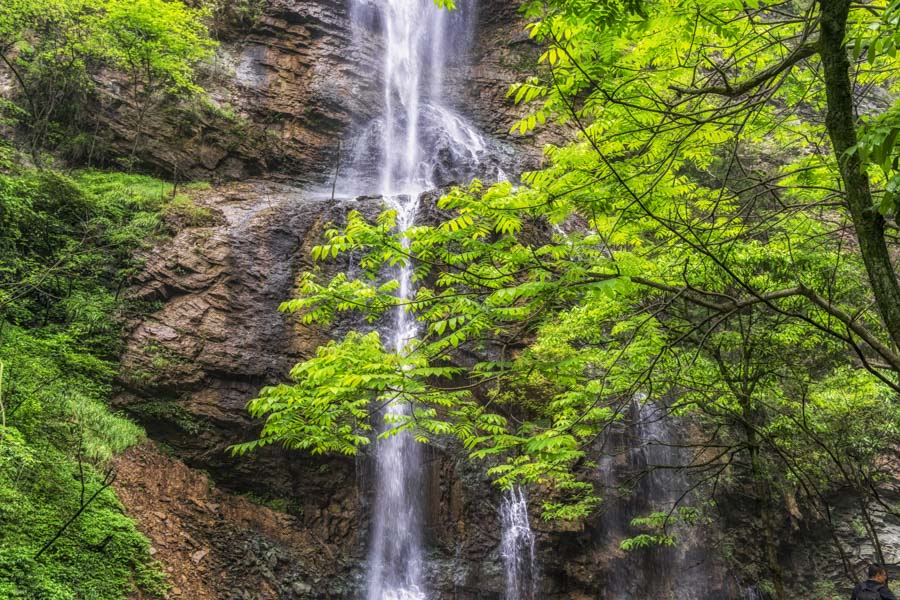
Away from the glass bridge and cliff-edge attractions, the scenic area also contains quieter places where water, rock, and forest create a more intimate atmosphere.
Caihong Lake (Rainbow Lake, 彩虹湖) and Shenquan Lake (Holy Spring Lake, 神泉湖) are attractive waterside locations. Their emerald surfaces lie close beneath the cliffs, where streams and waterfalls tumble from the rock. A boat ride on the river tram offers a gentler way to enjoy this part of the canyon, passing through green, shaded, verdant scenery and giving visitors time to slow down.
By the shores of Shenquan Lake are the Bandit Cave (土匪洞) and the Hole to Touch (摸摸洞). The Bandit Cave preserves traces of its more turbulent past, including a saltpetre-processing workshop, trenches, a cooking pit, and other remains associated with the bandits who once sheltered here. The Hole to Touch is a natural grotto noted for its unusual rock formations, now enhanced by colourful lighting.
Another distinctive feature is the Southern Red Flag Canal (南方红旗渠), a man-made irrigation channel created by the Tujia people. About one metre wide and one metre deep, it runs for more than ten kilometres, following the cliffs and bringing a human story into the canyon’s natural setting. It is worth pausing here to listen to the sound of water moving through the narrow channel.
The Tianhe Waterfall (Milky Way Waterfall, 天河瀑布) drops more than 100 metres; its name evokes water descending from the heavens. On clear days, the fine spray may catch the sunlight and form a rainbow.
The Hudiequan Waterfall (Butterfly Spring Waterfall, 蝴蝶泉瀑布) and the Pearl Wall present a quieter, more delicate scene. In this secluded ravine the spray strikes the stone and scatters like tiny beads, while butterflies are often seen flitting through the damp air. Swallow Cliff (燕子岩), close by, takes its name from the swallows that nest among the rocks, agile inhabitants of the canyon’s higher ledges.
Visitors can also walk beneath the sheet of Shuilian Waterfall (Water Curtain Waterfall, 水帘瀑布) or pause by the gentler cascades of the Shenquanxia Waterfalls (神泉峡). With streams, pools, and falls appearing throughout the route, water is one of Zhangjiajie Grand Canyon’s defining elements – shaping both its landscape and its atmosphere.
Routes of the Zhangjiajie Grand Canyon
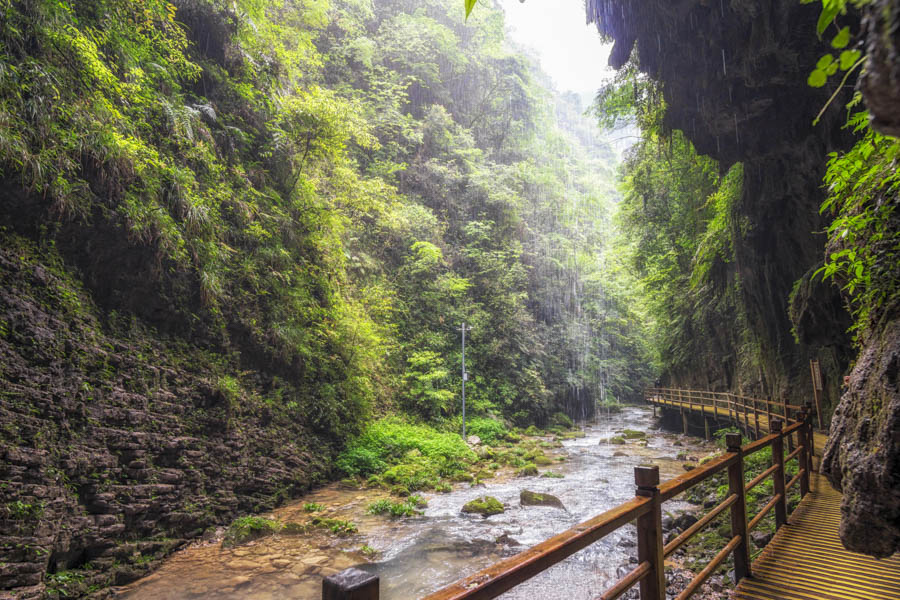
The Zhangjiajie Grand Canyon can be explored in several ways, depending on your schedule, stamina, and tolerance for heights.
Route A – Grand Canyon Only
Expected duration: over 2 hours
This route focuses solely on the canyon, excluding the Glass Bridge or upper viewing areas. It follows the shaded gorge through rock, water, and woodland, making it a good choice for visitors who prefer to avoid heights.
Visitor Centre → A Strip of Sky Slide → Rainbow Square → Rainbow Lake boat cruise → Divine Turtles Exploring the Stream → A Dream of Curtains → Touch Cave → Shenquan Lake boat ride → Shuangping (Zhangjiajie Grand Canyon Scenic Area Exit).
Route B – Glass Bridge, Sky Walk, Mountaintop, and Canyon
Expected tour duration: 3 hours
This is the most comprehensive route, combining the Glass Bridge, upper scenic areas, adventure activities, and the canyon floor. It suits visitors who want to experience the full range of the Zhangjiajie Grand Canyon in one visit.
Visitor Centre → Zhangjiajie Glass Bridge → Bungee Jumping → Qiaodong Experience Centre → Rock Climbing → Glass Plank Road → Aixiangfei VR Flying → Zip Line, A Strip of Sky Slide or Aixiangfei VR, Sightseeing Elevator → Treasure Hunt Elevator → Sculpture Elevator or Wuwang Slope Slide → Rainbow Square → Shenquan Rainbow Lake boat ride → Divine Turtles Exploring the Stream → A Dream of Curtains → Touch Cave → Divine Spring Lake boat ride → Shuangping. Zhangjiajie Grand Canyon Scenic Area Exit.
Route B1 – Partial Canyon, Mountaintop, Glass Bridge, and Sky Walk
Expected duration: 1 hour 30 minutes
This shorter route suits visitors who want to see the main highlights in a condensed visit.
Visitor Centre → A Strip of Sky Slide → Rainbow Square → Rainbow Lake boat ride → Lifts to the Upper Scenic Area: Sculpture Elevator → Treasure Hunt Lift → Sightseeing Elevator → Aixiangfei VR Flying → Glass Plank Road → Bridge East Experience Centre → Rock Climbing → Bungee Jumping Qiaodong Experience Centre → Zhangjiajie Glass Bridge → Scenic Area Exit (Glass Bridge).
Express Route – Glass Bridge and Mountaintop
Expected duration: 1 hour
This compact option is designed for travellers with very limited time. It focuses on the Glass Bridge and upper scenic area rather than the canyon floor.
Visitor Centre → Zhangjiajie Glass Bridge → Bungee Jumping → Qiaodong Experience Centre → Rock Climbing → Glass Plank Road → Aixiangfei VR Flying → return via the Glass Plank Road to Zhangjiajie Glass Bridge → Scenic Area Exit.
How to Get to the Zhangjiajie Grand Canyon
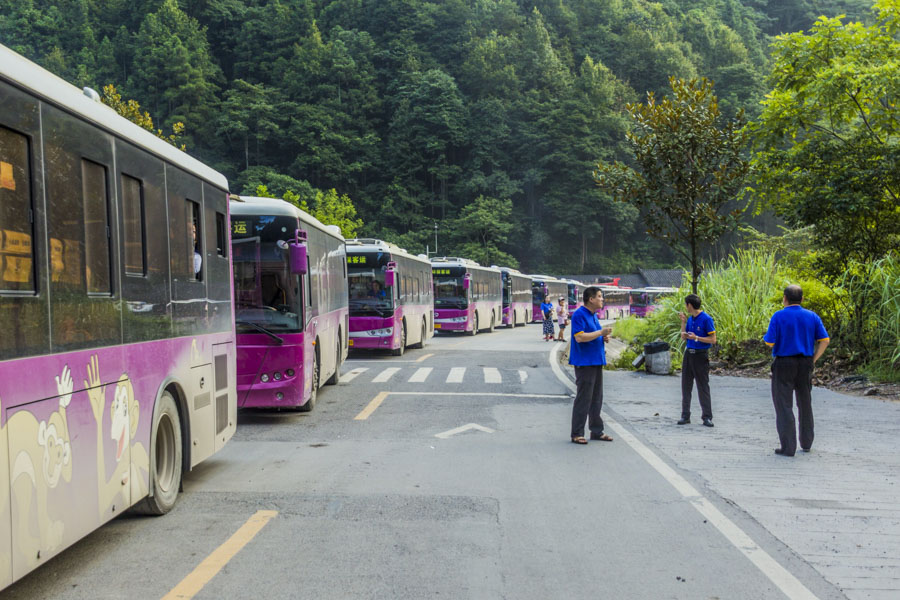
Option 1 – By Local Bus
From Zhangjiajie city centre, with a change at Wulingyuan
Start from Zhangjiajie Central Bus Station (张家界中心汽车站), located at 1 Guanli Road, Yongding District. At the departure area, look for the bus to Wulingyuan Bus Station; it should be clearly marked. Tickets can usually be bought from the driver for CNY/RMB 20, so there is no need to go to the ticket office.
On arrival in Wulingyuan, change to a direct bus to the Zhangjiajie Grand Canyon. This ticket is paid separately and costs around CNY/RMB 12.
Total journey time: approximately 1 hour 30 minutes.
From Wulingyuan District
Go to Wulingyuan Bus Station (武陵源汽车站), at the corner of Guihua Road and Weiyang Road (29.35015, 110.54609). Buses to the canyon depart every 30 minutes from 7:00 to 18:00.
Journey time: around 30 to 40 minutes.
Option 2 – By Tourist Bus
Two special tourist bus routes run directly between Zhangjiajie and the Zhangjiajie Grand Canyon.
Bus Route A departs from Zhangjiajie Central Bus Station.
Fare: CNY/RMB 20
Distance: 60 kilometres
Journey time: around 90 minutes
Bus Route B departs from Zhangjiajie West Railway Station.
Fare: CNY/RMB 18
Distance: 50 kilometres
Journey time: around 70 minutes
Departures from both stations are every 20 minutes, from 06:30 to 19:00 in summer and until 18:30 in winter.
These buses call at several key attractions en route, including Tianmen Mountain Lower Cable Car Station, Tujia Folk Garden, 72 Strange Buildings, Wulingyuan Commercial City and Yellow Dragon Cave.
On arrival, buses stop at the Grand Canyon Tourist Distribution Centre. From there, transfer to the park’s free shuttle bus (about 15 minutes) to the main entrance of the scenic area.
Option 3 – By Private Car or Minivan
A private car or minivan can directly pick you up at your hotel anywhere in Zhangjiajie City. Without stops, the journey usually takes around 50 to 60 minutes.
Hiring a car typically costs around CNY/RMB 200 to 300 ($29 to $44 / €25 to €38 / £22 to £32). As a rule, vehicles can accommodate up to four passengers.
You can arrange this service via your hotel concierge or the DiDi app. The driver will collect you from the agreed location and can take you to your hotel after the visit.
Security at the Zhangjiajie Grand Canyon
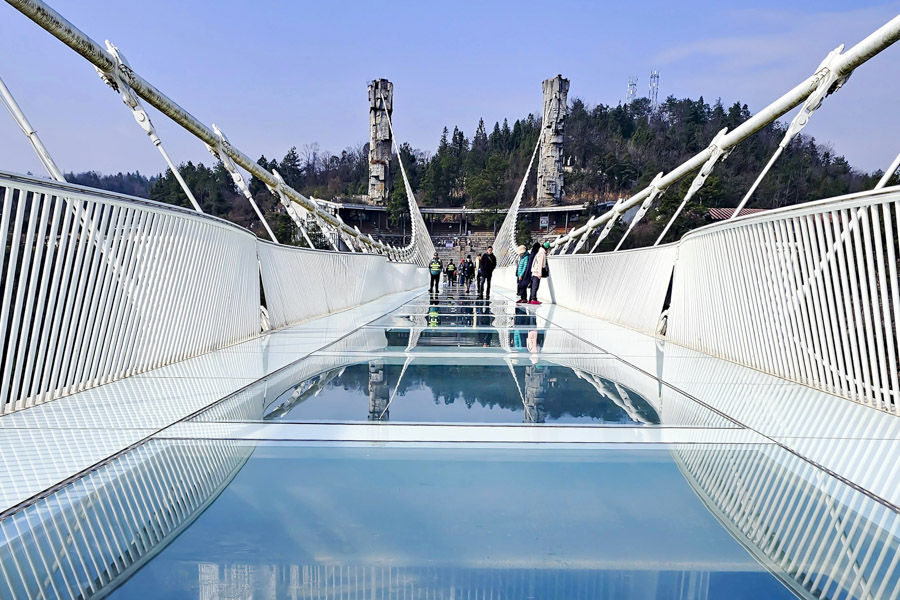
The Zhangjiajie Grand Canyon enforces strict safety and security measures, especially around the Glass Bridge and adventure attractions. To make your visit smoother, check the main rules and restrictions before you go.
Entrance Control
All visitors to the Glass Bridge area must pass through a security check; luggage and personal items are screened. Queues are likely at peak times, so allow extra time.
Visitor numbers on the Glass Bridge are limited for safety: no more than 800 people on the bridge at once, and roughly 8,000 visitors are allowed per day.
What to Wear
High-heeled shoes are not allowed on the Glass Bridge. Wear comfortable flat shoes or trainers with non-slip soles.
Visitors must collect free plastic shoe covers at the Bridge Reception Centre. These are compulsory to protect the glass.
Bring a light jacket or jumper, as the upper viewing areas and the canyon floor can feel cool. A raincoat is useful in changeable weather.
Adventure Activities
All adventure activities use safety equipment and are supervised by instructors.
Bungee jumping has strict medical restrictions. It is unsuitable for people with heart conditions, high blood pressure, pregnancy, certain spinal problems, or other relevant health issues. The minimum age is 16, and the permitted weight range is 40 to 90 kilograms (88 to 198 pounds).
For the zip line, the usual weight limit is 40 to 95 kilograms (88 to 209 pounds). Visitors who exceed the limit may be refused entry on the day, so check before you pay.
On the slideways, avoid building up excessive speed. The tracks are fairly narrow, with sharp bends where high speed can cause leg injuries.
Make sure to keep children within the reach of the Glass Bridge and viewing platforms; hold hands near the edges and steps.
On the Trails and Canyon Floor
Walking paths and viewing platforms have safety barriers and handrails. Park staff are stationed at key points and can assist in an emergency.
Take care on descents and on glass surfaces after rain, as paths, steps, and panels may become slippery. Walk slowly and use the handrails where provided.
When passing beneath rocky overhangs, lower your head and watch your step. Some rock edges are sharp.
Wear life jackets during boat rides.
Safety and Health
Some sections include steps, so expect a moderate amount of physical effort. The sun can be strong on the bridge and upper viewing platforms. Use sunscreen, wear a hat, and carry water.
Tips for an Optimal Visit
Cultural Etiquette
- The local population includes many members of the Tujia ethnic group; please respect local customs and traditions. Always ask consent before photographing local people.
- Few park staff speak English. Save key Chinese phrases on your phone or use a translation app.
Useful phrases:
- xièxie (谢谢) – thank you
- duìbuqǐ (对不起) – sorry
- kěyǐ ma? (可以吗?) – May I? / Is it OK?
A sincere smile and a patient, friendly attitude are often more appreciated than perfect pronunciation.
Environmental Rules
- The Zhangjiajie Grand Canyon is a protected natural area; please help preserve it.
- Take your rubbish with you or use the bins provided.
- Don’t smoke on the trail.
- Do not pick plants or leave marked paths.
Photography Tips
- The best light for photography is usually early in the morning or about an hour before sunset, when softer light brings out the contours of the rocks and the mist in the gorge.
- The Glass Bridge is especially striking when photographed from below, near the base of the pylons, or from the side along the Glass Skywalk. On the canyon floor, look for reflections in the water and light filtering through the foliage.
Money
Withdraw cash before your visit, as there are no ATMs inside the park.
Foreign bank cards are generally not accepted. Most services take cash or Chinese mobile payments such as WeChat Pay and Alipay.
A visit to the Zhangjiajie Grand Canyon can be included in a combined tour or arranged as an independent excursion. We can design a tailor-made trip to suit your preferences and schedule.