

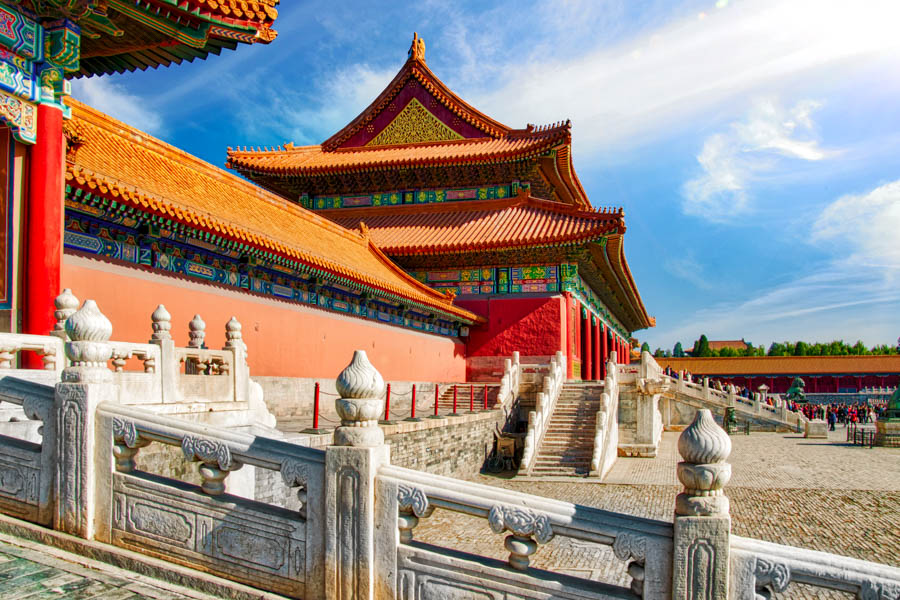
The Forbidden City (故宫, Zǐjìnchéng, its complete name is “Purple Forbidden City”), known to-day as the Palace Museum (故宫博物院, Gùgōng Bówùyuàn), stands at the heart of Beijing, its wide courtyards and ornate palace halls forming a vivid expression of China’s imperial past.
For centuries it served as the seat of power, where Ming and Qing dynasty emperors reviewed detailed reports from provincial administrations, met high-ranking officials, performed elaborate ceremonies, and oversaw the complex workings of court life.
Stepping inside the Forbidden City allows the carefully planned logic of its design to unfold, exhibiting the vast, historically rich complex as an understandable whole.
Forbidden City Tours
Visiting the Forbidden City is an encounter with centuries of politics, craftsmanship, and the cul-tural memory of life held within these high walls. Many travellers find it quietly fascinating to stand where emperors once stood and to trace the subtle intricacies of the carved beams and painted eaves.
We make every effort to secure entry tickets for significant stops on our China itineraries. When your tour includes this historic palace, Forbidden City tickets are arranged in advance so you can focus entirely on exploring.
The shorter Central China Highlights Tour offers a well-paced highlights experience, while the longer China natural-wonders itinerary pairs the capital with extended visits elsewhere, allowing you to choose either programme without reducing your time at the palace.
Our tours are fully customisable, so please mention your preferred rhythm and points of inter-est when considering booking with us.
Discover the Forbidden City as part of a thoughtful programme. With the help of a guide, you can take time to study its layout, architectural detailing, and rich colour symbolism, which will yield a measured appreciation of its purpose.
Best Time to Visit the Forbidden City

Weather
Beijing enjoys a classic temperate monsoon climate, featuring distinct seasonal characteristics. Spring and autumn are generally considered the most comfortable times for exploring the Forbidden City, with mild temperatures and clearer skies. Yet each season in Beijing has its own character, and travellers’ preferences vary – some appreciate the sharp clarity of winter, while others enjoy the city at its warmest and most energetic in summer.
Below is a seasonal overview, including average temperatures and some helpful tips for comfort when visiting:
Spring (March to May)
Typical temperatures: approximately 5 to 12 °C (41 to 53.6 °F) at night and 15 to 25 °C (59 to 77 °F) during the day.
Conditions: Dry and windy, pleasant air. Parks and gardens are in bloom.
Tips: Ideal for exploring the Forbidden City and vicinities on foot. Spring sometimes brings dust or sandstorms, which may temporarily reduce visibility.
Summer (June to August)
Typical temperatures: approximately 18 to 24 °C (64.4 to 75.2 °F) at night and 28 to 33 °C (82.4 to 91.4 °F) during the day.
Conditions: heavy rainfalls, high humidity and intense heat. July is usually the wettest month. Afternoon short thunderstorms are common.
Tips: Bring an umbrella and a pair of waterproof shoes. Plan indoor visits or rest during midday heat. Stay hydrated. Take early-morning or late-afternoon walks for better light and cooler temperatures.
Autumn (September–November)
Typical temperatures: approximately 8 to 15 °C (46.4 to 59 °F) and 15 to 25 °C (59 to 77 °F).
Conditions: Clear skies, pleasant mild air, and golden foliage.
Tips: Excellent walking and photography conditions. Layers are recommended for variable temperatures between day and night.
Winter (December–February)
Typical temperatures: approximately -10 to 0 °C (14 to 32 °F) and -2 to 5 °C (28.4 to 41 °F) during the day.
Conditions: Occasional snow, crisp air.
Tips: Dress warmly; gloves, warm scarves, and hats are recommended. Streets and museums are quieter, ideal for unhurried exploration. Experience the enchanting beauty of the Forbidden City blanketed in snow and its serene atmosphere. Mid-morning sunlight is best for photography. Watch for icy paths.
Crowd levels
The Forbidden City attracts very large visitor numbers, so timing your arrival is important.
- For a quieter experience, aim for the first entry slot (around 08:30) or visit in the later afternoon. Both timed-entry policies and official guidance recommend these windows to alleviate congestion.
- Some repeat visitors and tour guides note that midweek visits (Tuesday–Thursday) usually feel a little less crowded than weekends, although patterns vary by season and during holiday periods. Visitor-flow studies and museum notices indicate that early afternoon is the best time to visit the central halls, as they tend to be less crowded. If you plan to visit in the morning to early afternoon, consider exploring the peripheral halls during that time for a more tranquil experience.
Please note: China’s public holidays draw the heaviest crowds: During the Spring Festival period, the Chinese New Year (falls between 21 January and 20 February, depending on the lunar calendar), the Labour Day holidays (often around 1 to 5 May, but the official window varies each year), the summer school break (July and August), and the National Day “Golden Week” (1 to 7 October), Choose alternative dates if you prefer a more relaxed visit.
Opening Hours
The Forbidden City operates seasonally, with administration doing their best to sustain the flow of visitors and accommodate stress-free entry for everyone.
| High season | 1 April to 31 October | Opens at 08:30 | Ticket sales end at 16:00 | Last entry at 16:10 | Close at 17:00 |
| Low season | 1 November to 31 March | Opens at 08:30 | Ticket sales end at 15:30 | Last entry at 15:40 | Close at 16:30 |
Please note: The museum is normally closed on Mondays, except for national holidays that fall on Mondays, with the exception of the eve of the Spring Festival – it is recommended to always check dates before you travel.
For the latest Forbidden City hours, special opening days, or temporary closures, consult the Palace Museum’s official website.
Tickets
Same-day tickets are not available. All visits require advance bookings – reservations open seven days before your planned visit. The name on the booking must match the name on your ID or valid Mainland travel permit or residence permit for visitors from Hong Kong, Macao, and Taiwan (or Resident ID card for Mainland China residents), and it should be brought with you for on-site verification.
As of December 2025, Forbidden City entry ticket prices are:
- 1 April–31 October: 60 CNY/RMB (approximately $8.50, £6.80, €7.70)
- 1 November–31 March: 40 CNY/RMB (approximately $5.64, £4.27, €4.88)
Visit of the Galleries
The entrance to the following galleries is free: the Ceramics Gallery, the Sculpture Gallery, the Tools of War Gallery, the Woodblock Printing Gallery, and the Furniture Gallery.
The Gallery of Painting and Calligraphy is closed until further notice.
The ticket price is 10 CNY/RMB (approximately $1.42, £1.06, €1.21) per gallery for the following: the Treasure Gallery and the Gallery of Clocks. This price applies all year-round.
Additionally, ticket prices for some special exhibitions can vary significantly.
Please note that tickets must be booked exclusively via the Palace Museum’s official website or its WeChat ticketing service. If you do not arrive within your reserved entry slot, your reserva-tion will expire; however, same-day refunds may be requested under certain conditions.
Practical Additional Information
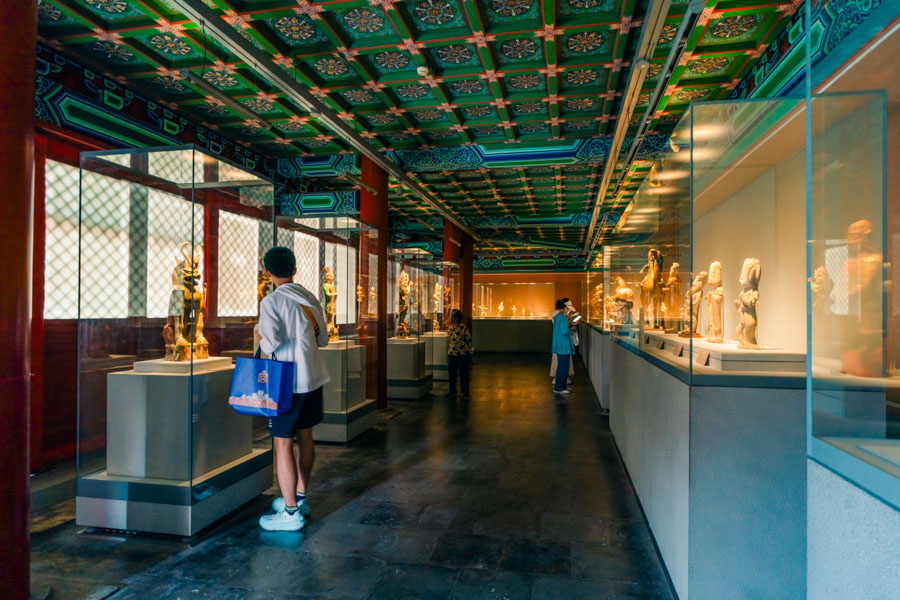
Main route and accessibility
- Visitors enter via the Meridian Gate on the south (from Tiananmen Square) and exit at the north gates.
- The shortest visit (major landmarks only) is 2 hours, enough to walk the central axis and see the main halls. A typical visit is half a day and lets you visit the central axis plus some side halls. An extended visit takes one day, with the opportunity to visit all the landmarks.
- Since 2002, the Palace Museum has provided a barrier free route along the central north–south axis, roughly 600 m from Zhaode Gate to Shenwu Gate, enabling visitors to navigate safely.
Comfort and clothing
- There are many stone paths and steps, so comfortable shoes and a light layer are advis-able in shoulder seasons.
Services and facilities available within the Forbidden City
- Accessibility for disabled visitors
- First aid office (1)
- Audio guides available in multiple languages
- Tour guides
- Luggage storage (1)
- Lavatories (14)
- Nursery (1)
- Shops (9)
- Bookshops (7)
- Restaurants (3)
- Coffee shops (3)
- Broadcasting station (1)
- Exits: North and East (2)
Etiquette and preservation
- It is prohibited to touch or climb on buildings, write on surfaces, or remove any objects. Rope barriers, signage, and staff instructions must be respected – the site is fragile and protected.
The Stories Within the Walls of the Forbidden City
Across six centuries, the Forbidden City evolved from an imperial residence to one of the world’s most visited museums. The timeline below highlights essential milestones, such as political shifts, architectural innovations, and cultural layers, and presents a few key Forbidden City facts that shape how the site is read today.
1406: Construction begins
The Ming Emperor, Yongle (Zhu Di), initiates the palace project, mobilising vast corvée labour, specially felled nanmu timbers, and quarried stone transported north by the Grand Canal and seasonal ice roads. It was a logistical and fiscal undertaking that reshaped imperial resources.
1420: The court moves north
Completion of the main palace complex allows the Ming imperial court to relocate from Nanjing to Beijing. The Forbidden City becomes the dynasty’s political and ceremonial centre. Who lived in the Forbidden City? Emperors of the Ming and Qing dynasties, their households (consorts, princes, and officials), and a large administrative and service staff, all arranged according to strict spatial hierarchies. Its timber-frame halls, built with sophisticated mortise-and-tenon carpentry and minimal traditional metal fixings, form the world’s largest surviving wooden palace ensemble.
1644: The Qing dynasty takes residence in the palace
The Manchu court preserves the north–south axial plan, overlays the site with new ritual practice, and substantially enriches the imperial collections. The palace remains the symbolic heart of imperial authority.
1736–1796: Qianlong’s cultural height
Qianlong, the sixth emperor of the Qing dynasty and a prolific patron, commissions extensive renovations, encyclopaedic catalogues, and major painting and decorative-arts projects. Under his rule, the palace becomes an unparalleled centre of collecting, scholarship, and craftsmanship.
1861–1908: Empress Dowager Cixi (慈禧太后)
As regent, Cixi dominates late-Qing court politics, commissions repairs and redecorations in the Forbidden City, and directs major architectural projects – notably restorations of the Palace of Eternal Spring (Changchungong) and the Palace of Gathered Elegance (Chuxiugong), as well as at the Summer Palace – fundamentally altering the architectural and philosophical symmetry of some of the landmarks. She arranged the succession that placed Puyi on the throne in late 1908.
1908: A child emperor
Puyi is enthroned in December 1908 as a very young child (born February 1906). Court life practices continue even as the dynasty approaches a transitional phase.
1912–1924: Emperor’s abdication but residence
After abdicating in 1912 (aged six), Puyi remains in the Inner Court under the “Articles of Fa-vourable Treatment”. He retained the imperial title in name under the Articles but had no sov-ereign authority. He continues this modified form of courtly life until warlord Feng Yuxiang’s 1924 takeover results in the retraction of his privileges and his departure from the palace.
1925: Palace Museum established
The Forbidden City is reconstituted as the Palace Museum, transforming the former imperial precinct into a public institution and steward of China’s imperial material heritage.
1930s–1940s: Treasures relocated
Faced with war and looting, museum staff and officials evacuated many collections southward to Shanghai and Nanjing and westward to Sichuan. Those movements determined the later dis-tribution and survival of key holdings.
1987: UNESCO listing
The Palace Museum was inscribed on the UNESCO World Heritage Site List in recognition of its outstanding universal value and cultural significance.
2025: A century as a museum
By 2025 the Palace Museum marks 100 years of conservation, restoration, and large-scale digiti-sation, consolidating its modern role as a global centre for research and cultural preservation.
Major Landmarks Within the Forbidden City
The Forbidden City reads as both a linear procession and a concentric court: a strict north–south central axis, an Outer Court for state ceremony, and an Inner Court for residence and governance, all enclosed by high walls and a defensive moat. Its plan embodies traditional feng shui and the hierarchical grammar of palace architecture that made imperial ritual legible at a glance.
Before beginning the progression through the palace, it helps to imagine the site as a sequence of gates, courts, and halls unfolding in a deliberate order. Visitors today generally follow the same south-to-north procession along the palace’s central axis that imperial officials once trod. But what was once a strict ceremonial route of ranks and forbidden doors is now a public, guided visitor sequence.
Major Landmarks of the Outer Core
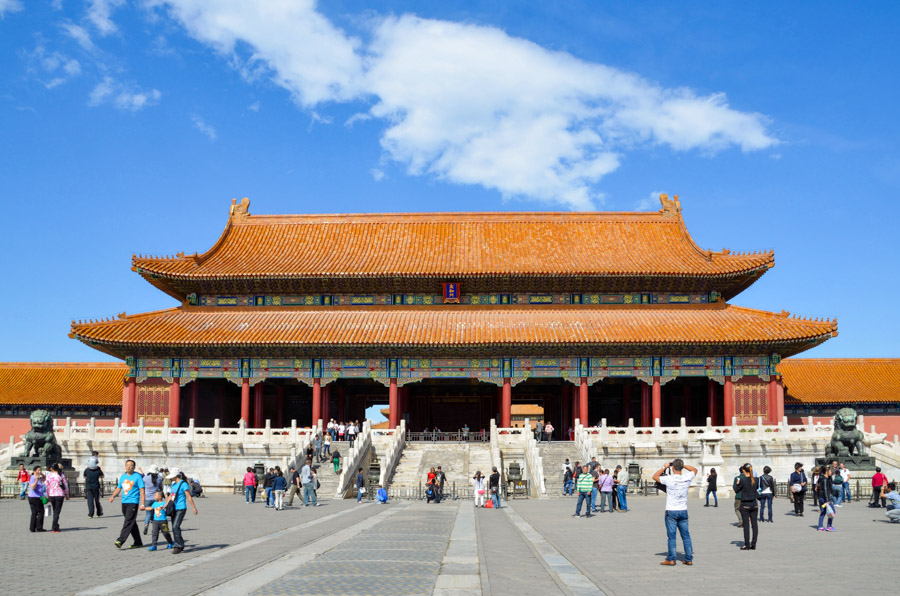
Meridian Gate (Wumen 午门)
The Meridian Gate – the principal entrance to the Forbidden City and the main southern approach to the palace – forms a monumental threshold, its broad terraces and projecting pavilions announcing the transition from the public city to the imperial realm. Historically a place of proclamation and ceremonial review, its scale and battlements once controlled access to the courts beyond.
Hall of Supreme Harmony (Taihedian 太和殿)
The largest and most ceremonial of the palace halls, the Hall of Supreme Harmony hosted enthronements and other major state ceremonies. Set upon an elevated marble terrace, its dragon-adorned throne, gilded beams, and yellow-glazed roof tiles speak the palace’s visual language; here, colour and ornament translate cosmology into unmistakable rank.
Hall of Preserving Harmony (Baohedian 保和殿)
Smaller but no less important, the Hall of Preserving Harmony served as a rehearsal and banquet hall and, in later dynasties, as the final stage for the imperial examinations. Its architectural restraint and elevated platform allowed it to mediate between public ceremonies and the palace’s more private functions.
Major Landmarks of the Inner Core
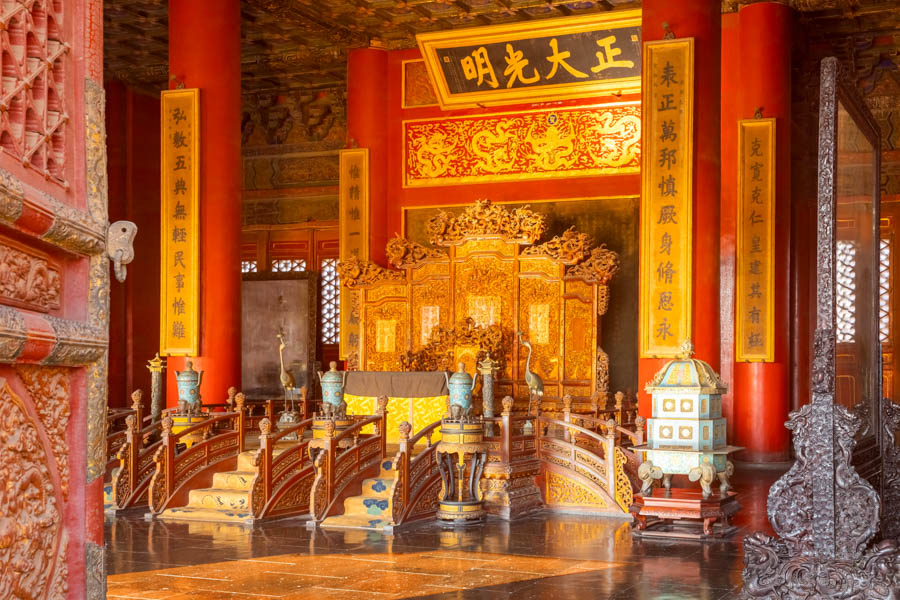
The Threshold Between the Two Courts
The Gate of Heavenly Purity (Qianqingmen 乾清门) marks the transition from the outer ceremonial areas to the residential and administrative heart of the palace. Passing through it shifts both the scale and the rhythm of the visit, signalling entry into the more private sphere of imperial life.
Palace of Heavenly Purity (Qianqinggong 乾清宫)
At the Inner Court’s core, the Palace of Heavenly Purity was the emperor’s principal residence during the Ming dynasty. In the Qing dynasty, particularly under Yongzheng and Qianlong, private residence activities shifted to adjacent halls, and Qianqinggong increasingly served as a venue for audiences and administrative affairs.
Imperial Garden (御花园) and the Hall of Imperial Peace (太平殿)
Located to the Northeast of the Inner Court, the compact Imperial Garden features rockeries, pavilions, and ancient cypresses, with the Hall of Imperial Peace set within it as a cultivated retreat. It was historically used for worshipping the Taoist mythological god Zhenwu, who controls the elements. The garden functions as an architectural microcosm of paradise, contrasting with the formal axis and ceremonial halls to the south.
Side Buildings
On the eastern and western flanks of the central axis lie numerous auxiliary palaces and service compounds. Over the centuries these accommodated a wide range of functions – residences for consorts, storage vaults for ritual garments and treasures, workshops and artisan quarters, textile and silver reserves, and even imperial-household services such as medicine stores.
Art, décor and collections

The Palace Museum’s holdings are enormous – over 1.8 million objects – and include world-class collections of ceramics, textiles, paintings, lacquerware, imperial robes, and more, with objects ranging from fine Ming dynasty attire, which encoded rank and ritual, to clocks and mechanical devices that once fascinated the court.
Its painting collections span Song-period masterpieces through to later literati and court works. Visitors may encounter the Song panorama Along the River during the Qingming Festival (attributed to Zhang Zeduan), the Ming literati painting by Shen Zhou, and Yuan-period works by Zhao Mengfu – noting that certain exceptionally early masterpieces survive as important imperial copies or are displayed only intermittently in their original form.
The Palace Museum also preserves a significant body of Qing court painting that blends Chinese and European techniques – most famously the work of the Italian Jesuit Giuseppe Castiglione (Lang Shining), who served the Qing court for several decades. His paintings fuse Western illusionistic modelling with Chinese materials and courtly subjects.
Symbolism of colour
Colour in the Forbidden City operates as a meticulously codified language, where hue conveys cosmology and imperial authority. For anyone studying colour meanings in China, the palace is one of the clearest architectural expressions of these principles.
Imperial yellow dominates roofs, tiles, and much of the ornamental detailing – a colour that, from the Ming dynasty onwards, was legally reserved for the emperor. Yellow-glazed tiles, special yellow paving bricks, and imperial porcelain collectively signal sovereignty, centrality, and the cosmic authority of the emperor, reflecting the colour’s association with the earth element and the centre in Chinese cosmology.
Red, another prominent hue throughout the complex, denotes happiness and good fortune, while green and blue suggest growth, harmony, and heaven.
Even the palace’s name invokes colour. Zǐ (紫, “purple”) refers to the Ziwei, or “Purple Star Enclosure”, which surrounds the North Star (Polaris) and aligns the emperor as a mediator between earth, heaven and the cosmic order.
A few other colours further illuminate the chromatic code. The Belvedere of Literary Profundity has black-glazed tiles, with black being associated with water in the Five Phases (五行, Wǔxíng) – the five fundamental elements that interact within the universe – and deliberately chosen to help protect the book tower from fire.
Dragon as a Major Symbol
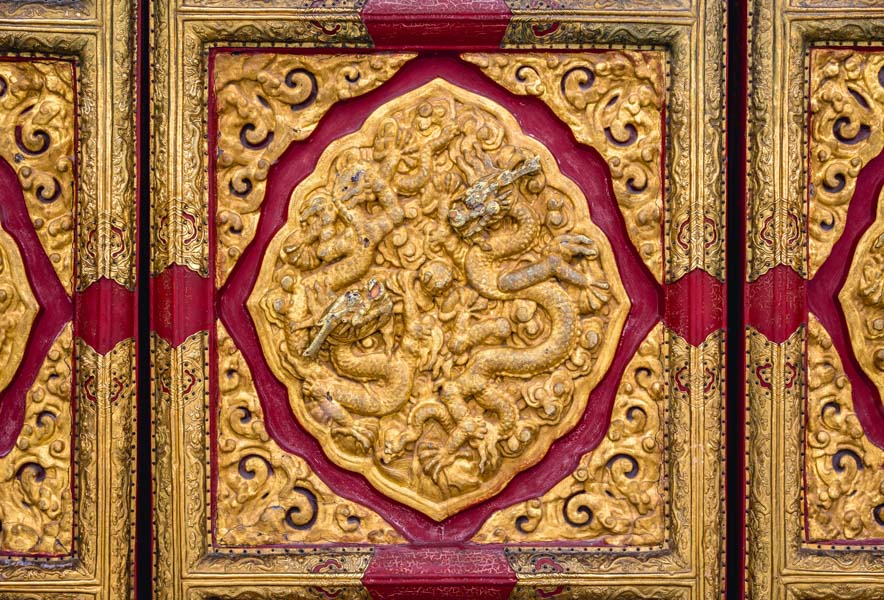
Imagery of the five-clawed dragon, symbolising ultimate power and representing the emperor, surrounds him. Dragons with varying numbers of claws also appear, each signifying a specific level of authority. Notably, in addition to the Dragon Throne, there is a carved, coiled dragon in the ceiling above it holding a pearl, as well as the Nine Dragons Wall near the Palace of Tranquil Longevity. Dragon imagery appears throughout the palace: the main staircase to the Taihedian (Hall of Supreme Harmony) features engravings of dragons and auspicious clouds, while the Golden Water River Bridges and the numerous dragon-head-shaped water spouts along the outer walls and roofs further emphasise their presence.
Geometric Shapes and Numerology in Architecture
Square and rectangular layouts represent Earth, while circular elements symbolise heaven; the Hall of Supreme Harmony is a typical example.
Curved rooflines represent a spiritual upward motion, connecting the earthly realm with the heavens.
Double-roof structures symbolise the dual nature of the cosmos – earth and sky.
Numbers hold great significance in the Forbidden City's design and decoration, with numerology being a key element. Nine, regarded as the greatest single number, is prominently featured, as seen in the Nine Dragon Wall, among other architectural details.
Heritage and Conservation: From the Forbidden City to the Palace Museum and Beyond
As one of the most important UNESCO World Heritage Sites in Beijing and part of the Imperial Palaces of the Ming and Qing Dynasties in Beijing and Shenyang, the Forbidden City represents the peak of traditional palace architecture and ritual design.
Restoration
From 2000 the Palace Museum undertook an intensified, institution-wide conservation programme that paired revived traditional crafts such as lacquer work, silk-mural painting, timber joinery, and marquetry with modern conservation science, including X-ray and spectroscopic methods.
The Qianlong Garden restoration, initiated about the same year in partnership with the World Monuments Fund (WMF), exemplifies this combined approach. Over twenty-five years, four courtyards and twenty-seven pavilions have been conserved, preserving original silk murals, carved woodwork, bamboo marquetry and jade inlay, and revitalising both rare artisan skills and part of the palace’s inner world.
Conservation
Conservation remains a delicate balance. To reduce risks to fragile buildings and collections, the Palace Museum combines strict ticketing management (timed, real-name bookings and daily caps) with data-driven planning of facilities and visitor flows.
Recent peer-reviewed studies have used GPS, geographic information systems (GIS) and behavioural data to optimise placement of seating, signage and waste bins and to model crowding patterns.
At the same time, the museum uses preventive-conservation science (materials analysis, microclimate monitoring, and targeted climate control) to protect interiors and artefacts while maintaining public access.
What is the Forbidden City used for today?
Beyond heritage care, the Palace Museum has become a national symbol and a driver of cultural diplomacy. As steward of millions of artefacts and an extensive complex of historic buildings, it curates major exhibitions, publishes scholarly research, develops cultural-creative products, and collaborates internationally on conservation and academic projects.
In Popular Culture
The Forbidden City has also appeared in global popular culture. Bernardo Bertolucci’s The Last Emperor (1987) was the first Western feature film authorised to shoot inside the palace. The production was granted unusually broad access and used the complex’s interiors extensively to stage the film’s early sequences.
Exhibitions in the Palace Museum
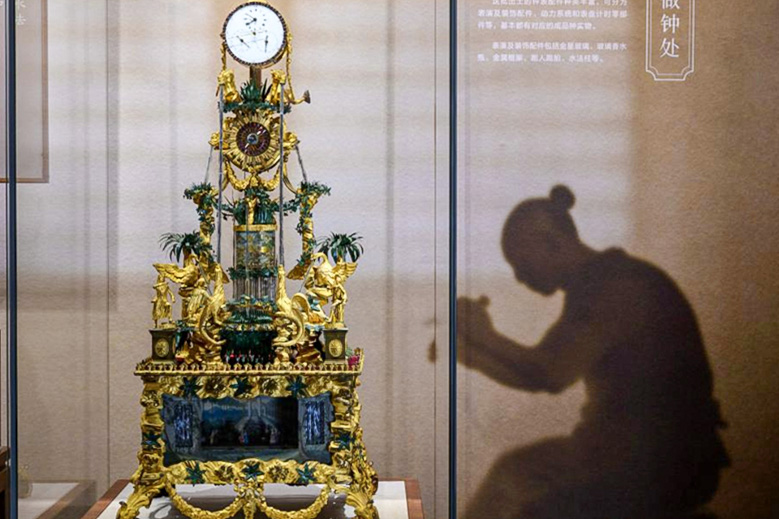
The Palace Museum’s temporary and permanent exhibitions present curated selections from its vast holdings, offering visitors the rare chance to view original artefacts up close. For scholars and casual visitors alike, these displays turn historical knowledge into lived encounters.
2026 Confirmed Exhibitions
Beneath the Ninefold Walls: Archaeological Discoveries from the Imperial Workshops Site
- Dates: 4 November 2025 – 8 February 2026
- Theme: An excavation-led display presenting recently recovered workshop material – tools, kiln fragments, production waste, and finished wares – that illuminate the palace’s internal craft economy and on-site manufacture.
- Venue: Palace of Eternal Longevity.
Golden Friendship, Shared Brilliance: A Special Exhibition Celebrating the 50th Anniversary of Thai–Chinese Diplomatic Relations
- Dates: 18 November 2025 – 24 February 2026
- Theme: A diplomatic loan show organised with the Royal Thai Embassy and Thai cultural bodies. Over 200 Thai national treasures are on display in a high-profile cultural ex-change marking five decades of relations.
- Venue: Hall of Literary Brilliance (Wenhua Hall).
Flourishing Times, New Beginnings: A Visual Chronicle from Cultural Heritage to Enriched Life
- Dates: 25 November 2025 – 24 February 2026
- Theme: A joint photographic exhibition (Palace Museum and Prince Kung’s Palace Museum) featuring over 200 images that trace a century of architectural change, conservation practice, and contemporary reinterpretation.
- Venue: Palace of Prolonging Happiness (Yanxi Gong).
2027 Outlook
Chengqian Palace Restoration and Reopening
- Dates (target): Expected completion in 2027.
- Project scope and aims: The restoration of the Palace of Celestial Favour (Chengqian Palace) will recover its 300-year-old Qing architectural layout and rare soft-ceiling decorations, preserve original interior finishes, and reinforce the structure. Once completed, the palace will reopen for exhibitions and public access, adding to the museum’s display space. The project forms part of the 2024–2028 heritage programme funded by a 371-million-yuan donation from the Hong Kong Jockey Club.
How to Get to the Forbidden City?
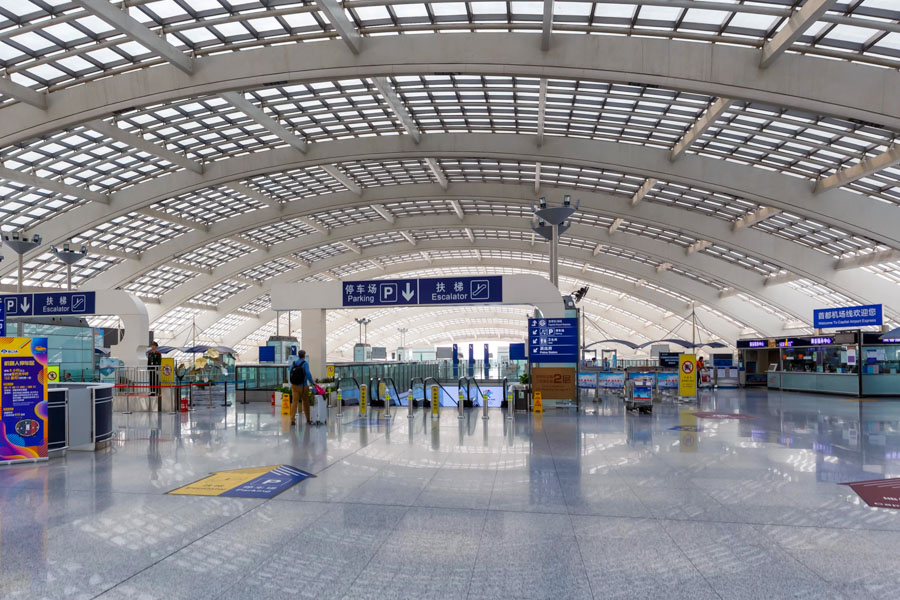
Visiting the Forbidden City is straightforward, with metro lines, buses, taxis, and airport-express links bringing you to the Tiananmen area.
Whether you arrive by air, rail, or metro, clear signage guides you to the south Meridian Gate. The journey is generally efficient, though at rush hour or peak visitor periods it is sensible to allow extra time for crowds and transfers.
From Airports
- Beijing Capital Airport (PEK): Take the Capital Airport Express subway (Terminals 3/2 → Sanyuanqiao → Dongzhimen), then transfer to the metro (Line 2 → Line 1) and alight at Tiananmen East or Tiananmen West stations. From either station it is a short walk to the Meridian Gate.
- Beijing Daxing Airport (PKX): Use the Daxing Airport Express subway to join the metro (Caoqiao or Daxing Xincheng interchanges stations) and continue to Line 1 / Tiananmen East or West stations, or take an intercity rail link or taxi into central Beijing and transfer there.
From Major Railway Stations
- Beijing Railway Station: A short taxi or a simple metro route (Line 2 → Line 1 or Line 2 → Qianmen station) reaches the Tiananmen / Forbidden City area.
- Beijing West / Beijing South: Take a taxi or connect by one or two metro transfers (commonly Line 9 → Line 1 or Line 4/7 → Line 1) to Tiananmen East or West stations.
Metro
- Main: Line 1 to Tiananmen East or Tiananmen West stations – short walk north across Tiananmen Square to the Meridian Gate.
- Alternative: Line 2 to Qianmen (interchange with Line 8), then walk north across the square.
Buses
Main stops: Tiananmen East (天安门东), Tiananmen West (天安门西), Tiananmen Square East or West, or Qianmen (前门) stations. Typical routes (examples): 1, 2, 52, 82, 120, 126 – indicative only; services change.
Taxis
Direct door-to-gate travel; useful with luggage or outside peak hours. Travel time varies with traffic, but a taxi is often the simplest option from airports or major stations.
Tips for an Optimal Visitor Experience
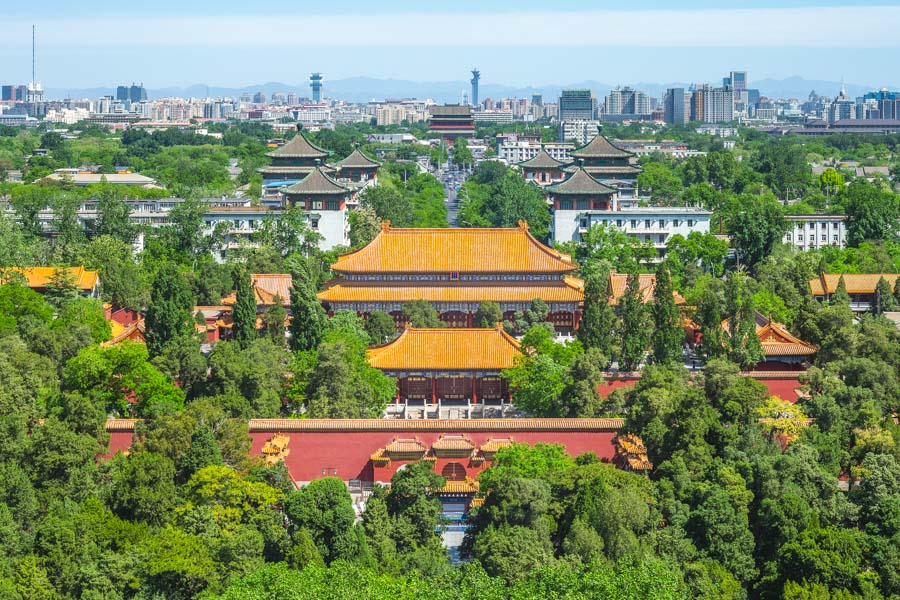
Make the most of your visit by blending technology, leisurely pauses, and a little local flavour. These suggestions are intended to deepen what you already know about the palace, and they offer small shifts in approach that can turn a good visit into a memorable one.
Use the Palace Museum’s digital tools on the spot.
Use the Palace Museum app and the QR codes beside many exhibits to bring up object histories, images, and short films while you stand before the originals. Download the app and any large media in advance – and bring a power bank – so the technology supports your stroll.
Plan micro-stops rather than a marathon walk.
Build in planned 10–15-minute rests in sheltered halls, the Imperial Garden, or exhibition rooms. Short pauses maintain your energy and give you time to notice carved details, inscriptions, and wear patterns that often pass unnoticed. Mark a few rest points on a simple map so the breaks feel purposeful.
Treat the Palace Museum shop as a mini-library.
The Palace Museum shop and nearby bookstalls offer exhibition catalogues, prints, and specialist guidebooks.
Make your visit a themed walk.
Choose one short theme, such as “colour and cosmology”, “crafts and carpentry”, or “imperial daily life”, and look for related details as you move through the palace. A theme sharpens your attention and turns familiar views into a kind of treasure hunt.
Finish with the Jingshan Park panorama.
Leave by the north gate and climb Coal Hill in Jingshan Park for a panoramic view of the palace roofs. It is one of the clearest vantage points for seeing how the Forbidden City sits within both its urban setting and its wider cosmological design.
Snack like a local after the climb.
The north gate and the surrounding hutongs are full of small vendors selling tanghulu, baozi, and other quick treats. Sampling one or two items from busy, well-liked stalls provides an authentic, convivial way to refuel.
For a more substantial meal, you may enjoy a Chinese dish with a view of the palace at the Palace Museum Restaurant (故宫餐厅). The Ice Cellar Restaurant (冰窖餐厅) provides a unique experience in an underground setting, while the Tower Corner Café (角楼咖啡) serves delicacies such as exquisitely baked cakes shaped like the Emperor’s Seal, accompanied by a cup of “Kangxi Emperor’s Favourite Chocolate”, the café’s most popular drink.