

Photo source: www.bursamuze.com
Address: Hocaalizade Mahallesi, Atatürk Caddesi, Kültür Sokak No: 8, 16010 Osmangazi, Bursa
Location: Google Maps
Telephone: +90 224 716 37 90/+90 444 16 00
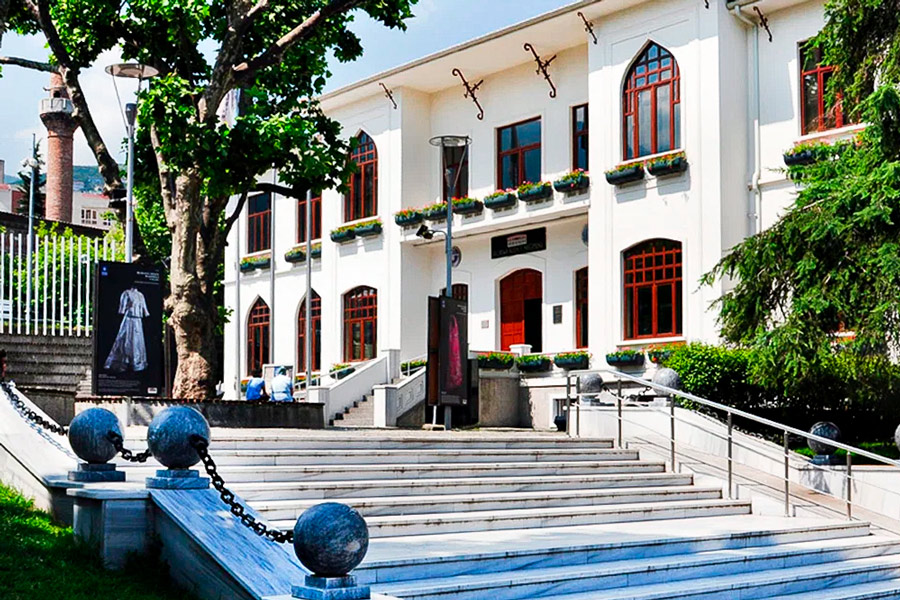
Built in 1926 as the city’s Courthouse, the Bursa City Museum stands at Heykel, the square at the eastern end of Atatürk Street, directly behind its equestrian statue of Atatürk. It is a long white building of two storeys over a basement, with pointed arches above the ground-floor windows and deep eaves under a tiled roof. A small balcony juts out over the main door. Palms and plane trees shade the paved courtyard, where tiers of stone seating form an open-air amphitheatre, and the red trams of the T1 line slide past on the square.
Few historical sites in Bursa gather so much of the place under one roof, from Roman Prusa to the car plants on the plain. Usually described as Turkey’s first city museum, it opened in 2004 in a building with a story of its own. The man who built it later became the leading historian of the very monuments its galleries explain.
History of the Bursa City Museum
In 1926 the Turkish Republic was three years old, and that same year the Bursa Courthouse and the Finance Office (Defterdarlık) were built. The two went up facing each other on what was then called Hükümet Meydanı, or Government Square, beside the governor’s offices and the town hall. Both are credited to Ekrem Hakkı Ayverdi (1899-1984), an engineer from Istanbul, then in his late twenties, who earned his living as a building contractor. He gave them the dress of the First National Architectural Movement: Ottoman arches, broad eaves and tiled roofs on a modern public building.
Ayverdi contributed to the construction of roads, bridges and hospitals until 1950. Then, in his fifties, he changed course entirely and became the foremost authority on early Ottoman architecture. His volumes on the first Ottoman period and on the reigns of Mehmed I and Murad II are still standard works. Among much else, they measure and describe the Green Mosque and the Muradiye Complex, a few streets from his courthouse.
On 29 October 1931, the eighth anniversary of the Republic, the statue of Mustafa Kemal on horseback was unveiled in front of the courthouse. People soon called the whole square Heykel, “the statue”, and the name has stuck.
Judges sat in the building for about 75 years, until Bursa Metropolitan Municipality took it over in 2001 and restored it. The museum opened on 14 February 2004. Two years later, the European Museum Forum honoured it with the Museum Worth Visiting Award 2006 at a ceremony in Lisbon. In 2019, the historic former finance office opposite the Bursa City Museum officially became its annex. The building opened with a temporary exhibition featuring 1866 drawings of Bursa by English traveller Mary Adelaide Walker (1820-1905), alongside the permanent display of significant art collections donated by painters Malik Aksel and Ömer Kaleşi.
Highlights
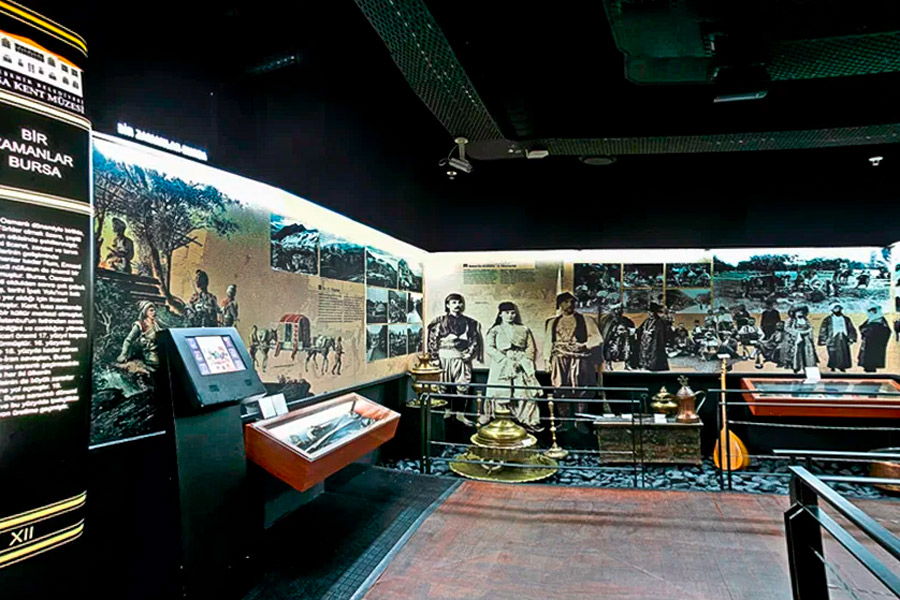
Most visits begin in the ground-floor galleries, climb to the first floor and end underground, in a lane of workshops.
Bursa, City of Civilisations
The first gallery runs from the earliest settlements on the plain through Bithynian, Roman and Byzantine Prusa to the Ottoman conquest of 1326. Its centrepiece is a group of figures of the six sultans buried in Bursa, from Osman to Murad II. Each lies in a tomb in the city, and all but Osman left a mosque complex, so the room works as a key to the domes outside. The story then moves through the earthquakes and fires of the eighteenth and nineteenth centuries to the War of Independence and the liberation of Bursa on 11 September 1922.
Contemporary Bursa and the City Model
The second gallery takes up the Republican decades, when Bursa grew from a silk town into an industrial city. From around 1960, factories and migrants arrived together, and the population climbed fast. Panels recall the Greek and Armenian communities who once shared the city, and trace Uludağ’s rise as a ski resort. The gallery ends at a large topographic model of Bursa, its monuments marked across the slope. Nothing else in the museum draws such a crowd, as visitors gather round to find their own street, or the next mosque on their list.
Bursa, Its Life and Culture
Upstairs, the theme changes from events to everyday life. The displays follow a local life from birth onwards, through wedding customs, neighbourhood ties and the city’s schools. The hot springs, which have drawn bathers here since Roman times, have a section of their own, and so does the local cuisine. Traditional clothes and household objects, many of them given by local families, fill the cases. Further on, the city’s famous names, its sport and its entertainments each have a corner.
Karagöz and Hacivat
Bursa claims Turkey’s shadow theatre as its own, and the first floor explains why. Legend says Karagöz and Hacivat were workmen on a mosque that Orhan Gazi was building in the city. Their joking and bickering slowed the work so badly that the sultan had them executed, then regretted it. To console him, a sage called Şeyh Küşteri stretched a sheet before a candle and brought the pair back as shadows. The figures are cut from camel or buffalo hide, painted and held against a lit screen. In 2009 Karagöz joined UNESCO’s list of the intangible heritage of humanity.
Producing Bursa
The basement opens with a hall dedicated to what the city makes. Here local industry takes centre stage, with displays of locally made cola, machinery and equipment, and cars from the factories on the plain. The section is modest in size, but it explains how the former silk capital became Turkey’s centre of car manufacturing. It also sets up the lane of workshops next door, where the city’s older trades are shown by hand.
The Handicraft Bazaar
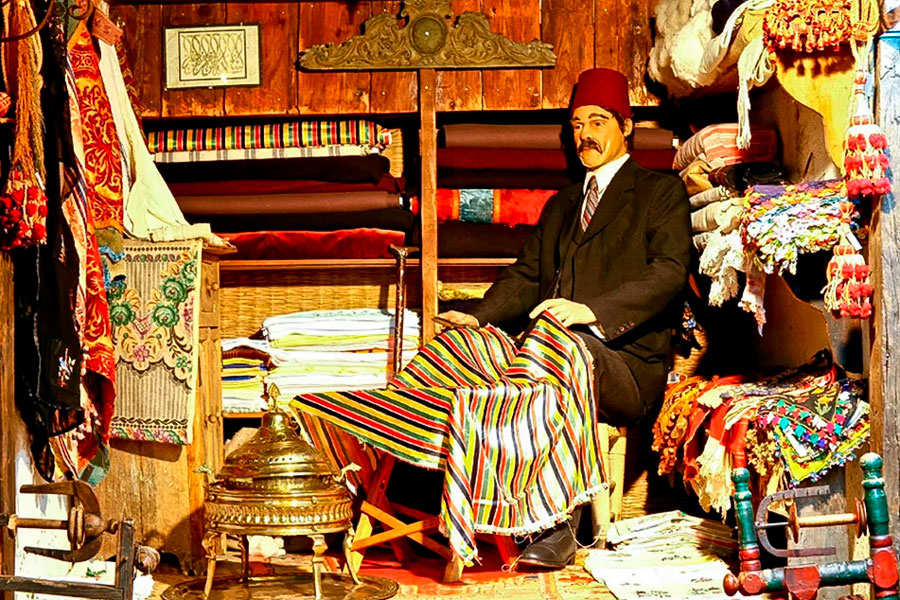
The basement holds the museum’s most atmospheric room, a stone-paved lane between dark timber shopfronts under a low, beamed ceiling. It was modelled on views of Bursa’s old bazaar drawn by European travellers. Behind each window a figure is at work: a cloth merchant, a saddler, a farrier, a tinsmith, a basket weaver, a tile painter and a knife maker. Several of these crafts are now close to vanishing, and the museum runs hands-on workshops to keep them alive. The lane ends at a sweet shop and a kebab house. A figure of İskender Efendi stands by his spit. In 1867, in his small shop in the Kayhan bazaar, he turned the roasting lamb upright, sliced it thin and served it over buttered pide. The dish still carries his name.
Silk City Bursa
A separate room in the basement follows the trade that made the city rich. It starts with the silkworm and its cocoon, and moves on through spinning and dyeing to finished cloth. For centuries, Persian silk came to Bursa by caravan and was sold on to Italian merchants, while the cocoons themselves were bought and sold at Koza Han. Some of the pieces on display carry Greek names, a reminder of how many communities lived from the trade.
Practical Information
Opening hours: Tuesday to Sunday, 09:00–17:30. The museum closes on Mondays, 1 January and the first days of religious holidays.
Admission: There is no charge.
Facilities: A café and a gift shop are on the ground floor.
How to Get to the Bursa City Museum
Tickets for local transport: A rechargeable BursaKart covers the metro, trams and city buses. It is sold at station kiosks and at outlets displaying its logo.
By tram: The red T1 line stops at Heykel, on the square in front of the museum. The same line links Heykel with the Ulu Cami stop and with Kent Meydanı.
By metro: The nearest Bursaray station is Demirtaşpaşa, north of Heykel. The walk takes about ten minutes.
By bus: Many city routes terminate at Heykel, beside the museum. Route numbers change, so it is worth checking the Moovit app.
On foot: From the Ulu Cami, Atatürk Street leads east to Heykel in about five minutes. The museum stands behind the statue.
By taxi: Metered taxis wait across the centre and can drop passengers at Heykel.
From the intercity bus terminal: Bursa Otogar sits about 10 km north of the centre. The T2 tram reaches Kent Meydanı from the terminal in about 25 minutes, and the T1 then continues round the centre to Heykel. A taxi takes about 30 minutes, or up to 45 in heavy traffic.
From Istanbul by ferry: Fast boats cross the Sea of Marmara to Mudanya or Güzelyalı in about 2 hours. From Güzelyalı a connecting bus runs to the Bursaray terminus at Emek, and the metro then continues to Demirtaşpaşa. From Mudanya, bus 1/M covers the same route.
From Istanbul by road: The drive over the Osmangazi Bridge takes about 2.5 hours, and coaches to the Otogar run throughout the day.
Tips for an Optimal Visit
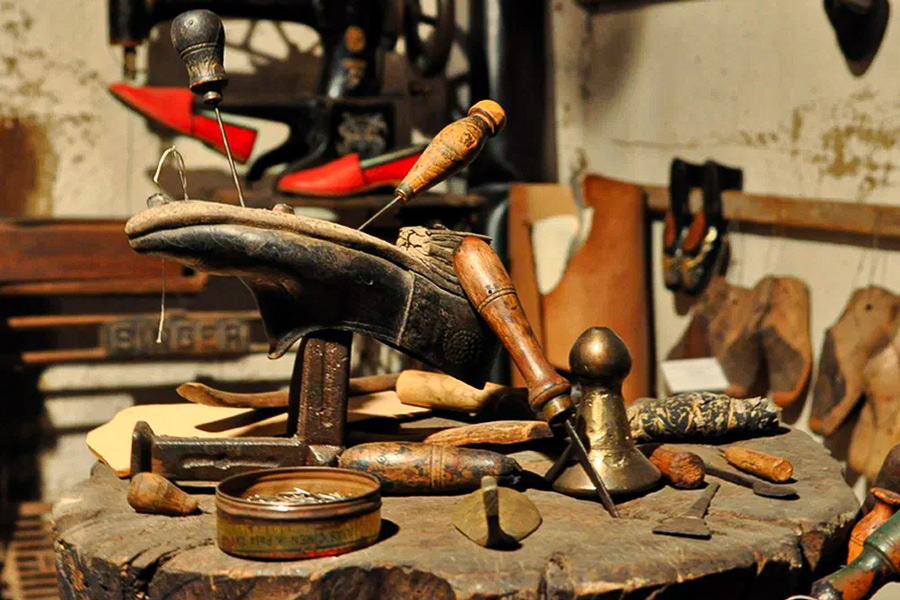
Recommended duration. Allow about an hour and a half for all three floors. The basement lane alone can easily hold a visitor for half an hour.
Labels. Most of the labels are in Turkish only, so a guidebook or a translation app helps upstairs. The basement lane needs no words.
Temporary exhibitions. Changing shows fill the corridors on every floor, on themes from coffee-house culture to the Bursa bride’s dowry chest.
Accessibility. Lifts and ramps reach every floor and gallery, and there are accessible toilets. Wheelchairs are available on request.
Combine with. The Ulu Cami and Koza Han lie about five minutes west along Atatürk Street. The Irgandı Bridge, with its craft studios, is about seven minutes east. Beyond it, the Green Mosque and Green Tomb stand at the top of Yeşil Street, 10 to 15 minutes from Heykel. The Osman Gazi and Orhan Gazi Tombs are about a quarter of an hour west, on the citadel hill at Tophane.
For seventy-five years, people climbed these steps to put their case before a judge. Now it is the city that comes here to be heard, through its sultans, its silk and its shadow puppets. And downstairs, in the lane of workshops, the saddler and the knife maker sit bent over their benches, the only people in the building who never go home at half past five.