

Address: Shahidlar Xotirasi Square, Amir Temur Street, Yunusabad District, Tashkent
Opening hours: Tuesday–Saturday – 09:00–17:00; Sunday – 09:00–15:00; closed on Mondays.
Lunch break: 13:00–14:00
Phone: (+998 55) 515-37-15

The Museum of Victims of Political Repression in Tashkent stands within the Shahidlar Xotirasi Memorial Complex, on a site where Soviet authorities carried out executions and secret burials in the 1930s.
The exhibition begins with the Russian conquest of Central Asia in the second half of the 19th century and follows the history of political repression through the Soviet period to present-day efforts to preserve the victims’ memory. Writers, scholars, public figures and government officials are among those whose stories are presented through original objects, interactive panels, video projections and multimedia installations.
Practical Information
- The museum is in Tashkent’s Yunusabad District, near the Tashkent TV Tower. The nearest metro station is Bodomzor, about a 15-minute walk away.
- Admission for foreign visitors costs 80,000 soum (around $7). Photography and video recording inside the museum require an additional fee, including when using a mobile phone.
- Individual and group guided tours are available in Uzbek, Russian and English for an additional fee.
- Most explanatory texts in the galleries and on display panels are in Uzbek only. Information in English is available via QR codes.
- The exhibition is relatively compact. Allow about an hour to explore the three halls without rushing, not including time to walk around the memorial grounds.
Shahidlar Xotirasi Memorial Complex
The museum forms part of the Shahidlar Xotirasi Memorial Complex, which covers around 17 hectares on the bank of the Bozsu Canal. The grounds also include a landscaped park and a central memorial.
At the centre of the complex stands an open rotunda, a memorial pavilion around 27 metres high dedicated to the memory of victims of political repression. Beneath its turquoise dome is a symbolic grave.
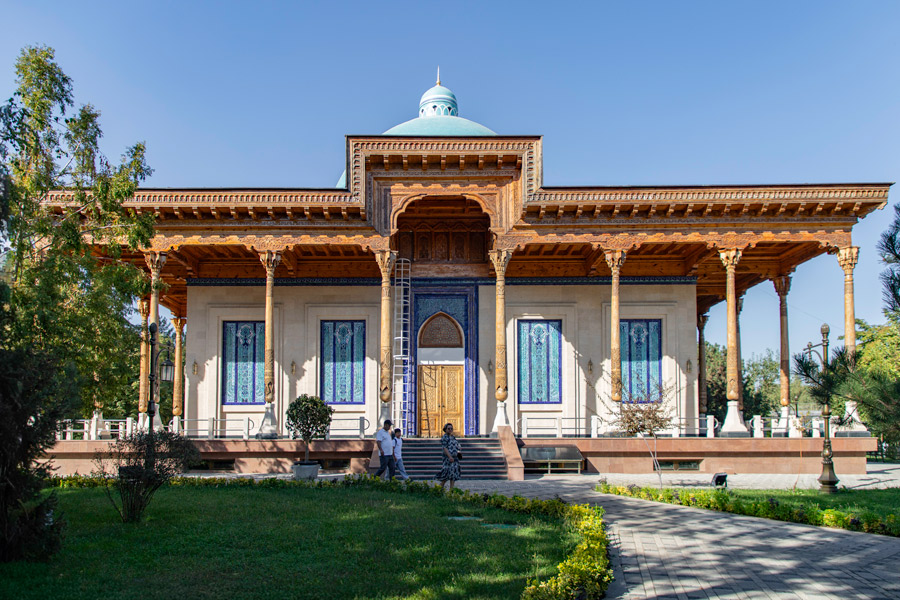
The museum building stands slightly below the rotunda, closer to the canal. Built in the traditions of Uzbek architecture, it is topped by two blue domes, with a wide wooden ayvan and decorative columns running along the facade. The massive doors are decorated with fine carving and blue ceramic tiles.
Exhibition and Key Exhibits
The three halls cover the period from the second half of the 19th century to the present day, from the Russian conquest of Central Asia and the Jadid movement to mass repression during the Soviet period, individual lives and present-day efforts to preserve the memory of the victims. The story is told through original objects and multimedia displays.
First Hall
The first hall contains the most extensive part of the exhibition. The lighting is subdued, and quiet background music plays throughout.
The exhibition begins in the second half of the 19th century, when the Russian Empire gradually established control over much of Central Asia. Documents, weapons from the period, clothing and household objects are displayed in this section.
The next section focuses on the Jadids, members of a reformist movement that developed in Central Asia around the turn of the 20th century. They opened schools using new teaching methods, promoted literature and the arts, and advocated the modernisation of society. Exhibits include photographs, early newspaper editions and personal belongings of people who were later repressed. Among them are books and spectacles belonging to Munavvar Qori, one of the leading figures of the Jadid movement. He was arrested in 1929 and executed in 1931.
By the early 1930s, political repression had affected many members of the Uzbek intelligentsia, including the poet Mahmud Hodiyev, known by his pen name Botu, and agronomist Abduvahob Murodi. Their personal belongings, including Botu’s clothing and Murodi’s microscope, are displayed in the museum.
Repression reached a particularly large scale during the Great Terror of 1937–1938. According to official figures, around 7,000 people were executed in Uzbekistan during these two years. Among the best-known victims were the writers Abdulla Qodiriy, Abdulhamid Cholpon and Abdurauf Fitrat, linguist and folklorist Gozi Olim Yunusov, journalist Ziyo Saidov and other members of the Uzbek intelligentsia.
One of the most striking exhibits from this period is an original GAZ-11-73. Cars of this type were used by the NKVD, the Soviet internal affairs and state security agency, to transport prisoners and are associated with the so-called “black raven”. A video projection on a textured wall in front of the car adds context to the display.
Second Hall
The smaller second hall focuses on later political repression during the 20th century. Portraits, photographs, documents and personal belongings tell the stories of people who faced persecution by the state.
One of the most memorable displays is devoted to Khudaybergen Devanov, widely regarded as the first Uzbek photographer and filmmaker. In the early 20th century, he photographed Khiva, and in 1910 he made the first Uzbek documentary film, recording the departure of Khivan Khan Asfandiyar. Devanov was arrested in 1937 and later executed, before being posthumously rehabilitated in 1959. Vintage cameras are displayed alongside materials about his life and work.
A separate section of the museum is devoted to the “Cotton Affair” of the 1980s. It began as an investigation into inflated cotton harvest figures and corruption in the Uzbek SSR, but over time grew into a large-scale campaign that affected thousands of people. Alongside genuine cases of corruption, there were also unfounded accusations and procedural violations; some cases were later reviewed. The museum presents this period through archival photographs and investigation records.
Third Hall
The third hall is noticeably different from the first two: it is brighter and more spacious. Here the exhibition moves on to the period of independence, the restoration of historical memory and the preservation of Uzbekistan’s cultural heritage.
This part of the exhibition mainly features photographs, multimedia materials and models of modern structures and historic and cultural monuments in Uzbekistan. They include the Centre of Islamic Civilisation in Tashkent, as well as the Imam al-Bukhari Complex near Samarkand and the Bahauddin Naqshband Complex near Bukhara.
Among the exhibits is a symbolic key presented to Tashkent in 2007, when ISESCO named the city the Capital of Islamic Culture for the Asian region. Nearby are much older objects, including original fragments of exterior decoration from Islamic architectural monuments dating back around 600 years.
What to Look For at the Museum
Examine the case files of Qodiriy, Cholpon and Fitrat. All three were prominent figures in Uzbek literature and were executed on the same day, 4 October 1938.
Abdulla Qodiriy, one of the founders of the Uzbek novel and author of Bygone Days, was first arrested in 1926 after publishing a satirical piece, but was soon released. He was arrested again at the end of 1937, this time on charges of anti-Soviet activity.
Cholpon was one of the leading Uzbek poets of the first half of the 20th century, as well as a novelist, playwright and translator. He was repeatedly criticised for alleged “nationalism” and was arrested in July 1937.
Abdurauf Fitrat was a writer, scholar and educator who worked in the fields of education, language, literature and music. In 1937, he was arrested on charges that included opposition to Soviet rule and “nationalism”.
Interactive panels provide access to archival material, including indictments, interrogation records, court decisions and death sentences. Many of the documents still bear the signatures of the accused, investigators and judges.
In the mid-1950s, the cases of all three were reviewed and the earlier charges against them were deemed unfounded.
Personal belongings are also on display, including Cholpon’s dutar and books by Fitrat, among them Mukhtasar Tarikhi Islom (A Brief History of Islam).
Talk to Said Rizo Alizoda. Born in Samarkand, Said Rizo Alizoda was a teacher, journalist and polyglot who spoke 14 languages. He introduced Uzbek and Tajik readers to Russian classics, translated works of Eastern literature into Russian, compiled dictionaries and wrote textbooks. He was arrested on charges of espionage in the late 1930s and spent the final years of his life in Vladimir Central Prison, where he died in 1945.
A large screen in the first hall features his digital avatar. Visitors can ask questions through a microphone and hear answers about his life and work in Uzbek, Russian, Tajik or English.
Walk around the memorial grounds. Shaded paths, flowerbeds and benches offer views of the memorial rotunda, the museum’s blue domes and the Tashkent TV Tower. One of the best views is from the pedestrian bridge across the canal.
History of the Museum
The location of the Shahidlar Xotirasi Memorial Complex was not chosen by chance. It lies beside the Bozsu Canal in an area known as Alvasti Kuprik, a name usually translated as “Devil’s Bridge”. In the early 20th century, this was a sparsely built-up area on the northern outskirts of Tashkent. During the 1930s, it was used for the execution and burial of victims of political repression.
Human remains were found here as early as the mid-20th century, but the history of the site began to receive wider attention in the late 1980s and early 1990s, when eyewitness accounts were collected and archival documents studied. In 1990, one of the largest mass graves was discovered during the construction of a tennis court near the Tashkent TV Tower.
Work on a memorial began in the late 1990s. All the remains uncovered at the site were reburied in city cemeteries. On 12 May 2000, the Shahidlar Xotirasi Memorial Complex opened on the former execution site as part of a state initiative led by Uzbekistan’s first president, Islam Karimov. Today it is included in Uzbekistan’s National Register of Immovable Tangible Cultural Heritage as a work of monumental art.
Efforts to commemorate the victims of political repression continued, and a separate museum was established within the memorial complex. It officially opened on 31 August 2002.
The original museum was considerably smaller, with a single dome and one exhibition hall covering around 400 m². It was expanded in 2008, when a second dome was added and the exhibition was reorganised across three halls with a total area of about 960 m².
The museum also carries out research: its staff study archival documents, add new material to the collection and publish the results of their research.
A major reconstruction was completed in 2026. The exhibition was updated with interactive panels, multimedia materials and modern installations, and the museum reopened to visitors.