

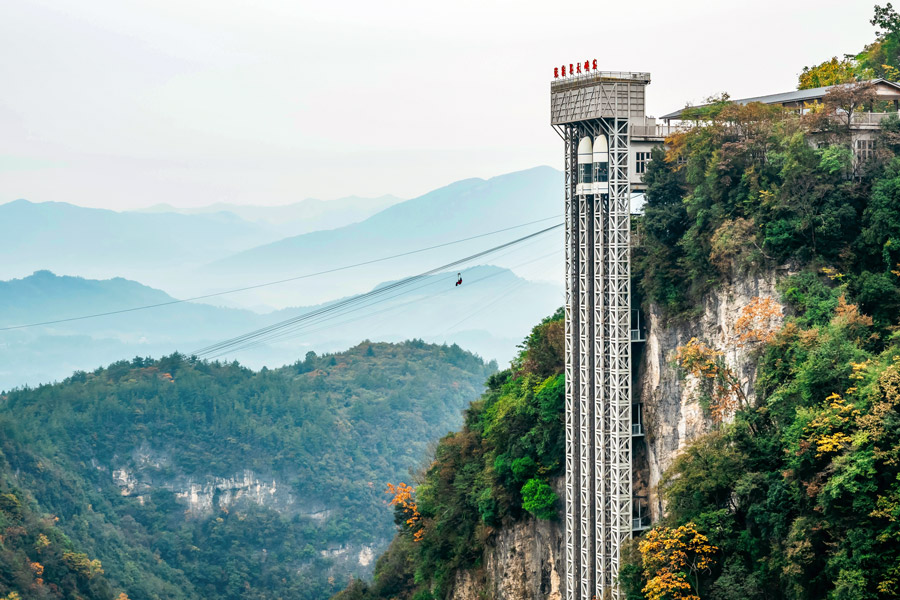
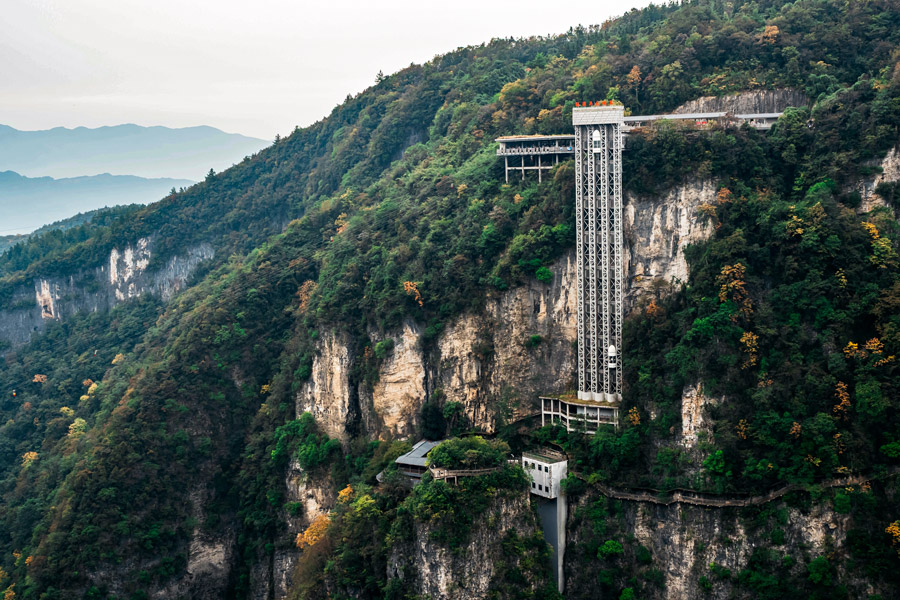
Rising among the majestic cliffs of the Yuanjiajie Scenic Area, part of Zhangjiajie National Forest Park, stands the Bailong Elevator (百龙天梯), a world-class tourist attraction. Its name translates as the Hundred Dragons Heaven Elevator, a reference to the imagery of a hundred dragons, a symbol of power, prosperity, and harmony in Chinese culture.
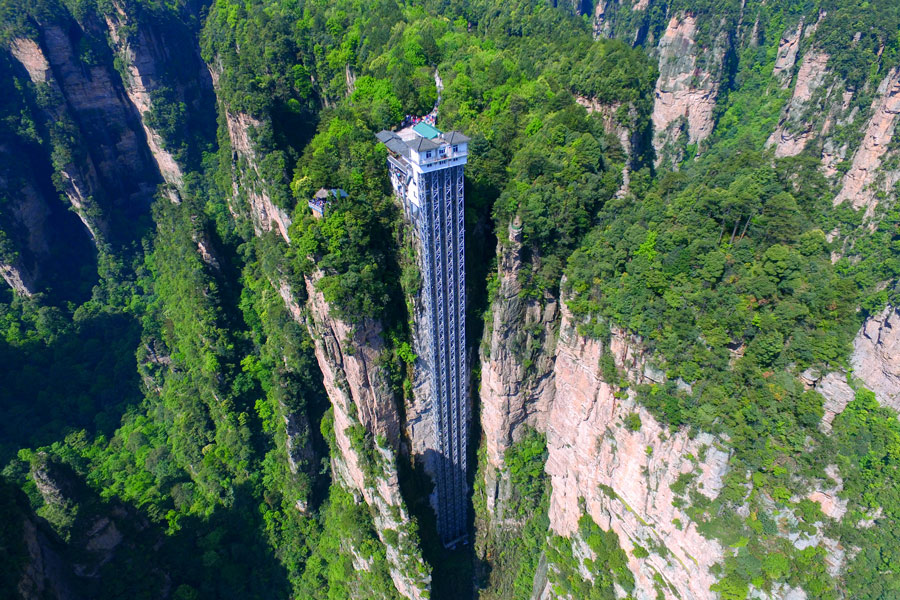
Certified by Guinness World Records as the tallest outdoor elevator in the world, the Bailong Elevator whisks visitors up 326 metres (1,080 feet) in less than two minutes. It provides quick access to the observation decks of Yuanjiajie and offers panoramic views of the park’s famous stone pillars. Today, it is considered not only an iconic symbol of Zhangjiajie but also an outstanding example of modern engineering, harmoniously integrated into a unique natural landscape.
Architecture and Facts about the Zhangjiajie Bailong Elevator
Construction of the Bailong Elevator commenced in September 1999 and was completed in April 2002. The elevator’s core systems were manufactured by the German Rangger International Elevator Company. Total investment in the project reached CNY/RMB 180 million (approximately $26.5 million, €23.2 million or £19.7 million).
Building the Bailong Elevator was a complex engineering challenge due to the specific terrain. To minimise its environmental impact, a significant part of the structure was housed inside the cliff face, while three double-deck panoramic cars were installed on the outside of the cliff and move parallel to one another.
The project was completed in several stages. First, a vertical shaft and technical tunnels were excavated inside the mountain massif. A steel load-bearing framework and guide rails for the cars were then assembled on the cliff surface. Installing the equipment on the sheer cliff face required specialised machinery and strict adherence to environmental regulations, as the work was carried out within a UNESCO World Heritage site.
Today, the Bailong Elevator serves thousands of visitors daily and plays an important role in the transport system of Zhangjiajie National Forest Park, helping to distribute tourist flows throughout the scenic area.
Key technical specifications of the Bailong Elevator:
Status: World’s tallest outdoor elevator (certified by Guinness World Records)
Running height: 326 metres (about 1,080 feet)
Above-ground section: 171.4 metres (about 562 feet), built against the side of a quartzite cliff.
Rock shaft: 154 metres (505 feet)
Steel structure: 172 metres (564 feet)
Speed: 3 metres per second (16.4 feet per second)
Ride duration: about 1 minute 58 seconds; the ascent can also take 1 minute 32 seconds.
Cabins: three panoramic glass-sided, double-deck elevators
Capacity: up to 46 passengers per elevator per trip
Load capacity: 4,900 kilograms per elevator
Throughput: about 18,000 passengers per day
Construction began: 1999
Completed and opened to visitors: 2002
Materials: steel, glass, and reinforced concrete
Location: Yuanjiajie Scenic Area, Zhangjiajie National Forest Park
Zhangjiajie Bailong Elevator Ride Tours
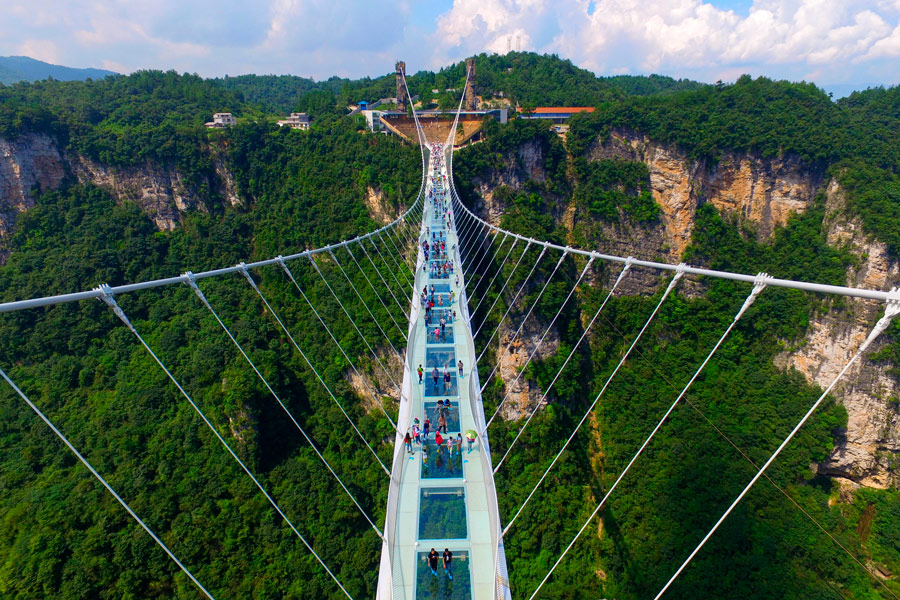
Soar above the stone forest of Zhangjiajie and take in the views of sheer sandstone pillars shrouded in mist and dense forests.
Choose a short four-day trip to Zhangjiajie to discover the region’s main natural wonders. The Bailong Elevator will take you to the top of a mountain plateau, opening the way to the famous rocky peaks that inspired the creators of the film Avatar. The itinerary also includes a walk across the Zhangjiajie Grand Canyon Glass Bridge, a ride on the Tianmen Mountain Cableway, and visits to the scenic spots of the national park.
Explore China’s natural and cultural heritage on the Stone and Water China Tour. After walking among the mountain peaks and riding the Bailong Elevator, you will discover the karst hills of Guilin, the winding Li River, the historic Fenghuang Ancient Town, and the vibrant neighbourhoods of Hong Kong. On this journey, the Bailong Elevator provides your first encounter with the country’s natural wonders and sets the tone for the rest of the trip.
Other travel formats around Zhangjiajie are available, including short excursions, multi-day programmes, and tours combining natural and cultural attractions across several regions of China.
Best Time to Ride the Zhangjiajie Bailong Elevator
Weather and Seasonal Conditions
The Bailong Elevator operates year-round, but the most comfortable conditions for a visit are usually found on clear days, when the panoramic windows of the cabins offer expansive views of the surrounding landscape. After rain and on misty days, the scenery takes on a completely different character, with parts of the cliffs hidden in the clouds and creating the famous “floating mountains” effect. For more information about the climate and seasonal features, consult our Zhangjiajie National Forest Park travel guide.
In adverse weather conditions, the elevator’s operating hours may be adjusted for safety reasons. Before visiting, check the latest information about its operation, particularly during the rainy season in June and July.
Best Time of Day
Plan your visit to the Bailong Elevator before 9:00 or after 14:00, when queues are usually significantly shorter. During the peak tourist season, the largest crowds typically arrive between 9:00 and 11:00, when numerous tour groups reach the lower station at the same time.
From April or May to October, waiting times can often reach one to two hours.
Practical Information
Opening Hours
The Bailong Elevator operates daily, although its opening hours vary according to the season. During the shoulder season, the lift is usually open from 08:30 to 18:00. During the peak season, it generally operates from 08:00 to 18:30.
On public holidays, opening hours may be extended from 07:00 to 20:00. If visitor numbers are exceptionally high, the park administration may extend operating hours further to accommodate all waiting passengers.
Ticket Prices
| Ticket Type | Low Season (Dec 1 – Feb 28) | Peak Season (Mar 1 – Nov 30) |
| One-way ticket | CNY/RMB 65 ($9.5, €8.5, £7) | CNY/RMB 72 ($10.5, €9.5, £8) |
| Return ticket | CNY/RMB 130 ($19.5, €17, £14.5) | CNY/RMB 144 ($21.5, €18.5, £16) |
| Discounted ticket | CNY/RMB 39 ($6, €5, £4.5) | CNY/RMB 43 ($6.5, €5.5, £5) |
Return tickets include VIP Fast Track access, which means that passengers do not have to use the main queue for either the ascent or the descent. This option is particularly convenient during the peak tourist season and on national holidays.
Admission is free for children under 1.3 metres (4.3 feet) tall. Concessionary tickets are available for children and teenagers under 18 years old, full-time students, and visitors aged 60 or over. Passengers purchasing a concessionary ticket must present a document proving eligibility.
Is Bailong Elevator Worth It?
The answer largely depends on your travel plans. For travellers looking for long hiking routes, the elevator may seem optional. However, for families with children, elderly visitors, and those with limited time, purchasing a ticket can be a practical solution.
Is the Zhangjiajie Bailong Elevator Safe?
Comprehensive testing and technical upgrades
Despite its unusual design and location on a sheer cliff, the Bailong Elevator was engineered as a highly secure facility. Before entering service, the elevator underwent comprehensive technical testing, including inspections of its load-bearing structures, guide rails, braking mechanisms, and control systems. Subsequently, the equipment has been upgraded several times, allowing operating speed and passenger capacity to be increased without compromising safety.
Structural resistance to environmental challenges
During the design phase, special attention was paid to the structure’s resistance to wind loads, vibrations, temperature fluctuations, and seismic activity. These measures are among the reasons why the facility is considered an outstanding example of modern engineering.
Multiple independent safety mechanisms and continuous monitoring
The engineering system includes several independent safety mechanisms. The elevator is equipped with load-bearing steel wire ropes, electromagnetic brakes, emergency safety gears, and buffers at the base of the shaft to cushion any potential impact in an emergency.
Operational record and reliability
In the event of a power cut, the Bailong Elevator automatically switches to a backup power supply, allowing it to complete the journey and evacuate passengers safely. The cabins are equipped with emergency communication systems, while the elevator’s movement is continuously monitored by automated tracking systems. Additionally, a standardised maintenance routine is also carried out daily on all elevator systems.
Since opening, the Bailong Elevator has carried tens of millions of passengers. According to the tourist area administration, no incident caused by a technical malfunction has been recorded during its operation, demonstrating its high level of reliability and safety.
Why Ride the Zhangjiajie Bailong Elevator?
Even if you have already travelled by cable car or mountain funicular, the Bailong Elevator offers a completely different experience. During the ascent, the cabin appears to detach from the cliff, revealing an increasingly wide view of dense forests and whimsical peaks. Thanks to its fully glazed facade, the surrounding scenery remains visible for almost the entire journey.
As the cabin emerges from the rock face, passengers reach the upper part of the park, where the dramatic sandstone pillars of Yuanjiajie, including the formation popularly known as Hallelujah Mountain, evoke the floating mountains of James Cameron’s Avatar.
This is precisely why riding the Bailong Elevator is more than simply a way to reach the next attraction. It is part of the experience. The contrast between modern engineering and ancient mountain formations makes the ascent especially memorable and offers a fresh perspective on the national park’s landscape.
The significance of the Bailong Elevator extends beyond visitor convenience. It has become part of a strategy to preserve Zhangjiajie’s natural landscape. By providing a rapid link between the valley and the upper part of the park, the Bailong Elevator reduced the need for major developments, such as accommodation and other tourism infrastructure, in ecologically sensitive mountain areas. This facilitated the relocation of certain facilities outside the protected landscape and helped limit the environmental impact of tourism.
How Do I Get to the Zhangjiajie Bailong Elevator?
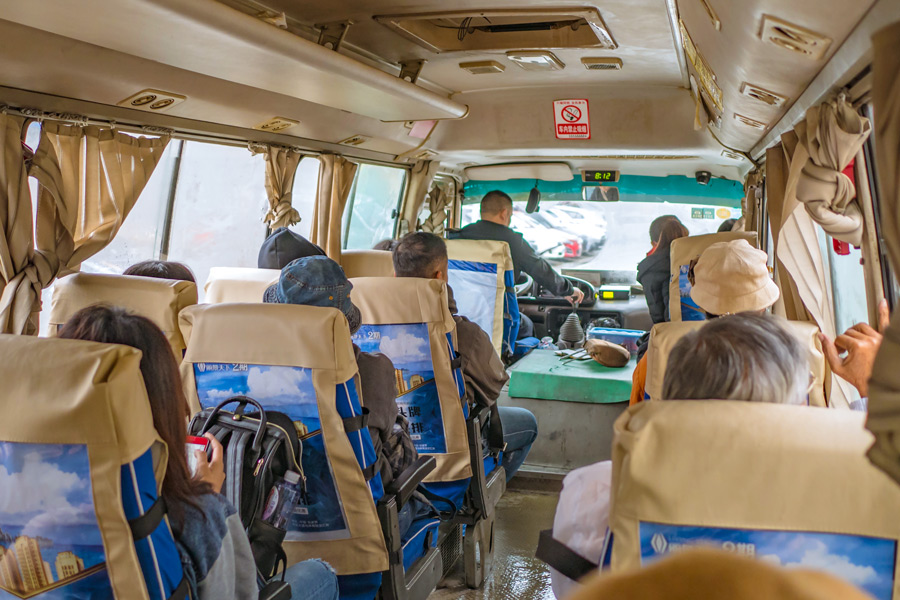
The Bailong Elevator has a lower and an upper station. Most visitors start their journey at the lower station, which is connected to the main entrances of Zhangjiajie National Forest Park by a network of free eco-shuttle buses. The best route depends on which entrance you use to access the park.
Via the East Gate (Recommended)
The East Gate, located in the Wulingyuan district, is considered the most convenient entrance and the closest to the Bailong Elevator. This route involves the fewest transfers and allows you to reach the lower station most quickly.
Step 1: Reach the East Gate of the national park.
Tourist buses depart regularly from Zhangjiajie city centre, Zhangjiajie West Railway Station and Zhangjiajie Central Bus Station. The journey takes approximately 40 to 50 minutes.
Step 2: Take the park shuttle bus.
After passing through ticket control and entering Zhangjiajie National Forest Park, transfer to the free eco-shuttle bus heading to the lower station of the Bailong Elevator. The ride usually takes between 25 and 40 minutes.
Via the South Gate
The elevator can also be reached via the South Gate, although this option is usually chosen by travellers planning a longer route through the park.
After entering, walk about 1 kilometre (0.6 miles) to Big Oxygen Bar Square, cross the Golden Whip Stream valley, and then transfer to an eco-bus heading to the lower station of the Bailong Elevator. This route takes significantly longer, but it allows you to combine the elevator ride with a walk through one of the most scenic parts of the national park.
Across the Mountaintop by Eco-bus
If you are already at the top of the mountain range and want to take the elevator down, the upper station can be reached by a free eco-bus that runs along the mountain peaks:
From Tianzi Mountain: If you travel up Tianzi Mountain via the Tianzi Mountain Cableway, you can catch a bus at the nearby car park. It travels along the high-mountain road to the Yuanjiajie parking lot near the upper station of the elevator. The ride takes about 40 minutes.
From the Yangjiajie Cableway Upper Station: The journey to the elevator’s upper station takes about 15 to 20 minutes.
After Reaching the Upper Station
After leaving the upper station, it takes about a 5-minute walk to reach the eco-bus stop. From there, you can continue through the Yuanjiajie area and visit famous attractions such as the Hallelujah Mountain, the First Bridge under Heaven, and the Enchanting Terrace.
Tips for the Best Bailong Elevator Experience
Bring a light jacket. Temperatures at the observation decks can be lower than at the foot of the mountain, especially in the morning, evening, or immediately after rain.
Keep your ticket handy. While travelling through the national park, you may need it at transfer or checkpoints, so avoid packing it deep inside your backpack until you have completed your route.
Have your camera ready. The ride is brief, leaving little time to find the best angle. To reduce reflections on the glass, turn off the flash and set your camera or phone to burst mode.
Choose a position beside the panoramic glass. If you want to appreciate the full scale of the ascent, try to find a place at the front of the cabin.
Be patient at the beginning of the ride. The cabin initially travels inside the rock formation, so panoramic views do not appear immediately. Within a few seconds, the elevator emerges onto the exposed section of the structure, revealing views of Zhangjiajie’s famous stone pillars.
Do not be alarmed if your ears pop. During the rapid ascent, the change in altitude may cause mild ear discomfort for some visitors—a sensation similar to what airline passengers experience. Swallowing a few times, yawning, or slowly chewing gum is usually enough to quickly equalise the pressure.
Prepare for a long walk. After leaving the upper station, most routes continue on foot, so bring drinking water and a light snack with you.
Plan a circular route. Many travellers combine an ascent on the Bailong Elevator with a return journey via the Tianzi Mountain Cableway or vice versa. This route allows you to see more of Zhangjiajie National Forest Park’s natural attractions without retracing your steps along the same trails.