

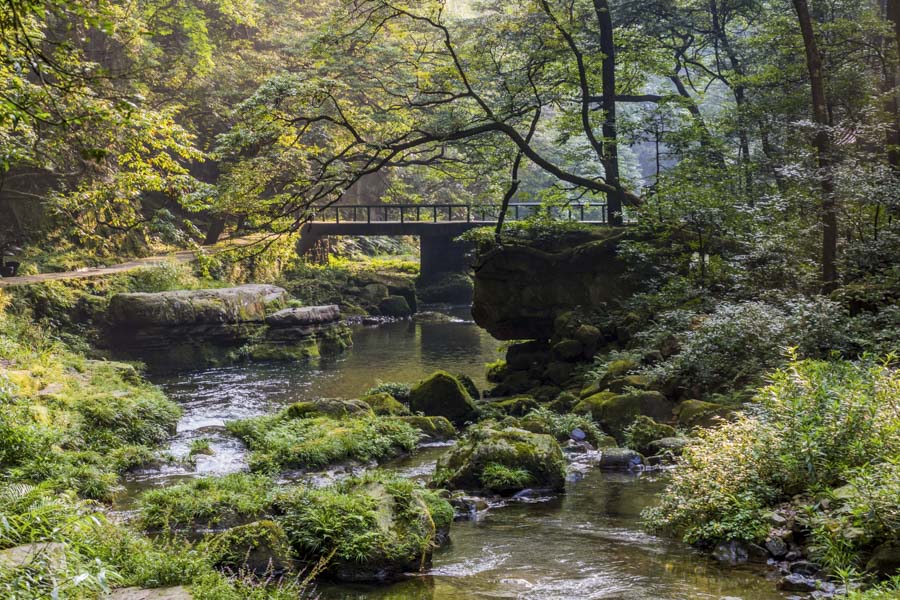
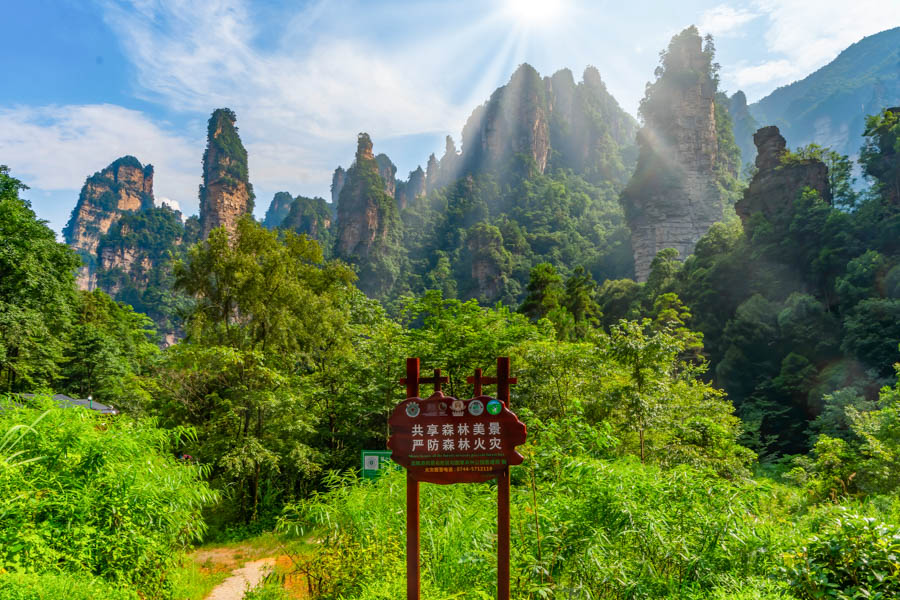
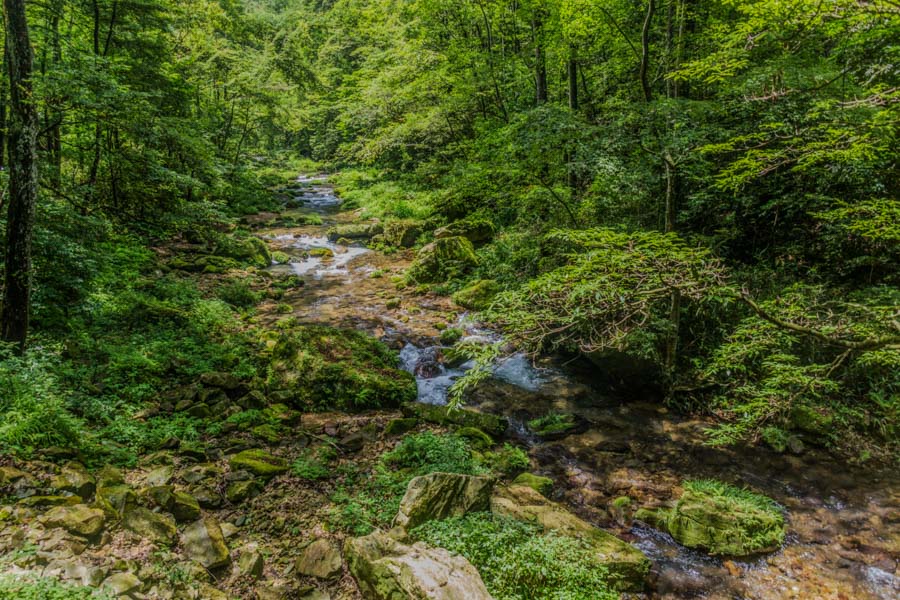
The Golden Whip Stream (Jinbianxi, 金鞭溪) is a picturesque mountain stream of roughly 7.5 kilometres, winding through the heart of Zhangjiajie National Forest Park in the Wulingyuan Scenic Area of Hunan Province. The trail follows the stream along the floor of a deep canyon and is regarded as one of China’s extraordinary hiking routes. Towering quartz-sandstone pillars loom overhead along the way - said to have inspired the floating mountains of Pandora in the legendary film “Avatar”. A crystal-clear stream threads between subtropical thickets, saturated with moisture and the rich scent of greenery.
A walk along the Golden Whip Stream offers several hours of genuine tranquillity: the forest’s music in the rustle of the treetops and the soft murmur of the water.
The Golden Whip Stream Tours
Enjoy the quieter scenery of the Golden Whip Stream as part of a four-day journey through Zhangjiajie’s dramatic landscapes. The route has a natural rhythm: after the high paths, sheer cliffs and open viewpoints comes this gentler stretch beside the water. The Golden Whip Stream feels like a pause in the itinerary – a place where the pace eases after the heights and the forest draws closer around you.
The path follows the stream through cool shade, dappled light and clear birdcalls. After the exposed cliffside walks, this part of Zhangjiajie offers a softer kind of beauty: water running over stones, trees leaning into the gorge, and the sense that the whole landscape has grown quiet.
Best Time to Visit the Zhangjiajie Golden Whip Stream
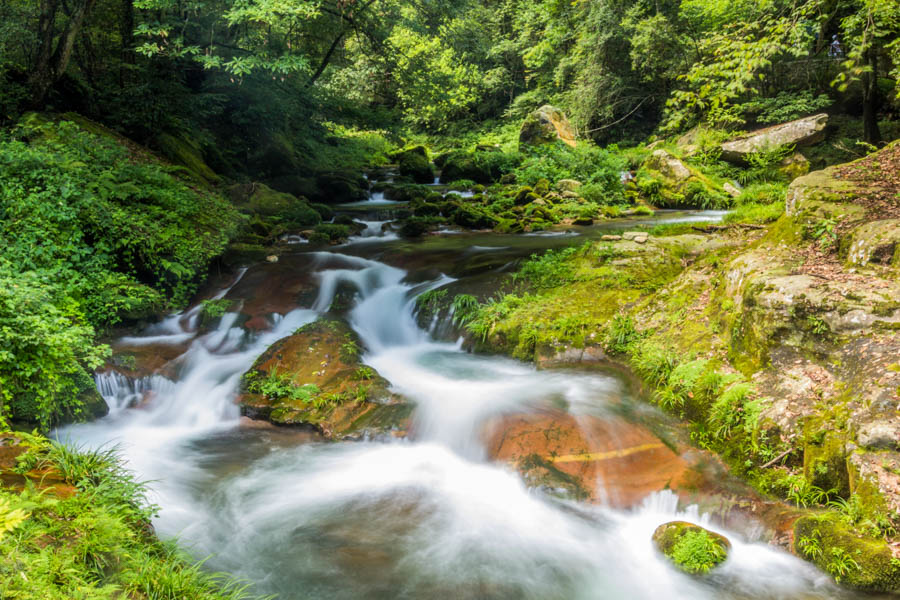
The Golden Whip Stream is rewarding in every season, though the mood of the gorge shifts noticeably through the year.
Spring (March to May) is perhaps the gentlest time to visit. The forest feels newly awake: leaves are fresh, buds begin to open, and after rain, mist often settles in the canyon, softening the outlines of the cliffs and trees. Temperatures generally range from about 8 °C (46 °F) to 18 °C (64 °F), making the walk comfortable. Visitor numbers are still relatively low, so the path along the stream feels quieter and more spacious.
Summer (June to August) brings dense greenery, warm air and high humidity. Temperatures rise from roughly 24 °C (75 °F) to 33 °C (91 °F), but the canyon remains noticeably cooler beneath the tree canopy. On a hot summer day, it can feel as much as 10 °C (18 °F) cooler here than in central Zhangjiajie, which makes a real difference during the walk. This is also peak tourist season, so expect more visitors, even though short downpours are common.
Autumn (September to November) is excellent for clear skies and striking light. Temperatures typically range from 15 °C (59 °F) to 23 °C (73 °F), rainfall becomes less frequent, and the quartz-sandstone pillars along the stream take on sharper outlines in the crisp air. After light rain, mist may gather around the peaks, making the upper cliffs appear to drift above the gorge. For photography, and often for overall comfort, autumn is one of the best times to visit.
Winter (December to February) suits travellers who prefer quiet paths and a more subdued atmosphere. Average temperatures are around 4 °C (39 °F) to 10 °C (50 °F), with occasional snowfall that can cloak the park in white. There are far fewer visitors, the trail is much quieter, and the pale winter mist between the rocks gives the stream an almost otherworldly stillness.
The best times to start the walk are before 09:00, while the trail is still relatively quiet, or after 15:00, when the main flow of visitors begins to thin out.
Practical Information: Planning Your Zhangjiajie Golden Whip Stream Hike
Ticket Price
Access to the Golden Whip Stream is included in the standard Zhangjiajie National Forest Park ticket, along with use of the park’s eco-friendly shuttle buses and basic visitor insurance.
The price of the entrance ticket varies depending on age:
- Adults (18 to 59 years): CNY 239 (approximately $35 / €30 / £26)
- Teenagers (14 to 17) and seniors (60 to 64): CNY 122 (approximately $18 / €16 / £14)
- Seniors (65+): CNY 39 (approximately $6 / €5 / £4)
- Children under 14: free
In peak season, advance booking is strongly recommended, as Zhangjiajie National Forest Park limits daily visitor numbers to 53,000. Although tickets remain valid for four consecutive days, visitors still need to reserve a specific date and time slot for each entry.
Opening Hours
- March to November: 07:00–18:00
- December to February: 08:00–17:00
Nearby Attractions
Most of the area’s best-known sights are either within walking distance of the Golden Whip Stream or a short ride away on park transport.
Visit Yuanjiajie, the closest high-altitude area to the trail, for wide views over Zhangjiajie’s stone pillars and mist-covered peaks. Take the famous Bailong Elevator to reach it, then continue to Yangjiajie if you want to see a quieter, less developed part of the scenic area, where narrow ravines, steep cliffs and swallows nesting in rock crevices give the landscape a more rugged character. For a gentler change of pace, ride the eco-tram through Ten-Mile Gallery (十里画廊), a valley known for its striking rock formations, including the Three Sisters Peak (三姐妹峰).
Climb to Huangshi Village, also known as Yellow Stone Village, for one of Zhangjiajie’s classic high viewpoints. Set at more than 1,000 metres (3,280 feet) above sea level, it is an exceptional point of view to take in the quartz-sandstone landscape, especially in the early morning when mist still lingers around the peaks.
Allow yourself to explore the wider Wulingyuan area, where Tujia culture, local songs, colourful evening performances and regional Hunan cuisine add another layer to the journey. Staying overnight in Wulingyuan District makes it easier to enjoy the park at a leisurely pace and visit nearby sights the following day.
Add Tianmen Mountain to a longer Zhangjiajie itinerary if time allows. Its natural arch, known as Heaven’s Gate; the mountain-top Tianmenshan Temple; and the sheer cliffs rising through passing clouds offer a very different atmosphere from the Golden Whip Stream and Wulingyuan.
Stay a little longer if you can. The Golden Whip Stream may be one of the gentlest parts of Zhangjiajie, but it sits within a much larger landscape of cliffs, forests, villages and mountain views.
History and Legends of the Zhangjiajie Golden Whip Stream
Ancient Legends: Where the Mountains Have Spirits
Long before Zhangjiajie was known beyond China, these mountains formed a quiet, remote landscape home to local communities such as the Tujia, Bai and Miao peoples, whose traditions still enrich the region’s cultural life. In Tujia belief, the natural world was alive with guardian spirits of mountains, water, caves and trees. Nature was not a backdrop but a living presence. A stream was more than water; it was the earth’s voice. The towering sandstone peaks, rising between forest and sky, came to symbolise the connection between the human world and the spirit realm.
The Legend of the Golden Whip
According to legend, Emperor Qin Shi Huang – the first emperor of China, associated with the Great Wall and the Terracotta Army – once owned a magical whip that could move mountains and fill valleys with the sea. One day, while the emperor slept, the Dragon King’s daughter stole the whip and replaced it with a counterfeit. The stolen whip turned to stone and remained forever at the bottom of a gorge beside the stream. It is said that the emperor never noticed the switch. The stone whip still stands here today, a silent reminder of one of Chinese legend’s stranger tales.
A Mythical Kingdom on Screen
The banks of the Golden Whip Stream also feature in Chinese screen history. Several scenes from the much-loved television epic Journey to the West were filmed here between 1982 and 1988, around the time Zhangjiajie National Forest Park began to open to visitors. The gorge’s cliffs and peaks provided an ideal natural setting for the world of Sun Wukong, the Monkey King.
Look up, and local imagination supplies familiar forms. One squat, protruding peak is said to resemble Zhu Bajie; two neighbouring pillars of different heights suggest the sturdy Monk Sha and the slender Tang Monk. Farther on, a solitary peak surrounded by smaller formations is associated with Sun Wukong and his companions. Nature shaped these stone figures long before Wu Cheng’en wrote Journey to the West in the 16th century – one of the four great classical novels of Chinese literature and later the basis for the classic television series.
When the World Discovered Zhangjiajie
In 1982, the Chinese government officially established Zhangjiajie National Forest Park, China’s first national forest park. Its extraordinary quartz-sandstone formations, shaped over millions of years by weathering and erosion, soon attracted international attention. In 1992, UNESCO inscribed the wider Wulingyuan Scenic Area on the World Heritage List, bringing Zhangjiajie to a much wider international audience.
Zhangjiajie Golden Whip Stream Trail Itineraries and Difficulty
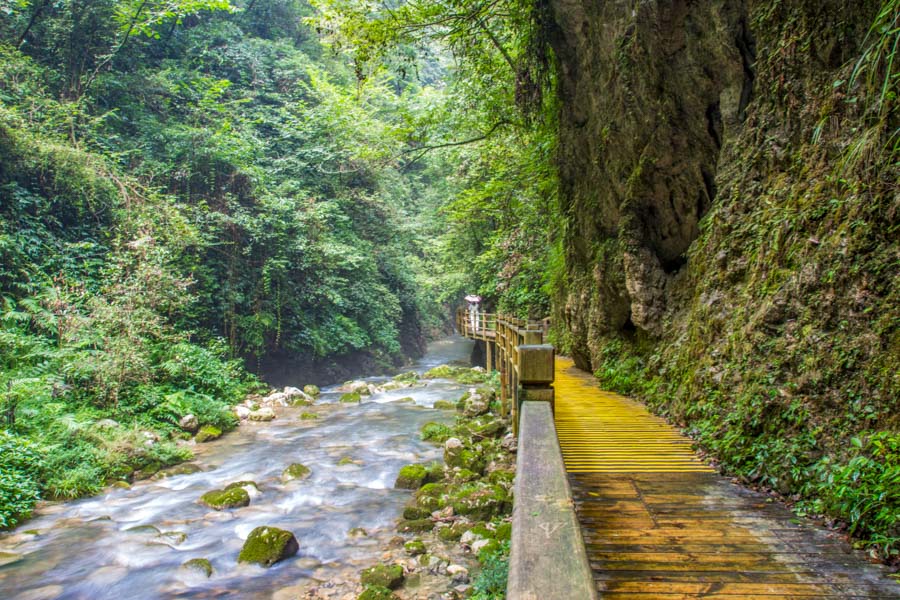
The trail along the Golden Whip Stream is easy to follow yet breathtaking. It is made for slow walking: pause by the water, look up at the cliffs, listen to the forest, and take in the smaller details that are often missed on faster mountain routes. It is made for slow walking:
Itinerary
The classic route begins at the Oxygen Bar Square (老磨湾大氧吧广场), near the South Gate of the Wulingyuan Scenic Area at the western end of the stream, and finishes at Shui Rao Si Men (水绕四门), near the East Gate at the eastern end. This itinerary lets you start on the quieter side of the trail and gradually move towards the busier part of the park.
You can also walk the route in reverse, starting at Shui Rao Si Men and the East Gate and finishing at the Oxygen Bar Square and the South Gate.
The full one-way walk, allowing for photos and short rests, usually takes around three hours. Most visitors return by the park shuttle bus rather than walking the same route back.
Difficulty
The trail is relatively flat, with only minor changes in elevation. Much of the route is laid with wooden boardwalks and stone paving, making it one of the more accessible walks in Zhangjiajie National Forest Park. It is generally suitable for families with children, older visitors, and travellers with varying levels of fitness.
There are no major obstacles along the main route, although some sections may be less convenient for pushchairs because of narrow passages or occasional steps. No transport runs along the trail itself, so the full route is completed on foot.
Suggested Hiking Trail Combinations
- Route 1 - From the South Gate to Bailong Elevator: Start at the Oxygen Bar Square → Golden Whip Rock → Drunk Arhat Peak → Mother-baby Love Rock → Cleave Mountain to Save Mother Rock → Candle Peak → Literary God Rock → Purple Pond → Lovers Peak → Camel Peak → Stream Flowing Through Four Gates → Exit and take a bus to the Bailong Elevator.
Visiting time: 1 day
Difficulty: Average - Route 2 – From Huangshi Village to the Ten‑Mile Gallery: Depart from Huangshi Village, and when you reach the Oxygen Bar Square, follow Route 1, continuing through the full stream, then at the “Stream Flowing Through Four Gates”, take the mini train to “the Ten‑Mile Gallery”.
Visiting time: 1 day
Difficulty: Average - Route 3 – From Huangshi Village to Yuanjiajie: Same itinerary as for route 2 until Lovers’ Peak, then walk to Yuanjiajie. Expect steeper paths and stairs as well as longer walking.
Visiting time: 1 day
Difficulty: More demanding - Route 4 - From “Stream Following the Four Gates” to “Lovers Peak”: Start your hike starting at the “Stream Following the Four Gates” and then pass Camel Peak → Leaping Fish Pond → Lovers Peak. Then walk the reverse way.
Visiting time: 1 to 2 hours
Difficulty: Easy
The Golden Whip Stream’s Wildlife
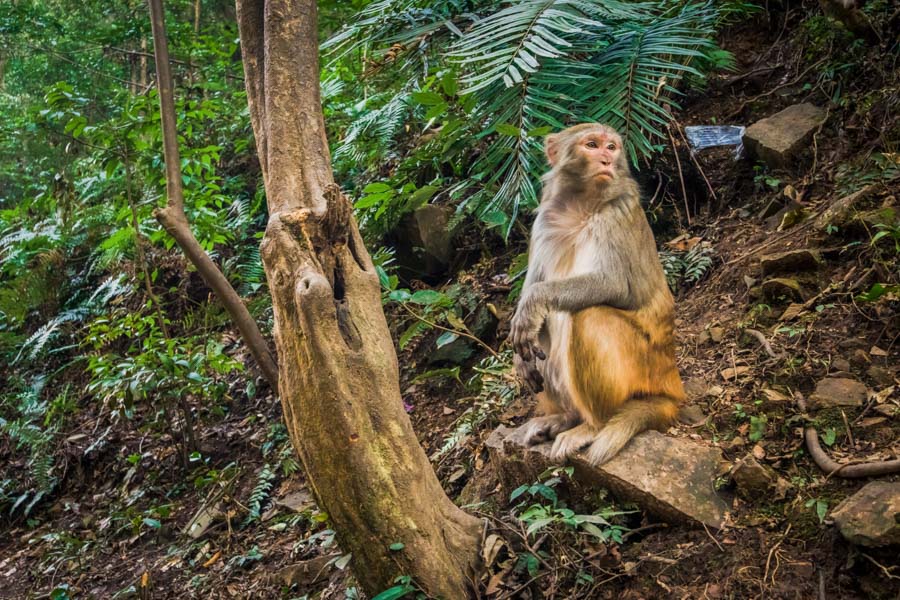
Flora
The Golden Whip Stream Canyon has the feel of a natural subtropical garden. Along the route, the damp air, filtered light and constant sound of water create ideal conditions for a rich variety of plants.
Look out for the lobster flower, named for the shape of its striking blooms, and for the soft scent of Salvia daiguii. The dove tree, admired for its pale, wing-like flowers, adds a delicate note to the forest scenery. Along the stream banks, nanmu trees thrive in the humid shade, while higher up, the cliffs are framed by the elegant silhouettes of ginkgo trees. Rare herbs used in Traditional Chinese Medicine also grow in the area.
Fauna
Wildlife is part of the experience along the Golden Whip Stream. Macaques are often seen near the trail as well as squirrels; fish move through the clear water, and butterflies and dragonflies appear in the warmer months. Birdsong is almost constant, especially in the quieter stretches of the canyon. is almost constant, especially in the quieter stretches of the canyon.
Birdwatchers may spot species such as the Little Forktail, Slaty-backed Forktail, Plumbeous Redstart and Brown Dipper near the water, while the wooded areas may offer sightings of the Blue Rock Thrush, Rosy Minivet and Collared Finchbill.
One of the stream’s rarest inhabitants is the Chinese giant salamander, known locally as the “baby-cry fish”. Sightings are unusual and should be considered a matter of luck rather than expectation. The surrounding forests are also associated with rare mammals such as pangolins (scaly anteaters), though encounters are extremely unlikely.
Top Sights Along the Golden Whip Stream
Begin at the Oxygen Bar Square (老磨湾大氧吧广场), a broad, tree-fringed area near the start of the trail. The air here is often described as especially fresh, and many visitors pause here for a few minutes before setting off along the Golden Whip Stream. It is a good place to slow your pace, take in the wooded surroundings, and prepare for the walk ahead.
Stone Figures of the Canyon
At the trailhead, look out for the Yingbin Rock, or Welcoming Crag (迎宾岩), a formation whose contours are said to resemble a smiling face. It makes a fitting introduction to a route where many of the rocks have acquired names, stories and personalities of their own.
Among the vertical pillars, the Golden Whip Rock (金鞭岩) is the route’s defining landmark. This is the legendary formation that gave the gorge its name. Rising to roughly 380 metres above the gorge floor, the monolith has been shaped by wind, rain and time. In the late afternoon, when sunlight warms the quartz-sandstone surface, the rock takes on a golden hue, and the “stone whip” seems to point skywards.
Close by stands the Magical Hawk (神鹰护鞭), protector of the stream, a peak whose outline suggests a bird with outstretched wings. Together with the whip, it forms one of the most recognisable views along the route.
Farther into the south-western part of the canyon, two peaks stand close together as if leaning towards one another. This formation is known as Meeting Across a Thousand Miles (Qianli Xianghui, 千里相会). One peak is often imagined as a broad-shouldered warrior in armour, with a sword at his side; the other appears more slender and graceful. This formation is shaped as much by local imagination as by stone.
Along the way, you will notice many other named formations, including the Camel Peak (骆驼峰), Mother and Child Peak (母子峰), Literature Star Rock (文星岩), Forty-Eight Generals Rock (四十八将军岩), Brush Holder Mountain (笔架山) and others. Their names add a playful layer to the walk, encouraging visitors to study the shapes rising above the stream.
Pools Worth Pausing For
As the path moves into the shade of the trees, you will come to the Longevity Spring (长寿泉), marked by a stone slab inscribed with three Chinese characters. Pause here for a moment and listen to the soft sound of the water. Many visitors take a sip or fill a bottle before continuing along the trail.
Further into the canyon, the streambed widens, the current slows and the surface darkens to a glassy stillness. This is the Zicao Pool, or Purple Grass Pond (紫草潭), a still pool about 2 metres (6.5 feet) deep. Its name is traditionally linked to the purple algae said to grow on the stony bed. A natural stone bridge arches above the pool, adding to the secluded atmosphere here.
Carry on to the Jumping Fish Pool (跳鱼潭), a livelier stretch of water where small fish frequently break the surface. Nearby stand two camphor trees: one is said to resemble a mushroom, the other a large umbrella, their shapes reflected in the water. Another distinctive tree in this area is the Chonghuan Tree (重欢树), or Tree of Reunion. Its split trunk is often compared to two lovers reunited after a long separation.
Other Landmarks Along the Way
One notable site is Zhang Liang’s Tomb (张良墓), associated with the celebrated military strategist and statesman of the Western Han dynasty (206 BCE–25 CE). A tradition holds that Zhang Liang spent his later years in seclusion, devoting himself to spiritual practice and Daoist study. Today, a memorial stone marks the site linked with this revered figure.
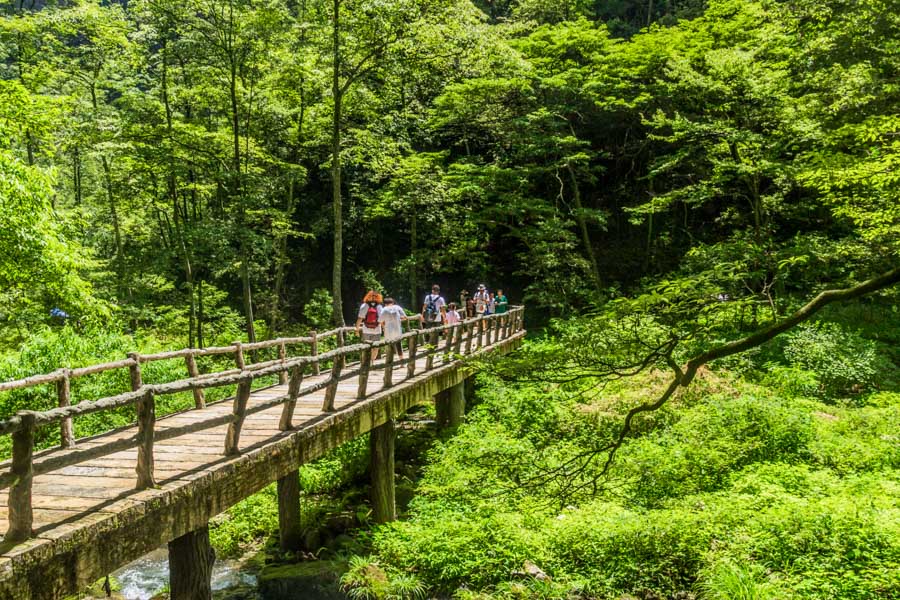
Wooden bridges cross the stream at intervals, each opening a slightly different view of the water, rocks and forest. It is worth pausing on one of them in the early morning, when mist rises slowly from the gorge and the peaks appear above it, one after another.
Near the end of the route stands Zhima Pagoda (止马塔), an elegant wooden pavilion with a traditional Chinese-style roof. It offers a convenient place to rest before the final section of the walk.
The trail eventually reaches Shui Rao Si Men (水绕四门), where four streams converge: Jinbian Stream, also known as the Golden Whip Stream; Kuangdong Stream (矿洞溪); Yuanyang Stream (鸳鸯溪); and Longwei Stream (龙尾溪). Together, they form a broad stretch of water enclosed by mountains, creating the impression of a natural gateway at the canyon’s end.
By the time you reach this point, the route will have unfolded through rock formations, pools, trees, bridges and local legends. The Golden Whip Stream is an easy walk and deserves attention: the more slowly you move, the more the canyon reveals.
How to Reach the Zhangjiajie Golden Whip Stream?
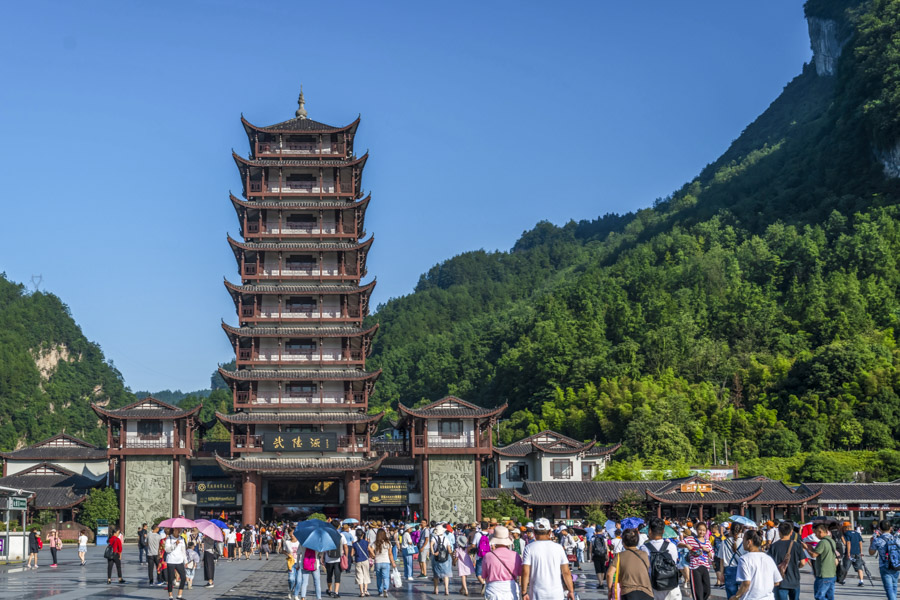
There are several ways to reach the Golden Whip Stream, depending on your starting point and which direction you want to walk the trail.
From Zhangjiajie Hehua International Airport (DYG) (张家界荷花国际机场)
Zhangjiajie Hehua International Airport is about 6.5 kilometres (4 miles) from the centre of Zhangjiajie City.
The quickest and most convenient option is to take a taxi directly from the airport to the Zhangjiajie National Forest Park ticket office at the South Gate of the Wulingyuan Scenic Area.
The journey usually takes around 40 minutes and costs about CNY/RMB 80.
You can also take the Airport Shuttle Line 1 to the city centre, then change to a bus heading for the scenic area. Shuttle buses typically run every 20 to 40 minutes.
From the South Gate ticket office, it is about 500 metres (0.3 miles) to the trail entrance at the Oxygen Bar Square, which is easily reached on foot.
From Zhangjiajie City Centre
Your departure point in the city depends on which direction you plan to hike along the Golden Whip Stream.
Option 1: South Gate to East Gate
Choose this option if you want to walk the trail from the western end of the stream towards the east, starting near the Oxygen Bar Square and finishing at Shui Rao Si Men.
Head to Zhangjiajie Central Bus Station (张家界中心汽车站), located at No. 1 Guanli Road. Buses towards Zhangjiajie National Forest Park depart regularly from here.
Opening hours: 06:30 to 18:30
Frequency: approximately every 10 minutes
Distance: 41 kilometres (25.4 miles)
Journey time: about 45 minutes
Fare: CNY/RMB 20
Option 2: East Gate to South Gate
Choose this option if you prefer to walk the route in reverse, from the eastern end of the valley towards the west.
Make your way to Zhangjiajie West Railway Station (张家界西站). From the station exit, walk for about one minute to the Tourist Distribution Centre on the right-hand side. From there, take a direct bus to Wulingyuan Bus Station (武陵源汽车站). The Wulingyuan East Gate is then about a 15-minute walk away.
Distance: 21 kilometres (13 miles)
Journey time: about one hour
Fare: CNY/RMB 13
Zhangjiajie West Railway Station address: Wulingshan Avenue, Shadi Township, Yongding District, Zhangjiajie.
Wulingyuan Bus Station location: junction of Guihua Road and Weiyang Road, Wulingyuan District
Because the connections are simpler, independent travellers usually find Option 1 more convenient.
From Wulingyuan District
If you are staying in Wulingyuan District, you are already very close to the scenic area. Most travellers reach the entrance area and ticket offices either on foot or by taxi, depending on the location of their hotel or guesthouse.
Distances within Wulingyuan are short, so this is often the easiest and least tiring option. Once inside the scenic area, take the park shuttle bus to the trailhead near Shui Rao Si Men if you want to start from the eastern end of the Golden Whip Stream. If you prefer to begin at the Oxygen Bar Square, plan your route via the South Gate instead.
Responsible Travel Along the Golden Whip Stream
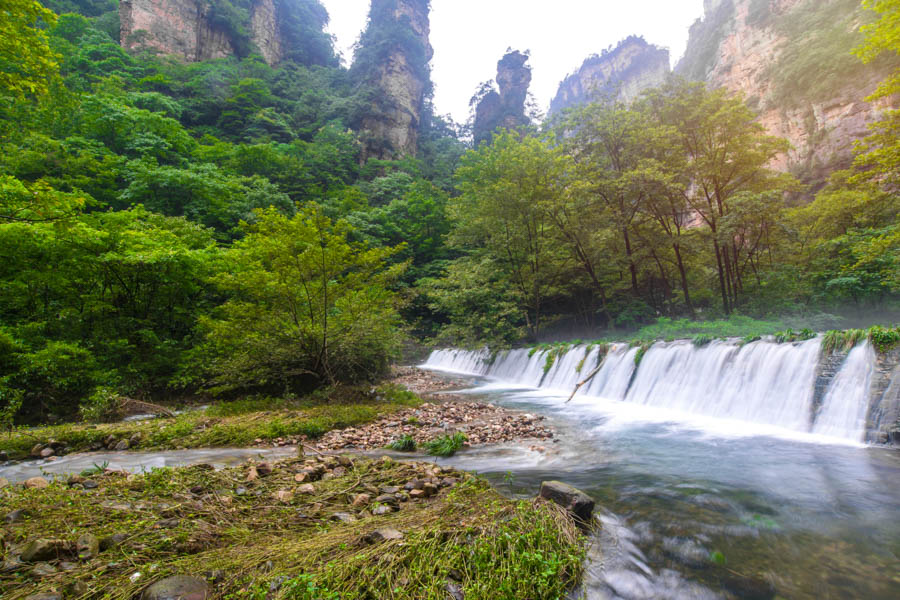
The Golden Whip Stream is more than a gorgeous walking route. It forms part of the wider Wulingyuan Scenic Area, which hosts at least 3,000 plant species and provides habitat for several endangered animals, including the Asiatic black bear, clouded leopard and Chinese water deer. This ecosystem existed long before the area opened to visitors, and even a simple walk through the canyon deserves care and respect.
A few practical rules will help protect the natural environment around the stream.
Please take your rubbish with you. Bins are limited along the route, so it is worth carrying a small rubbish bag and taking away everything you bring in. Plastic bottles, food wrappers, tissues and other waste should all leave the park with you.
Respect plants or rocks. Picking flowers, breaking branches or removing stones is not allowed. The park is home to 517 species of trees, many of them rare or vulnerable, and even small actions can disturb the balance of the forest.
Stay on the path. The trail has been designed to reduce pressure on the surrounding ecosystem. Rising visitor numbers have already contributed to the loss and fragmentation of natural vegetation, as well as damage to tree roots. By keeping to the marked route, you give the forest the space it needs to recover and survive.
Keep the stream clean. Swimming in the Golden Whip Stream is strictly prohibited to protect the ecosystem and keep the water clean. In designated shallow areas, you may touch the water, but please do not go deeper.
Protect wildlife. Macaques along the trail are used to people and may approach visitors for food. Please resist the temptation to feed them. Human food disrupts their natural feeding habits and can alter their behaviour.
Keep noise to a minimum. Loud music and shouting disturb birds and animals. Wulingyuan receives more than 20 million visitors a year, and every visit has an impact. Speaking softly and moving through the canyon at an unhurried pace is one of the simplest ways to reduce yours.
Refrain from smokin on the trail. Smoking is prohibited in the forest area. During dry periods, fallen leaves can catch fire easily, and the risk of forest fire rises sharply.
This canyon was shaped over millions of years. With a little care, visitors can help keep its streams, trees and quiet forest life protected for those who come after them.
Tips for an Optimal Visit
What to Wear
Bring a light outer layer. Even in summer, the canyon can feel noticeably cooler than more open parts of the park, so a light jumper or long-sleeved windproof jacket may be useful.
Choose comfortable footwear with non-slip soles. Trainers or light hiking boots are usually enough, but the stone slabs along the trail can become slippery after rain.
Wear loose, breathable clothing. The air in the canyon is humid, especially in the warmer months, and quick-drying fabrics will make the walk more comfortable.
Pack a lightweight raincoat. Mountain weather changes quickly in Zhangjiajie, and short afternoon showers are common.
What to Bring
Carry water and a few snacks. There are no shops along the trail itself, so buy what you need before you start.
Bring a small first-aid kit with wet wipes, antiseptic and plasters, just in case of minor scrapes or blisters.
Use sun cream and insect repellent, especially in spring, summer and early autumn.
Take some cash. Small shops and kiosks near the trailheads may not accept international cards.
Bring a power bank, especially if you plan to take photos, use maps or spend the whole day inside the park.
Photography Tips
Go early for the best light. In the morning, the light is softer, mist often hangs between the cliffs, and the trail is much quieter.
Use a polarising filter if you have one. It reduces glare on the water and makes the stream look clearer, revealing pebbles and small fish.
Consider visiting in winter for unusual light. Once the leaves have fallen, long directional rays can reach deeper into the canyon, creating a rare effect that is harder to find at other times of year.
Pause on the wooden bridges. They offer some of the best compositions, with water, forest and cliffs all visible in the same frame.
Practical Tips
Carefully plan your day’s itinerary. If you are combining the Golden Whip Stream with Yuanjiajie or Tianzi Mountain, it is often better to visit the higher viewpoints first and leave the stream for the afternoon, when the trail is usually quieter.
Keep food sealed and out of sight. Macaques are attracted to strong smells and may approach visitors carrying visible snacks.
Follow the signs, but keep an offline map as a backup. The route is signposted in both Chinese and English and is generally easy to follow, but mobile signal can be unreliable in the canyon.