

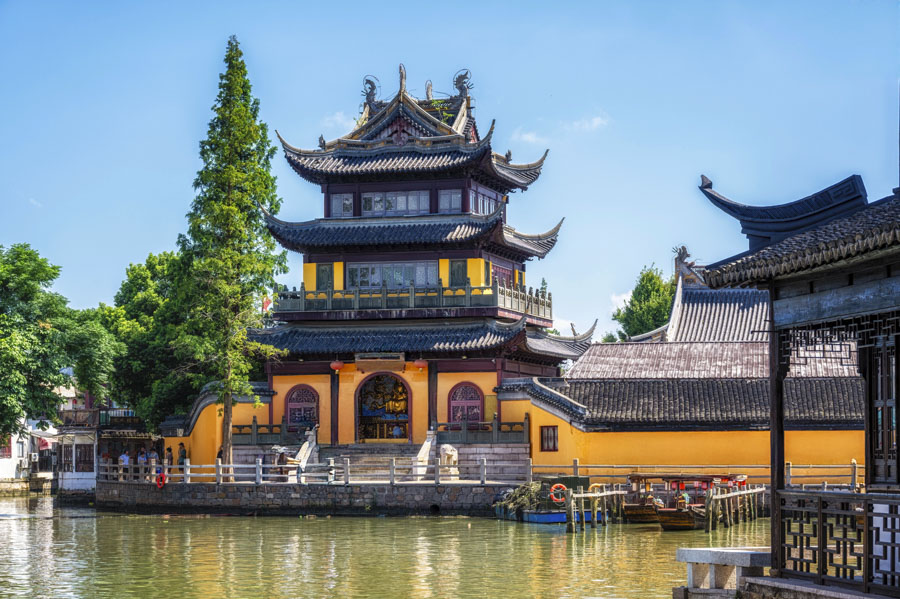
Yuanjin Temple (圆津禅院) is situated on the tranquil banks of the Caohe River in the ancient water town of Zhujiajiao, where the still waters reflect the tiled roofs and sturdy stone façades. The atmosphere here is calm and unhurried, perfectly mirroring the town’s own pace.
At first glance, the temple’s architecture draws the eye. The sweeping, upturned eaves, timber columns and open galleries create a harmonious layered composition of plays of light and shadow. The proportions of the structure are carefully balanced, encouraging a slower rhythm, one that invites contemplation rather than spectacle.
Over time, Yuanjin Temple has become woven into the literary and artistic life of the region. Its halls once displayed verses on calligraphic scrolls composed by visiting scholars, while the pavilions served as spaces for discussion, readings and quiet exchanges. Thus, the temple has functioned not only as a place of worship but also as a meeting point for intellectual discourse.
This connection to cultural tradition remains perceptible today. Yuanjin Temple continues to attract both residents and travellers, forming an essential part of the living tapestry of Zhujiajiao and embodying the town’s enduring dialogue between devotion, scholarship and daily life.
Yuanjin Temple Tours
An introduction to Chinese culture can begin not in the heart of Shanghai but on its quieter fringes – in the ancient water town of Zhujiajiao, where canals, stone bridges and low whitewashed houses create a more leisurely pace of life. A visit to Yuanjin Temple provides a natural pause within this landscape, bringing into focus the heritage of Shanghai’s outskirts and the broader Jiangnan region.
Travellers looking for a compact excursion may opt for a one-day tour to Zhujiajiao from Shanghai. Such an itinerary typically includes time to meander along the waterways and across the arched bridges, explore the elegant Kezhi Garden, and browse the narrow streets of the old town centre, where small shops maintain traditional crafts.
For longer journeys through China, this corner of the Shanghai area brings a gentler rhythm to the itinerary. Green courtyards and willow-lined banks provide a welcome contrast to the metropolis. Tours such as the 7-day Beijing & Shanghai Highlights and the 10-day Central China Discovery Tour incorporate time here, pairing the bustling major urban centres with the serene charm of a traditional water town.
Best Time to Visit Yuanjin Temple
Yuanjin Temple is open year-round, though certain occasions create a special atmosphere. On major Buddhist observances – such as Guanyin’s Birthday (the 19th day of the 2nd lunar month), Guanyin’s Enlightenment Day (the 19th day of the 6th lunar month), and Guanyin’s Renunciation Day (the 19th day of the 9th lunar month) – worshippers gather in small groups. Incense drifts through the courtyards, and the temple’s tranquil rhythm becomes even more apparent.
In the summer, when Zhujiajiao hosts the Ancient Town Intangible Cultural Heritage Season, featuring traditional performances and evening events, a visit here offers a more contemplative counterpoint. The temple provides a glimpse of the town’s spiritual life amid the broader celebrations.
For those seeking a quieter experience, weekday mornings are ideal. At this time, visitor numbers are lower, and the softer light enhances the architectural details, making it one of the most rewarding moments for photographers.
Exploring Yuanjin Temple: Practical Information
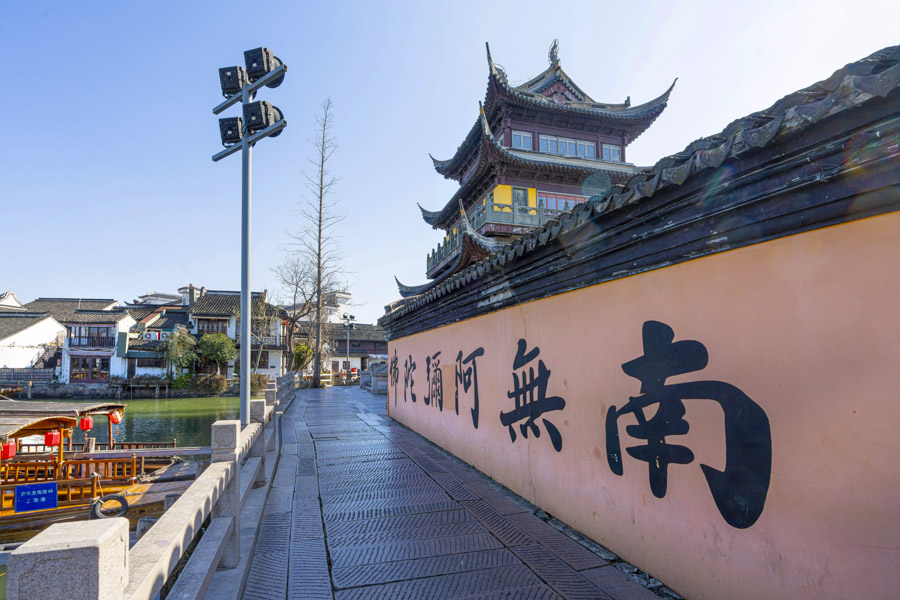
Yuanjin Temple is an active place of worship within the Chan (禅宗, Chánzōng) Buddhist tradition, which emphasises meditation and inner discipline. At its heart stands the image of Guanyin (观音), the bodhisattva of compassion, to whom visitors pray for protection, family harmony and well-being. Locally, the temple is sometimes referred to as the “Temple of the Goddess” or Niangniang Temple (娘娘庙), reflecting the special devotion associated with this figure.
Many come here for its peaceful atmosphere, which contrasts with the hustle and bustle of the surrounding town. The inner halls are open to visitors, offering a chance to appreciate the architectural features typical of Chinese Buddhist temples and to sense how religious practices are woven into everyday community life.
Admission is free, allowing visitors to enter quietly and explore at their own pace.
History of Yuanjin Temple
Yuanjin Temple was founded in 1341, during the Yuan dynasty (1271–1368). By that time, Zhujiajiao had already begun to develop as a trading hub along the waterways of the Jiangnan region. The establishment of the Buddhist temple reflected the growth of the local community and its spiritual life. Located beside the river, the site was easily accessible to both residents and travellers, gradually becoming an integral part of the town’s visual and social landscape.
In the centuries that followed, the complex underwent several phases of renewal. During the Wanli reign (1573–1620) of the Ming dynasty (1368–1644), the buildings were renovated. In 1658, under the Qing dynasty (1644–1911), a more extensive restoration was carried out under the leadership of Abbot Tongzheng, during which additional halls and pavilions were constructed.
From the early Qing period onwards, successive abbots were renowned for their skills in calligraphy and painting. Their reputations attracted writers and artists of the time, and the temple grounds began to feature inscriptions, scrolls and artworks that contributed to its cultural identity. Many of these works were lost during the upheavals of the late 19th and early 20th centuries, although some surviving pieces were later transferred to museums in Jiangsu and Suzhou. A number are now held in the Qingpu District Museum.
By the first half of the 20th century, the temple had fallen into decline due to ongoing wars. In the early 1950s, much of the built complex had vanished, leaving primarily stone steles inscribed with texts, including the Record of the Qinghua Pavilion Restoration and the Record of the Main Hall Restoration. These carved inscriptions remain some of the most tangible connections to the temple’s earlier form.
A new phase began in 1999, when large-scale restoration work sought to recover the historical character of the complex. The temple reopened in 2000 as part of broader efforts to preserve Zhujiajiao as one of the culturally significant historic settlements in the Shanghai area.
Yuanjin Temple Architecture & Design
The architecture of Yuanjin Temple adheres to traditional principles of Chinese temple design while remaining closely integrated with the waterside setting of Zhujiajiao. Situated near Tai’an Bridge (泰安桥) on the riverbank, the complex is part of the town’s historic landscape rather than standing apart from it. Its appearance maintains the balanced proportions and symbolic language typical of Buddhist architecture in the Jiangnan region. The layout is compact and organised, with the halls arranged along a central axis, creating a structure that feels clear and harmonious.
The sweeping tiled roofs serve both practical and symbolic purposes. In addition to providing shelter for the buildings, their curved shapes are traditionally associated with spiritual aspiration and protection, hinting at a connection between the earthly realm and the celestial. Latticed windows and doorways, often adorned with geometric patterns, filter the light softly. This results in a play of shadow and brightness that fosters a sense of stillness.
Inside the pavilions, the architectural design continues with timber beams, columns and brackets that define the interior spaces. At the entrances, stone carvings of guardian lions stand alongside figures of elephants – animals commonly regarded in Buddhist symbolism as representations of strength, steadiness and the spiritual path.
While the complex has experienced periods of loss and reconstruction, its architectural character remains cohesive. The present buildings reflect continuity in layout and decorative techniques, demonstrating reverence for historical form while preserving the temple’s visual identity within the townscape.
Must-see Highlights of Yuanjin Temple
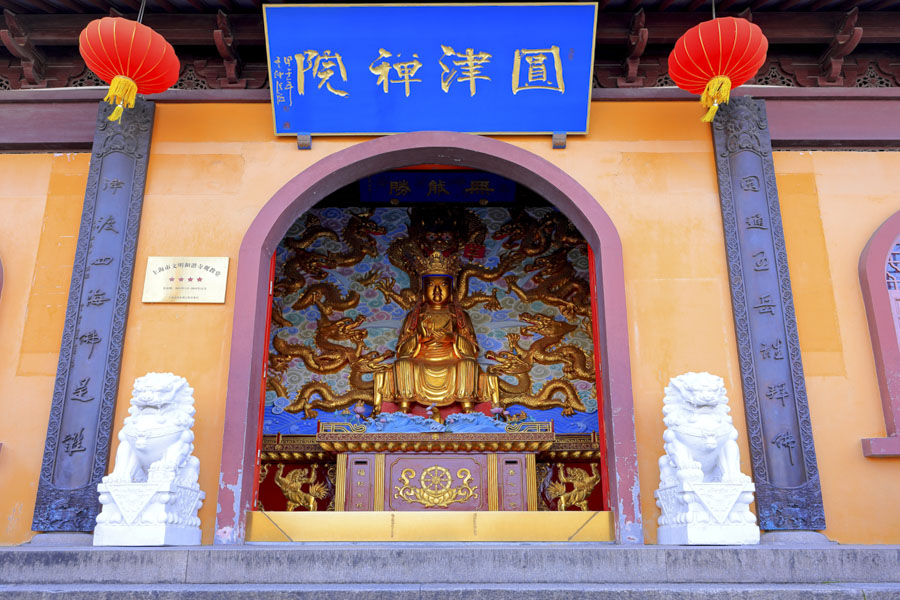
Yuanjin Temple gradually reveals its character through its prayer halls, sculptural images of Buddhist deities and cultural relics that reflect centuries of devotion and artistic heritage.
Sacred Halls of Yuanjin Temple
A convenient starting point is the entrance on the embankment along Caohe Street, near the western side of Tai’an Bridge (泰安桥). Just inside lies the Maitreya Hall, also known as the Hall of the Heavenly Kings. Here, visitors are welcomed by statues of the Buddha and protective guardian figures, their intricately carved details and painted surfaces setting a modest tone of composure from the outset.
At the centre of the complex is the Yuantong Bao Hall – the primary Great Hero Hall – where the principal Buddhist images are enshrined, including the central figure of Avalokiteshvara (Guanyin). The hall’s proportions and understated ornamentation lend it a serene presence. Adjacent rooms include the Three Saints Hall, dedicated to Amitabha Buddha, Avalokiteshvara and Mahasthamaprapta, figures closely linked to Pure Land devotion.
The walk naturally leads to Qinghua Pavilion (清华阁), the most recognisable structure within the complex. Rising to about 18 metres, this three-tiered pagoda is one of the notable historic buildings of Zhujiajiao. From the upper level, stunning view unfold over winding canals, tiled roofs and arched stone bridges – a landscape that has longinspired poetry and local lore. The pavilion also houses a number of cultural artefacts, including carved stone inscriptions.
Qinghua Pavilion is linked to the idea of the “Twelve Scenic Views of Zhujiajiao” – a collection of named vistas within the historic town. Titles such as “Geese Alighting on Caoxi Stream” (Caoxi Luoyan) and “Sails Gathered at Distant Shores” (Fan Shou Yuan Pu) reflect a tradition of viewing the town not just as a centre of commerce, but as a harmonious landscape shaped by water, light and memory.
Divine Statues and Spiritual Imagery
Several sculptural works contribute to the temple’s spiritual atmosphere.
In the Main Hall stands a gilded image of the Thousand-Armed Guanyin, which offers a visual expression of boundless compassion. The multitude of miniature arms creates an impression of continuous movement, while the surrounding figures of eighteen arhats, carved from camphor wood, contribute to an ambiance of concentration and inner stillness.
Within the Hall of the Heavenly Kings are the four directional guardians – the Si da tian wang (四大天王) – each embodying a specific protective force. Their martial presence is balanced by the cosmological significance they represent.
In the inner courtyard, a bronze statue of the Laughing Maitreya, traditionally dated to the Ming period, embodies themes of abundance and renewal. Flanking it are two stone qilin, mythical creatures often seen as symbols of protection and prosperity.
Beneath the main hall lies the Underground Dragon Altar, one of the temple’s more unique features. A black jade dragon coiled around a pearl symbolises the spirit of the river, while small niches containing miniature Buddha figures create a sense of a secluded devotional space, distinct from the open courtyards above.
How to Get to Yuanjin Temple?
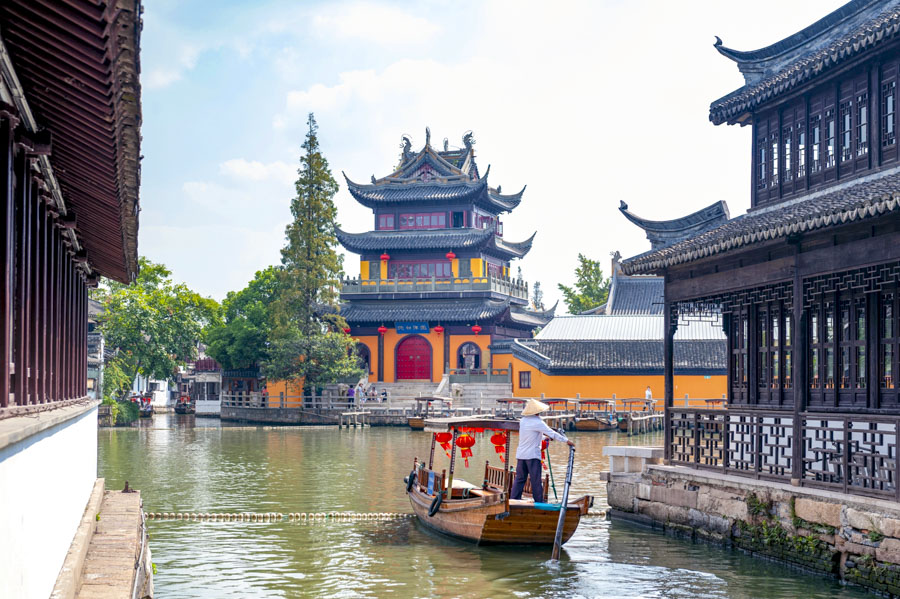
Yuanjin Temple is located at No. 193, Caohe Street (漕河街193号). It can be reached on foot from the main entrances to Zhujiajiao Water Town or by boat along the canals.
From the Zhujiajiao Ancient Town Tourist Centre
Walk along Xijing Street towards Jingting Port (井亭港). At the canal you will see three neighbouring bridges – Yongquan Bridge (涌泉桥), Zhonglong Bridge (中龙桥), and Yong’an Bridge (永安桥) – all leading across the waterway into the heart of the old town. After crossing to the western side of the canal, continue towards Dongjing Street.
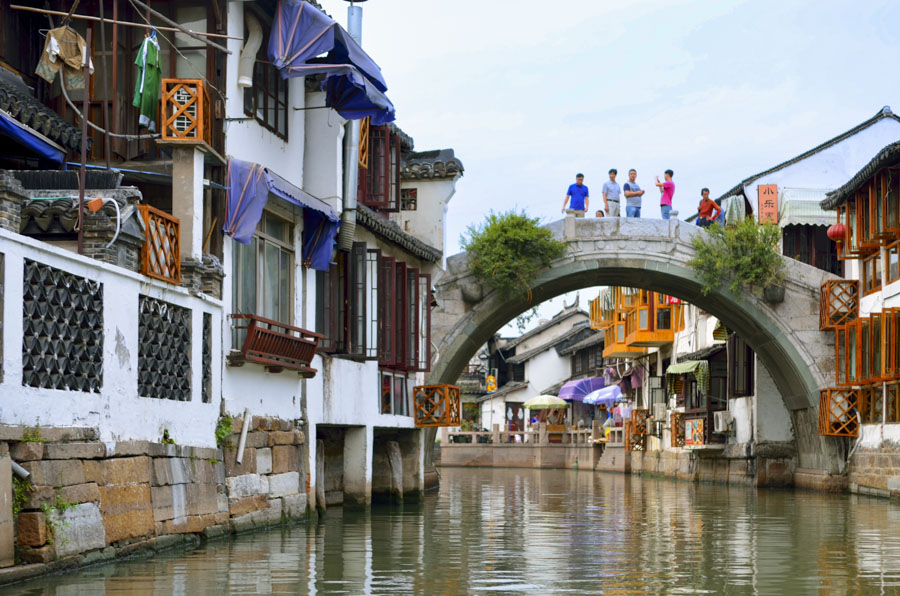
A short walk brings you to Fangsheng Bridge (放生桥), the largest and most recognisable stone bridge in Zhujiajiao. Crossing this broad five-arched bridge leads directly onto Great North Street (Beida Street), the town’s main commercial thoroughfare lined with traditional houses, shops, and teahouses. Follow the winding street until you reach Tai’an Bridge, a steep stone arch facing Yuanjin Temple. The temple entrance stands just beyond the bridge.
From the main tourist arrival area on Xinfeng Road
Many visitors arriving from Shanghai begin their walk here. From Xinfeng Road, follow the pedestrian streets leading towards the canal district and Great North Street. The walk through the old town takes about ten minutes and passes several historic bridges before reaching Tai’an Bridge and Yuanjin Temple.
By boat
Traditional wooden boats operate along the canals of Zhujiajiao, with boarding points near Kezhi Garden and other sections of the waterfront. Many routes pass through the central waterways and stop near Great North Street, from where Yuanjin Temple is only a short walk across Tai’an Bridge.
Essential Visitor Tips for Yuanjin Temple
A few practical considerations can make your visit both comfortable and relaxed:
- One of the most striking views of the temple is from the water. During a canal boat ride, the complex appears particularly atmospheric in the evening, with soft lighting reflecting on the river and the outline of Qinghua Pavilion rising above the surface.
- Take the time to notice smaller elements: carved timber details, ceramic figures along the cornices and stone steles bearing inscriptions. Much of the temple’s historical character is expressed through these features.
- As an active place of worship, the temple calls for a respectful manner. Conversations should be kept low, and photography of people at prayer is best avoided.
Together with the surrounding bridges, canals and narrow streets, Yuanjin Temple forms part of the wider experience of Zhujiajiao. Within its walls, incense and candles are still lit before the image of Guanyin, connecting the present moment with longstanding devotional practices. Even a brief pause here can shift the pace of your exploration towards something more reflective.