

A Living Religious Landmark in Old Tashkent
Address: 107/1 Karasarai Street, Almazar District, Tashkent
Opening hours: Daily (hours vary depending on the building)
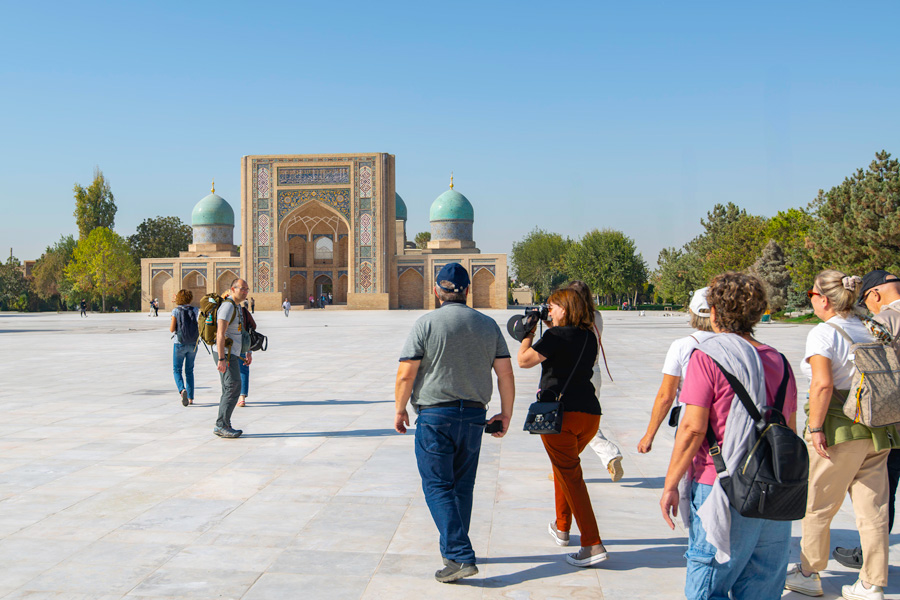
The Hazrat Imam, or Khast-Imam, complex is one of Tashkent’s main spiritual centres and among the most meaningful things to do in Tashkent for travellers interested in the city’s religious and historical heritage. Its history reaches back more than a thousand years and continued even through the Soviet period, giving the ensemble a rare sense of continuity. Today, it is regarded as one of the most important historical and religious sites in Tashkent and Central Asia as a whole.
The Khast-Imam architectural ensemble covers around 2 hectares in the old part of the city. Its buildings date mainly from the 16th to 19th centuries, though the complex also includes later structures from the modern period. Around it, traditional mahalla neighbourhoods have survived, with narrow lanes, mud-brick houses and a way of life that still carries the atmosphere of old Tashkent.
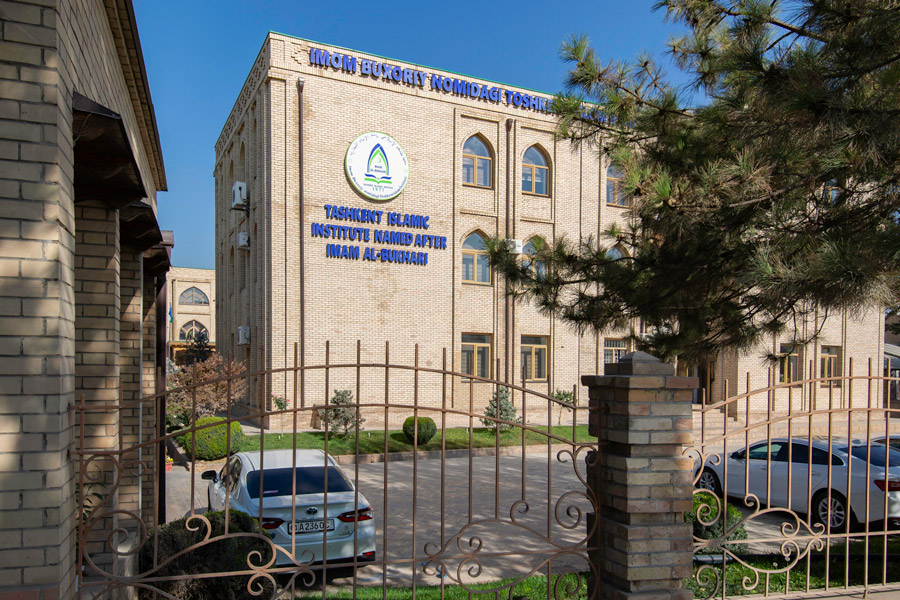
The complex is rarely still for long. Pilgrims arrive from different countries to visit the mausoleum of the theologian Kaffal ash-Shashi, while Tashkent residents come to the mosque for prayer or simply to cross the square at an unhurried pace. The Islamic Institute is also located here, where students receive religious education and train to become imams and preachers. For travellers, Khast-Imam offers more than a sequence of historic buildings. It brings together Islamic architecture, the spiritual history of Tashkent and the quiet sense of a place that remains part of the city’s daily life.
Visiting Guidelines
When visiting the mosque and mausoleum, women are advised to bring a headscarf. It is also customary to remove your shoes before entering these buildings.
By evening, the square takes on a different character, especially when the architectural lighting comes on. It is worth checking the lighting schedule in advance.
There are places serving Uzbek cuisine near the complex, where you can try plov.
A visit to the Khast-Imam complex is included in several Advantour tours, including the Tashkent tour, the Sufi religious tour, and various Uzbekistan and combined Central Asia itineraries.
Hazrat Imam: Scholar and Spiritual Figure of Tashkent
The complex is named after the 10th-century scholar Abu Bakr Muhammad Kaffal al-Shashi, also known as Hazrat Imam, meaning “Holy Imam”. He was born in 904 in Shash, as Tashkent was then known.
In the early 10th century, Shash was a busy commercial and craft centre within the Samanid state. Silk Road caravan routes passed through the city; goods from China, Europe and the Arab lands were traded in its bazaars, while local workshops produced ceramics, metalwork, woodwork and leather goods day after day.
In one of the workshops near present-day Chorsu and Eski-Juva, a boy learned the craft of lock-making from his father. His name was Abu Bakr Muhammad. Surnames in the modern sense did not exist at that time; people were often identified by their profession and place of origin. This is how he became known as Kaffal al-Shashi, which translates from Arabic as “the locksmith from Shash”.
Alongside his craft, Kaffal al-Shashi was drawn from childhood to religion and learning. After studying at a madrasah, he travelled to Baghdad, Mecca and Medina – leading centres of the Islamic world at the time – where he continued his education and teaching. On returning to his native city, he became one of the first local imams, received the title Hazrat Imam and, over time, came to be regarded as the chief spiritual protector and patron of Tashkent.
The main focus of Kaffal al-Shashi’s life was the spread of the Shafi’i madhhab – a school of Islamic jurisprudence that sets out principles for interpreting the Qur’an and regulating everyday Muslim life. Through his work, this teaching took root in the region and spread beyond it. Today, the Shafi’i school is predominant in Syria, Lebanon, Palestine and Jordan, and is followed by millions of Muslims in South-East Asia and the Caucasus. Within this tradition, Kaffal al-Shashi is regarded as one of the scholars whose writings helped establish the Shafi’i school more widely.
For Muslims, visiting his mausoleum is a ziyarat – a pilgrimage to the grave of a righteous person. In Islamic tradition, saints are believed to retain spiritual closeness to God after death and may act as intercessors in prayer. At the tomb of Kaffal al-Shashi, people pray for healing, the blessing of children and protection for their loved ones.
Inside the Complex
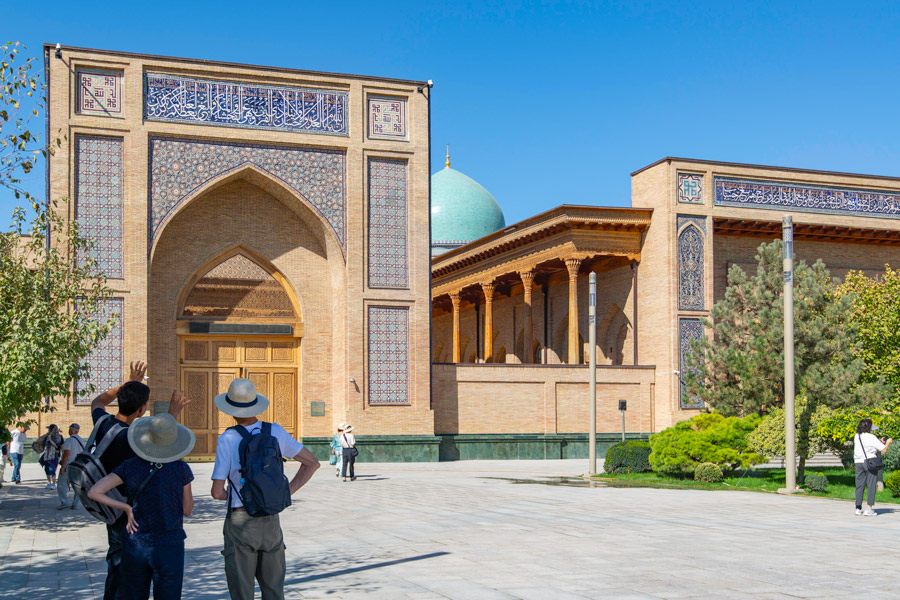
The Hazrat Imam complex developed over many centuries and still bears traces of different periods and styles – from medieval Tashkent architecture to modern interpretations of Uzbekistan’s regional traditions.
The Kaykovus Canal
A walk around Khast-Imam Square often begins at the Kaykovus Canal, also known as Kalkauz, which is more than a thousand years old. According to legend, while living in Baghdad, Kaffal ash-Shashi performed an important service for the Caliph. In gratitude, the Caliph offered him any reward he wished. The scholar did not ask for wealth, but for the restoration of the irrigation canals in his native Shash, where the waterways had been filled in and the city was left without a proper water supply.
According to the same legend, the Caliph granted his request, and one of the canals associated with this story is identified as Kaykovus, which still runs beside the complex today.
Hazrat Imam Mosque
To the left of the canal stands Hazrat Imam Mosque. Its appearance follows the broader architectural language of the ensemble: a brick façade, a tall portal decorated with ornament and stylised Arabic inscriptions, and an iwan terrace supported by rows of carved wooden columns. Together, these elements evoke the traditions of medieval Eastern architecture.
One detail, however, is unusual for old Tashkent: the two 52-metre-high minarets. Their height immediately shows that the building is modern, since tall minarets were not traditionally built in Tashkent because of the city’s seismic activity. The mosque was built in 2007 on the initiative of Uzbekistan’s first president, Islam Karimov. It is active today and can accommodate up to ten thousand worshippers. Prayers are held here five times a day, and the mosque becomes especially busy on Fridays, when the communal Jumu’ah prayer takes place.
Khast-Imam Square
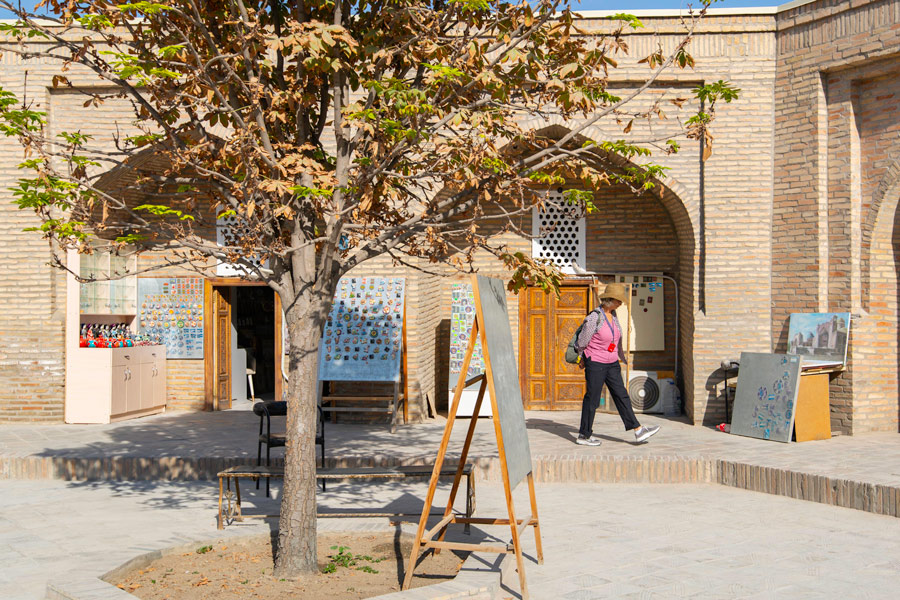
Behind the mosque lies a spacious square framed by historic buildings. The largest of them is the 16th-century Barak-khan Madrasah, whose portal stands directly opposite the rear of the Khast-Imam Mosque. Today, the madrasah’s inner courtyard houses workshops and stalls selling ceramics, textiles, copperwork and other examples of Uzbek craftsmanship.
Here you can find carved boxes with hidden mechanisms, painted ceramic tableware, jewellery, traditional-style accessories and much more. Uzbek clothing is especially eye-catching – women’s and men’s chapan robes with bright patterns, often chosen by tourists for souvenir photographs.
Also on the square stand the relatively small buildings of the Tilla-Sheikh Mosque and the Mui Mubarak Madrasah, close to one another. The ribbed blue dome of the latter immediately stands out against the smoother domes of the complex. For many decades, this was where the Uthmanic Qur’an was kept – a 7th–8th-century manuscript dating back to the time of the Prophet’s companions and regarded as one of Islam’s most important relics.
In November 2025, the manuscript was moved to the nearby Islamic Civilization Center and placed beneath a similar ribbed blue dome. Contemporary architects echoed the silhouette of the Mui Mubarak dome, creating a visual dialogue between different eras that can be seen directly from the square.
The Mausoleum of Kaffal ash-Shashi
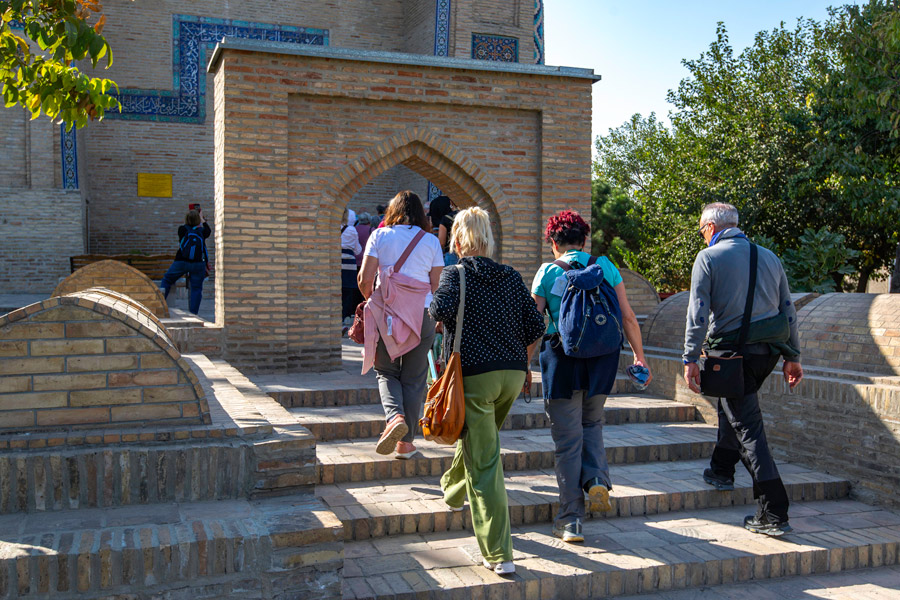
The main spiritual centre of the Khast-Imam complex remains the mausoleum of Kaffal ash-Shashi, located to one side of the square. A low arch stands before the entrance – a striking feature of traditional Eastern architecture that gently makes the visitor bow their head. Inside the mausoleum, alongside the burial place of Hazrat Imam himself, lie other spiritual figures, including Imam Eshon Bobohan, who played an important role in the history of the Khast-Imam complex in the 20th century.
The mausoleum remains an active place of pilgrimage, but it is also open to tourists. Inside, the atmosphere is very quiet: visitors may pray, or simply pause at the resting place of a man whose name has been remembered for more than a millennium.
After exploring the complex, you can walk through the surrounding mahallas, where narrow streets, mud-brick houses and tall, solid duval walls still remain. Together, they give a rare sense of old Tashkent before the large-scale redevelopment of the 20th century.
History of the Khast Imam Complex
10th century: the first mausoleum
After the death of Kaffal ash-Shashi in 976, he was buried outside the city walls, in the Bogy-Keikaus garden. The first mausoleum was built over his grave – a modest structure that became a place of devotion for believers from across Mawarannahr. Until the 14th century, his tomb remained the main, and perhaps the only, holy site in Tashkent.
16th century: the Shaybanid era
The 10th-century mausoleum has not survived. The present building was constructed in 1542, during the reign of the Shaybanid dynasty. Around the same period, another major structure appeared in the complex – the Barak-khan Madrasah, named after the ruler known by the nickname Barak-khan, meaning “lucky”.
The Mui Mubarak Madrasah was also founded in the same century. Its name translates as “blessed hair”. According to legend, it was in this building that a lock of the Prophet Muhammad’s hair was kept. At first, the madrasah was a small cell for dervishes – ascetic monks belonging to one of the branches of Islam.
19th century: the Kokand period
In the mid-19th century, when Tashkent was part of the Kokand Khanate, two mosques were added to the complex. In 1857, the Tilla-Sheikh Mosque was built; its name translates as “Golden Sheikh”. In 1865, the Namazgoh Mosque was added, its name meaning “place for prayer”. Around the same time, the Mui Mubarak Madrasah was rebuilt and expanded.
It was then that a library was established there, eventually becoming one of the richest collections of Islamic manuscripts in the region.
A Difficult Period: The 20th Century
The 20th century was a difficult period for Khast-Imam Square. At the beginning of the century, the Namazgoh Mosque was destroyed, and the mausoleum of Kaffal ash-Shashi was closed. Even so, believers continued to visit it during the hardest years.
History has preserved a rare precedent: in 1943, Imam Eshon Bobohan – preacher at the Tilla-Sheikh Mosque and teacher at the Mui Mubarak Madrasah – secured a meeting with Stalin and received permission to establish the Spiritual Administration of Muslims of Central Asia and Kazakhstan on the grounds of Hazrat Imam. In the midst of official atheism, Islam in Tashkent not only survived but gained institutional status. The complex became a spiritual centre for millions of Muslims across Soviet Central Asia.
Later, the Namazgoh Mosque building was also transferred to the Spiritual Administration of Muslims. It was restored, and in 1971 the Imam al-Bukhari Islamic Institute opened there – the first Muslim higher education institution in the USSR.
In 1966, Tashkent suffered a catastrophic earthquake that destroyed much of the old city. The mausoleum of Kaffal ash-Shashi and the surrounding buildings survived, making Khast-Imam one of the few authentic medieval architectural ensembles preserved in the city.
Khast-Imam Square Today
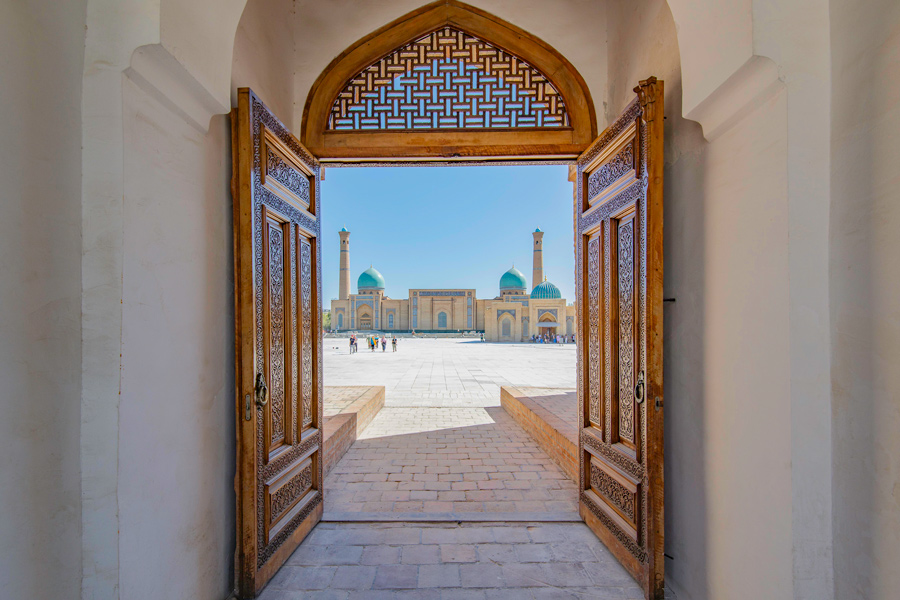
After Tashkent was designated the capital of Islamic culture in 2007, the scattered buildings of Khast-Imam were brought together into a single complex for the first time. Restoration work was carried out, and a new cathedral mosque and the building of the Spiritual Administration were erected. The square has gradually been landscaped, with paths, flower beds and benches added, while the complex itself continues to serve as both a place of memory and a living part of the city.
In March 2026, the Centre for Islamic Civilisation opened next to the complex – a new, modern museum that now complements the Khast-Imam architectural ensemble, which has taken shape over many centuries.