

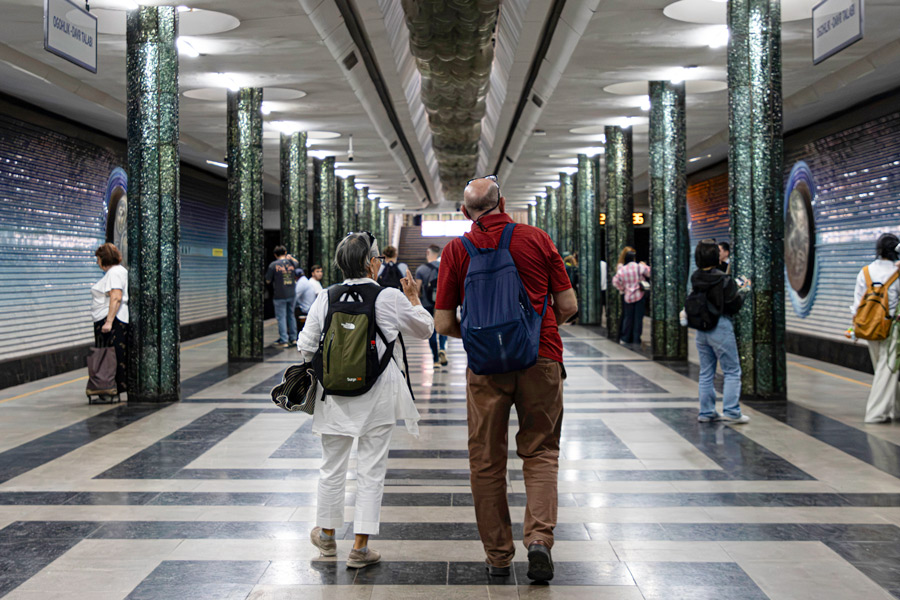
The Tashkent Metro is one of the most convenient and affordable ways to get around the capital of Uzbekistan, as well as an important part of the city’s architectural heritage. In 2026, Kosmonavtlar station became a component of the serial UNESCO World Heritage property “Tashkent Modernist Architecture. Modernity and Tradition in Central Asia,” marking international recognition of one of the city’s most distinctive architectural legacies.
What makes the Tashkent Metro particularly memorable is the character of its stations. Many were designed as more than simple transport facilities: some feel closer to a grand ballroom or palace, and others draw on Uzbekistan’s history, literature, science, and even Soviet space programme. For travellers, it is one of the more unusual things to do in Tashkent, shining a light on a remarkable world beneath its streets.
The sections below cover how the network is organised, how to use it, which stations are especially worth seeing, and the history and architecture behind this part of Tashkent.
Tashkent Metro Overview
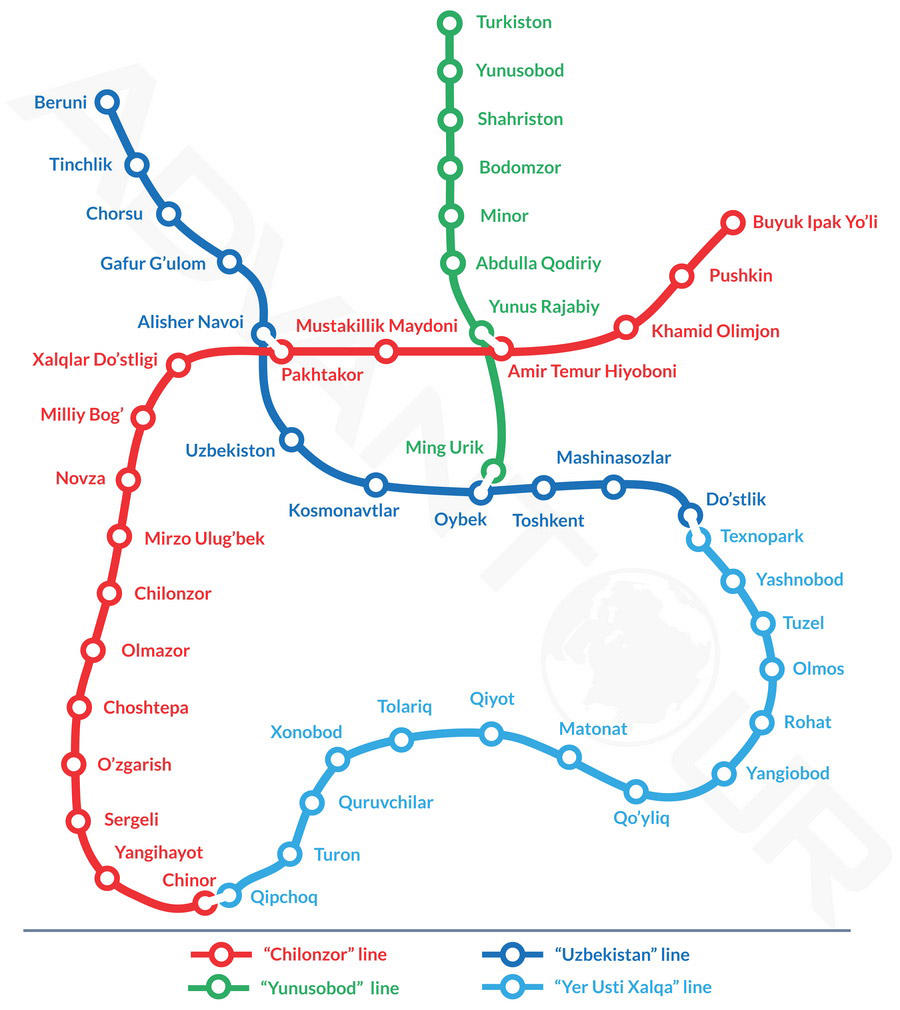
The Tashkent Metro system currently has four lines and 50 stations, covering about 70 kilometres across the city, with further extensions planned. The network includes the Chilonzor Line, Oʼzbekiston Line, Yunusobod Line, and Yer Usti Xalqa Line (Overground Ring Line). Four interchange points allow passengers to change between lines through connecting passages.
| Name of line | Number of stations |
| Chilonzor Line | 17 |
| Oʻzbekiston Line | 11 |
| Yunusobod Line | 8 |
| Yer Usti Xalqa Line (Overground Ring Line) | 14 |
Several generations of metro trains operate in Tashkent. Older 81-717/714-series Nomernoy cars, many of them modernised over the years, still run alongside newer trains, a Tashkent-specific version of the Moskva family. Designed with the city’s conditions in mind, these newer trains operate on both underground and elevated sections of the metro.
Tashkent Metro Map
How to Use the Tashkent Metro
Tashkent Metro Opening Hours and Timing
The Tashkent Metro generally operates from 05:00 to 24:00. The Yer Usti Xalqa Line (Overground Ring Line) operates from 06:00 to 23:00. Train intervals vary by line, with services running more frequently during peak hours and less frequently at other times. For a more comfortable journey, consider travelling outside the busiest times when possible.
Tashkent Metro Tickets, Fares, and Payments
The fare varies depending on the payment method. It can be paid in cash, by card, or via the ATTO app.
| Ticket and payment type | Where to buy or use | Fare |
| 1. One-time electronic ticket (ATTO card, bank card, phone with QR) | ATTO cards can be purchased at Metro ticket offices or UzPost post offices. They can be topped up at terminals in the stations and through mobile apps such as ATTO, Payme, Click, and others. | 2,500 UZS (approximately $0.14 / €0.13 / £0.11) |
| 2. One-time paper QR ticket | Available for cash at Metro ticket offices. | 3,000 UZS (approximately $0.25 / €0.22 / £0.19) |
Please note: fares are current as of 2026. Currency conversions are approximate and may change with exchange rates.
At the station entrance, use a supported payment method at the turnstile: scan a paper QR ticket or tap an ATTO card, bank card, or phone on the contactless reader. If you have any problems, station staff can assist you.
When changing between Metro lines, simply follow the signs inside the station. No additional fare is required for transfers. Transfer passages are part of the Metro system and usually take only a few minutes to walk through. Station names on information displays are shown in Uzbek (Latin script) and Russian, and announcements are made in both languages.
Accessibility, Safety, and Photography Rules
Most stations are equipped with escalators, and newer stations have lifts for passengers with limited mobility. During normal hours, entrance areas often have security frames and staff carrying out security baggage checks. Photography and video recording have been permitted in Metro stations since 2018. This is especially useful for visitors, as Tashkent’s Metro is known for its elaborate and visually striking station interiors.
Choosing the Right Exit
Finding the right exit for first-time visitors may be a bit challenging. Some stations have several exits leading to different sides of the surrounding streets, and it is not always obvious which one is closest to your destination. Yandex Maps is convenient for planning routes on the Tashkent Metro: it can show you which station to use, where to change lines, and even whether it is better to board near the front or the rear of the train for a particular exit. It is worth checking your route before leaving the station, as the right exit can make reaching your destination a little easier.
Notable Tashkent Metro Stations
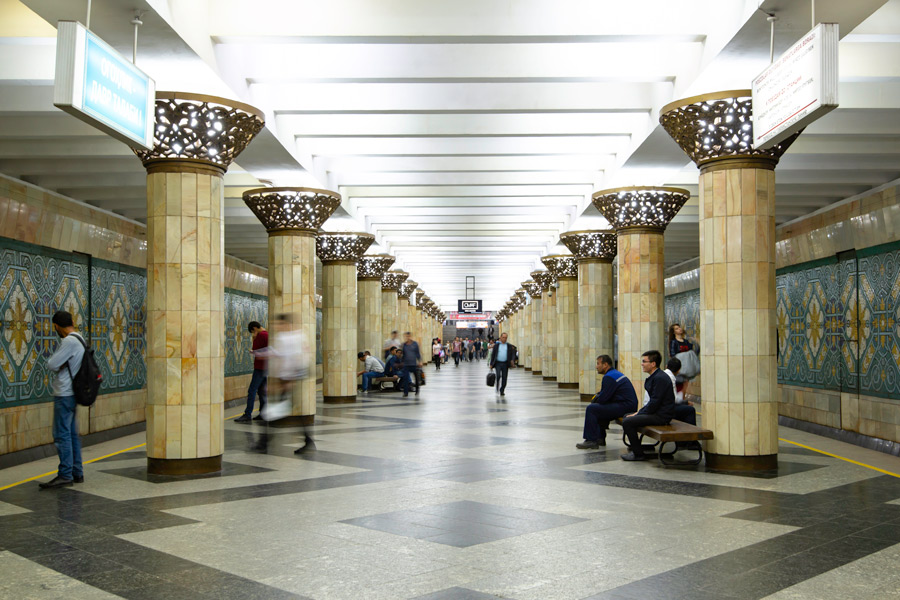
In the Tashkent Metro, many stations were designed around a particular theme, with all elements used to give each one its own unmistakable features. The following stations are among the more popular and interesting ones for travellers to visit:
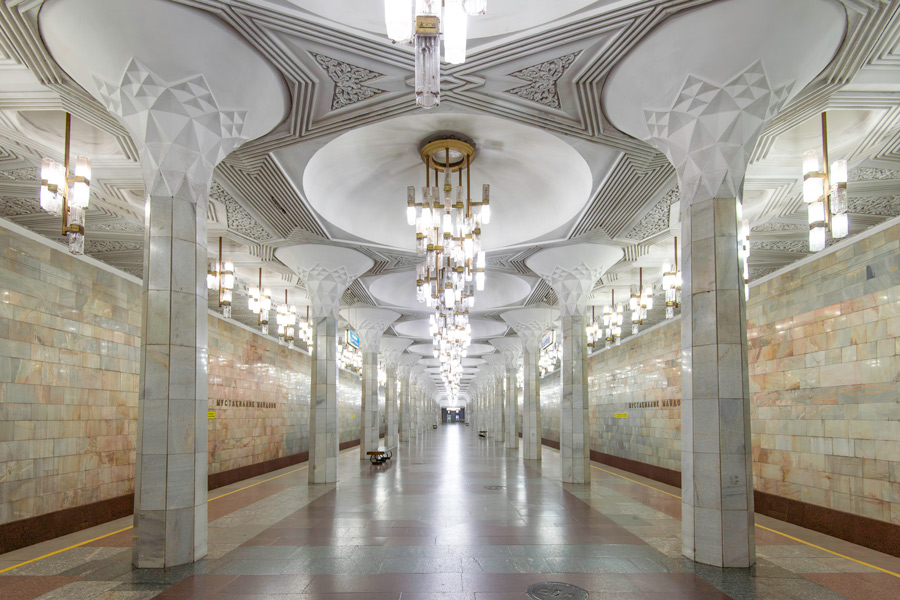
Mustaqillik Maydoni station
> Chilonzor Line
A spacious and formal station with pale marble, repeating columns, geometric ceiling decoration, and rows of chandelier-style lights in the middle. Located beneath Independence Square, it has a distinctly monumental and ceremonial character.
Pakhtakor station
> Chilonzor Line
Pakhtakor stands out for its vivid cotton imagery. Large decorative mosaic panels line the walls of the spacious columned hall, with the repeated cotton motifs giving the station a bright, richly decorated appearance.
Alisher Navoiy station
> Oʼzbekiston Line
Named after the great Uzbek poet Alisher Navoiy, this station has an ornate, palace-like character. Pointed arches, blue dome-like ceilings, and colourful decorative reliefs echo architectural motifs associated with Central Asia, giving the interior a detailed and cohesive appearance.
Kosmonavtlar station
> Oʼzbekiston Line
A space-themed station. Deep blue surfaces and portraits of figures from the history of astronomy and space exploration create an unusual atmosphere. It is also one of the ten sites in Tashkent’s UNESCO-listed modernist heritage.
Toshkent station
> Oʼzbekiston Line
Toshkent station takes the city itself as its main theme. Ceramic decoration, ornamental columns, and large wall panels combine images of Tashkent’s architecture, nature, people, and everyday life.
More time? Explore the Yunusobod Line.
Consider riding the > Yunusobod Line and exploring some of its stations as well. Travel one stop on the Oʼzbekiston Line from Toshkent to Oybek station, transfer over to the Yunusobod Line and get off at Bodomzor. With its modern-looking geometric design and tall lights in the middle of the platform, it is a useful stop for visitors with access to several northern Tashkent attractions, including the TV Tower, Japanese Garden, and Uzexpocentre.
Architecture and Art of the Tashkent Metro
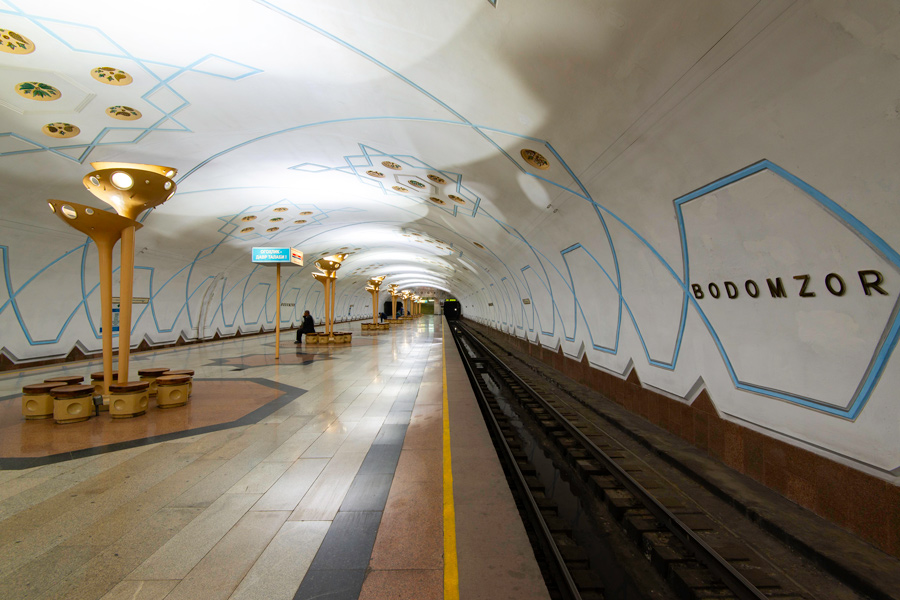
The architecture of the Tashkent Metro reflects a locally rooted form of modernism, combining contemporary engineering and planning with local artistic traditions.
The stations use marble and granite alongside ceramics, mosaics, glass, metal, and carved ganch (traditional Uzbek decorative art using a gypsum-based decorative material to create intricate relief designs).
The stations were conceived as integrated architectural and artistic ensembles, with monumental art incorporated into their original design. Themes connected with literature, science, space exploration, nature, and Uzbekistan’s cultural identity appear in mosaics, ceramic panels, reliefs, and lighting. The result is a Metro that functions as everyday infrastructure and also as a collection of large-scale public artworks.
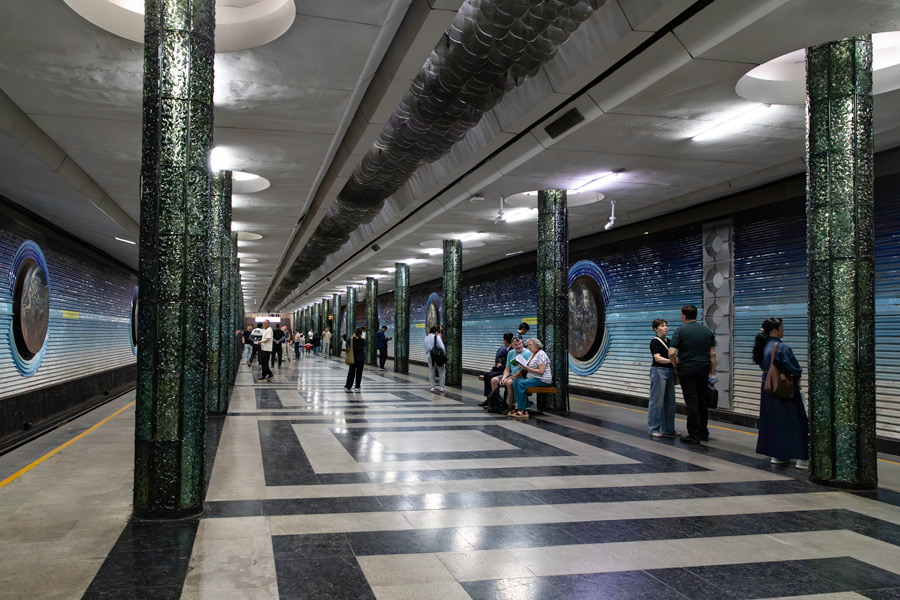
The Kosmonavtlar station is one of the clearest examples. Designed by Sergo Sutyagin and Sergei Sokolov, the station uses a gradual shift from light to deep blue to evoke the vastness of outer space. A long chandelier with glass elements suggests the Milky Way, while twelve medallion frescoes trace a visual history of humanity’s exploration of the cosmos, depicting mythological Icarus, astronomer Ulugh Beg, and Soviet cosmonaut Yuri Gagarin. Dark-green, glass-covered columns and the high ceiling further reinforce the sense of openness and weightlessness. Oʼzbekiston station combines modernist architecture with traditional decorative elements. Large light fixtures shaped like cotton bolls line the platform, and enamelled ceramic panels depict flowing water and the ceiling is decorated with carved ganch. These and many other stations show just how varied the Tashkent Metro can be.
History of the Tashkent Metro
The history of the Tashkent Metro is closely connected with the rapid transformation of the city in the second half of the 20th century. Tashkent already had buses and trams, but the city’s growing population created a need for a higher-capacity rapid transport system. The devastating earthquake of 26 April 1966 also brought seismic safety to the forefront of urban planning. Design work for a metro began in 1968, and construction followed in the early 1970s. From the beginning, the system was developed with Tashkent’s high seismicity and difficult ground conditions in mind.
The Soviet-Era Metro
The first section of the Tashkent Metro opened on 6 November 1977, coinciding with the 60th anniversary of the October Revolution. It comprised nine stations on the Chilonzor Line, running from Olmazor station in the southwest of the city to Amir Temur Xiyoboni station in the centre. The line was extended in 1980 with three additional stations, bringing the total to 12.
A second line, later known as the Oʼzbekiston Line, opened in 1984 with five stations. It was expanded in stages in 1987, 1989, and 1991. By the end of this period, the two lines together had 23 stations, forming the core of the network that continued to serve Tashkent for the next decade.
Development after Independence
In 2001, the Yunusobod Line opened with six stations, becoming the first metro line opened in independent Uzbekistan. Two more stations, Yunusobod and Turkiston, were added in 2020.
A major new phase of expansion began in 2020, when the Metro extended beyond its traditional underground network. The first section of the elevated Yer Usti Xalqa (Overground Ring) Line opened with seven stations, and a new elevated Sergeli area branch opened with five stations, connecting to the Chilonzor Line at Olmazor station. The elevated ring continued to expand, with five more stations opening in April 2023, bringing the total to 48 stations. The final two, Turon and Qipchoq, entered passenger service on 11 March 2024, completing the connection between the elevated ring and the Sergeli area line and bringing the Tashkent Metro to 50 stations.
Exploring Tashkent by Metro
You can explore several notable stations on a short ride without changing lines. The routes below can also be enjoyed as simple self-guided Tashkent Metro tours, combining several of the city’s most interesting stations with nearby sights. Many of our Tashkent tour programs include a metro ride as part of the itinerary.
Possible Route 1
Take the Oʼzbekiston Line between Alisher Navoiy, Oʼzbekiston, Kosmonavtlar, Oybek, and Toshkent stations. At Alisher Navoiy, you can combine the metro visit with the nearby Tashkent City Mall; Oʼzbekiston is also close to Humo Arena, a modern sports and performance venue. The Kosmonavtlar Station is close to the Uzbek National Puppet Theatre, whose building is also an interesting example of late-Soviet architecture. From the Oybek station, the State Museum of Arts of Uzbekistan is within walking distance. At the final stop, the Toshkent station, you can continue to the Tashkent Northern Railway Station (Shimoliy Vokzal) and the nearby Tashkent Railway Museum, where locomotives and other railway equipment are displayed in an open-air setting.
Possible Route 2
On the Chilonzor Line, travel between Amir Temur Xiyoboni station, Mustaqillik Maydoni station, and Paxtakor station. At Amir Temur Xiyoboni station, the Amir Temur Square and State Museum of Timurid History are just a short walk from the station. The Mustaqillik Maydoni station brings you directly to Independence Square, and the Paxtakor station is close to Tashkent City Mall and several theatres, including the Uzbek National Academic Drama Theatre and Ilkhom Theatre.
The Tashkent Metro has a character you can experience in many ways: the cool air as you descend underground, the faint mineral scent of the stations, the echo of footsteps, and the almost tambourine-like rumble of a train arriving through the tunnel. These details are part of what makes the Metro worth seeking out, even when you have nowhere in particular to go. Take a ride, get off at a few stations, and let the Metro become part of your experience of the city.