

Public Holidays in China in 2026
| Date | Holiday |
|---|---|
| January 1–3, Thu-Sat | New Year's Day |
| February 15–23, Sun-Mon | Spring Festival |
| April 4-6, Sat-Mon | Qingming Festival |
| May 1-5, Fri-Tue | Labour Day |
| Date | Holiday |
|---|---|
| June 19-21, Fri-Sun | Dragon Boat Festival |
| September 25-27, Fri-Sun | Mid-Autumn Festival |
| October 1-7, Thu-Wed | National Day |
| Date | Holiday |
|---|---|
| January 1–3, Thu-Sat | New Year's Day |
| February 15–23, Sun-Mon | Spring Festival |
| April 4-6, Sat-Mon | Qingming Festival |
| May 1-5, Fri-Tue | Labour Day |
| June 19-21, Fri-Sun | Dragon Boat Festival |
| September 25-27, Fri-Sun | Mid-Autumn Festival |
| October 1-7, Thu-Wed | National Day |
Public Holidays in China in 2027
| Date | Holiday |
|---|---|
| January 1–3, Fri-Sun | New Year's Day |
| February 15–23, Mon-Tue | Spring Festival |
| April 4-6, Sun-Tue | Qingming Festival |
| May 1-5, Sat-Wed | Labour Day |
| Date | Holiday |
|---|---|
| June 19-21, Sat-Mon | Dragon Boat Festival |
| September 25-27, Sat-Mon | Mid-Autumn Festival |
| October 1-7, Fri-Thu | National Day |
| Date | Holiday |
|---|---|
| January 1–3, Fri-Sun | New Year's Day |
| February 15–23, Mon-Tue | Spring Festival |
| April 4-6, Sun-Tue | Qingming Festival |
| May 1-5, Sat-Wed | Labour Day |
| June 19-21, Sat-Mon | Dragon Boat Festival |
| September 25-27, Sat-Mon | Mid-Autumn Festival |
| October 1-7, Fri-Thu | National Day |
*The official public holiday calendar for the following year is usually released by the State Council of the People’s Republic of China in the first half of November. Until then, the main dates based on the Gregorian and lunar calendars can serve as a practical guide.
China’s festival calendar brings together ancient rituals, seasonal customs and modern national holidays. Each year, seven official public holidays shape the rhythm of travel across the country, from family gatherings and temple visits to fireworks, festive meals and local celebrations. Some holidays fall on fixed dates, while others follow the lunar calendar, so their dates change from year to year.
Below, you will find a guide to China’s main public holidays, with notes on their traditions, atmosphere and timing. One of them may even help you choose the best dates for your journey.
Public Holidays in China
New Year’s Day (Yuandan, 元旦)
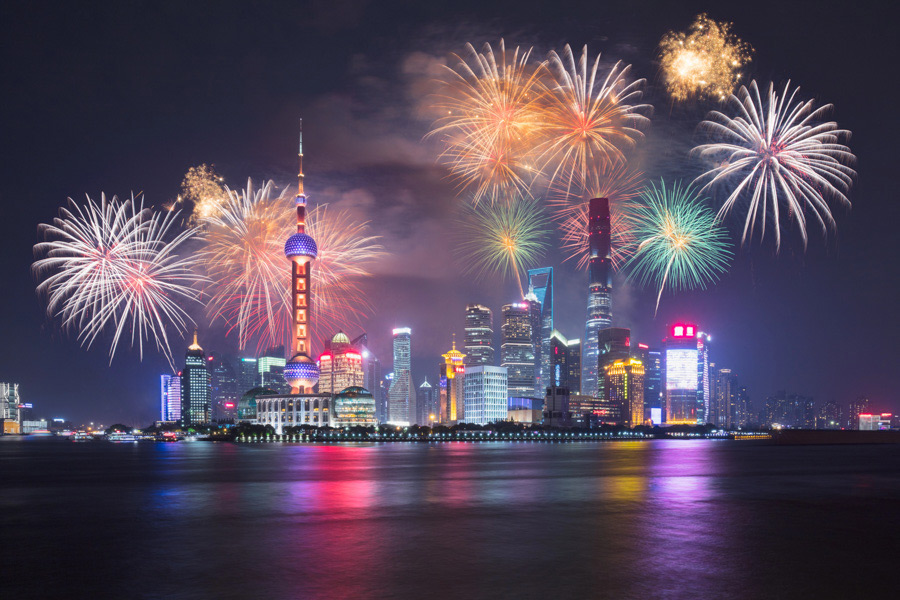
In China, New Year’s Day has followed the Gregorian calendar since 1912 and is observed as a short modern public holiday. It is often accompanied by festive lights, special meals and public events. In Beijing, some people gather at Tiananmen Square to watch the national flag raised, while in Shanghai, Guangzhou and other major cities, waterfronts, squares and skyscrapers are frequently illuminated for the occasion. Many companies, universities and cultural venues also organise New Year concerts or gala performances.
Unlike the lunar calendar-based festivals, Yuandan does not carry the same traditional, ritual significance. For many people, it is a time to meet friends, go out to dine, do some shopping or simply enjoy the first days of the new year.
Spring Festival (Chunjie, 春节) / Chinese Lunar New Year
The first day of the first lunar month marks the beginning of Spring Festival, also known as the Lunar New Year and China’s most important holiday season. Across the country, daily life shifts into a different rhythm as hundreds of millions of people travel home for the New Year’s reunion dinner. At the centre of the celebration is the family table, often bringing several generations together.
Certain foods carry particular meaning. Fish is associated with abundance and prosperity; dumplings are especially common in northern China, and rice cakes are widely eaten in the south. Fireworks and firecrackers, traditionally believed to drive away evil spirits, add sound and colour to the holiday atmosphere, though their use is restricted in some cities today.
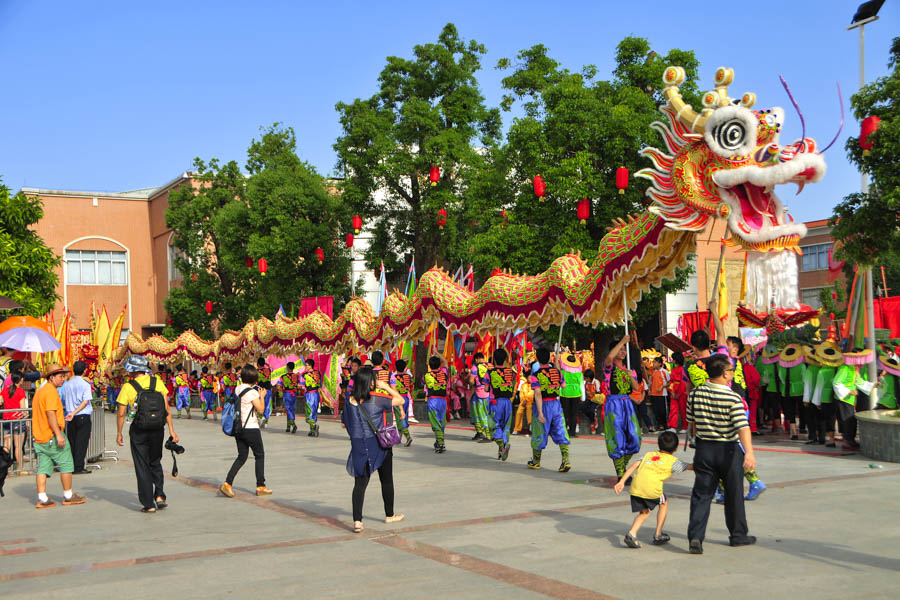
During Chinese New Year, relatives and friends exchange red envelopes known as hongbao (红包), usually containing money and given as a wish for happiness, health and good fortune. Streets and homes are decorated with red lanterns and festive couplets, while temple fairs in major cities bring together lion and dragon dances, street food, folk performances and seasonal games.
On New Year’s Eve, many families watch the CCTV Spring Festival Gala, a long, televised variety show of music, comedy, dance, acrobatics and elaborate stage effects. For many households, it has become as much a part of the evening as the meal itself.
Qingming Festival (清明节)
Qingming Festival is linked to the solar calendar rather than the lunar calendar and usually falls in early April, when spring is well under way. The name “Qingming” means “clear and bright”, and the festival is closely associated with remembrance, renewal and the first outdoor days of the season.
The central custom is ancestor worship. Families visit cemeteries to clean graves, bring offerings such as food and tea, and burn incense and paper offerings for the deceased. The mood is reflective rather than gloomy: it is a day for memory, respect and family continuity.
After visiting ancestral graves, many people spend time outdoors. Spring outings known as taqing (踏青), or “stepping on the green”, are a long-standing part of the season’s traditions. Parks and riversides attract walkers and kite-flyers; teahouses serve fresh spring tea, and qingtuan (青团) – green sticky rice cakes, often flavoured with mugwort – are a popular seasonal treat.
Labour Day (Laodong Jie, 劳动节)
Labour Day falls on 1 May. Its origins are tied to the international labour movement, and in China, it was officially established as a public holiday in 1949. Over the following decades, it became associated with socialist ideals and the recognition of workers’ contribution to the new state. In the early years of the People’s Republic of China, the holiday was often marked by parades, rallies and honours for model workers.
Today, Labour Day has a more everyday public feel. The holiday period is now closely associated with domestic travel, short family breaks, shopping and city events. For many people, it is one of the main opportunities in the year to take a short trip.
This also makes Labour Day one of China’s busiest travel periods after Spring Festival. Trains and flights tend to book up quickly, resorts and national parks receive large numbers of visitors, and shopping centres organise major sales. In cities such as Shanghai, Beijing and Chengdu, holiday programmes may include food festivals, concerts and cultural events. If you’re planning to travel at this time, it is wise to book transport and accommodation well in advance.
Dragon Boat Festival (Duanwu Jie, 端午节)
Dragon Boat Festival is one of China’s most vivid summer holidays. It is marked by the sound of drums, the synchronised movement of the oars and the sight of brightly decorated dragon boats on the water. The best-known story associated with the festival is linked to Qu Yuan (屈原), a poet and statesman from the ancient state of Chu, who is traditionally said to have drowned himself in the Miluo River in 278 BC after his homeland fell to the Qin.
According to legend, local people raced out in boats to look for him and threw rice into the river to keep fish away from his body. From this story come two of the festival’s best-known traditions: dragon boat racing and eating zongzi (粽子), sticky rice dumplings wrapped in bamboo leaves.
Today, dragon boat races are held on rivers and lakes across China. Teams row in rhythm to the beat of a drum, while crowds gather along the banks to watch. Zongzi come with many regional fillings, from pork and beans to red dates and sweet pastes.
Other customs reflect older ideas of protection and good health. Bundles of mugwort and calamus are hung on doors to ward off harmful influences, and children may wear five-coloured silk threads as a wish for good luck and well-being. Since 2009, the Dragon Boat Festival has been included on UNESCO’s Representative List of the Intangible Cultural Heritage of Humanity.
Mid-Autumn Festival (Zhongqiu Jie, 中秋节)
Celebrated on the fifteenth day of the eighth lunar month, the Mid-Autumn Festival falls at the time of the full moon. It is traditionally associated with reunion, harmony and longing for loved ones far away. Its calm, moonlit atmosphere makes it one of the most memorable evenings in the Chinese calendar.
The festival is closely linked to the legend of Chang’e (嫦娥), the moon goddess and wife of Hou Yi, the archer. According to the best-known version of the story, she drank the elixir of immortality, rose to the heavens and made the moon her eternal home.
Mooncakes (月饼) are the festival’s central food. These dense, round pastries are often filled with lotus seed paste, red bean paste or salted egg yolk, and their shape symbolises the full moon. Families gather for dinner, look up at the night sky and exchange mooncakes in decorative boxes.
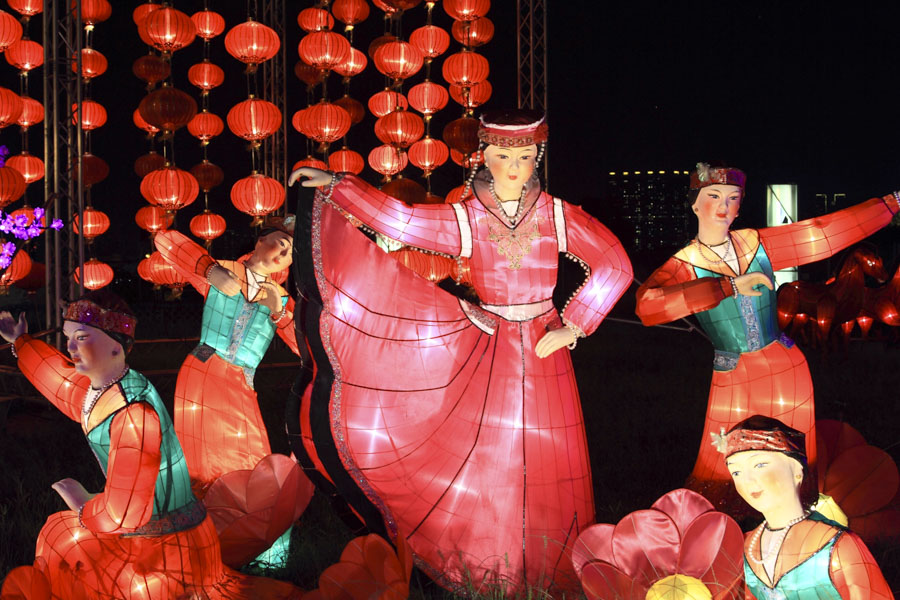
Lanterns also add to the evening atmosphere, especially in parks, gardens and historic districts. Places such as West Lake in Hangzhou, Crescent Lake in Dunhuang, the Bund in Shanghai and Beihai Park in Beijing are often regarded as especially memorable.
National Day and Golden Week (Guoqing Jie, 国庆节)
National Day is celebrated on 1 October and marks the founding of the People’s Republic of China in 1949. It is the country’s main modern state holiday and is associated with national identity, unity and public ceremony. Red flags appear across cities, official buildings are decorated, and Tiananmen Square becomes the symbolic focal point of the celebrations.
On major milestone anniversaries, especially the decade mark, large-scale military parades may be held in Beijing. In other years, the holiday is typically marked by a morning flag-raising ceremony, fireworks, concerts, exhibitions and cultural events across the country.
National Day also signals the start of Golden Week (黄金周), a seven-day national holiday introduced in 1999 to support domestic tourism and consumption. During this time, hundreds of millions of people travel to visit family, take holidays, explore national parks or return to their hometowns.
Golden Week is one of the busiest travel periods in China. Popular destinations such as Zhangjiajie, Guilin and the Great Wall can become extremely crowded, while train tickets, flights and hotels sell out quickly. For visitors, it can be an exciting time to see the country in celebration, but it requires careful planning and early booking.
School Holidays in China
The academic year in China is usually divided into two semesters. The first begins in September and runs until mid-January, while the second starts in late February or early March and continues until June. Most schools observe two main school holiday periods during the year.
Winter holidays generally fall between late January and late February, often lasting around four weeks, and they usually coincide with the Spring Festival. Summer holidays run through July and August and are the longest break of the academic year, lasting about eight weeks. In addition, schoolchildren have time off for public holidays, including National Day and Golden Week, as well as Labour Day. If you’re planning to travel, it’s worth keeping the school timetable in mind, as popular destinations become noticeably busier during these periods.
There isn’t one single nationwide school calendar across China. Holiday dates are set separately by local education authorities, most of the time at the city or provincial level. In many places, the academic year begins around 1 September, though the date is not the same everywhere.
The Gaokao, China’s national university entrance examination, is particularly important in the country’s education system. It is usually held on 7 June and may last from two to four days, depending on the province. During the exam period, roads near examination centres may be affected, and many parents wait nearby to greet their children after the exams, sometimes with flowers.
National Day and Closures
Golden Week and National Day are among the busiest periods on China’s travel calendar and can create one of the longest public holiday breaks of the year. Government offices, embassies, schools and universities are closed throughout the holiday. Banks and post offices usually operate only through major branches in city business districts, so it is sensible to arrange currency exchange and other financial matters in advance. Most hospitals continue to receive patients, though some specialist services may be limited.
Shops, shopping centres, restaurants and tourist attractions generally remain open, and many extend their hours or run seasonal promotions. Public transport operates as usual, but demand is high. Train and flight tickets, as well as hotel accommodation, should be booked well in advance, ideally several months before travel. During Golden Week and other official public holidays, private cars with seven seats or fewer can usually use motorways toll-free, which adds further pressure to road traffic.
Religious Holidays in China and Closures
China is a secular state, yet religious traditions and spiritual practices remain important in the lives of millions of people. The government officially recognises five religions: Buddhism, Taoism, Islam, Catholicism and Protestantism. Although religious festivals are not national public holidays, the change is often felt around temples, churches, mosques and historic communities where these traditions have long been part of daily life.
Buddhism
Buddhism has one of the oldest and most visible religious presences in China, with more than one hundred million worshippers and about 34,000 temples across the country.
Among the most important Buddhist festivals are Buddha’s Birthday (佛诞节, Fódàn Jié), Bodhi Day (成道日, Chéngdào Rì) and Parinirvana Day (涅槃节, Nièpán Jié). On these occasions, worshippers take part in temple ceremonies, make donations to monasteries, follow a vegetarian diet, and sometimes release birds or fish as a symbolic act of compassion. Incense rises above temple courtyards, monks chant sutras to the slow sound of bells, and pilgrims bring flowers, fruit and red candles to the altars.
Government offices, banks, shops, museums and most tourist attractions generally continue to operate as usual. The main differences are concentrated around major Buddhist temples, where visitor numbers rise during festival periods. Queues may form at entrances, and some prayer halls or pavilions may close temporarily for religious services. If you would like to observe rituals while avoiding the largest crowds, an early-morning visit is the best option.
Taoism
For more than two millennia, Taoism has formed part of China’s spiritual and cultural heritage, influencing ideas of harmony, health, medicine, martial arts and the relationship between people and the natural world. Today, China has more than 9,000 Taoist temples and monasteries, many of them set in mountains long regarded as sacred.
Among the most significant Taoist festivals are the Birthday of the Jade Emperor (玉皇诞辰, Yùhuáng Dànchén) and the Birthday of Laozi (老子诞辰, Lǎozǐ Dànchén). The Three Yuan Festivals (三元节, Sānyuán Jié) also hold an important place in Taoist tradition. This cycle includes the Lantern Festival (元宵节, Shàngyuán Jié), associated with the glow of lanterns at the close of the New Year celebrations; the Ghost Festival (中元节, Zhōngyuán Jié), dedicated to ancestors and wandering spirits; and the Water Festival (下元节, Xiàyuán Jié), when prayers are offered for well-being, purification and harmony. On these days, temples may be decorated with prayer ribbons, while worshippers light incense and make offerings of fruit and tea.
Visitor numbers can rise noticeably at Taoist temples during major festival days. Beyond the temple complexes, however, daily life continues much as normal: government offices, shops, transport services and city infrastructure are generally unaffected.
Islam
Islam in China is closely associated with several ethnic communities, particularly the Hui, Uyghur, Kazakh, Dongxiang, Kyrgyz and Salar peoples, and is practised by around 18 million people. Mosques can be found across the country, and Muslim neighbourhoods are often recognisable by their halal restaurants, market stalls, busy food streets and minarets rising above older urban quarters.
The main Muslim festivals are Eid al-Fitr (开斋节, Kāizhāi Jié), which marks the end of Ramadan, and Eid al-Adha (古尔邦节, Gǔ’ěrbāng Jié), which commemorates Ibrahim’s willingness to make a sacrifice. On these days, worshippers gather for communal prayers, visit relatives, prepare festive dishes and share food with neighbours and those in need.
The most visible celebrations take place around major mosques and in Muslim neighbourhoods. Areas such as the Id Kah Mosque in Kashgar and Xi’an’s Muslim Quarter become especially lively, with halal markets, restaurants and public gatherings drawing large crowds. Elsewhere, daily routines and transport services continue with little change.
Catholicism
Catholicism has a long and complex history in China, reaching back more than seven centuries. Its earliest traces can be found at the Stele Forest Museum in Xi'an, where the Nestorian Stone is displayed. The Assyrian monk Alopen travelled the Silk Road and brought Christianity there. The first Franciscan mission appeared in the late thirteenth century, and in the late sixteenth century the Jesuit Matteo Ricci became one of the most influential figures in exchange between Chinese and European intellectual traditions, including the introduction of Western scientific knowledge to Chinese scholars. Today, China has thousands of Catholic churches, some of which are also valued as architectural and historical landmarks.
The main Catholic festivals are Christmas (圣诞节, Shèngdàn Jié) and Easter (复活节, Fùhuó Jié). Churches may be decorated with fir wreaths, candles and flowers, while solemn masses, choral hymns and family gatherings mark the occasion. In major cities, Christmas is also visible beyond church communities, with lights, seasonal displays, decorated shop windows and festive markets adding to the atmosphere.
The Cathedral of the Immaculate Conception in Beijing, St Ignatius’ Cathedral in Shanghai and St Francis’ Cathedral in Yichang attract particularly large numbers of worshippers and visitors during major services. Outside church districts, public transport, shops, museums and historical attractions operate as usual.
Protestantism
Protestant Christianity spread more actively in China during the nineteenth century, with the arrival of European and American missionaries. Unlike Catholics, who recognise the authority of the Pope in Rome and Church Tradition, Protestants base their faith primarily on the Bible and do not recognise any equivalent authority.
Today, Protestant communities are present in all major Chinese cities, with tens of millions of believers across the country.
Christmas and Easter are the most important festival periods for many Protestant congregations. Services often include hymn singing, communal prayers, festive concerts and family gatherings. In some cities, church music evenings and Christmas concerts are open not only to worshippers but also to visitors who wish to attend.
The festive atmosphere is especially noticeable at churches such as Moore Memorial Church in Shanghai and Chongwenmen Church in Beijing, where major services draw large congregations. These celebrations do not generally affect the operation of banks, restaurants, public transport or other city services.
Things to Do in China on Official Holidays
Holidays in China are often best understood away from the main sightseeing routes. Pause in a city square, step into a market, or join an evening walk, and the rhythm of the celebrations starts to reveal itself – through food stalls, lanterns, music, family outings and small seasonal rituals.
On the first day of the year, city parks offer a quiet glimpse of the new calendar cycle. Before many visitors have begun their sightseeing, local residents are already practising Tai Chi Chuan, dancing, jogging or gathering in small groups before stopping for hot baozi and sweet rice buns from nearby stalls. In recent years, grand events have been organised to showcase China’s intangible cultural heritage. In Beijing, for example, giant laser character parades with fireworks take place. Drone shows are also organised in several cities, bringing striking scenes to the public while highlighting the country’s technological advances. In 2026 Chongqing, referred to as the 8D city, released 8,000 drones before the New Year countdown.released 8,000 drones before the New Year countdown. Taking part in events like these reveals the modern side of the country and offers an extraordinary way to celebrate the New Year.
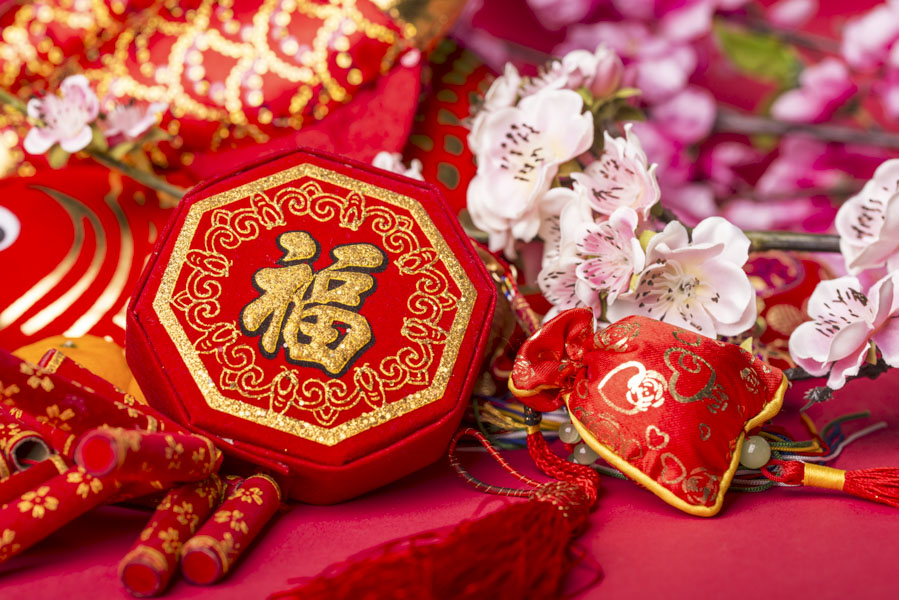
During the Spring Festival, small family-run workshops are kept busy cutting red paper decorations known as chuanghua (窗花). You may also see the character fu (福) written on scarlet paper and hung upside down – a familiar New Year custom based on wordplay that suggests that good fortune has arrived. To celebrate it the local way, on the first day buy new clothes, exchange New Year greetings, eat traditional food, visit a temple and burn incense to pray for good luck. To take the pulse of the country, over the next few days, visit different cities. Then you will return home refreshed.
At Qingming Festival, the season itself becomes part of the experience. Blossoming avenues, riverside paths and tea-growing areas draw people outdoors, while teahouses begin serving fresh spring harvests. A bike ride followed by a cup of new-season tea fits the day’s quieter mood. You can also fly a kite; they come in all sorts of varieties. According to local tradition, to get rid of your bad luck, fly it away by cutting the string of your kite and letting it go. Finally, be sure to try qingtuan and sanzi, two delicious local specialities.
Labour Day has a more public, leisurely feel. Go to a riverside promenade, browse a night market, or take in the city viewpoints after dark as the lights of the metropolis gradually come on after sunset.
During the Dragon Boat Festival, arrive early to watch the boats being prepared and to cheer on the paddlers during the race. Shouting encouragement, clapping along, and getting swept up in the energy of the crowd is really great fun!
Small protective details appear alongside the races and festive food: herbal drinks made with mugwort, embroidered xiangbao (香包) pouches worn as amulets, and the sound of drums carrying across the water all add to the atmosphere.
At the Mid-Autumn Festival, the atmosphere becomes gentler. Choose a viewpoint, lakeside path or garden terrace from which to watch the full moon rise, then stroll among lanterns and enjoy mooncakes with the evening views.
National Day is most vividly felt on the streets. Join the locals on a walk through decorated squares, take photos from a balcony viewpoint, and enjoy an evening outing with the festive atmosphere.
Chinese holidays are rooted in family traditions, seasonal food, red lanterns over narrow lanes, temple bells, public gatherings and the wish to spend meaningful days with loved ones. Each festival returns with the changing seasons, bringing people together through familiar rituals and renewed expectations year after year. For travellers, engaging in those festivities can make China feel less like a route of landmarks and more like a lived-in country.