

He Long Park (贺龙公园) sits in the heart of Zhangjiajie, at the foot of mist-shrouded quartzite peaks. It is the city’s main gateway to the landscape often described as the “floating mountains” and a natural starting point for journeys into Tianzi Mountain, where some of Zhangjiajie National Forest Park’s most famous pillar views are concentrated.
Named after He Long, the celebrated Communist revolutionary who was born in this region, the park has a dual character: part memorial Red Education Base and part mountain plateau open to tourism. Visitors often pass through on their way to the cable car, but it is worth lingering. Shaded paths, open viewpoints, and glimpses of stone pinnacles through the trees give the park a quieter rhythm before the ascent.
From here, the cable car carries you towards the high ridges of Tianzi Mountain. As you climb, the landscape opens beneath you: sandstone pillars rising from deep green valleys, mist-softened gorges and ridgelines fading into the distance. On clear days, you can read the shape of the terrain from above; in cloudier weather, the peaks appear and vanish through the moving mist, so the view changes minute by minute.
He Long Park Tours
He Long Park features on several of our China tours and marks a welcome change of pace.
The 10-day China Sightseeing Tour offers a broad introduction to the country, moving from the Forbidden City in Beijing and the Terracotta Army in Xi’an to the modern skyline of Shanghai.
Zhangjiajie sits at the heart of the journey, where the emphasis shifts from imperial history and urban scale to mountain scenery. Here, He Long Park serves as a natural gateway to Tianzi Mountain and the pillar landscapes that give this part of Hunan its distinctive character.
The 15-day China Group Adventure follows a different rhythm, focusing on China’s natural landscapes rather than its cities. The route includes the Longsheng Rice Terraces, a cruise on the Li River, the glass-bottomed bridge over Zhangjiajie Grand Canyon, and the rocky trails of Tianmen Mountain. Within this fuller outdoor itinerary, He Long Park provides a quieter pause between cable-car rides, narrow paths, deep gorges, and high viewpoints — a place to gather your bearings before the mountains open out again.
Best Time to Visit He Long Park
He Long Park is open throughout the year in a mid-subtropical mountain monsoon climate, and the landscape around Zhangjiajie changes markedly with the seasons.
Spring (March to May), 15 to 25°C (59 to 77°F), brings fresh greenery, flowering slopes, and mist over the peaks after rain. April is usually the most scenic month; May marks the start of the rainy season. This is a busy travel period, so it is worth booking accommodation in advance.
Summer (June to August), up to 33°C (91°F), is lush, green, and often misty after showers. It is also peak season, with high humidity and longer queues on popular routes.
Autumn (September to November), 18 to 28°C (64 to 82°F), is often the best time to visit. Rain is less frequent, the air is clearer, and the forests begin to turn gold and red. There are also noticeably fewer visitors than in summer.
Winter (December to February), 1 to 8°C (34 to 46°F), is the quietest season, suited to travellers who prefer a calmer visit. On clear days, the snow-dusted peaks stand out sharply against the sky.
Opening hours: 08:00 to 18:00
Entrance fee: Free. Entry to He Long Park is included in the general Zhangjiajie National Forest Park ticket.
History and Legends of He Long Park
Tianzi Mountain is closely associated with Marshal He Long (1896-1969), one of Hunan’s best-known figures. This Tujia people’s land, and He Long was born and raised here in a poor family. He went on to become a senior military leader of the People’s Republic of China and the People’s Liberation Army (PLA), serving with the Ground Force, before the Cultural Revolution.
In the 1930s, Tianzi Mountain features in his revolutionary campaigns, and locals still tell stories from that time. One legend says that when He Long was surrounded by armed troops near Luoguta, peasants hid him inside a rolled-up mat and saved his life.
In 1935 he joined the Long March (长征) during the Chinese Civil War.
He Long Park was established in 1986 to mark the marshal’s 90th birthday. In 1995, Jiang Zemin, then General Secretary of the Communist Party of China, personally carved the park’s name in calligraphic script on a stone, and this inscription remains on display.
In 1997 the site was designated a Provincial Protected Memorial.
After He Long’s death in 1969, his remains were interred for many years at Babaoshan Revolutionary Cemetery in Beijing (北京市八宝山革命公墓). In 2009, his ashes were reburied in He Long Park, and in 2012, his wife, Xue Ming, was laid to rest beside him.
Things to Do in He Long Park
He Long Park is a major stop on the Tianzi Mountain route and an important memorial site. Many Chinese visitors come here to honour Marshal He Long. The park, which is also connected with patriotic education and the history of the Communist Party of China, offers spectacular viewpoints for memorable photographs.
Bronze Statue of He Long
The park’s centrepiece is a 6.5-metre bronze statue of He Long, weighing 9 tonnes, set atop Yunqing Rock. The marshal is depicted holding a pipe, one of the most recognisable features. A horse stands at the base.
He Long Memorial
The graves of He Long and his wife lie in a quiet section of the park. The memorial is decorated with a bas-relief of the marshal in profile, wearing the classic cap of the Chinese People’s Liberation Army, the Jiefang mao (解放帽), and holding his pipe. On commemorative dates, visitors leave fresh flowers at the graves.
Revolutionary Heritage of He Long Park
Along the park’s paths are memorials to those involved in the revolutionary movement. The Museum of Weapons (兵器馆) and the Exhibition Hall (陈列馆) display materials on He Long’s life and revolutionary career, while the General’s Stele Forest (将军碑林) preserves inscriptions and dedications to military commanders linked with Tianzi Mountain.
Large bas-reliefs around the park depict scenes from the revolutionary struggle, with soldiers, commanders, and local residents carved on stone. Together, these monuments explain why He Long Park is regarded not only as a scenic stop but also as the main historical memorial in the Tianzi Mountain area.
Scenic Viewpoints and Photo Spots
He Long Park sits on Yunqing Rock (云青岩), a 100 square metre stone platform, at about 1,100 metres above sea level, and has several viewpoints over Tianzi Mountain.
As you follow the park’s paths, you will pass viewing platforms with classic Zhangjiajie panoramas. Highlights include Imperial Writing Brush Peak (Yubi Peak, 御笔峰), a cluster of stone pillars about 100 metres high that resemble upturned writing brushes, and Fairy Offering Flowers (仙女散花), a formation said to look like a maiden carrying a basket of flowers.
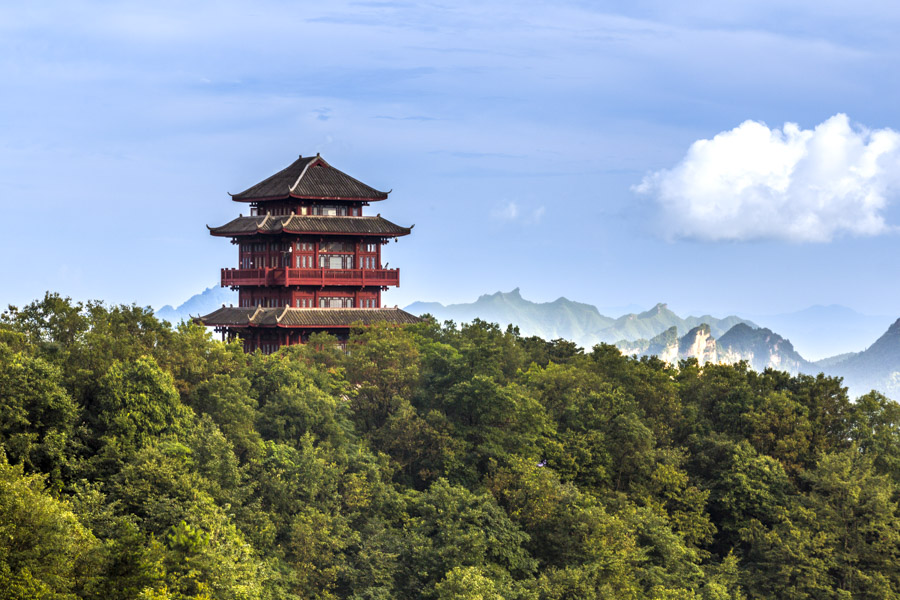
From the main terraces, you can also see the Tianzi Pavilion (天子阁), a multi-storey pagoda built in traditional Chinese style.
Finish your walk at the Yunqing Rock viewing platform, a few steps from the park exit. From here, there is a wide view across the West Sea Peak Forest (西海峰林), where hundreds of quartzite pillars stretch into the distance, often fading into the mist.
How to Get to He Long Park
The entrance to He Long Park is next to He Long Park Station (贺龙公园站), one of the eco-shuttle stops inside Zhangjiajie National Forest Park. Shuttle buses connect the main scenic areas, including Tianzi Mountain Cableway Upper Station (天子山索道上站), which is about 1.5 kilometres (0.93 miles) from the park.
The eco-shuttles generally operate from 08:00 to 19:00 and until 18:00 in winter. Shuttle rides are included in the Zhangjiajie National Forest Park ticket, so you can use the buses as often as you need while your ticket is valid.
To reach He Long Park from Zhangjiajie city, first travel to the East Gate of the Wulingyuan Scenic Area in the Wulingyuan District. Local buses run from Zhangjiajie Central Bus Station to Wulingyuan Bus Station; the journey takes about one hour and costs around CNY/RMB 20 (approximately $2.80 / €2.50 / £2.10).
From Wulingyuan Bus Station, the East Gate is about a 15-minute walk or a five-minute taxi ride.
After entering the scenic area, take the eco-shuttle to Tianzi Mountain Cableway Lower Station (天子山索道下站), located at the Site of Sansuo in the Suoxiyu Scenic Spot (29.3772° N, 110.5101° E). From there, you can continue by cable car towards Tianzi Mountain and He Long Park.
He Long Park Tips for an Optimal Visit
A visit to He Long Park usually forms part of a full day at Tianzi Mountain, so a little planning makes the route much easier.
Queues and logistics
The cable car is the busiest point at Tianzi Mountain. At weekends and on public holidays, waiting times can reach 1 and a half hours. Eco-shuttles usually run regularly, but queues may also form at stops during busy periods. Aim to arrive when the park opens at 08:00 and return to the cable car before the main rush.
Clothing and footwear
Wear non-slip trainers or sturdy walking shoes with good tread. Leather shoes, sandals, and heels are unsuitable for the steps, stone paths, and wooden walkways. Dress in layers: a moisture-wicking base layer, a thin jumper, and a light windproof jacket, as mountain temperatures can be more than 10°C cooler than the city. In winter take gloves and a hat. A lightweight foldable raincoat is useful year-round.
Weather and rain
Summer showers are often short, usually lasting around 30 to 40 minutes. Once they pass, the clouds may lift to reveal clearer views of the peaks and valleys, so it’s worth waiting if platforms are misty. During thunderstorms, keep away from tall trees and exposed viewpoints.
Safety
Do not climb over fences or lean over railings for photographs. Stay on marked paths, especially in wet or misty conditions.
Money and communications
Most shops inside the park accept mobile payments, including WeChat Pay and Alipay, but carry a small amount of cash. Mobile internet in the Tianzi Mountain area is generally reliable for navigation and mobile payments.
He Long Park offers a unique glimpse into a modern chapter of Chinese history, far from Beijing and viewed from the province perspective. Away from the crowds, the site's spectacular scenery will captivate visitors seeking tranquility during a day of sightseeing.