

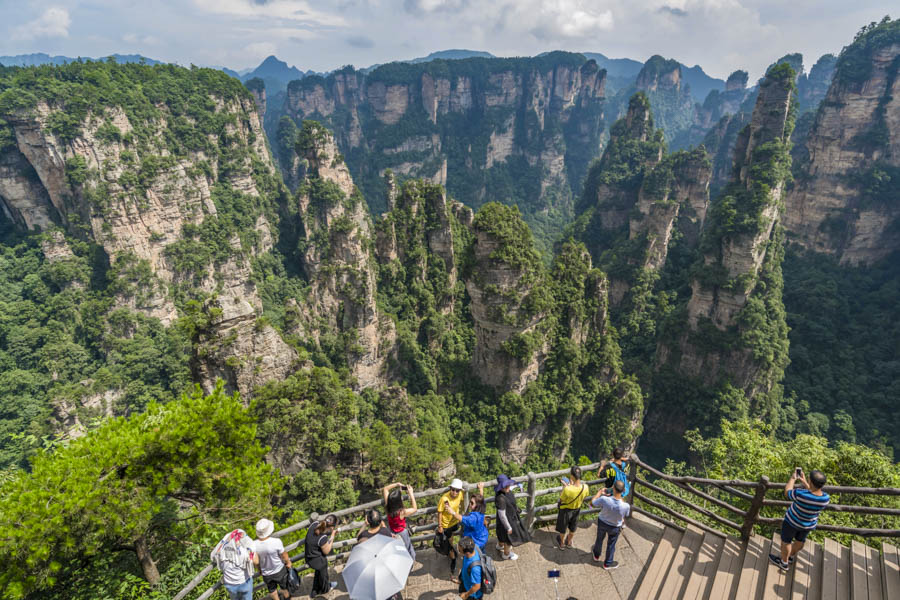
Tianzi Mountain Scenic Area (天子山景区) covers 67 square kilometres in the northern part of the Wulingyuan Scenic Area, about 35 kilometres (21.7 miles) from central Zhangjiajie and 5 kilometres (3.1 miles) from Wulingyuan District. Part of Zhangjiajie National Forest Park, Tianzi Mountain has earned the grand title “the Monarch of the Peak Forest”. Its highest point, Kunlun Mountain, rises to 1,262.5 metres, giving the area a commanding presence within the wider Wulingyuan landscape.
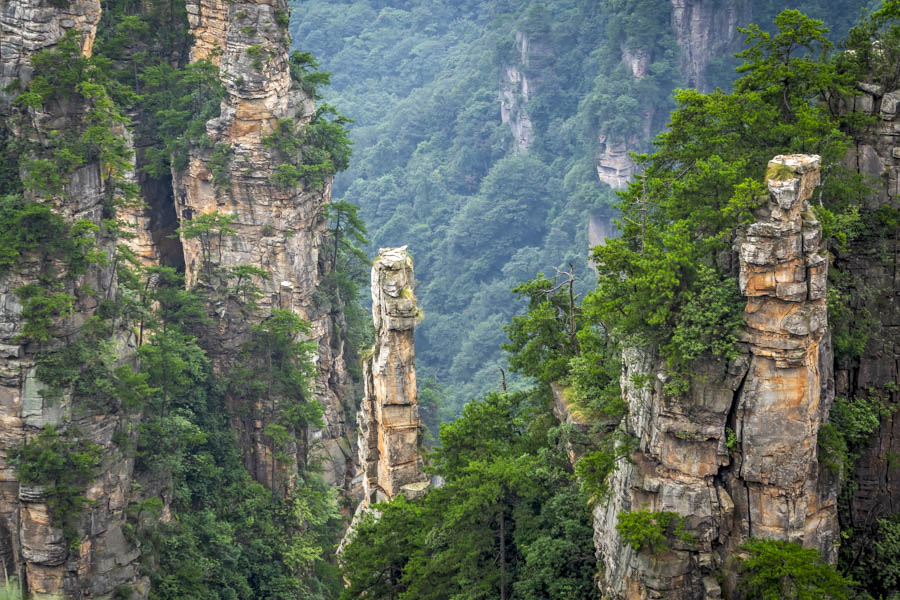
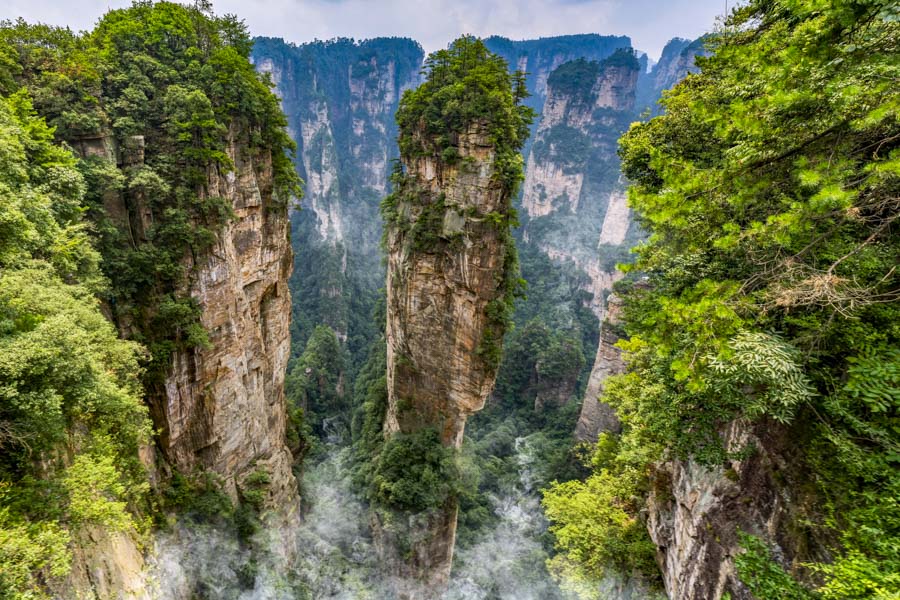
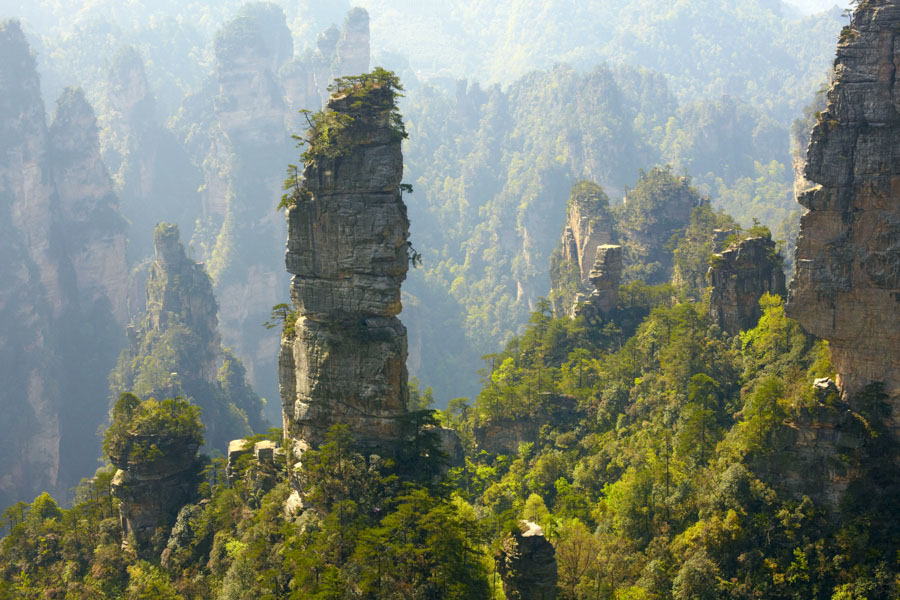
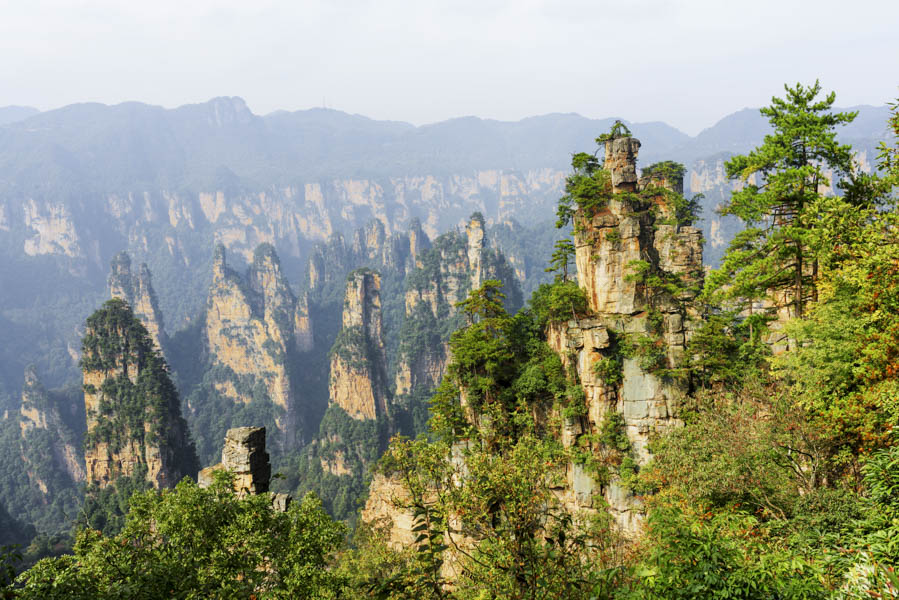
Tianzi Mountain is one of Zhangjiajie’s most unforgettable landscapes, where thousands of quartz sandstone pillars, formed from ancient rock and sculpted by immense spans of erosion, rise above deep ravines and narrow gorges, often veiled in mist. Across this vast stone forest, more than 80 viewing platforms look out over the scenery from different angles. At dawn, the cliffs gradually emerge through drifting cloud; by evening, their summits melt into a dense blue-grey haze. This constant shift of light, scale, and atmosphere gives the mountain its particular sense of depth and movement.
Tianzi Mountain Tours
Explore Tianzi Mountain as part of a 10-day journey through some of China’s most remarkable cultural and natural landscapes. The route begins with the monumental sights of Beijing and the historic landmarks of Xi’an before continuing to Zhangjiajie, where deep valleys, narrow gorges, and forested sandstone peaks create a mountain setting unlike anywhere else in China.
Here, you will ride one of the world’s longest cable cars towards the Heaven’s Gate of Tianmen Mountain, look out across the Grand Canyon from the glass bridge, and take in the soaring peaks of Yuanjiajie, whose unusual forms helped inspire the landscapes seen in the movie Avatar.
From Zhangjiajie, the journey continues to Shanghai, where busy intersections, riverside towers, and illuminated skyscrapers introduce a very different rhythm. Within this wider itinerary, Tianzi Mountain occupies a special place: a quieter, more elemental encounter with China’s natural scenery, where stone pillars, drifting mist, and deep mountain silence leave a lasting impression.
Best Time to Visit Tianzi Mountain
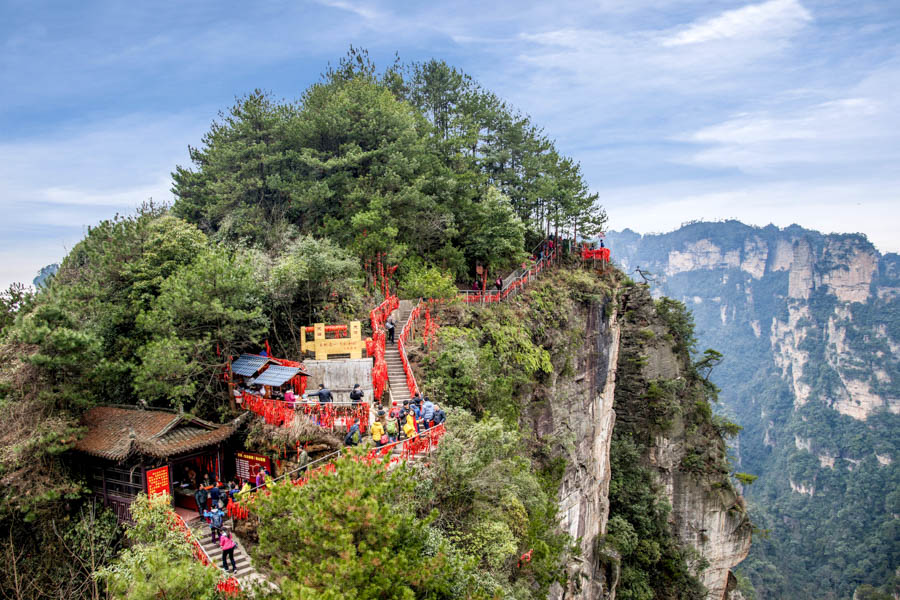
Tianzi Mountain lies in a subtropical monsoon climate and changes with the weather, the light, and the season. The same landscape can feel different hour by hour: cliffs appear and vanish in mist, distant peaks sharpen after rain, and the stone forest takes on a new character as the year moves on. For this reason, choose your timing to make the journey comfortable and to enjoy the type of scenery you prefer.
Spring (March to May) brings mist, damp air, and vivid new greenery. Gorges are often wrapped in cloud, and the rocks can seem to rise out of empty space. Temperatures typically range from 15 °C to 25 °C (59 °F to 77 °F). Spring is especially photogenic on Tianzi Mountain, although thick mist can sometimes hide distant views. In April and May, mountain trees and rhododendrons bloom; after rain, the forest exhales the perfume of wet stone and pine resin.
Summer (June to August) is a season of heavy clouds, lush slopes, and saturated colours. The mountainsides feel dense and almost subtropical, with dark greenery carpeting the ravines, while the tops of the stone pillars appear and disappear in mist. Temperatures often reach 28–33 °C (82–91 °F), though the viewing platforms are noticeably cooler than the valley. Summer is especially popular with domestic visitors, so queues for cable cars and shuttle buses can be long. The calmest time to visit is soon after the park opens.
Autumn (September to November) is generally regarded as the most comfortable season for visiting Tianzi Mountain. The air becomes drier and clearer, temperatures fall from about 29 °C (84 °F) in September to around 10 °C (50 °F) in November, and visibility is often at its best. In October, the slopes begin to turn ochre and amber. This is when the stone forest looks more defined and the chances of far-reaching panoramas are much higher.
Winter (December to February) is the quietest season. Temperatures can drop to about 2 to 10 °C (36 to 50 °F), and peaks are sometimes edged with frost. Streaks of snow against the dark quartz-sandstone pillars create a strikingly unusual winter scene in Wulingyuan. Visitor numbers are much lower, and queues are minimal, though on icy days, some trails, viewing platforms, or cable cars may be temporarily closed for safety reasons.
Practical Additional Information
Opening Hours
Opening hours in the Tianzi Mountain Scenic Area vary slightly by season. From March to November the area is usually open from 07:00 to 18:00. In the quieter winter months, from December to February, opening hours are generally from 08:00 to 17:00.
The Tianzi Mountain cable car operates from 07:30 to 17:30 in high season and from 08:00 to 17:00 in low season. Schedules may change due to weather, maintenance, or visitor flow, so it is worth checking the latest information before your visit.
Tickets and Entrance Fees
DISCLAIMER: Ticket prices are listed in local currency and may change without prior notice. Exchange rates are provided for reference only and may fluctuate. As a tour operator, Advantour is not responsible for errors, omissions, later price changes, exchange-rate differences, or services provided by third parties. Travellers are advised to check fares, terms and conditions, availability, and booking details with official suppliers or authorised booking platforms before making a reservation.
A visit to Tianzi Mountain is included in the combined ticket for Zhangjiajie National Forest Park. The ticket is valid for four consecutive days and includes use of the park’s internal shuttle buses. However, each visit date and time slot must be registered at the ticket office in advance.
As a general guide, the entrance fees are:
| Visitor Category | Price |
| Visitor Category | Price |
| Adults (18–59 years old) | CNY/RMB 239 ($33.30, €29.40, £24.80) |
| Teenagers (14–17) & Seniors (60–64) | CNY/RMB 122 ($17, €15, £12.70) |
| Seniors (65+) | CNY/RMB 39 ($5.40, €4.80, £4.10) |
| Children under 14 | Free* |
* An insurance fee of around CNY/RMB 3 may be payable separately for children.
Cable car fares are charged separately. A one-way ride costs around CNY/RMB 72 ($10 / €8.90 / £7.50), while a return ticket costs around CNY/RMB 144 ($20.10 / €17.80 / £15).
Festivals and Cultural Performances
A visit to Tianzi Mountain can also offer a glimpse into the culture of the local Tujia ethnic minority, particularly during seasonal festivals and community events.
Since 2022, the Rice Seedling Transplanting Festival (張家界插秧节) has been held in May or June at the foot of the mountain, around the scenic Laowuchang (老屋场) area, Sky Field Garden (空中田园), and Dongwangping Village (东旺坪村). The festival brings together farming traditions, music, and local celebration, with ox-ploughing demonstrations, duck-catching games, traditional songs, lively dances in costume, and the rhythmic sound of drums.
History and Legends of Tianzi Mountain
A Landscape Carved by Time
Around 380 million years ago, the area now known as Tianzi Mountain lay beneath the SEA. Over long periods, marine sediments built up on the seabed, were compacted by water pressure, and gradually hardened into quartz sandstone. As the Earth’s crust uplifted and the waters retreated, the rock was exposed to wind, rain, and slow erosion. Layer by layer, over immense stretches of time, the stone forest took the form we see today.
The quartz sandstone layer here reaches up to 500 metres, creating Zhangjiajie’s unusually deep and dramatic pillar landscape. In 2010, this distinctive type of scenery was officially recognised internationally as the Zhangjiajie landform, joining established geological terms such as karst and geyser. The area was inscribed on the UNESCO World Natural Heritage List in 1992 and became part of a UNESCO Global Geopark in 2004.
The Legend of Xiang Dakun
Before the Ming Dynasty (1368–1644), the region’s highest peak was known as Qingyan Mountain, or “Green Rock Mountain”, a name reflecting the greenish tone of the stone. Its later name is associated with the story of Xiang Dakun, a leader of the local Tujia people who, in 1353, led a rebellion against the ruling power. He is said to have gathered many followers and proclaimed himself Xiang Wang Tianzi – “King of Heaven” – a title traditionally associated with supreme authority in Chinese political culture.
In 1385, the Hongwu Emperor dispatched an army of some 10,000 troops to Hunan to suppress the rebellion uprising. After about 40 days of fierce fighting, Xiang Dakun was killed at the foot of the mountain. The peaks have borne his name ever since, and the tale of the local leader who challenged imperial authority remains part of the area’s folklore.
The Fairy Offering Flowers
The legend does not end with Xiang Dakun’s death. According to local tradition, his grieving lover wandered the mountains in search of him. Unable to find him, she scattered flowers across the slopes as a sign of eternal devotion – and from that day, the mountains were said never to cease blooming. The young woman herself was transformed into a stone figure holding a basket of flowers, one of the silent forms that appear to reach for the sky.
Things to do at Tianzi Mountain
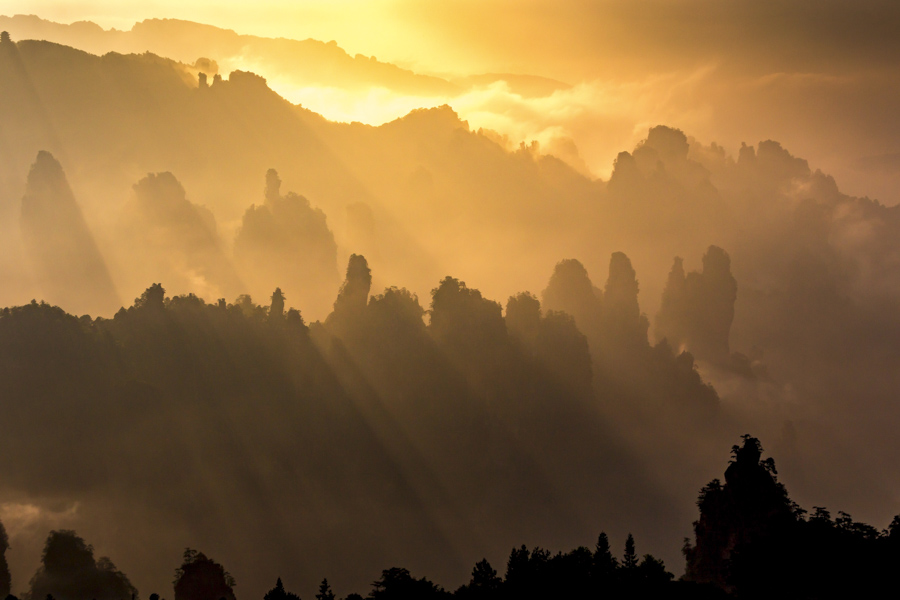
Tianzi Mountain is best enjoyed slowly: first from above, as the cable car climbs over ravines and mist-clad cliffs, then on foot along paths that lead between viewpoints, named peaks, and rock formations shaped by both geology and local legend.
Ride the Tianzi Mountain Cableway
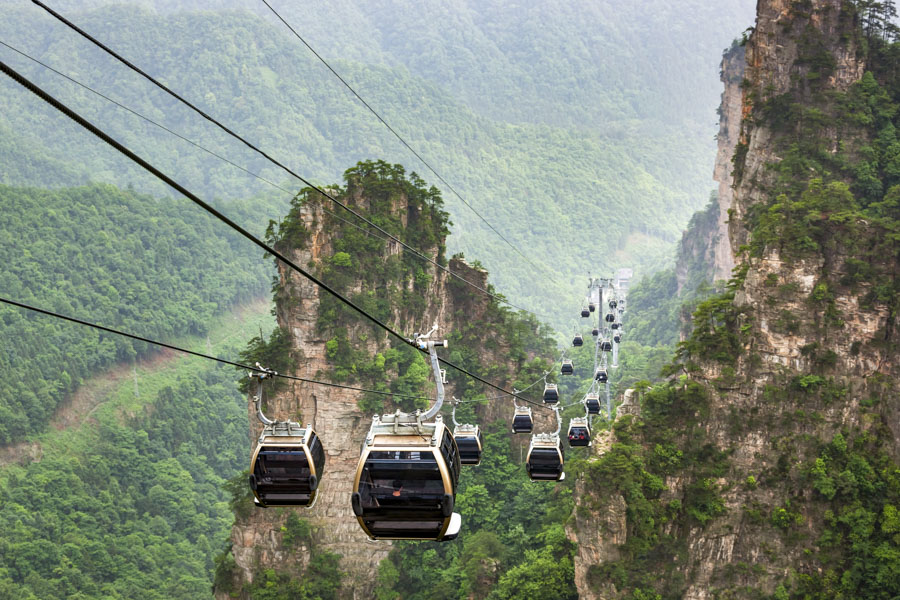
The Tianzi Mountain Cableway (天子山索道) is an unforgettable way to reach the upper part of the scenic area. The cabins glide over ravines and narrow gorges, passing sheer cliffs and peaks often wrapped in mist. Within minutes, the landscape opens into Zhangjiajie’s sandstone pillar scenery, with slender stone columns rising in every direction.
See the Four Scenic Wonders of Tianzi Mountain
Local descriptions of Tianzi Mountain often refer to four scenic wonders, each created by weather, light, and season.
“Sunrise Rays ” describes the early morning light when the first rays break through the mist and the peaks take on a golden edge against the darker sky.
“Moonlight Radiance” captures the mountain under moonlight when the stone forest casts long shadows and the outlines of the peaks grow softer and less certain.
“Sea of Clouds” are the sea of clouds that rise from below and gather around the slopes, turning the peaks into isolated islands above a pale expanse.
“Winter Snow” brings a different stillness: after snowfall, the mountain becomes almost monochrome, with branches, ledges, and stone pillars traced in white.
Explore the Landmarks of Tianzi Mountain
Many of Tianzi Mountain’s landmarks are shaped as much by local memory as by geology. The rocky peaks have long been given vivid names, and the main viewpoints help visitors appreciate the scale and character of the mountain landscape.
Parks and Viewpoints
A natural place to begin is He Long Park (贺龙公园), one of Tianzi Mountain’s principal landmarks. The park honours Marshal He Long, who was born locally and became a prominent military figure in twentieth-century China. Near the entrance stands a 6.9-metre bronze statue of the general, weighing more than nine tonnes and regarded as one of the largest bronze sculptures in China.
The park blends naturally into the mountain setting, with paths around its edge opening onto some of Tianzi Mountain’s most recognisable formations. It also contains the Weapons Museum, an exhibition hall, and the General’s Stele Forest.
About 200 metres east of He Long Park stands Tianzi Pavilion (天子阁), a six-storey building in traditional Chinese style, built in 1995. Its upper floor is one of the main viewing platforms in the central part of Tianzi Mountain, offering wide views over the stone forest as it stretches towards the horizon.
Other viewing platforms worth noting include the Grand Sightseeing Platform, the busiest and most popular spot for classic views of the peaks; Yunqing Rock Platform (also known as West Sea Stone Forest), a well-known panoramic terrace on the western edge of He Long Park; Gap-Linear Valley Platform, a more remote viewpoint reached by a narrow bridge over a chasm; Arranging Battles Platform above Shentang Gulf, which offers a quieter view of the gorge; and Heavenly Soldiers Gathering Platform, another peaceful stop, with layered sandstone scenery typical of Zhangjiajie.
Along the Mountain Paths
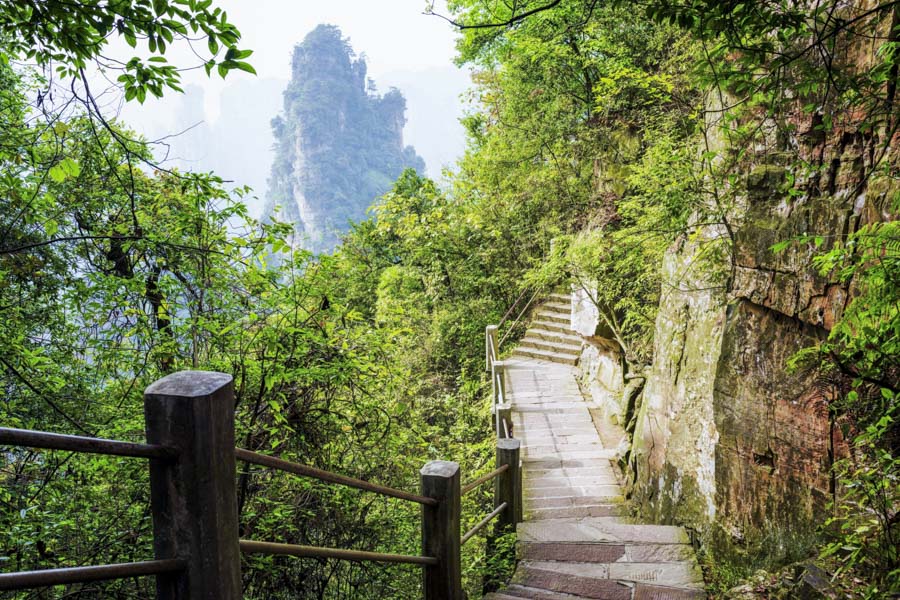
From Tianzi Pavilion, you can continue towards Moon Pass (月亮垭), a scenic saddle between two peaks, about 30 minutes’ walk away. From there, the landscape opens in both directions, giving a clear sense of the mountain’s height and depth.
South Heaven Gate (南天门) is a striking natural stone arch, roughly 15 metres high, standing near the cliff edge. The rock appears to part like a gateway, framing the rugged masses beyond.
Another memorable formation is the Bridge of Immortals (张家界仙人桥), a natural bridge about 26 metres long spanning a deep chasm. In misty weather, the bridge can partly disappear into clouds, making the stone platform appear almost suspended in the air.
The Wolong Ridge links Tianzi Mountain with the Ten-mile Gallery. The walk requires some effort, but the ridge offers changing views over peaks, valleys, and forested slopes.
The Peak Gallery
The peaks of Tianzi Mountain invite a slower look. Many of their outlines suggest recognisable forms, and local tradition has given them poetic names.
The Three Sisters Peaks (三姐妹峰) are three separate stone pillars standing close together. From a distance, their silhouettes are said to resemble young women gazing into the distance. Nearby, Fairy Offering Flowers (仙女献花) appears as a solitary peak whose shape recalls a woman holding an armful of flowers.
Imperial Brush Peak (御笔峰), one of Zhangjiajie’s best-known formations, consists of several narrow pillars rising like inverted calligraphy brushes. Training Horses by a Warrior shows two rocks near the cliff edge, one resembling a horse and the other a warrior in armour. Marshal Rock completes this natural gallery and is traditionally associated with Xiang Dakun, the local Tujia leader whose legend is closely tied to Tianzi Mountain.
Quieter Walking Routes
For travellers who wish to escape the busiest viewpoints, Tianzi Mountain has longer walking routes through quieter sections of the scenic area. These trails take more time and stamina, but they offer a closer encounter with the mountain landscape.
Route 1: From Tianzi Mountain to Ten-mile Gallery
Difficulty: Moderate
Distance: 8 kilometres (5.0 miles)
Walking time: Around 4 hours
Route type: One-way
Tianzi Pavilion → Moon Pass (30 minutes) → Heaven Platform (30 minutes uphill) → Wolong Range, passing the Three Sisters Peaks (2 hours) → Ten-mile Gallery gate (1 hour). From there, you can continue walking or return to town by eco-bus.
Route 2: From Tianzi Mountain to Sansuo
Difficulty: Moderate
Distance: 7 kilometres (4.3 miles)
Walking time: Around 3 hours
Route type: One-way
Tianzi Pavilion → Moon Pass (30 minutes) → Heaven Platform (30 minutes uphill) → Wolong Range → South Heaven Gate (30 minutes) → Sansuo bus stop (1 hour). From Sansuo, eco-buses run to the East Gate of Wulingyuan Scenic Area and to the entrance of the Ten-mile Gallery.
How to Get to Tianzi Mountain?
There are several ways to reach Tianzi Mountain, depending on your route, how much time you have and how much walking you want to do.
Option 1: Tianzi Mountain Cableway
The Tianzi Mountain Cableway is the most popular way to reach the upper scenic area. The ride takes about 10 minutes, climbing 692 metres (2,270 feet) over a distance of 2,084 metres (2.08 kilometres / 1.29 miles). Each cabin holds up to eight passengers, and the cableway can carry roughly 2,100 people per hour.
To use this route, first make your way to the East Gate of Wulingyuan Scenic Area in Wulingyuan District. If you are staying in Zhangjiajie city, take a local bus from Zhangjiajie Central Bus Station to Wulingyuan Bus Station. The journey takes about one hour, and tickets cost around CNY/RMB 20 ($2.80 / €2.50 / £2.10).
From Wulingyuan Bus Station, the East Gate is about a 15-minute walk or a roughly five-minute taxi ride. Once inside the East Gate, take the eco-shuttle to the lower cable-car station. The lower station (天子山索道下站) is located near the Site of Sansuo within the Suoxiyu Scenic Spot (29.3772° N, 110.5101° E); the upper station (天子山索道上站) lies in the eastern part of Tianzishan Scenic Spot (29.3911° N, 110.5005° E).
In peak season queues for the cable car can take around 1 to 1 hour and a half, so allow extra time.
Option 2: On Foot via Ten-Mile Gallery
This is a more demanding but rewarding route, with scenic views en route. From the East Gate of Wulingyuan Scenic Area, take the park shuttle to the Ten-mile Gallery junction (29.3594° N, 110.4939° E). From there you can continue on foot or take the tourist tram to Three Sisters Peak. The tram costs around CNY/RMB 38 one-way ($4.20 / €3.70 / £3.10).
From Three Sisters Peak, the ascent continues up a long flight of stone steps and normally takes about 2 to 3 hours. The route requires good fitness, but it offers views that you won’t see from the cable car.
Option 3: Via Yuanjiajie
This route lets you combine two major Wulingyuan areas in a single day. Take the Bailong Elevator – the world’s highest outdoor lift – from the valley floor to the Yuanjiajie plateau. After exploring the famous “floating mountains” and the main landmark, Hallelujah Mountain, take the free shuttle bus to Tianzi Mountain. The transfer between the two areas takes about 40 minutes.
This is a convenient way to visit both sites in a day. However, if your schedule allows, it is better to visit them separately. In high season, queues for the Bailong Elevator can stretch to two hours, which leaves much less time for viewpoints and walking.
Security at Tianzi Mountain
Although Tianzi Mountain has good infrastructure and well-marked routes, it is a high-altitude natural area, so it is advisable to apply the usual basic safety precautions. Fog, humidity, sudden weather changes and the many stone steps can make walks more tiring than they at first appear.
Railings: most hiking trails and viewing platforms have railings, but the stone steps and paths can become slippery after rain.
Footwear: wear comfortable walking shoes with a good grip; trekking poles are helpful, especially on longer ascents and descents.
Clothing: mountain weather changes quickly. Even on warm days peaks can be shrouded in cool mist or hit by strong winds. Carry a lightweight jacket or raincoat year-round.
Crowds: popular viewpoints get very crowded, especially in high season and during Chinese public holidays. Keep well back from the edge and watch your belongings in dense crowds.
Wind: open areas can be windy; secure hats, scarves, and other loose items.
Timing: allow plenty of time and ensure you reach the upper cable car station before closing. Missing the last cabin can force a descent in the dark, which is best avoided.
Wildlife: on some trails, especially around Tianzi Pavilion, you may encounter wild monkeys. They are accustomed to visitors and may grab food or drinks - keep snacks and bottles inside your rucksack, not in your hands.
Tips for Exploring Tianzi Mountain
Allow at least half a day, even if you plan to use the shuttles and cable car, - distances between viewpoints can feel much longer once you factor in staircases, changes in elevation, and frequent photo stops.
- Looking beyond the famous panoramas. Between the main viewing platforms there are quieter corners and short side paths that open onto the stone forest and gorges, often with far fewer people.
- If visibility is poor, don’t rush off. Clouds move quickly here, and within 15 or 20 minutes the view can change dramatically, revealing peaks and valleys that were hidden moments before.
- For photography, the hours after rain are often the most interesting. Mist lingers between the pillars, and damp rocks and forests appear darker, sharper, and more defined. In humid conditions, wipe your lens regularly to avoid blurred shots.
- As you walk, notice the small details as well as the panoramas: wind through the pines, echoes from the gorges, birdsong from the forest, and the slow change of light through the mist. Tianzi Mountain is shaped not only by its viewpoints but by the gradual journey through the mountain forest itself.
A visit to Tianzi Mountain needs time, a little planning, and readiness to walk more than the map suggests. Don’t try to see everything at once. Lingering at a few viewpoints, following quieter paths, and waiting for the light and mist to shift will leave a stronger impression than rushing between stops.