

Formal name: Republic of Uzbekistan
Location: Uzbekistan is a landlocked country in Central Asia, bordered by Kazakhstan to the north and northeast, Kyrgyzstan and Tajikistan to the east and southeast, Afghanistan to the south, and Turkmenistan to the west. Much of the country lies between the Amu Darya and Syr Darya rivers. The landscape ranges from the Kyzylkum Desert and lowlands in the west and centre to the foothills and mountains of the Tien Shan and Pamir-Alay in the east.
Capital: Tashkent
Area: 448.900 km2
Land boundaries: Uzbekistan has a total land border of 7,090.12 km: Afghanistan – 143 km, Kazakhstan – 2,356.31 km, Kyrgyzstan – 1,476.12 km, Tajikistan – 1,283.2 km and Turkmenistan – 1,831.49 km.
Population: approximately 38.5 million people.
Language: Uzbek is the state language. Russian is also widely spoken, particularly in larger cities and in tourism and business.
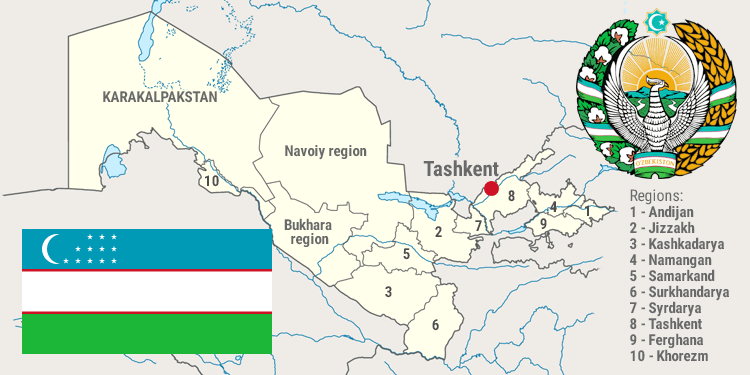
Administrative and Territorial Structure: Uzbekistan consists of the Republic of Karakalpakstan, 12 regions and the city of Tashkent. The country has 177 districts and 120 cities.
Religion: Islam is the majority religion. Uzbekistan is a secular state, and freedom of religion is guaranteed by the Constitution.
Currency: The national currency is the Uzbek sum (UZS). Foreign currency can be exchanged at banks and authorised exchange offices, as well as through some ATMs and banking services. See our Uzbekistan currency page for practical information.
National Symbols: Flag of Uzbekistan, Emblem of Uzbekistan.
Climate: Uzbekistan has a dry, continental climate, with hot, sunny summers and cold winters. Temperatures vary considerably across the country: the desert and lowland areas experience the greatest summer heat, while winters are colder in the north and in the mountains. Spring and autumn generally bring milder temperatures and are the most comfortable seasons for travelling.