

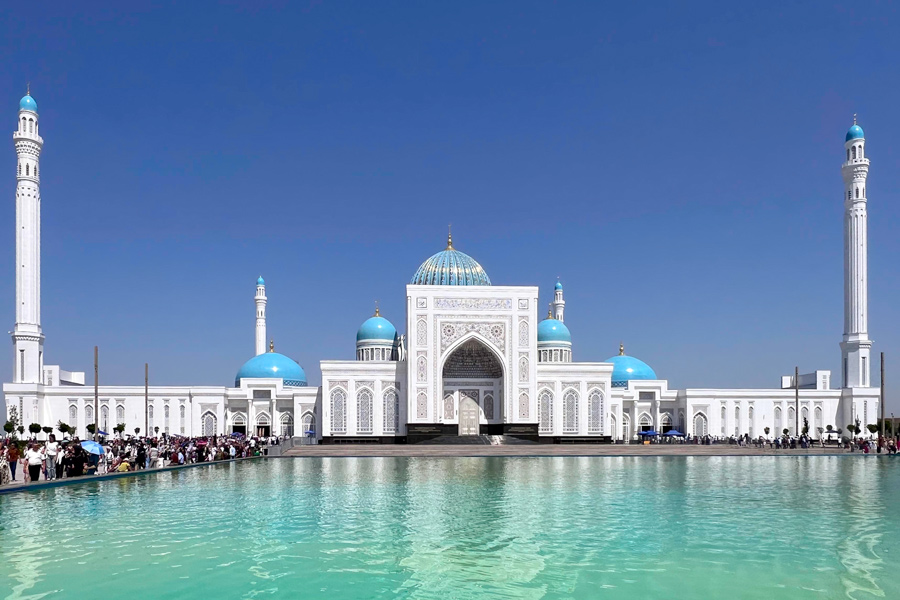
Address: Uzbekistan, Payaryk District, Samarkand Region, village of Khartang (Khoja Ismoil)
The Imam al-Bukhari Memorial Complex is one of the most revered sacred sites in the Samarkand Region, linked to the great Islamic scholar and compiler of hadiths. His tomb lies here, in the village of Khartang, and over the years a major religious complex has developed around it.
According to historical accounts, a severe drought struck Samarkand in the autumn of 870. Not long before that, Imam al-Bukhari had died in seclusion and exile in nearby Khartang. Manuscripts recount that no rain fell until the people of Samarkand came to his grave to pray. After that, heavy rain is said to have continued for seven days.
The story carries added meaning in light of one of the hadiths recorded by al-Bukhari, in which knowledge is compared to rain falling on the earth: some soil receives it and comes to life, some preserves it for others, and some remains barren.
That image still feels fitting here. Today, the Imam al-Bukhari complex stands not only as a place of pilgrimage, but also as a reminder of knowledge passed on across generations – and of the lasting presence of one of the Islamic world’s most influential scholars.
History of the Imam al-Bukhari Complex
The complex stands in the village of Khartang, 25 kilometres (15.5 miles) from Samarkand, where Muhammad ibn Isma’il al-Bukhari, better known as Imam al-Bukhari (810–870), was buried. He is best known as the compiler of Al-Jami’ al-Sahih, widely regarded as the second most important source in Islam after the Quran.
For centuries, his burial site remained modest in appearance. Even so, it drew pilgrims from across the Islamic world. People travelled here over long distances, crossing deserts and steppes along the caravan routes of the Silk Road, to pay their respects and offer prayers. The first mausoleum was built here in the 16th century, during the Shaybanid period, and soon became an important place of pilgrimage.
A new phase began in 1997–1998, when, on the initiative of Uzbekistan’s first president, Islam Karimov, the site was rebuilt and expanded to 10 hectares (24.7 acres). A mosque was also added at that time, with space for around 1,500 worshippers.
In 2021, another large-scale reconstruction began on the initiative of the second president, Shavkat Mirziyoyev. Five years later, in March 2026, the renovated complex opened. Covering around 44–45 hectares (109–111 acres), it became one of the largest cultural projects in Central Asia. For comparison, the Registan in Samarkand occupies a far smaller area – around 1.5 hectares (3.7 acres).
Today, the complex includes a mausoleum, a large congregational mosque, a museum, a library, and infrastructure for pilgrims, including hotels and leisure areas. After the reconstruction, it is said to be capable of receiving up to 65,000 visitors a day.
A visit to Samarkand’s three major shrines – the mausoleum of Imam al-Bukhari, Shah-i-Zinda, and the Ruhabad mausoleum – is sometimes described as a lesser pilgrimage. In future, the al-Bukhari complex is also expected to become part of the Umrah Plus programme, a concept that links the traditional journey to Mecca and Medina with visits to Samarkand’s major sacred sites.
Architecture and Layout
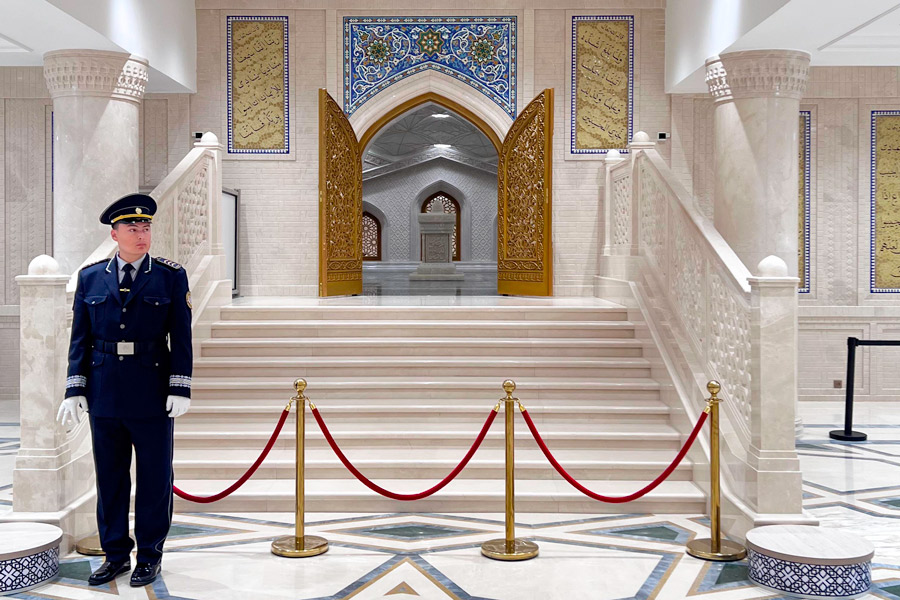
The Imam al-Bukhari complex combines traditional Islamic architectural forms with modern construction technologies. The project was conceived as a unified space where architecture, landscape, and spiritual meaning work together. Broad squares, avenues, water features, and a carefully planned layout create a sense of calm and openness throughout the site.
White marble is used extensively across the façades, giving the complex its bright, monumental character and symbolising purity of thought and intention. The material also serves a practical purpose: the pale surfaces reflect sunlight and help reduce indoor temperatures by around 10–15 degrees on hot summer days.
Near the entrance to the mosque is a decorative pond that has quickly become one of the most photographed parts of the complex. From certain angles, it creates the impression that the building is rising directly from the water.
The Mosque
The main mosque of the Imam al-Bukhari complex is one of the largest in the region and can accommodate around 10,000 worshippers. Its design draws on traditional ornament, carved details, and extensive marble finishes.
It remains an active place of worship, with daily prayers still held here. Four minarets shape its silhouette, each rising to 75 metres (246 feet). This makes them taller than the minaret of the Islam Khoja complex in Khiva, which reaches 56.6 metres (186 feet) and was previously regarded as the tallest in Uzbekistan.
The Mausoleum of Imam al-Bukhari
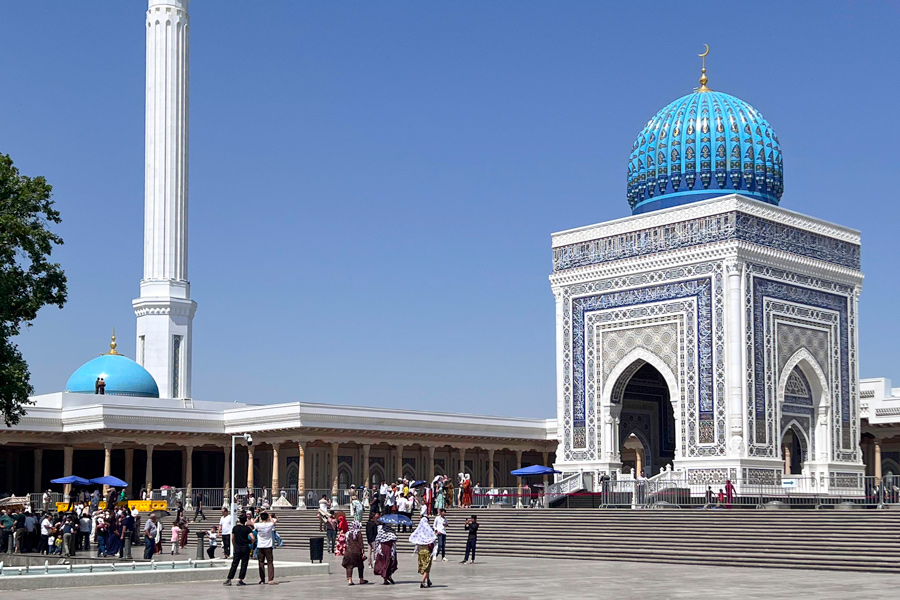
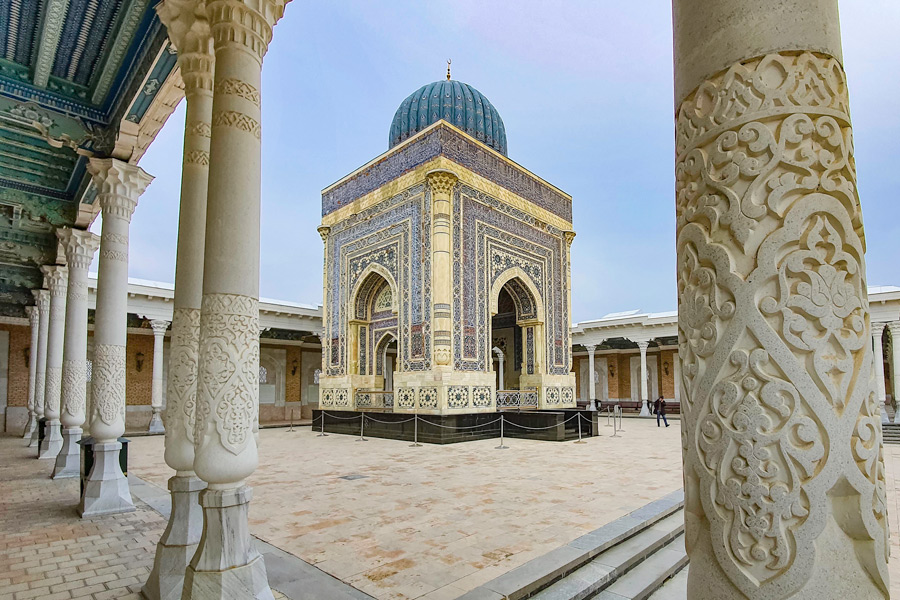
At the spiritual centre of the complex is the mausoleum of Imam al-Bukhari, where the scholar’s tomb and tombstone are located. The historic space around it still feels like a traditional place of pilgrimage, or ziyarat, where people come to pray, reflect, and spend time in quiet devotion.
Ancient plane trees grow nearby and, according to local tradition, were planted around 500 years ago. There is also an old spring here, and its water is believed to have healing properties.
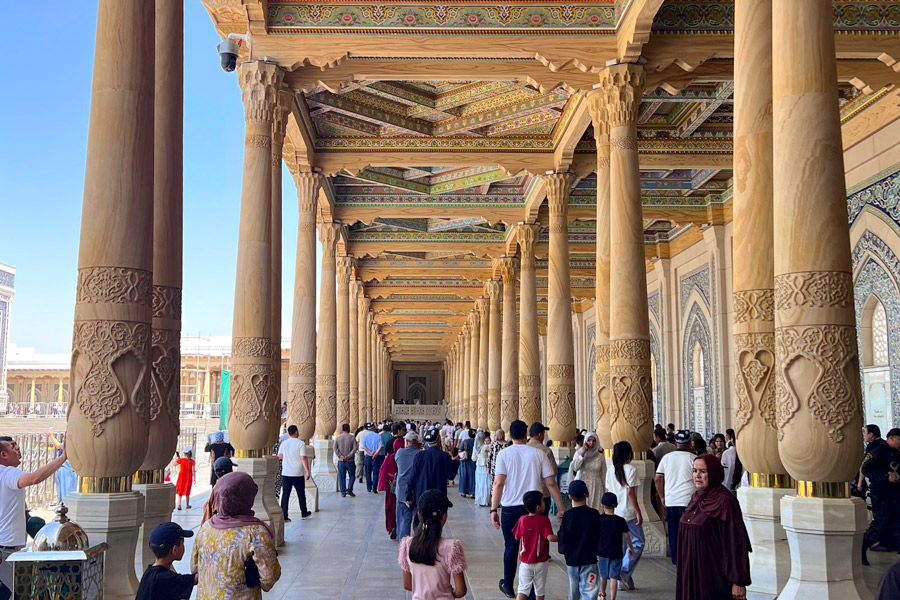
One of the most striking architectural features in this part of the complex is the iwan terrace, enclosed on three sides. This characteristic element of Islamic architecture offers welcome shade in the summer heat. At the Imam al-Bukhari complex, the iwan is supported by 154 columns richly decorated with carved wood and traditionally understood to symbolise the trees of the Garden of Paradise.
The Museum
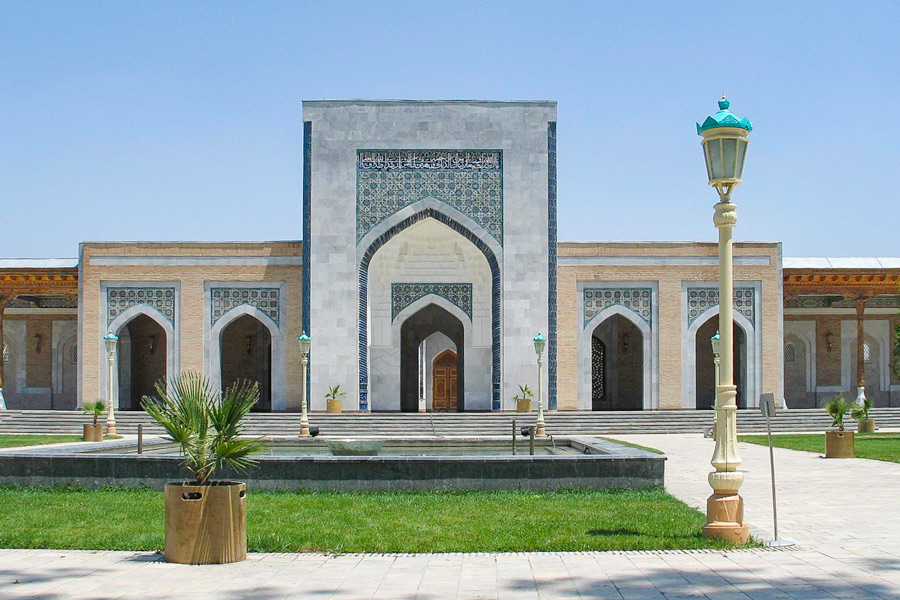
The complex includes nine pavilions that together form a single museum space. Here, the life of Imam al-Bukhari, his scholarly work, and the historical context of his era are presented in detail. The exhibitions use modern technologies, including artificial intelligence and 3D reconstructions, making the material easier to follow even for visitors without specialist knowledge. There is also a separate area for children, where the displays are presented in a more interactive and accessible format.
Imam al-Bukhari’s Life
The museum traces all stages of the scholar’s life. His full name was Abu Abdullah Muhammad ibn Ismail ibn Ibrahim ibn al-Mughira al-Bukhari. The final part of his name – the nisba al-Bukhari – indicates his place of birth.
One section is devoted to his difficult childhood. He lost his father early, and tradition also holds that he lost his sight as a child. It is said that his vision returned several years later through his mother’s constant prayers.
The museum also focuses closely on his years of travel. Al-Bukhari spent much of his life in the major centres of the Islamic world – Mecca, Medina, Basra, Damascus, and other cities – where he collected and organised hadiths. In Medina, the Al-Bukhari Mosque stands as a reminder of his long stay there and continues to be visited by pilgrims.
The museum also covers the final period of his life. As his reputation grew, he came into conflict with both theologians and political authorities. According to a widely repeated account, he was forced to leave Bukhara after refusing to give private lessons on privileged terms, insisting instead that knowledge should remain open to everyone.
He later moved to Khartang, where he soon died in exile, far from his native city. Yet the knowledge he gathered continued to spread in precisely the way described in one of his hadiths: some received it and came to life, while others preserved it for future generations.
The Making of Al-Jami’ al-Sahih
The scholar’s principal work is Al-Jami’ al-Sahih – literally, The Authentic Collection – often known simply as Sahih al-Bukhari. It stands at the centre of the museum display and contains around 7,000 traditions relating to the life and deeds of the Prophet Muhammad.
In the 9th century, more than 600,000 hadiths were in circulation, though not all were regarded as reliable. Stories were passed from person to person, sometimes with changes, additions, or inaccuracies. By then, distinguishing authentic traditions from doubtful ones had become an urgent task.
That meant tracing each chain of transmission in detail: who had narrated the account, from whom, and under what circumstances. Al-Bukhari travelled widely, verified reports with great care, and eventually selected only those hadiths he considered authentic. The work is said to have taken him around 16 years.
He was also known for an extraordinary memory. Contemporaries were said to be astonished by the number of traditions and transmission chains he could recall by heart. One well-known story tells of how he was tested with one hundred hadiths whose chains had been deliberately mixed up. First, he repeated them exactly as he had heard them. Then he identified and corrected every error.
In the museum, these hadiths are presented in an interactive format. Visitors can pull out special panels, after which the text appears on a screen and can be viewed in several languages.
The Prophet’s Life and the Spread of Islam in Central Asia
A separate part of the museum is devoted to the Prophet Muhammad and to the events that Imam al-Bukhari later gathered and organised in his writings. The exhibition follows key stages of his life, including the revelation in Mecca, the migration to Medina, and the formation of the first Muslim community.
Another section traces how Islam spread across Central Asia in the centuries that followed and became part of the region’s historical and cultural development.
Visitor Information
- Access to almost all parts of the complex, including the mosque and mausoleum, is free of charge. Only the museum requires a ticket.
- As the Imam al-Bukhari Complex is a sacred place for Muslims, visitors are expected to observe a modest dress code. Women should cover their shoulders and knees and wear a headscarf. Men should wear clothing that covers the knees.
- Shoes must be removed before entering the mosque and mausoleum. Photography is generally permitted, although restrictions may apply in some areas.
- A visit to the complex usually takes around 3–4 hours. Those who want to explore it in greater detail may need longer.
- New accommodation has also been built for pilgrims and visitors, including one four-star hotel, one three-star hotel, and around 20 family-run guesthouses. Together, they can accommodate up to 1,500 people, making longer stays here far more practical.