

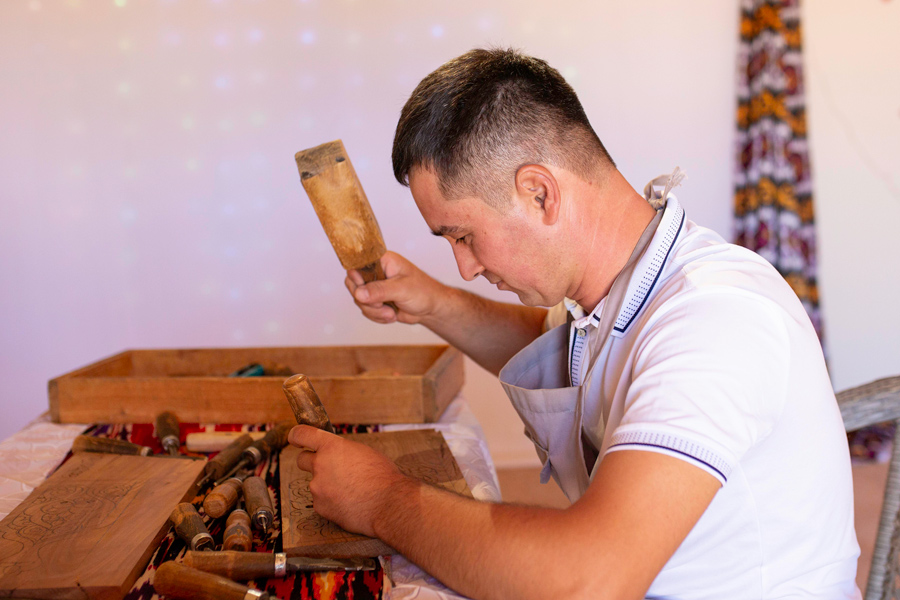
Wood carving in Uzbekistan is an ancient craft rooted in the shaping and ornamentation of wood. Carved doors and columns, household furniture, and latticed windows that gently filter sunlight have long been part of everyday Eastern life. These elements give Islamic architecture and homes in traditional urban neighbourhoods, known as mahallas, their distinctive character and quiet elegance.
Uzbek wood carving continues to captivate both local residents and visitors, while also inspiring contemporary architects. One example is the design of the Uzbekistan Pavilion at Expo 2025 in Osaka, whose concept draws on the distinctive wooden columns of the Juma Mosque in Khiva, reinterpreting this traditional form in a modern context.
History of Wood Carving in Uzbekistan
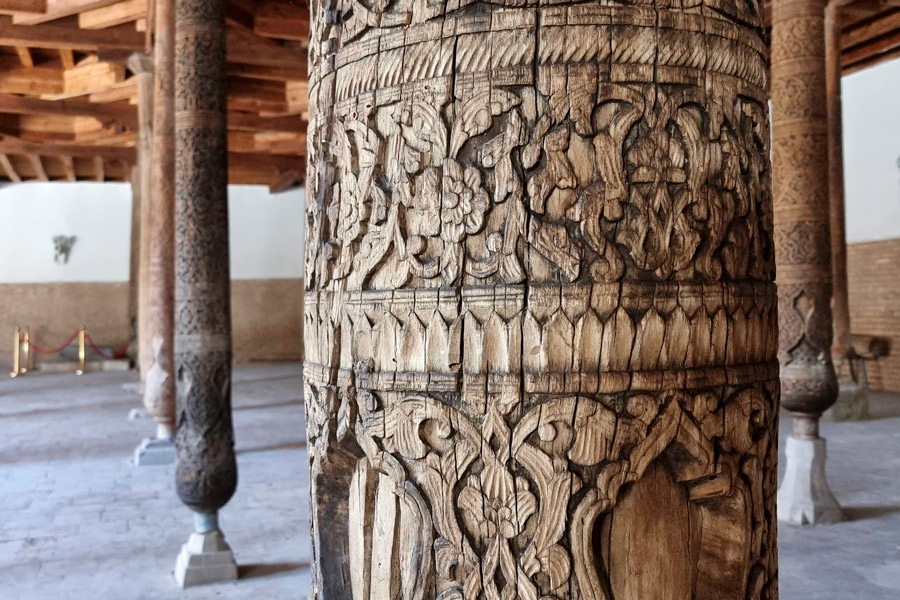
Large wooden architectural elements have been produced in Uzbekistan since ancient times. Surviving examples and fragments testify both to the great age of this craft and to the high level of skill achieved by Uzbek wood carvers in the past. One such discovery was made in the village of Obburdon in the Zarafshan Valley, where a carved wooden column dating to the 9th–10th centuries was found. Remarkably, it has remained well preserved despite the passage of more than a thousand years.
In earlier periods, carved wooden entrance doors were especially valued. Their solid construction and refined decoration signalled the status and prosperity of the household. Today, such doors are rarely seen in private homes, but monumental examples survive in religious, cultural, and administrative buildings, as well as in museum collections. Notable among them are sycamore doors created by the renowned Khiva master Ata Palvanov in the late 19th–early 20th century, now housed in the Museum of Applied Arts in Tashkent, as well as doors by Kadirjon Haydarov, which adorn the Museum of the History of Uzbekistan.
In the 19th century, the artist Vasily Vereshchagin captured the distinctive beauty of Uzbek carved doors in his painting The Doors of Tamerlane, now part of the Tretyakov Gallery collection in Moscow.
Another characteristic feature of traditional residential buildings, mosques, and madrasas is the carved lattice known as panjara. These structures are assembled from dozens of slender wooden bars, fitted together without nails or glue to form complex geometric and ornamental patterns. Panjara provide protection from the intense sun while still allowing soft daylight to enter interior spaces.
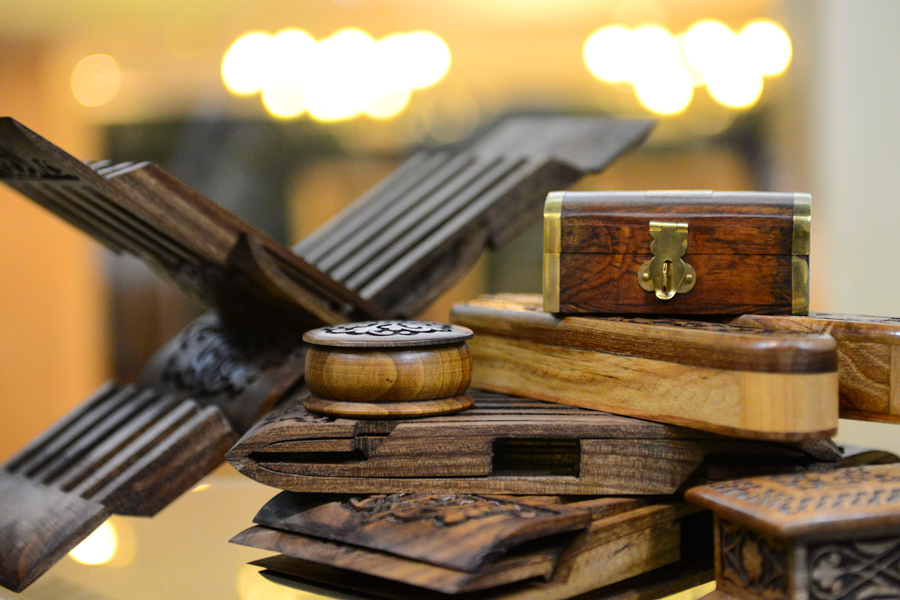
Alongside large architectural elements, Uzbek wood carving also produced a wide range of smaller objects. These include furniture such as low hon-taht tables and chairs, as well as screens, boxes, and decorative wooden dishes known as lyagans.
A particularly distinctive item is the carved book stand called lavhi. These stands often have several tiers – sometimes up to sixteen – and can be assembled in different configurations to support books at various reading angles. Their intricate construction requires exceptional precision, and the ability to make lavhi has traditionally been regarded as a mark of true mastery. Most commonly used for the Qur’an, they are equally suitable for other books, making reading more comfortable and stable.
Trees, Wood species, and Their Significance in Uzbekistan
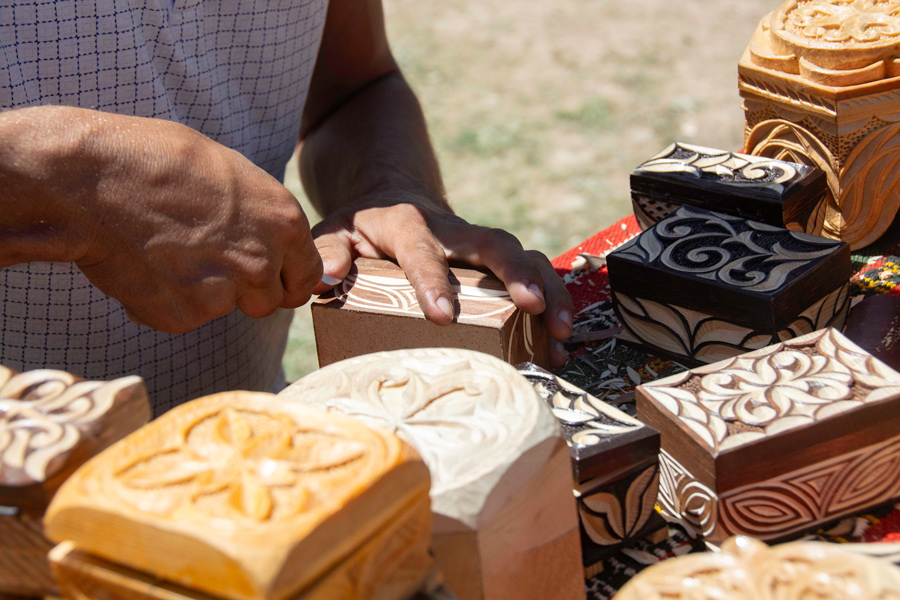
Trees have long held a special place in Uzbekistan. They provide much-needed shade and relief from the heat and are traditionally associated with ideas of family, harmony, and inner balance. Beyond their practical role, trees also carry spiritual meaning. In mosque architecture, for example, carved wooden columns symbolise the divine garden and serve as a visual expression of faith and continuity.
Wood has traditionally been used throughout the home, valued for both its beauty and its natural qualities. These interior elements create a sense of warmth and comfort, while the material itself is considered environmentally friendly and naturally antiseptic.
In large-scale Uzbek wood carving, the most commonly used species are walnut and sycamore (plane tree), prized for their strength and rich texture. Other types of wood – including archa (juniper), mulberry, poplar, and apricot – are more often chosen for smaller objects and decorative items.
The surface of natural wood preserves the story of the tree’s life. Growth rings can reveal periods of drought or abundant rainfall, meaning that each finished piece retains a quiet record of time and environment.
Uzbek wood carving highlights this natural texture rather than concealing it, enhancing the surface with finely worked ornament. Through the skill of experienced craftsmen, everyday materials are transformed into objects of lasting aesthetic and cultural value.
Regional Styles of Uzbek Wood Carving
The most widely recognised schools of Uzbek wood carving are associated with Kokand, Khiva, and Tashkent, each with its own stylistic features and techniques.
The Kokand school, like other traditions of the Fergana Valley, is known for its refined workmanship and an abundance of delicate detail. Carved pieces from this region often display complex ornamentation and a high level of precision. Among contemporary masters, Otabek Umarov, the great-grandson of Kodirjon Haydarov, the founder of this tradition, is particularly well known.
The Tashkent style is more restrained in appearance, yet it stands out for its distinctive use of varnishing and selective colouring of carved elements – techniques not typically found in other regional schools. This approach gives the works a subtle decorative contrast while preserving their overall balance. Notable representatives of the Tashkent school include Akmal Azlarov, Mekhmon Abdusattarov, and Anvar Alimbayev.
The Khiva school is often regarded as the most distinctive. Local craftsmen traditionally avoid varnish, treating the surface only with special oils. This method preserves the natural texture and colour of the wood, giving the finished pieces a particularly organic appearance. A prominent contemporary master of this style is Odamboy Masharipov, who continues the traditions of the renowned late 19th–early 20th century craftsman Ata Palvanov.
Carving Techniques and Ornamental Motifs
Uzbek wood carving is based on two principal techniques. The first is relief carving, in which the background is cut away so that the ornament stands out in raised form. This surface is often further enriched with fine secondary patterns, creating a layered visual effect. Relief carving remains the dominant technique in the Uzbek tradition.
The second method is openwork carving, where decorative outlines are cut into a flat surface, producing a lighter and more transparent design.
Among the most characteristic ornamental motifs are geometric compositions known as baghdadi and pargori, as well as flowing plant-based patterns referred to as islimi. These elements form the visual foundation of regional styles across Uzbekistan.
Where to See and Buy Carved Wooden Works in Uzbekistan
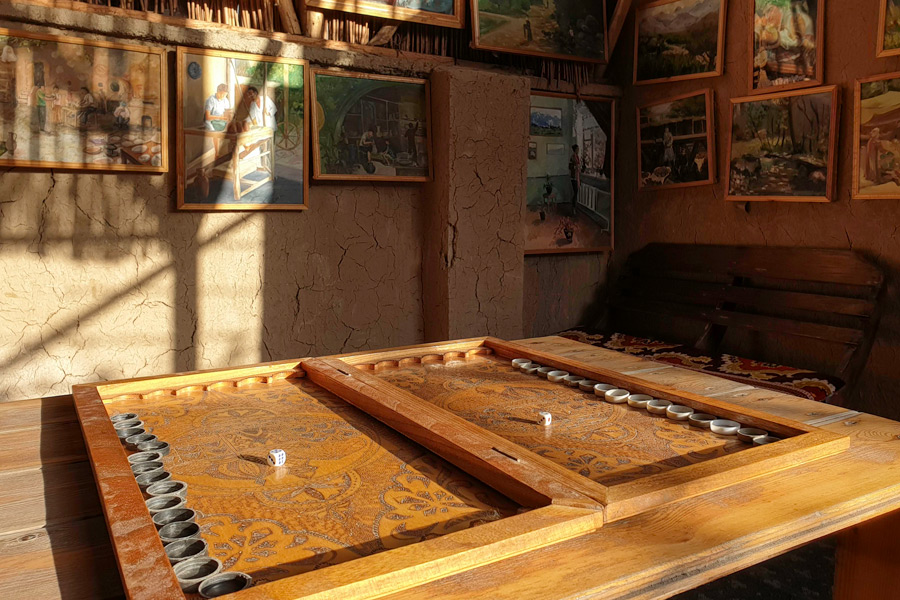
Wooden souvenirs and decorative items can be found at craft festivals and fairs, as well as at bazaars and specialised souvenir shops across the country. For a deeper experience, however, it is often best to seek out the craftsmen themselves and visit their workshops. Many well-known Uzbek wood carvers welcome visitors, offering informal tours and sharing insights into a craft that has been passed down through generations. Among them are recognised masters such as Odamboy Masharipov and Akmal Azlarov, both of whom run their own workshops and offer master classes; Masharipov is featured in the prestigious Homo Faber Guide, while Azlarov is a member of the Khunarmand Craftsmen’s Association and has been awarded a Medal of Honour for his contribution to the craft.
Historic examples of wood carving can be seen in museum collections. In Tashkent, the State History Museum holds an extensive collection of more than 400 carved wooden objects, while notable displays can also be found at the Art Museum and the Museum of Applied Arts.
Carved wooden elements are also part of the living urban environment. Many houses and public buildings throughout Uzbekistan feature traditional wooden details.