

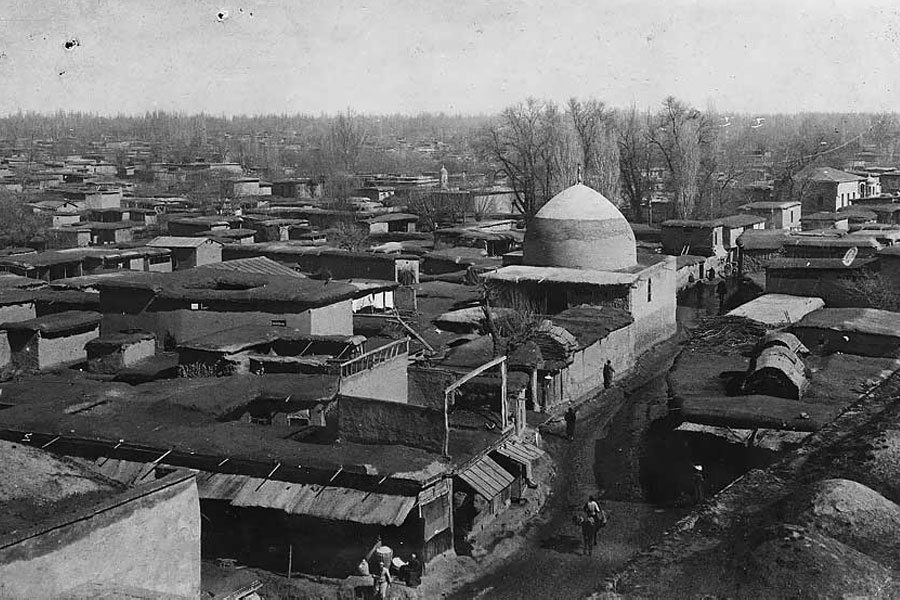
Tashkent the capital of Uzbekistan, has developed over more than two millennia at the meeting point of settled agricultural communities, steppe routes and long-distance trade across Central Asia. Its history is not that of a single city growing continuously on one site: over the centuries, the main urban centres of the Tashkent oasis shifted as trade routes, political powers and settlement patterns changed.
The region appears under several names in early written sources. Chinese chronicles mention a territory known as Yuni from around the 2nd century BC. In the 3rd century AD, an inscription of the Sasanian ruler Shapur I refers to Chach, the historical region associated with the Tashkent oasis. Arabic authors later rendered the name as Shash. By the 10th and 11th centuries, forms of the name Tashkent – generally understood as “stone city” – were appearing in the works of scholars including al-Biruni and Mahmud al-Kashgari.
Archaeology provides an even earlier view of life in the area. Shashtepa, in the southern part of modern Tashkent near the Jun Canal, is one of the key sites for understanding the city's beginnings. Its archaeological layers extend back to the first millennium BC, while in the 2nd–1st centuries BC a fortified settlement developed here. Excavations have uncovered substantial mud-brick defensive walls, passages and the remains of a monumental central building. Shashtepa stood between the agricultural oasis and the steppe and appears to have served as both a defensive point and a place of exchange between settled farmers and pastoral communities.
As the Tashkent oasis developed, its urban focus gradually shifted. One of the most important sites from the early medieval period is Ming Urik, whose remains now lie close to the centre of modern Tashkent. The settlement became a major urban centre of Chach and reached its height in the 7th and 8th centuries. Archaeologists have uncovered fortifications and substantial public and residential structures, including a complex interpreted as a ruler's residence. Ming Urik helps trace the transition from the earlier settlements of the oasis to the medieval city that eventually developed into Tashkent.
By the 9th and 10th centuries, the city had become an established centre of trade and crafts. The old city's commercial life was concentrated around Chorsu, where routes from different gates converged before continuing into streets lined with workshops, shops and markets. The name Chorsu itself is commonly associated with a crossroads or meeting of four roads, a fitting description of the area's historical role.
Trade shaped the neighbourhoods around the bazaar. Traditional mahallas – residential quarters organised around local communities – were often associated with particular crafts or occupations. Weavers, metalworkers, traders and other craftsmen lived and worked in areas close to the commercial centre, creating a city in which workshops, homes, mosques and markets stood within the same compact network of streets.
Chorsu has remained a commercial centre through repeated changes to the city around it. Today, the large covered Chorsu Bazaar occupies this historic trading district, while nearby religious buildings preserve another layer of old Tashkent.
Among them is the Kukeldash Madrasah, built in the 16th century during the Shaybanid period. Standing above the Chorsu area, it was one of the largest madrasahs in Central Asia and originally contained a spacious courtyard surrounded by student cells, teaching rooms and a mosque. Over the centuries the building suffered earthquake damage and was used for different purposes, including as a caravanserai, before being restored. It remains one of the most recognisable monuments of Tashkent's old city.
Religious architecture also developed around the burial places of respected scholars and Sufi figures. Several of these sites grew into larger architectural ensembles as mosques, madrasahs and other buildings were added over time. The Hazrati Imam complex, for example, developed around the burial place of the 10th-century scholar Abu Bakr Kaffal al-Shashi. The Sheikhantaur ensemble grew around the mausoleum of the Sufi Sheikh Hovendi at-Tahur and today also includes the mausoleums of Kaldyrgach-biy and Yunus Khan.
These surviving sites show a different side of Tashkent from the broad avenues and Soviet-era architecture of the modern capital. Around Chorsu, Hazrati Imam and the remaining old mahallas, the earlier structure of the city can still be traced through its markets, religious complexes and neighbourhood streets – fragments of a much larger urban landscape that developed over centuries along the trade routes of the Tashkent oasis.