

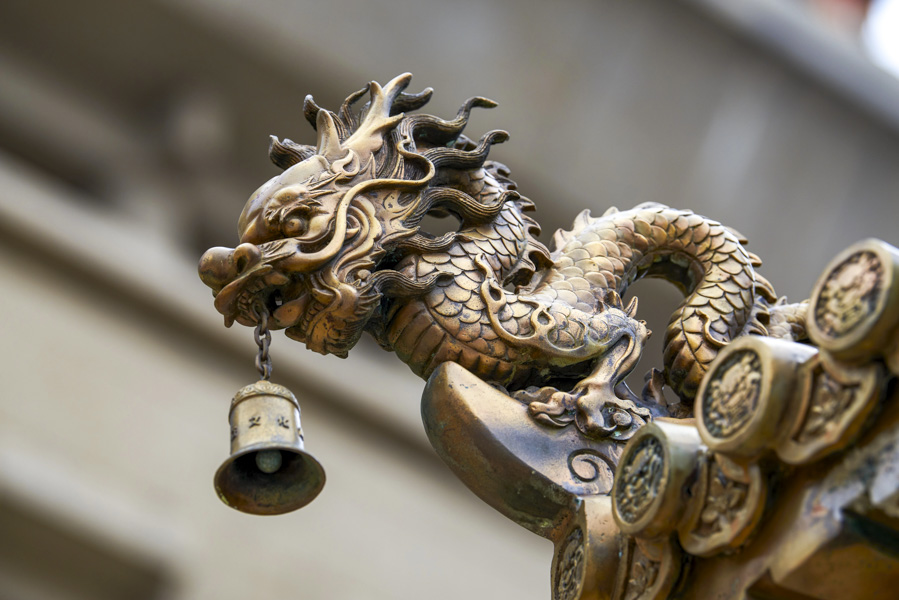
China’s cultural heritage is beautifully expressed through patterns, colour, refined forms, and tactile surfaces. Ancient ceramic vessels bear the hallmarks of early craftsmanship, while carved jade objects convey ideas of harmony and social status. Bamboo weaving remains vital to daily life, just as it has been for thousands of years. Over the centuries, Chinese applied arts have reflected a practical philosophy rooted in respect for materials, a measured rhythm of work, and a careful balance between utility and beauty. These traditions developed in artisan households, temples, markets, and workshops, where bamboo, clay, metal, stone, and textiles gradually took shape and acquired symbolic meaning.
For travellers, exploring handicrafts and traditional crafts provides a deeper insight into China beyond its formal image. Everyday objects used at home, during festivals, and in ritual settings reveal how techniques and materials are closely intertwined with regional customs and ways of life. Through applied arts, it becomes possible to connect with the country on a more intimate level, shaped by skill, patience, and continuity.
Where Nature Becomes Form: Bamboo Weaving and Wood Carving in China
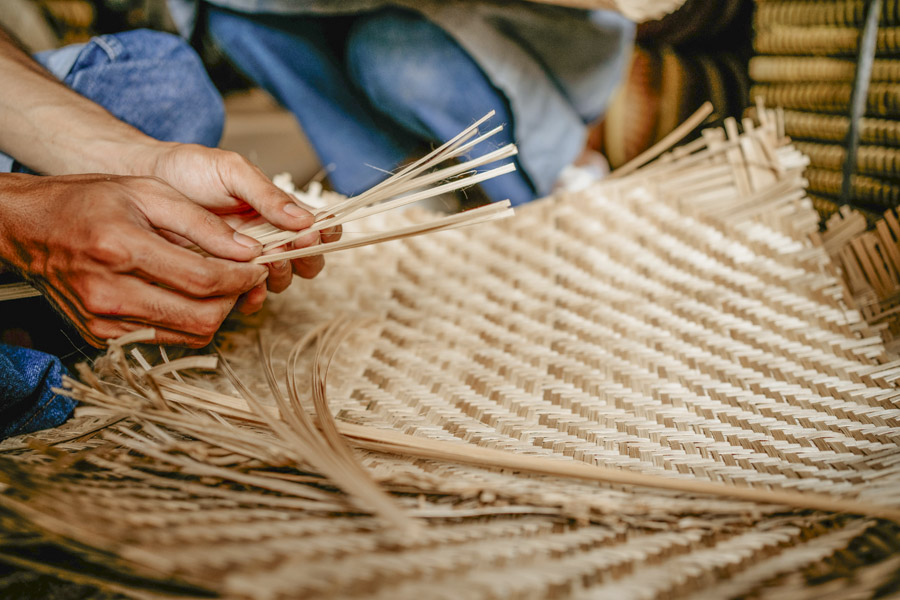
Bamboo and wood occupy a unique place in Chinese culture. From ancient times, these materials have been used to build homes, furnish interiors, and embody concepts of balance and refinement. Woven baskets and screens, bamboo furniture, carved wooden panels, architectural elements, and interior details have accompanied daily life in China for centuries, shaping both domestic spaces and aesthetic traditions.
Bamboo Landscapes and Craft Regions of China
Bamboo stands out as one of the most widely available and resilient materials traditionally used for household and decorative objects. Its craft traditions span a broad geographic range, from the interior regions of Gansu to the fertile southern provinces of Fujian, Sichuan, and Guangdong. Each area has developed its own techniques and visual language. For instance, Qingshen County is renowned for its refined bamboo weaving tailored specifically for porcelain tea sets, with narrow strips following the curved shapes of teapots and bowls. In Liangping County in Chongqing, artisans produce painted and embroidered bamboo curtains, while in Shengzhou, Zhejiang, craftsmen create lamps and furniture adorned with intricately designed patterns. In Anhui, bamboo is transformed into lightweight woven mats for both furniture and interior use.
Where to See and Buy Bamboo Crafts in China
Many bamboo-weaving centres are accessible to travellers interested in traditional crafts. In southern China, the water town of Wuzhen offers opportunities to experience this craft showcased in cultural heritage parks and local markets. Wander through the narrow streets and canals, and you will discover a variety of woven baskets, coasters, lamps, and other everyday household items.
In major cities, high-quality bamboo products are readily available. In Beijing, the Panjiayuan Antique Market (北京潘家园旧货市场) features pavilions specialising in traditional handicrafts, including bamboo weaving. Similar items can also be found in souvenir shops located in central tourist districts, such as around Yu Garden and Yuyuan Market in Shanghai, as well as along the streets of the Muslim Quarter (西安回民街) in Xi’an.
Safeguarding Bamboo Craft Traditions in China
In recent decades, bamboo craftsmanship has received formal recognition and support. Various documentation and preservation initiatives have been implemented with the involvement of UNESCO and Chinese cultural institutions, ensuring that these valuable skills are passed down and continue to be part of rural life. In 2008, bamboo weaving was inscribed on China’s National List of Intangible Cultural Heritage, reinforcing its cultural and historical significance. These efforts contribute to promote awareness and appreciation of bamboo craft, ensuring their survival for future generations.
Cultural Significance of Chinese Wood Carving
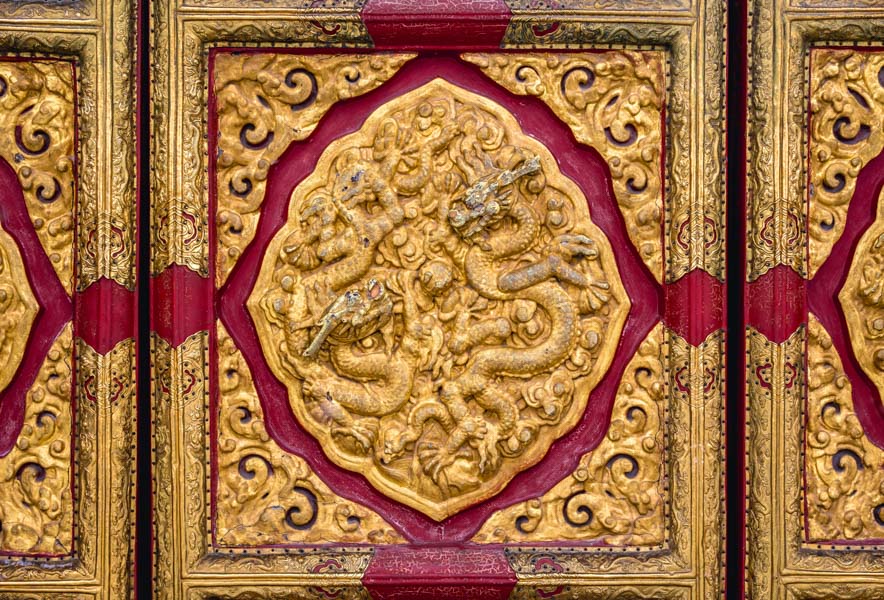
Wood carving represents another vital form of artistic expression in China, deeply rooted in both cultural history and everyday life. Carved wood features prominently in furniture, wall panels, decorative screens, and architectural elements found in temples and historic houses. Craftsmen frequently work on a grand-scale, creating intricate carvings on doors, columns, cornices, and window shutters.
These objects are imbued with layered meanings. Motifs associated with prosperity, natural cycles, and historical narratives are carved into the wood’s surface. Images of animals, plants, and scenes from legends and mythology integrate seamlessly into the structure, providing each piece visual depth and symbolic resonance.
Wood Carving Origins and Regional Traditions in China
One of the most renowned centres for Chinese wood carving is Dongyang in Zhejiang Province, where the tradition stretches back over 1,300 years. This local style is celebrated for its exquisite details and the blending of flat and three-dimensional carving within elaborate designs.
In the Wuyuan region of Jiangxi Province, wood carving is closely tied to traditional architecture, with carved beams, window frames, and latticework forming essential components of residential and religious buildings. These techniques are still actively employed in the restoration of historic structures.
In Guangdong Province, the Chaozhou school has developed its distinctive artistic canon, with carved elements commonly applied to furniture and decorative objects. This technique practised by the Teochew ethnic group, known as Teochew woodcarving, originated from the Tang Dynasty (618 to 907 CE).
Where to See and Buy Wood Carving in China
Wooden carvings can be found in major craft markets throughout the country. In Beijing, the historic Liulichang Cultural Street (琉璃厂文化市场) features numerous shops that specialise in traditional handicrafts, antiques, and folk art.
In Yunnan Province, Jianchuan Wood Carving Art Town (剑川木雕艺术小镇) offers an opportunity to explore works created by artisans of the Bai ethnic group, renowned for their long-standing rich carving traditions.
Meanwhile, in Yangshuo County, near Guilin, West Street (阳朔西街) provides another excellent location where craft shops display delicate carved wooden items alongside a variety of other local products.
Museums of Chinese Wood Carving
Significant collections of Chinese wood carvings are preserved in museums and galleries throughout the country. The China Wood Sculpture Museum in Harbin (中国木雕艺术馆) exhibits both miniature works and grand-scale, multi-layered compositions.
In Beijing, the China Red Sandalwood Museum (中国紫檀博物馆) displays antique furniture, screens, and decorative objects crafted from precious hardwoods. Additionally, the Shanghai Museum (上海博物馆) holds a noteworthy collection that includes carved panels, ritual objects, statuettes, and furniture associated with the imperial period.
Layers of Shine: Chinese Lacquerware and Painting
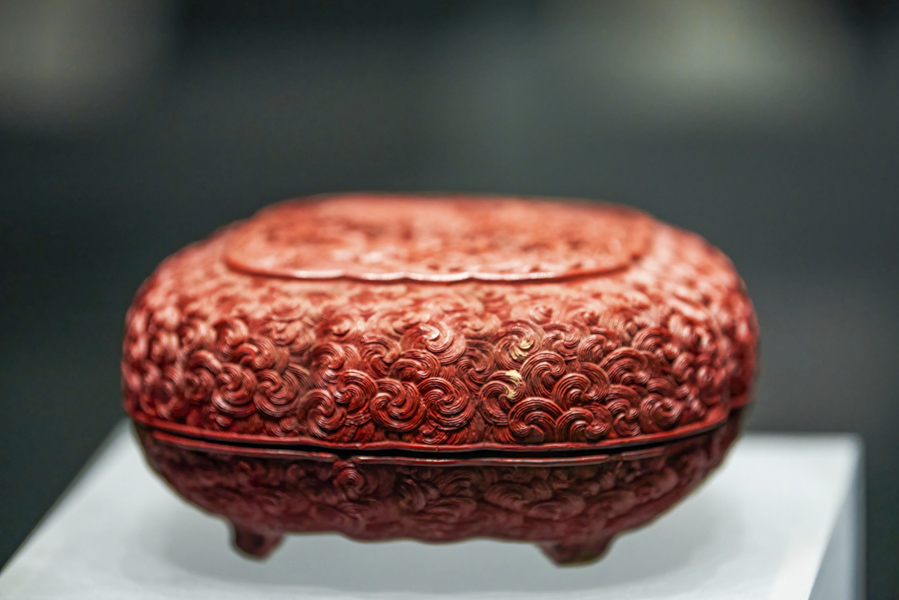
In Chinese culture, lacquerwork and painting have long been esteemed as refined forms of artistic expression shaped by colour, surface, and atmosphere. Both traditions place strong emphasis on precision, patience, and a nuanced understanding of form and texture, qualities that have defined Chinese visual culture for centuries.
What Makes Chinese Lacquerware Special
Traditional lacquer craftsmanship in China involves the meticulous application of multiple thin layers of lacquer, made of a natural polymer extracted from the lac tree, onto a wooden, bamboo or cloth base. This technique creates a surface known for its depth, soft sheen, and durability. Lacquered objects have been widely used in domestic and ritual contexts, eventually coming to symbolise endurance, discipline, and the value of sustained, meticulous work.
One of the most technically demanding forms of this art is carved lacquer, or Qīdiao (漆雕), developed during the 12th century. After numerous layers — sometimes dozens or even hundreds — of lacquer have been applied, the surface is carved to reveal exquisite relief designs. The result is a dense, sculptural texture with pronounced depth and clarity of line. Items such as boxes, trays, and ceremonial vessels are particularly prized, valued not only for their complexity but also for their longevity and suitability for transmission across generations.
Notable Hubs of Chinese Lacquerware
The heart of Chinese lacquer craftsmanship is Fuzhou, the capital of Fujian Province. It is here that a distinctive tradition developed, characterised by light yet durable objects with a polished surface and subtle lustre. This heritage can still be experienced in the historic Sanfang Qixiang (三坊七巷) district, also known as Three Lanes and Seven Alleys, where small workshops and specialist shops showcase contemporary works rooted in traditional methods. Nearby, the Taigu Lacquer Art Space Museum (福州太古大漆空间艺术馆) in Zhuqi Township provides insights into traditional techniques and their modern interpretations.
A broader historical perspective on lacquer art is offered by major museum collections. In Beijing, the Beijing Gold Lacquer Inlay Art Museum (北京金漆镶嵌艺术博物馆) focuses on decorative traditions associated with court culture. Meanwhile, in Wuhan, the Hubei Provincial Museum (湖北省博物馆) houses the “Introduction to the Art of Lacquered Articles in the Qin and Han Dynasties”, one of the most comprehensive permanent exhibitions dedicated to early lacquerware. The artefacts on display illustrate how lacquer was integrated into both everyday life and ritual practices during the Qin and Han periods.
Chinese Painting: Visual Traditions
Chinese painting is closely linked to observation, restraint, and inner balance. Its imagery often draws on landscapes, symbolic motifs, and mythological references, all conveyed through a limited palette and expressive brushwork. This tradition is inseparable from calligraphy; the shared tools and principles of movement allow written characters and painted forms to exist within a unified visual language.
In addition to classical techniques, China has developed distinctive forms of painting that utilise unconventional materials. Iron Painting (Tiehua, 铁画) employs forged iron strips arranged into compositions that reflect the rhythm and structure of ink painting. Another example is sugar painting (Tanghua, 糖画), a popular street tradition in which molten sugar is shaped into images of animals, zodiac figures, and auspicious symbols. Created through swift, confident movements, these works serve as both visual performances and edible delights, merging craftsmanship with everyday experience.
Metal and Enamel in Chinese Decorative Arts
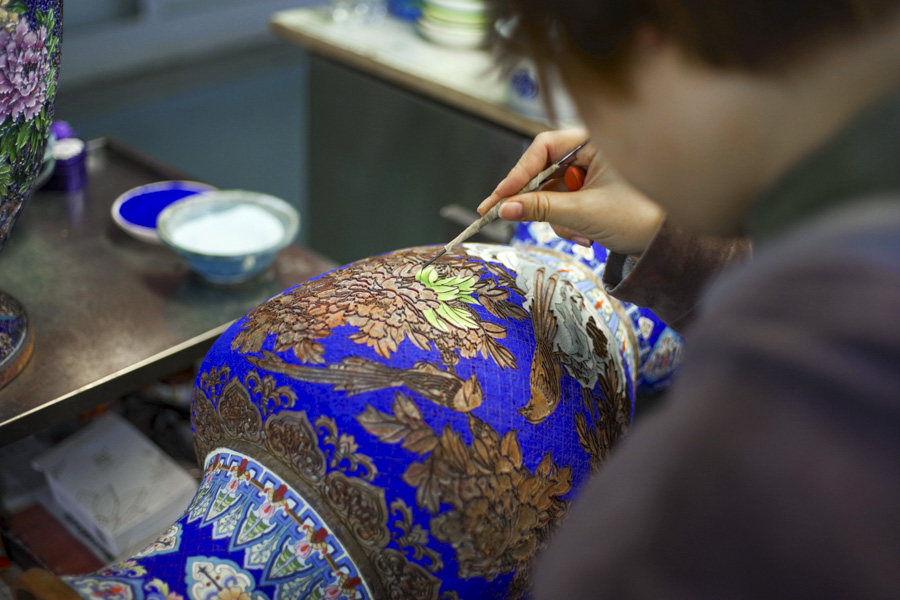
Chinese craftsmen have long been renowned for their ability to unite contrasting materials within a single object. Over the centuries, specialised workshops developed techniques that combined the restrained brilliance of metal with the vivid colours of glazed enamel, producing refined works that balance strength with decorative elegance.
This tradition has given rise to several distinctive forms. One of the most well-known techniques is cloisonné, which developed in Beijing. The technique involves filling small compartments formed by thin metal wires with powdered enamel, which is then fired to create richly coloured surfaces. It was brought to China from Persia during the Yuan Dynasty. The jingtailan (景泰蓝) technique is a style of cloisonné, translating to “Jingtai blue ware” because blue is the dominant colour used, and it also refers to the Jingtai Emperor. Cloisonné vessels and decorative objects were particularly valued during the Ming and Qing dynasties. Another refined practice is gold thread inlay (金丝镶嵌), used to adorn weapons, boxes, and personal accessories with intricate linear patterns. Traditional sword forging, known as the “bao jian duanzao” technique (宝剑锻造技艺), flourished especially in the regions of Zhejiang and Jiangsu, where finely crafted blades came to symbolise precision and cultivated taste. Carved metal locks, door fittings, and hinges also constitute an important part of this heritage and continue to be featured on residential buildings, temples, and shopfronts.
Today, examples of these crafts can be found in museum collections within the urban landscape. Hangzhou and Suzhou are home to workshops specialising in inlay and traditional forging, while during festivals and temple fairs in tourist cities, visitors can purchase items directly from artisans. In Beijing, cloisonné works are displayed at the Beijing Enamel Factory (北京市珐琅厂) and the Capital Museum (首都博物馆) and can also be found in craft shops located in historic hutong areas such as Yangmeizhu Xiejie Street (杨梅竹斜街), the Dashilan district, and Nanluoguxiang hutong alley (南锣鼓巷). A broader historical perspective is provided by the National Museum of China (中国国家博物馆), where metalwork and enamel are presented as integral elements of China’s unified visual and material culture.
Chinese Paper Cutting: Traditions and Places
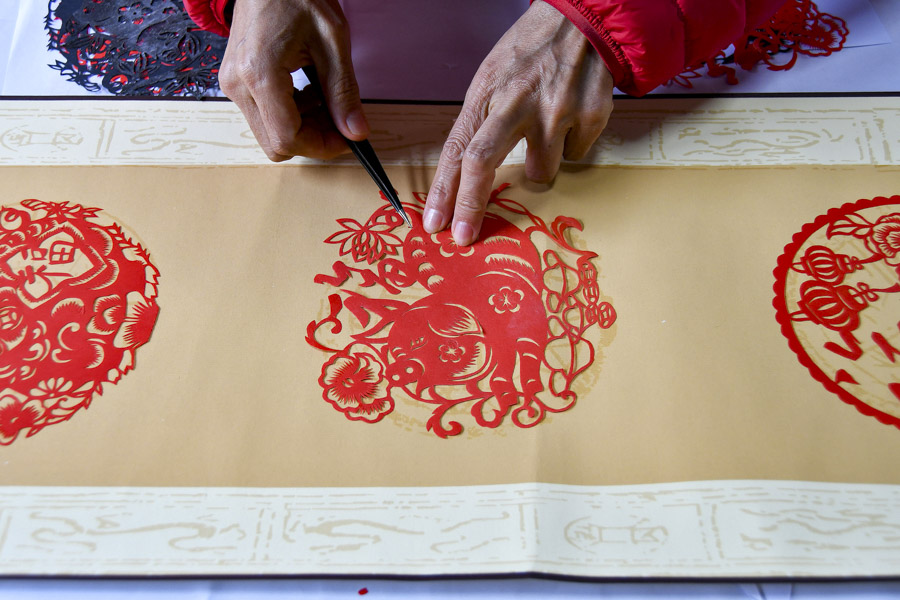
Traditional paper cuttings, known as jiǎnzhǐ (中國剪紙), form an essential part of festive and family customs in China. Created with scissors or fine blades, these delicate designs are used to decorate windows and doorways during Chinese New Year, weddings, and seasonal celebrations. Through intricate patterns, a simple sheet of paper is transformed into a visual expression of wishes for good fortune, longevity, and protection.
The origins of paper cutting are commonly linked to Beijing, where the technique emerged as an urban folk art before spreading widely across the country. Craftsmen from Suzhou later gained notable recognition for their refined line work and complex compositions, often compared in spirit to painting and calligraphy. In recognition of its cultural importance, Chinese paper cutting was inscribed on UNESCO’s Representative List of the Intangible Cultural Heritage of Humanity in 2009.
Today, paper cutting is easily encountered in many regions of China. In Beijing, jiǎnzhǐ is available in cultural and tourist districts such as Liulichang Cultural Street, while in Xi’an, small shops in the Muslim Quarter continue to produce and sell cuttings as part of everyday practice. Local designs often reflect Islamic decorative traditions, combining geometric patterns with Chinese folk imagery. During major festivals, paper cuttings also appear at temporary markets and temple fairs.
The artistic and historical value of this craft is further explored in museum collections. Dedicated displays can be seen at the China Paper Cutting Museum (中国剪纸博物馆) in Yangzhou, Jiangsu Province, while the Shaanxi History Museum (陕西历史博物馆) presents carved examples that reflect regional styles and cultural contexts.
Chinese Porcelain, Pottery and Ceramics
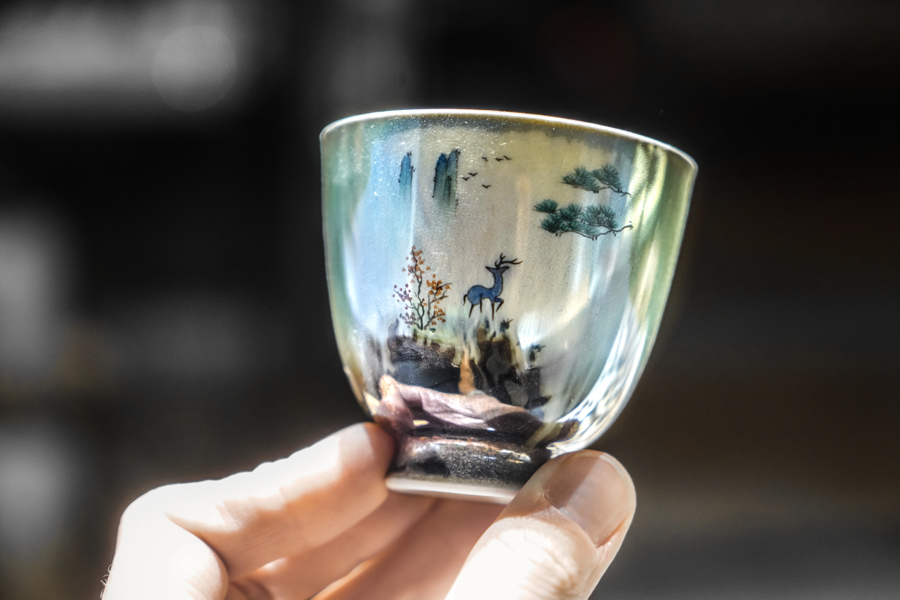
Chinese porcelain and ceramics hold a central place in the country’s artistic heritage, reflecting a long-standing balance between visual refinement and practical use. Porcelain production is traditionally believed to have originated in southern China, in the Dongjiang Valley of Guangdong Province, where deposits of white kaolin clay and favourable firing conditions allowed for early experimentation.
Over time, Jingdezhen (景德镇) in Jiangxi Province emerged as the most influential hub of porcelain production. For more than a thousand years, the city has refined both technology and decoration, and during the Ming dynasty (1368–1644), it became the site of imperial kilns, specialised state-run factories, supplying porcelain to the court. Other regions also developed distinctive ceramic traditions. Longquan (龙泉) in Zhejiang is known for its celadon ware, characterised by translucent glazes with fine crackle patterns, while Yixing (宜兴) in Jiangsu Province specialises in unglazed ceramics traditionally used for tea utensils.
An overview of these traditions can be found in major museum collections. In Beijing, the Palace Museum (故宫博物院) displays outstanding examples of imperial porcelain, while the Shanghai Museum (上海博物馆) houses one of the country’s most comprehensive ceramic collections. The Jingdezhen China Ceramics Museum (景德镇中国陶瓷博物馆) focuses on the development of the local school and its influence across successive dynasties. Ceramics can also be found in antique districts and specialist markets, including Panjiayuan Antique Market (潘家园旧货市场) in Beijing and Dongtai Road Antique Market (东台路古玩市场) in Shanghai, where historic pieces and traditional wares are sold alongside other collectibles.
China’s ceramic tradition extends beyond household objects and museum displays into monumental forms of artistic expression. The most striking example is the Terracotta Army of Qin Shi Huang, the first emperor of a unified China, who reigned from 221 to 210 BCE. This vast funerary complex, near Xi’an, was built in the 3rd century BCE and comprises thousands of life-sized clay figures of warriors and horses arranged, each typically ranging from 1.75 metres (5 ft 9 in) to about 2 metres (6 ft 7 in) tall. Arranged to guard the tomb of Qin Shi Huang, the site demonstrates the impressive technical ambition and expressive range of ceramics on an unprecedented scale. In addition to its Terracotta Army, Qin Shi Huang is also revered for initiating the construction of the Great Wall of China, for which tours are organised to the Badaling and Mutianyu sections, allowing visitors to admire the magnificence of its monumental architecture that has been preserved and restored.
Art of Stone Carving and Jewellery in China
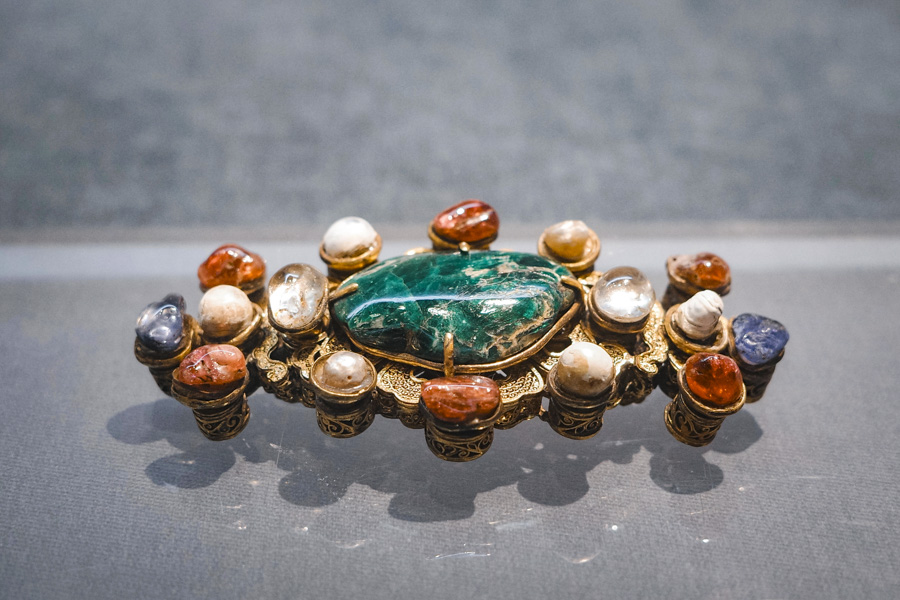
Stone carving and jewellery made from natural minerals in China have traditionally been associated with concepts of protection, prosperity, and social standing. In this context, material, form, and motif function as a unified whole, and stone objects are rarely created for decoration alone.
A wide variety of materials is valued in Chinese jewellery traditions, including jade, pearls, sapphires, agate, crystal, and turquoise. These stones are crafted into ornaments where texture, shape, and symbolic meaning are meticulously considered. Amulets and pendants often depict animals, zodiac figures, auspicious characters, or abstract protective signs, serving as personal talismans worn as jewellery or kept within the home.
Historically, centres of stone carving and jewellery production developed along the routes of the Silk Road and in major urban areas. Beijing and Suzhou became renowned for refined decorative stonework, while southern China benefited from access to a wide variety of materials arriving through maritime trade networks.
Today, stone handcrafts can be found both in museum collections and specialised markets in large cities. One notable institution is the Donghai Crystal Museum of Lianyungang (连云港东海水晶博物馆) in Jiangsu Province, which presents outstanding examples of natural crystal alongside finely crafted works from Donghai and other regions of China. Extensive collections of jewellery and ritual objects made from precious stones are also housed at the Geological Museum of China (中国地质博物馆), which boasts over 200,000 specimens, including the world’s largest known gemstone, a 3.5-tonne rock crystal.
Pearl craftsmanship is showcased at the Hainan Jingrun Pearl Museum (海南京润珍珠博物馆), where visitors can explore both the exhibition and an associated pearl plantation. Another remarkable example can be found at the Sanxingdui Museum (三星堆博物馆) in Guanghan, Sichuan, which displays a rare turquoise mosaic depicting a dragon. If you are searching for a unique and personalised piece of jewellery, certain shops offer the experience of collecting pearls directly from the oysters of your choice, which are then crafted into an exclusive item designed especially for you in the romantic Zhujiajiao Water Town.
For those interested in acquiring stone jewellery, several major hubs stand out. Donghai International Crystal Jewelry City Plaza (东海国际水晶珠宝城) offers a wide selection of decorative objects and jewellery made from natural stones. In Shenzhen, the Shuibei International Jewelry Trading Center specialises in high-end jewellery crafted from precious metals and gemstones. Enthusiasts of jade and jadeite may also wish to visit the Guangzhou Hualin International Jewelry Market (华林国际玉器城), where jewellery, figurines, vessels, and other objects are sold alongside works in gold and silver.
Tattoos in China: Traditions, Symbols and Modern Ink

Chinese black ink, dating back to the Neolithic period, was produced by burning pine and animal materials. Nowadays, it is made of black carbon pigment with a water-based binder. Ink sticks, one of the "four treasures of the study", were used by the emperor and often impressed with characters and motifs, particularly dragons. Black ink played a significant role in the development of writing arts in China, serving as a medium for calligraphing poems, painting and also tattooing.
Since ancient times, tattooing in China has served as a form of visual expression closely linked to cultural symbols and personal history. In many communities, tattoos were not only decorative but also acted as markers of life stages, social roles, or group identity. Although attitudes towards tattoos have evolved over time, the symbolic significance of these practices remains profound. Tattoos in Chinese culture may embody philosophical and religious meanings. The artistry and mastery involved in tattooing often reflect a deep cultural heritage, with skilled tattoo artists passing down their knowledge through generations.
Tattooing as Identity: Ethnic Traditions in China
In classical Chinese history, tattoos were often regarded with ambivalence or disapproval. Historical records indicate their use as a form of punishment referred to as “zong” or “mo” punishment during the Shang and Zhou periods, and in later periods they became associated with marginalised groups and criminal subcultures, reinforcing social stigma.
During the Song Dynasty, General Yue Fei’s (1103-1142) mother tattooed the words "Jing Zhong Bao Guo", which can be translated as “Serve the country with the utmost loyalty”, on his back to encourage him to fight the enemy. This tattoo was then considered a heroic act of filial piety in line with Confucianism’s ideas.
However, within certain ethnic minorities in southern and southwestern China, tattooing developed along very different lines.
On Hainan Island and in neighbouring areas, tattoos were traditionally linked to rites of passage. For instance, among the Dulong (独龙族), girls around the age of twelve or thirteen received a butterfly tattoo on their faces to signify their transition into adulthood. Similar symbolic meanings can be found in the tattooing practices of adolescent boys among the Dai (傣族). Common motifs such as dragons, tigers, elephants, birds, and plants reflect respect for nature, ancestral spirits, and protective forces. For the Li people (黎族), tattoos serve as clan identifiers and signs of maturity, expressing ideals of beauty along with wishes for protection and good fortune.
Urban Tattoo Culture in Modern China
In recent decades, tattooing has re-emerged in China’s major cities as part of contemporary visual culture. The use of black ink, traditionally employed in Chinese calligraphy, showcases a connection between the art of writing and tattooing. Coloured inks, particularly in contemporary tattoos, allow for vibrant expressions of personal identity and cultural heritage.
Urban centres like Beijing and Shanghai boast specialised studios that offer traditional Chinese imagery with modern techniques. Notable studios in Beijing include Longxiutang Tattoo (龙绣堂) in the 798 Art District and Spring Tattoo in Chaoyang District. In Shanghai, clusters of studios can be found around Tianzifang and People’s Square, including Han Tattoo (汉刺青) and Zhencang Tattoo (针藏). These spaces provide clients the opportunity to collaborate closely with artists, discussing designs and choosing from extensive collections of sketches.
Chinese Textiles and Fibres: Knots, Embroidery and Silk Traditions
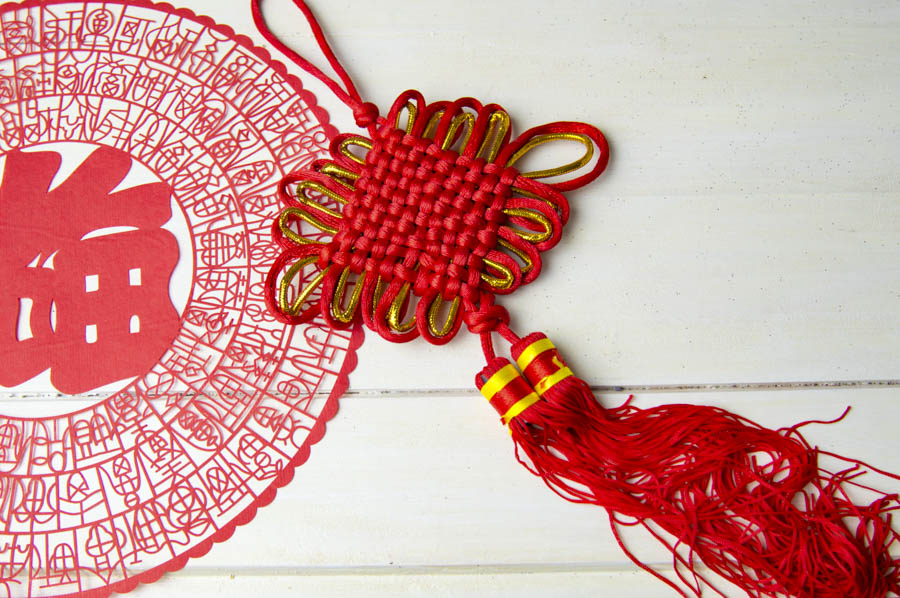
The art of working with textiles and the evolution of weaving techniques have long played an important role in both daily life and festive culture in China. Vibrant colours, exquisite patterns, delicate embroidery, and openwork structures reflect aesthetic preferences while also serving as a means of preserving cultural heritage across generations.
Chinese Knotting: A Traditional Decorative Craft
One of the most recognisable expressions of this tradition is Chinese knotting (中国结), a decorative craft based on the creation of ornamental knots, traditionally made from red thread. These knots are widely regarded as symbols of good fortune and protection closely tied to concepts from Buddhist and Taoist philosophy, such as harmony, continuity, and prosperity.
Traditionally, Chinese knots are crafted from silk cords folded into balanced, symmetrical designs without the use of glue or metal components. Each knot possesses its own name and symbolic meaning. For example, the Pan Chang Knot (盘长结) represents infinity and longevity; the Double Coin Knot (双钱结) is associated with wealth and good luck; and the Ruyi Knot (如意结) conveys wishes for well-being and the fulfilment of aspirations.
Today, decorative knotting remains a vibrant part of living tradition. Chinese knots are widely used in interior decoration and Chinese clothing and are prominently featured during festivals and family celebrations, particularly at Chinese New Year. They are commonly found in craft shops and traditional markets, where the practice continues as an active expression of cultural identity.
Miao Embroidery: Ethnic Textile Art of Guizhou
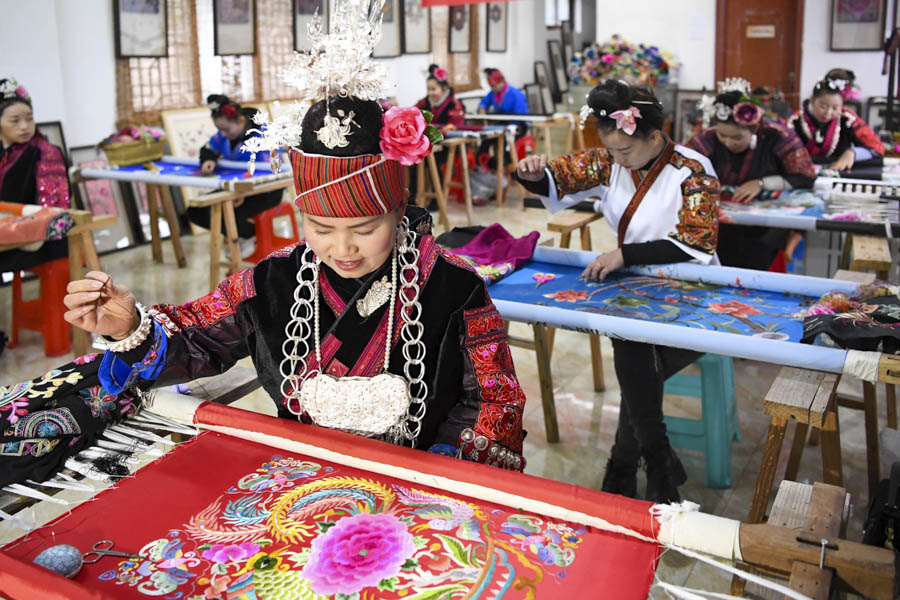
A distinctive place within China’s textile traditions is held by Miao embroidery (苗绣), a highly intricate decorative technique practised by the Miao people (苗族), primarily in Guizhou Province. Vivid colours, elaborate ornamentation, and motifs inspired by nature and mythology are hand-embroidered onto garments and accessories. These designs reflect the Miao worldview, family histories, and collective memory. The skills involved are passed down through generations, and the finished works are often described as the Miao epic worn, preserving cultural identity in textile form.
In recent decades, this tradition has become an important source of local livelihood, bringing Miao embroidery to a wider audience. Embroidered items can be found in many villages across Guizhou, with Xijiang Qianhu Village (西江千户苗寨) standing out as the largest concentration of Miao communities in the world. Visitors can purchase embroidered works, rent traditional clothing, and meander through the village streets, where textile patterns are an integral part of everyday visual life. The Xijiang Miao Nationality Museum (西江苗族博物馆) houses a substantial collection of traditional garments and embroidery samples, offering insight into the evolution of local styles.
Chinese Silk: Weaving Traditions and Silk Paintings
Silk occupies a central position in Chinese cultural history, long associated with refinement, status, and technical excellence. Over the centuries, silk fabrics, garments, and decorative items were produced for the elite, reflecting both aesthetic canons and social hierarchy. Hangzhou, recognised as a historic centre of silk weaving, played a key role in refining production and processing techniques that shaped the industry on a national scale.
Beyond its use in clothing, silk became a medium for artistic expression. From the Warring States period (c. 475–221 BCE) onwards, painters and calligraphers used silk as a surface for detailed imagery and inscriptions, employing ink and mineral pigments. One of the earliest surviving examples of this practice is the silk painting Depicting a Man Riding a Dragon (人物御龙帛画), preserved in the Hunan Provincial Museum (湖南省博物馆) in Changsha.
Further insights into silk traditions can be gained at the Suzhou Silk Museum (苏州丝绸博物馆), where ancient looms, embroidery, and textiles illustrate each stage of production. In Xi’an, the Tang West Market Museum (大唐西市博物馆) places silk within a broader historical context, highlighting its role in trade, diplomacy, and cultural exchange.
Learn More About the Expansive Realm of Chinese Applied Arts and Crafts
The applied arts of China encompass a vast array of practices that go well beyond the previously mentioned. Techniques such as fan making, kite crafting, lantern production, costume sewing for folk performances, seal engraving, and many others remain essential to regional traditions. Together, these crafts create a rich cultural landscape, intricately woven into daily life, ritual practices, and local identity.
When travelling in China, it is worthwhile to look beyond museums and markets. Engaging in workshops, watching artisans at work in craft villages, or learning basic techniques such as calligraphy, knotting, or embroidery provides a more immersive experience of these traditions. Such encounters offer a personal insight into Chinese culture, characterised by skill, continuity, and a deep respect for craftsmanship.