

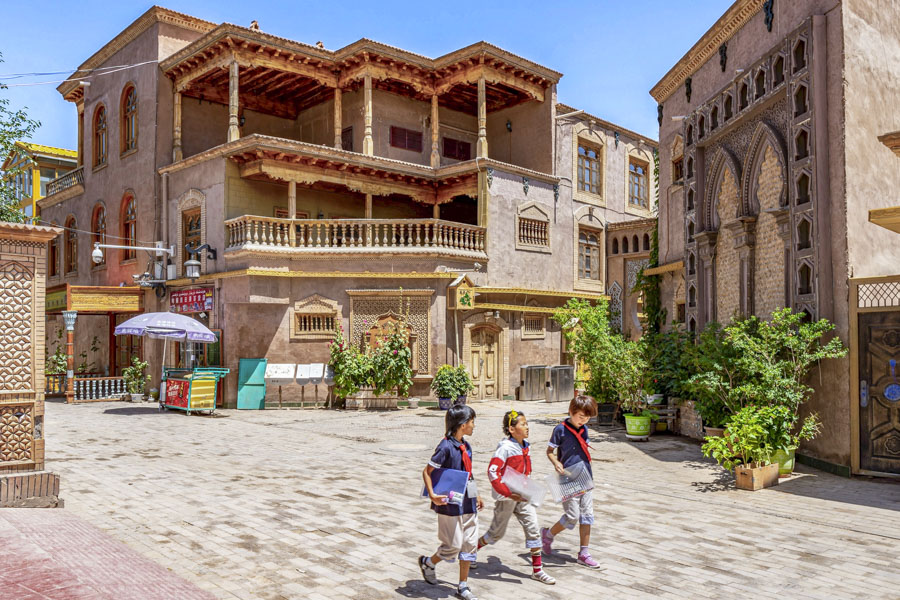
The Old City of Kashgar (喀什老城) is the historic heart of this oasis on China’s western edge, shaped by its place along the Silk Road. Its winding alleys, mud-brick houses, and small courtyards evoke the character of older Kashgar. Much of the district was extensively redeveloped from 2009 onwards, with buildings demolished, reconstructed, or restored; the area today combines historic fabric with newer construction.
Jiefang North Road separates Kashgar Old City into eastern and western districts. Across the area, distinctive streets and lanes offer a varied streetscape, from the Jiulongquan quarter and guesthouse-lined Bagqi Alley to Hanbaza Street and the lively bar street.
Kashgar Old City Tours
Kashgar Old City is a nationally rated 5A tourist attraction.
A walk through its grounds offers a close look at the atmosphere. Without any rush, you can take in the details of the historic buildings, pop into artisan workshops, and observe the daily life of the Uyghur people. Here, in everything from the distinctive architecture to culinary traditions and crafts, the living heritage of the past can be felt.
Around a bend a small market may come into view. The scent of fresh bread drifts from a house, and nearby, a craftsman continues working on a traditional piece. The Old City of Kashgar does not so much invite you to go sightseeing as it does to discover, little by little, a living space where history remains part of everyday life.
For your first visit, choose a day trip. Stop by the bustling markets, sample simple, hearty local dishes, and take in the main cultural sights. The itinerary includes a visit to the famous Abakh Khoja Mausoleum, just outside the historic centre, followed by a walk through the Old City, where you can see the renowned Id Kah Mosque and experience the contrast between historic Kashgar and the modern city.
If you would like to explore further, consider other trips that include a visit to Kashgar. These journeys offer a broader perspective on Xinjiang’s history, culture, and nature.
Best Time to Visit Kashgar Old City
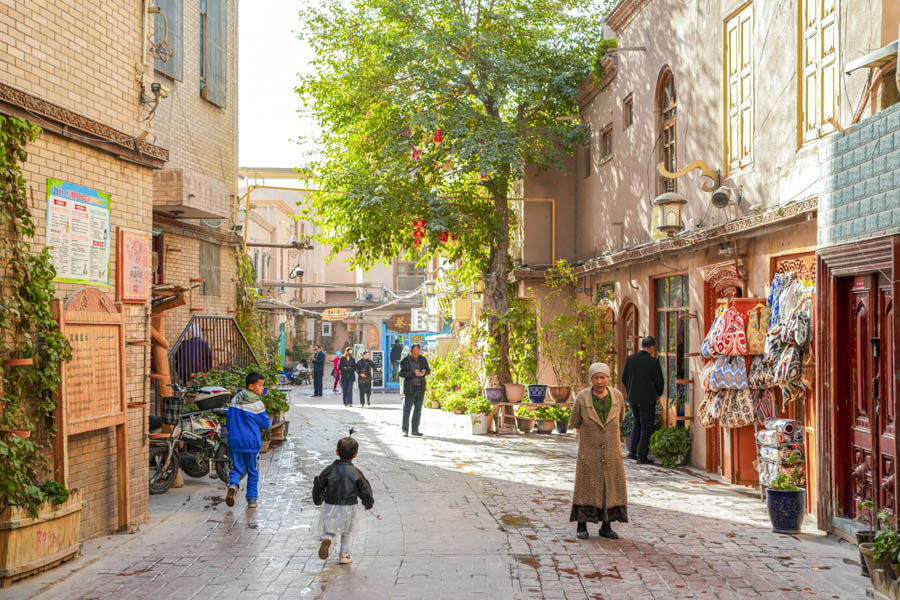
Choosing the best time to visit the Old City largely depends on the daily rhythm of its historic quarters, which changes noticeably throughout the day. The call to prayer marks the passing hours, carrying through the streets. Friday holds special significance in Muslim religious life, when worshippers gather for congregational prayer, particularly at Id Kah Mosque. Here, within the Old City, you can observe a centuries-old way of life as slow-paced scenes unfold throughout the day.
In the early morning, tranquillity often reigns: the labyrinth of alleys is still quiet, and the soft light perfectly highlights the texture of the mud-brick walls, allowing you to take in the details at your leisure. The bazaars and teahouses are livelier. As the day grows hotter, life in the Old City slows down – this is a time for leisurely relaxation in the shade of awnings and the cool interiors of artisan shops.
Towards evening, the atmosphere changes. As the air cools, the streets fill with activity, friendly conversations spring up on doorsteps, and the air is filled with the aromas of traditional baked goods. The bazaars and tea houses grow busy again, and live music is sometimes played. The real magic happens at sunset, when the receding sun paints the mud roofs in golden tones, gradually giving way to the nighttime lighting, which completely changes your perception of the ancient oasis.
For the most vibrant experience, consider visiting during the warmer months. Many everyday activities move outdoors into the streets and courtyards, offering guests a glimpse of life in these centuries-old quarters.
The East Gate Opening Ceremony featuring Uyghur music and dance takes place daily at the East Gate. The performance begins at 10:30 and 18:00, and during the high season, an additional ceremony is sometimes held at 12:00. It lasts about 20 minutes, and it is free.
If you want to learn about seasonal weather changes and major religious festivals, check out our Kashgar City Guide.
History of Kashgar Old City
The Birth of a Silk Road Oasis
The history of the Kashgar Old City spans more than two millennia, during which it developed as one of the key oases of the Silk Road. Emerging at the crossroads of trade routes linking China with Central Asia, Persia, and Europe, this outpost flourished under the Karakhanid Khanate, particularly from the 10th to 12th centuries, which became an important centre of Islamic learning and Turkic culture. The city later came under Mongol rule and, after the Mongol conquests (13th century), became the domain of Čengiz Khan’s second son, Čaḡatāy.
The Mediaeval Fortress City
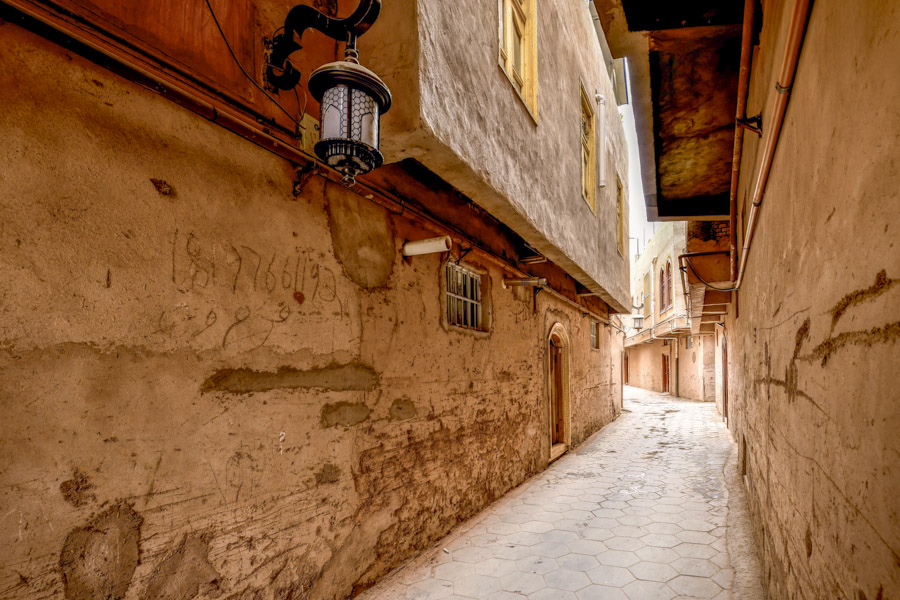
Starting from the 13th–14th centuries, the central part of Kashgar developed as a dense, defensive labyrinth through which trade caravans from across Central Asia and beyond continuously passed. It was during this period that the ancient oasis was visited by the famous Venetian merchant Marco Polo (visited c. 1273–1274), who noted the presence of a Christian community. Over the centuries, this quarter was built from sun-dried brick, wood, and clay. Due to a lack of space, new generations built their homes directly on top of their ancestors’ homes, causing the city to gradually grow upwards on the foundations of times gone by.
A turning point in its history came in the 16th century, when the ruler Mirza Abu Bakr Dughlat destroyed the ancient fortifications and built a new city in their place, which, today, is inhabited by Uyghurs and is called the Old City. Later, Kashgar came under the rule of the Chinese Qing dynasty (1644–1912).
During the 19th century, Kashgar became a focal point of British and Russian rivalry known as the “Great Game”, following its inclusion in Xinjiang province at the end of the 19th century.
The Great Transformation
In 2009, a new chapter began in the history of the ancient oasis: a major project to modernise and rebuild the Old City. The large-scale renovation of its centuries-old quarters, driven by the need to protect residents in this seismically active region, attracted considerable international attention and sparked active debate. Time has shown that the project sought to balance modernisation with the preservation of the Old City cultural character. Many old buildings were replaced with renovated structures designed to reflect traditional Eastern architecture. Wider, more accessible streets opened up the historic quarter to visitors and helped revitalise its economy.
The Living Symphony of Kashgar Today
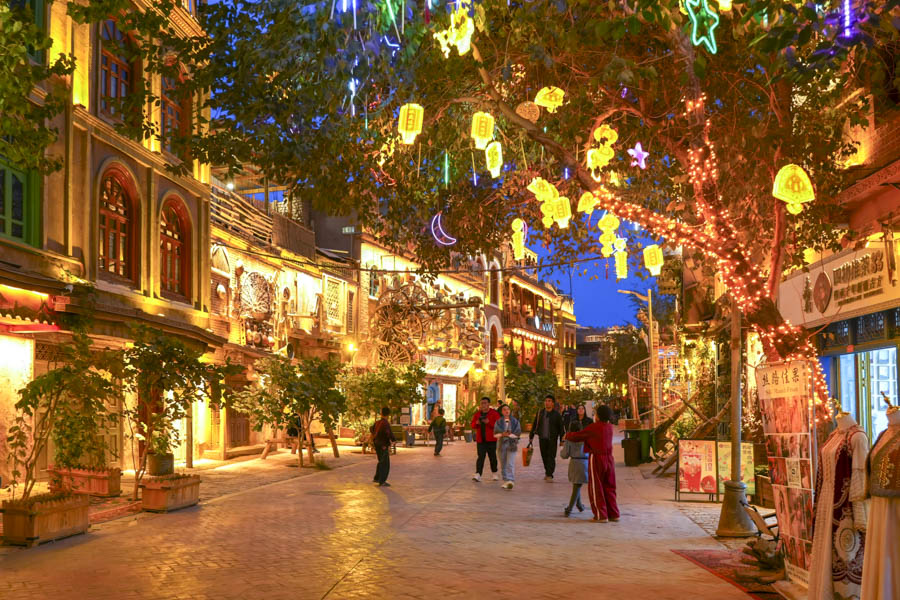
By the mid-2000s, Kashgar was largely inhabited by Uyghurs. The renovation has transformed the historic quarters into a comfortable, welcoming space for travellers. Today, cosy restaurants serving local cuisine, gift shops, and artisan workshops harmoniously coexist here, while performers in traditional dress stage shows and Uyghur dances in the squares. The city has carefully carried its heritage into a safe, modern setting. Today, the Old City of Kashgar is a captivating kaleidoscope of vibrant colours, distinctive architecture, enticing aromas, inspiring scenes, and the warm smiles of local residents.
Architecture of Kashgar Old City
The Urban Layout and Spatial Anatomy
The Old City of Kashgar covers about 3.6 square kilometres, and the scenic area stretches for approximately 1.5 kilometres (0.93 miles) from east to west and 1 kilometre (0.62 miles) from north to south. The main thoroughfare – Jiefang North Road (Jiěfàng běi lù, 解放北路) – divides the historic area into western and eastern parts. Inside the Old City, there are about 630 buildings, many of which remain part of the residential fabric.
The area’s layout follows the traditions of Central Asian Islamic urban planning. Unlike the strict grid typical of some Chinese cities, its alleys curve organically, sometimes end in cul-de-sacs, and meet at various angles. The residential buildings form a cohesive whole, with houses closely adjoining one another. Courtyards hidden behind the façades provide private spaces and help mitigate the effects of the dry climate.
The Contrast of Epochs and Materials
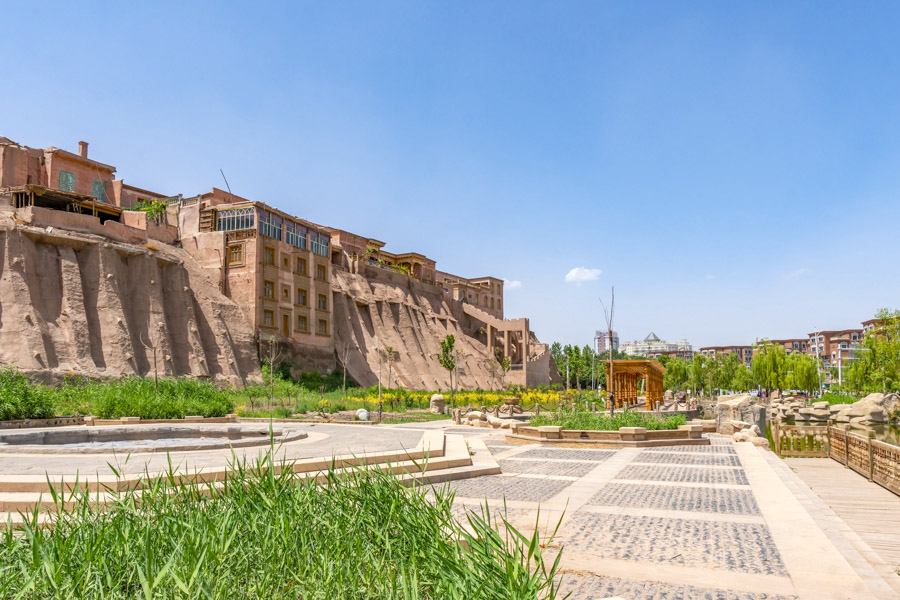
The Gaotai district holds a special place in the eastern part of the Old City. This area has preserved its authentic buildings, and many structures in the neighbourhood date back several centuries. It is a rare fragment of Kashgar’s former appearance. Here, mud-brick houses stabilised with straw and wooden frames stand on a loess cliff. In the main part of the Old City, however, modern concrete buildings predominate following the reconstruction, with traditional features reimagined through decorative elements.
The Intricate Details of Uyghur Artistry
It is the details that connect the different generations of local buildings. Arches, columns, carved shutters, and wooden elements around doors and windows give the buildings a recognisable Eastern character. Flat roofs, open terraces, and balconies adapt the dwellings to the hot summer, while the greenery in “Ayiwang-style” courtyards provides welcome shade. Traditional buildings are also characterised by thick walls and few storeys.
As a result, the architecture of the Old City blends several historical layers: the mud-brick houses of Gaotai, modern reconstructed quarters, and motifs that reference the traditions of the Uyghur and Islamic worlds.
Must-See Attractions in Kashgar Old City
The Old City reveals its character in the details. It is worth turning down an unfamiliar alley, climbing up to a rooftop, lingering by an artisan workshop, or simply watching everyday life in the neighbourhood.
Start your exploration at the East Gate Opening Ceremony, held at the Old City’s main entrance. Each day the area around the gate comes alive with the sound of drums as performers in vibrant traditional costumes greet the public with Uyghur songs and dances. For a few minutes, the area becomes a colourful stage, bringing performers and passers-by together in a festive atmosphere.
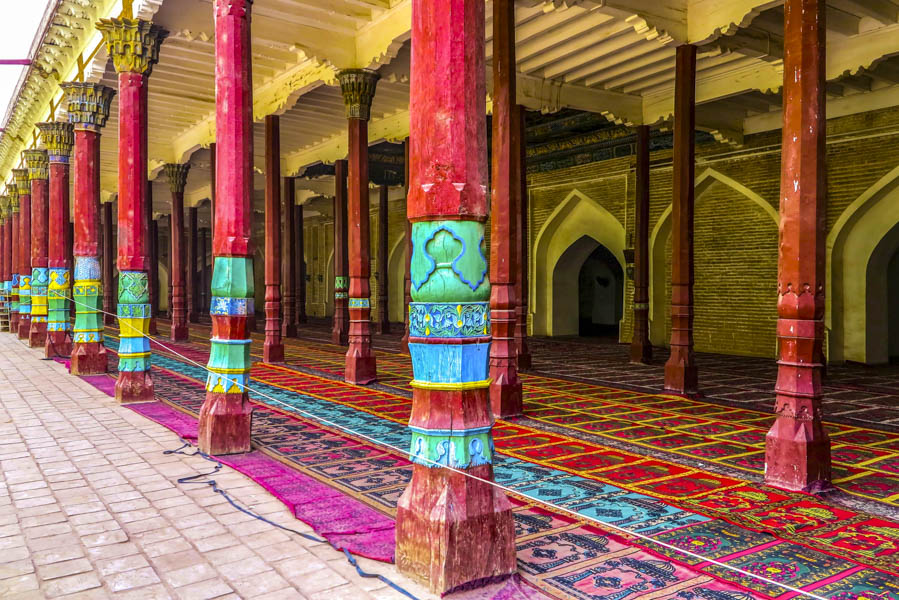
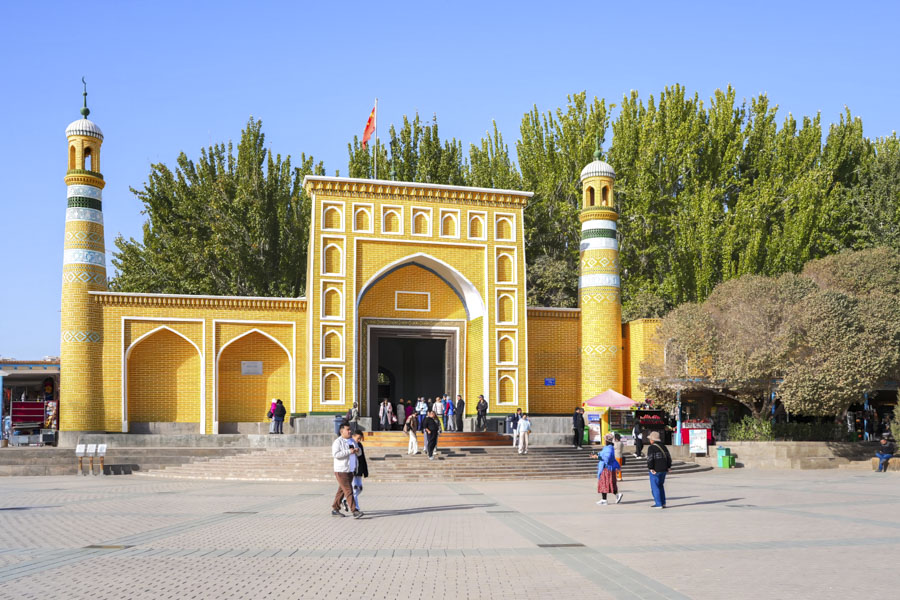
Nearby is the Id Kah Mosque, a historic mosque built in the 15th century and one of Kashgar’s main architectural symbols. Its expressive yellow facade, arched entrance, minarets, and shady courtyard reflect the character of Central Asian Islamic architecture. The courtyard is accessible during the day, while the indoor hall is open to worshippers during prayer times. Visitors can generally access the premises from the morning until early evening. Admission is free for Muslims and requires a fee for other visitors.
Next, stop by the Flowerpot Bazaar (花盆巴扎), where you can make your own souvenir by moulding and painting a clay flowerpot to take home. In the eastern part of the Old City, don’t miss the Herbal Tea Bazaar (药茶巴扎), where you can pick up aromatic herbal blends and herbs used in Traditional Chinese Medicine.
On the ancient Wustangboyi Road (吾斯塘博依路), you will find the Century-old Teahouse (喀什百年老茶馆). Order a pink milk tea and find a seat by the window: if you are lucky, you might hear elderly residents performing Muqam, a traditional Uyghur musical repertoire recognised on UNESCO’s Representative List of the Intangible Cultural Heritage of Humanity in 2008. Around 18:30, it is worth returning here for the evening dances, which are followed by a small parade featuring camels.
For the best panoramic views of the Old City, head to the open observation deck at the Sky Garden Viewpoint. From here, the mud-brick roofs of the historic quarters stretch out like a sea. You can also climb the famous Kunlun Tower (喀什昆仑塔) for a view of old Kashgar from even higher up. Continue your walk through the Han Bazaar (汗巴扎), a bustling street of snack stalls between the eastern and western parts of the Old City.
In the western part of the quarters, Rainbow Alley (彩虹巷) and Taha Lane (塔哈巷) are particularly popular colourful spots for photographs and traditional Uyghur costumes. In the morning, before 10:00, the light here is especially soft. At Budai Alley (布袋巷), the familiar urban space transforms into a unique artistic scene: rugs decorate the walls, decorative hulu gourds hang overhead, and old suitcases become part of the street decor. Also visit the Oil Painting Street (油画一条街), which is lined with studios and galleries where local artists create and display their work. It’s a lovely place to see paintings inspired by Kashgar and get a glimpse of the city’s contemporary art scene. Old Knives Alley (老刀巷) inspires photographs with its colourful and distinctive decor.
A walk through the Old City will inevitably lead you to the famous artisan street, Kumudai’er Wazha Road (库木代尔瓦扎路). One of its busiest sections is the Copper Bazaar (铜器巴扎), where work is in full swing from early morning. By day, the street becomes a bustling shopping gallery, with rows of polished copper jugs, bowls, and decorative knives displayed along the counters, while craftsmen chat with passers-by.
Be sure to stop by The Naan of Great-Great-Grandpa’s Father (爷爷的爷爷的爸爸的馕) to try one of its huge naans. Crispy on the outside and soft on the inside, it is particularly good with rose jam.
Shopping in Kashgar Old City
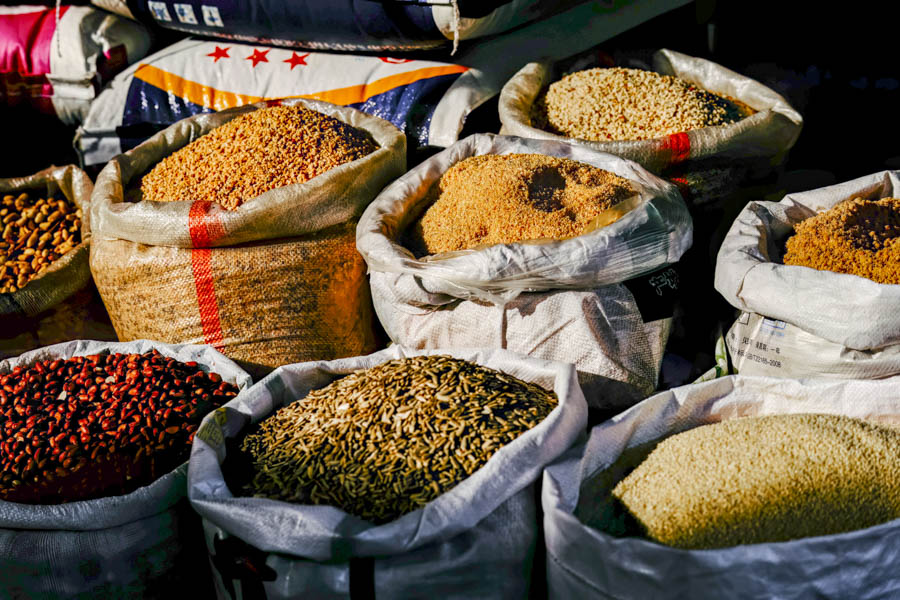
Wander through the narrow streets of the historic quarter and pop into the small workshops and specialist markets, where craftsmen work with wood, metal, clay, and fabric.
Look out for the vibrant pottery: handmade bowls, jugs, plates, and decorative items. In the copperware shops, you can find trays, teapots, bowls, and other utensils with chased patterns.
Wooden products include carved boxes, bowls, trays, and spoons with traditional patterns. Among the textiles, look for embroidered doppa hats and bright items made of Atlas silk – a fabric with a distinctive multi-coloured pattern. Traditional musical instruments, including the dutar and rawap, are also sold in the Old City. In the tea shops, you can choose aromatic blends of flowers, herbs, and spices.
How to Get to Kashgar Old City
The Old City is easy to reach from different parts of Kashgar by bus or taxi. For navigation, you can show the driver Kashgar Old City (喀什古城) or East Gate (东门), one of the main entrances to the historic quarter.
Buses 2, 7, 8, 22, and 28 run to the Old City; Id Kah Mosque is a convenient stop for visiting the central part of the quarter. Buses 7 and 15 can take you to the East Gate stop.
Taxis are a convenient option, especially if you are travelling with luggage or from another part of the city. Kashgar Railway Station is about 9 kilometres (5.6 miles) from the Old City, and the journey takes approximately 15 minutes. Kashgar Airport is about 12 kilometres (7.5 miles) from the historic quarter, and the journey takes roughly 20 minutes by car.
It is best to explore the Old City on foot: its narrow streets and alleys are ideal for walking, and the main sights are close to one another. Many streets may also be restricted to vehicles.
Tips for an Optimal Visitor Experience
Wear comfortable shoes. The Old City’s narrow streets and alleys are best explored on foot, so comfortable footwear will make your walk more pleasant.
Dress with local traditions in mind. More modest clothing is appreciated when visiting mosques and other religious sites.
Bargain in markets and small shops. Haggling is common, especially when buying gifts and handmade items.
Carry cash in yuan. It is helpful to have small notes so that sellers can give you change more easily.
Leave time for spontaneous stops. Workshops, small teahouses, courtyards, and alleys can all add interest to a stroll through the Old City.
Ask permission before photographing people. This simple gesture helps maintain a pleasant rapport with craftsmen, sellers, and others you may wish to photograph.
Think of it as a living neighbourhood, not a museum. Don’t enter private courtyards unless invited, and be respectful of residents’ privacy during your visits.