

Zhangye (张掖) lies in the heart of the Hexi Corridor, an oasis region on the southern edge of the Gobi Desert. The Badain Jaran Desert lies to the northeast, while the Tengger Desert is further east. Fertile farmland and lush vegetation around the city contrast sharply with the arid landscapes of northwestern China. Situated between deserts and mountains, it served as an important Silk Road hub for centuries – a crossroads were trade caravans passed and goods, ideas, and cultural traditions where exchanged.
Exploring Zhangye offers the opportunity to immerse yourself in the region's history and culture, sample local cuisine, visit traditional shops, and purchase produce and handicrafts from Gansu province and the surrounding region.
A trip to Zhangye also provides access to the area's extraordinary natural and historical landmarks. Beyond the city, travellers can discover multi-coloured mountain ranges, deep gorges, desert expanses, ancient cave shrines, and the remains of historic fortifications.
This travel guide will introduce you to the city's history and culture, as well as its temples, museums, parks, and markets. It will also highlight interesting places to shop and help you plan your journey through the region's main attractions.
Zhangye Tours
Where vibrant mountain colours meet ancient temples and silent deserts, Zhangye offers a gateway to a mysterious world shaped by faith, art, and journeys across the East.
Take a seven-day trip across Western China, beginning in the ancient city of Xi'an and continuing through Zhangye, Jiayuguan, and Dunhuang. In Zhangye, travellers can admire spectacularly multi-coloured mountains that appear to have been painted across a vast stone canvas. Next, the route leads to the Mogao Caves, where ancient frescoes and Buddhist imagery reveal the spiritual history and artistic heritage of the region.
For a more in-depth experience, a ten-day adventure across Western China is ideal. Zhangye serves as the starting point for a journey through golden deserts, ancient cities, and traditional bazaars. As the journey heads west, both the landscapes and its rhythm change: rugged mountains give way to silent desert expanses, while historic landmarks yield to the living traditions of Turpan and the vibrant streets of Kashgar. Along this itinerary, experiences unfold through the silence of the desert, the aromas of local cuisine, ancient legends, and the bright colours of Western China.
Zhangye is also easy to include in other trips across China: the city can serve as a memorable highlight of a shorter tour or as part of a grander itinerary, where natural wonders, ancient art, and centuries-old traditions meet the modern rhythm of the country.
Best Time to Visit Zhangye
The best time to visit Zhangye for general outdoor activities is from May to June and September to October, when the weather is comfortable, the skies are clear, and the soft light beautifully accentuates the terrain and colours of the Danxia hills. The summer months see the highest number of visitors, particularly at the region’s natural sites, while the first week of October, which coincides with China's National Day holiday, is one of the busiest periods of the year.
Spring (March to May) brings a gradual warming after the winter frosts. The average temperatures rise from around 5°C (41°F) in March to 17°C (63°F) in May. Rainfall remains low, although strong winds and dust are possible in spring, which can reduce visibility. By the end of the season, the surrounding landscape becomes greener, and the weather is suitable for city walks and excursions.
Summer (June to August) is the hottest and wettest period of the year, with an average temperature of around 22–25°C (72–77°F). July is the hottest month, with daytime temperatures commonly reaching 31°C (88°F). Despite August accounting for most of the annual rainfall, Zhangye remains relatively dry overall.
Autumn (September to November) brings clear skies and rapid cooling: the average temperature drops from around 18°C (64°F) in September to 3°C (37°F) in November. Precipitation also decreases significantly compared to the summer season.
Winter (December to February) is cold, dry, and generally clear, with an average temperature of around −4°C to −1°C (25°F to 30°F). January is the coldest month, and temperatures can occasionally fall below −13°C (9°F). Snow is generally limited, but cold and windy conditions can make long walks and visits to exposed natural sites less suitable.
History of Zhangye
Modern Zhangye grew on the site of a settlement that emerged more than two thousand years ago. In 104 BC, following the military campaigns of Emperor Wu of the Han dynasty against the nomadic Xiongnu people, the Zhangye Commandery was established here. The name Zhangye itself derives from the expression 张国臂掖,以通西域, which literally translates as "extending the arm of the state to the western lands". This reflected the empire's desire to strengthen its position and maintain connections with territories beyond China.
Thanks to its location among deserts and mountains, the city quickly developed into an important military, commercial, and agricultural hub. The waters of the Heihe River, which originates in the Qilian Mountains, fed the fertile oasis and made it possible to supply food not only to local residents but also to passing caravans. In 554 AD, Zhangye was renamed Ganzhou, the name by which it is mentioned in mediaeval sources. The city assumed a particularly prominent role during the Tang dynasty (618–907), when trade and cultural ties in the region flourished on a grand scale.
Along with goods, new faiths and artistic traditions reached Zhangye. Buddhism found fertile ground for expansion, and the city became home to monastery complexes and temples. In 609, Emperor Yang of the Sui dynasty (581–618) visited Zhangye, where he met delegations or representatives from 27 western states, demonstrating the city's importance as a centre of diplomatic and commercial exchange. During the Western Xia period (1038–1227), construction began on the Dafo Temple, which subsequently became the spiritual and cultural centre of the city.
Zhangye’s history was also recorded in the accounts of European travellers. In the 13th century, the Venetian merchant and traveller, Marco Polo, visited the city and reportedly spent about a year there. Later, Zhangye became part of the Mongol Empire. During the Ming Dynasty (1368–1644), it acquired new defensive structures, including the Drum Tower. After the gradual decline of caravan trade, the city lost its former international significance but retained its role as an important regional centre.
Today, Zhangye’s historical heritage lives on in its temples, ancient buildings and cultural landmarks, while interest in the unusual landscapes of the surrounding area has given the ancient oasis a new lease of life as a tourist destination. Zhangye city also serves as a gateway to the Zhangye UNESCO Global Geopark, designated by UNESCO in 2020.
Things to Do in Zhangye
Places to Visit in Zhangye
Discover the historical heart of Zhangye – a place where ancient temples, pagodas, and merchants’ courtyards have preserved the distinctive character of bygone eras.
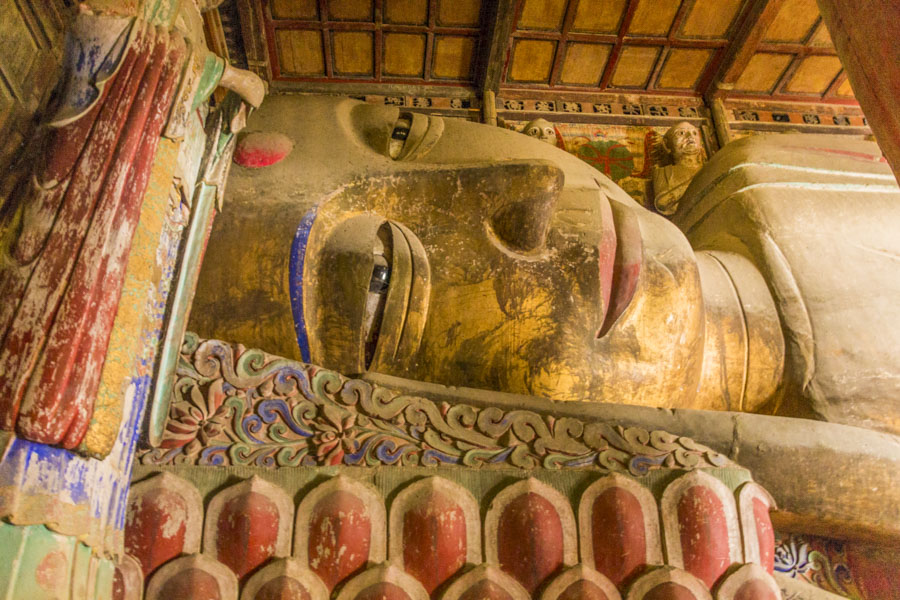
Start your route in the city centre at the Zhangye Giant Buddha Temple (Dafo Temple, 张掖大佛寺), Zhangye's main historical landmark. Step into the majestic hall and look up at the 34.5-metre-long reclining clay statue of Sakyamuni Buddha, depicted at the moment of his entry into nirvana. Admire the building’s monumental wooden structure and Qing-era frescoes depicting Celestial Deities, Journey to the West, and Classic of Mountains and Seas – along with the Eighteen Arhats and untitled scenes of landscapes, flora and fauna.
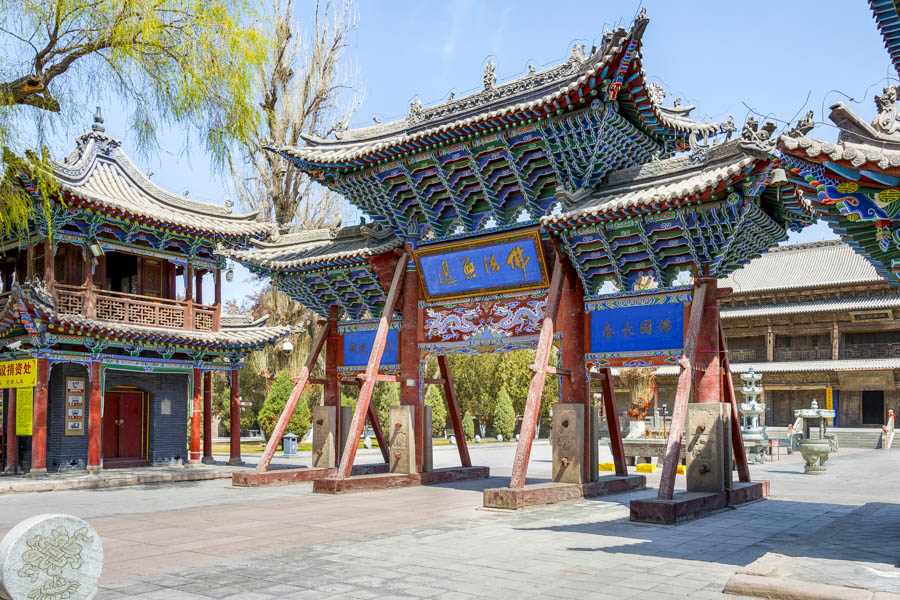
After leaving the monastery, walk a short distance northeast to the Zhangye Shanxi Guild Hall (张掖山西会馆), built in 1724 with funds provided by wealthy merchants from Shanxi. Step inside to explore its peaceful courtyards, see the ancient open-air theatrical stage, and visit the grand halls. The intricate wood and stone carvings throughout the complex are particularly impressive.
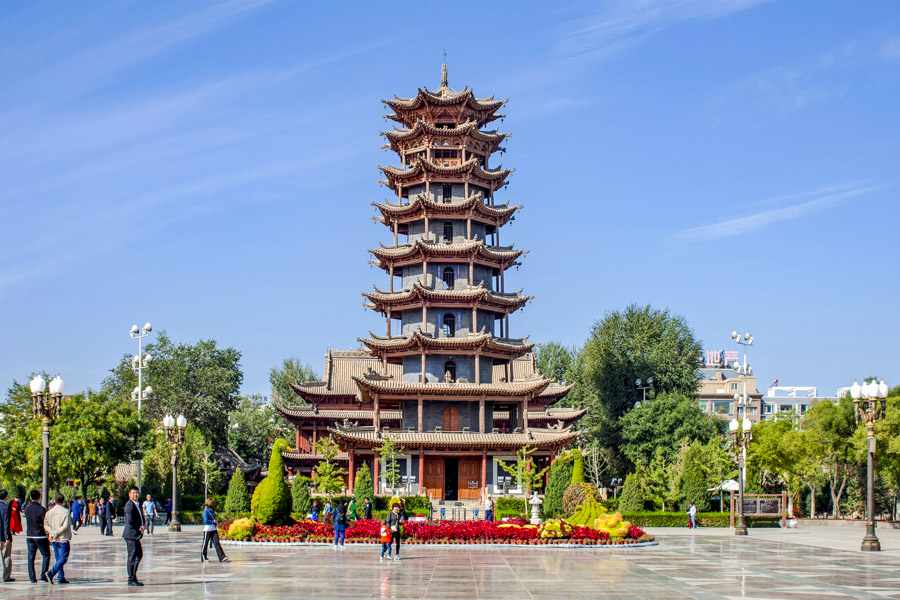
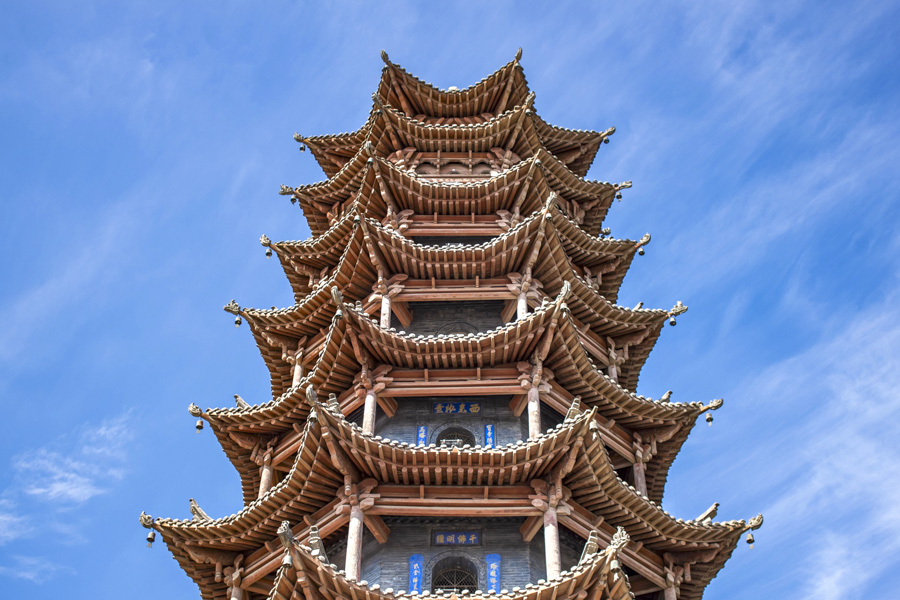
Then head west to Wanshou Temple (万寿寺), better known as Muta Temple or Wooden Pagoda Temple. Here you will be greeted by a nine-storey, octagonal pagoda standing nearly 33 metres high, whose current appearance took shape after a 1926 reconstruction. Take a close look at the carved details and wooden dragon heads beneath the eaves, as well as the calligraphic inscriptions above the entrances: "Reach Paradise" and "Enter the State of Samadhi".
Conclude your walk at the Zhangye Drum Tower (张掖鼓楼), also known as Zhenyuan Tower (镇远楼). Admire its three-storey structure, upturned eaves and richly decorated façades. Pass through one of the four arched passageways and examine the wooden details and broad galleries at the top of the tower.
Zhangye Surroundings
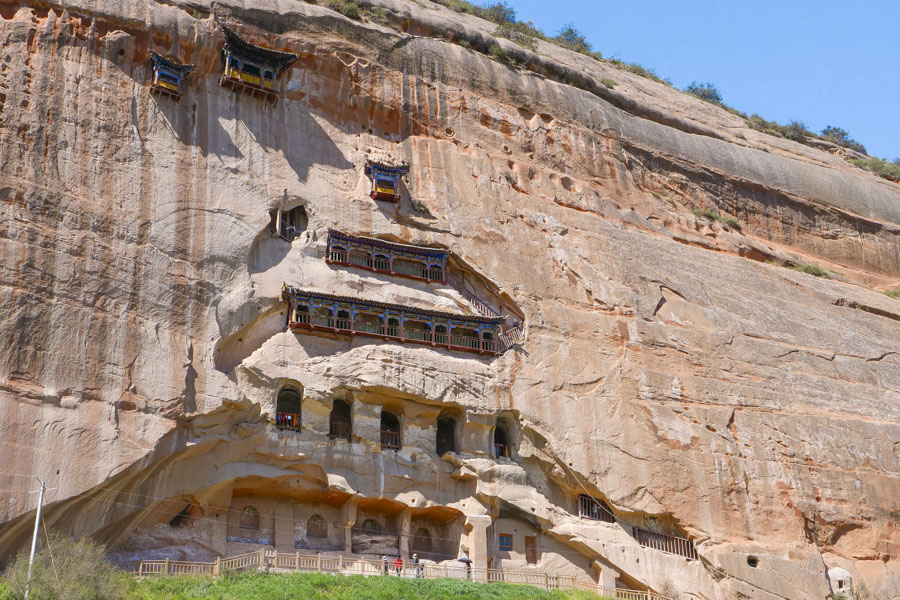
Venture beyond Zhangye to discover another side of the region – mountain grottoes and ancient border fortresses.
Head to the Matisi Grottoes (马蹄寺石窟群), approximately 65 kilometres (40.4 miles) from Zhangye, and climb the narrow staircases carved directly into the cliffs. More than 70 cave shrines and niches are hidden among the mountain slopes at the foot of the Qilian Mountains, combining Buddhist art with the harsh beauty of the highlands and the cultural landscape of the Yugur people region.
Set aside a day for a trip to the Jiayu Pass (嘉峪关) – a mighty fortress that marks the western end of the Ming Dynasty Great Wall of China. Pass through the massive gates, climb the walls, and imagine the lines of caravans that once passed through this fortified border.
Museums in Zhangye
Explore Zhangye’s history through its museums, where archaeological finds, ancient manuscripts, and folk culture items tell the story of the region's past.
The Zhangye Museum (张掖市博物馆) houses archaeological finds related to the history of the city and its surrounding areas. The collection features more than 11,000 historical artefacts, including stone and ceramic items, bronze objects, coins, weapons, burial artefacts, and other relics that allow visitors to trace the region's development across different historical periods.
Be sure to stop by the Ganzhou District Museum (甘州区博物馆), located within the Dafo Temple Scenic Area. Its exhibitions introduce the history and cultural heritage of the city, while the museum preserves a part of the rich collection of historical relics associated with the temple complex.
Theatres in Zhangye
Experience Zhangye’s contemporary theatre scene at the Zhangye Silk Road Culture and Arts Centre (张掖丝绸之路文化艺术中心), which brings together the Zhangye Grand Theatre (张掖大剧院) and Qiyi Theatre (张掖七一剧院). The centre hosts touring performances, musical and dance productions, theatre festivals, and programmes introducing audiences to traditional Chinese art and local cultural heritage.
Qinqiang opera (秦腔) – a traditional Chinese opera genre with roots dating back centuries – holds a special place in the city's cultural life. It is known for its powerful, expressive vocals, energetic movements, and distinctive percussion sound. The Zhangye Qiyi Theatre Performing Arts Co. Ltd. launched the One-Yuan Theatre (一元剧场) programme, which allows visitors to watch traditional Qinqiang productions for just CNY/RMB 1. The programme gives tourists the opportunity to experience live folk art in an authentic theatrical tradition for a nominal fee. Performances are often held at Qiyi Theatre in the Zhangye Silk Road Culture and Art Center, although schedules and venues may vary.
Entertainment, Parks, and Shopping in Zhangye
After exploring the city’s main landmarks, discover another side of Zhangye – lively, modern, and full of local colours.
Entertainment in Zhangye
Throughout the year, cultural activities are in full swing across Zhangye's main squares. Festive concerts, performances by local musical groups, and large-scale open-air dance events are regularly organised here. Visit one of the central squares in the evening: this is where Zhangye reveals itself not just as a city steeped in ancient history but also as a lively and dynamic place where residents gather to dance, listen to music, and socialise.
The city becomes particularly vibrant during major national holidays, including the Spring Festival (Chinese New Year) and the Dragon Boat Festival. At these times, the streets may feature costume parades, traditional craft fairs, and folk performances. If your trip coincides with one of these festivals, set aside a couple of hours for a leisurely stroll through the centre. It is an excellent way to experience the festive atmosphere of the city and observe authentic local life.
Parks around Zhangye
Discover the fantastic landscapes of Zhangye by visiting the most famous scenic areas in the surrounding area.
Take a break from the city bustle at Zhangye National Wetland Park (张掖国家湿地公园) – a vast green oasis stretching right along the northern outskirts of Zhangye. It is worth coming here to take a leisurely stroll along the wooden boardwalks among the reeds, ride a bike through the shaded avenues, or rent a pedal boat for a serene moment on a small lake.
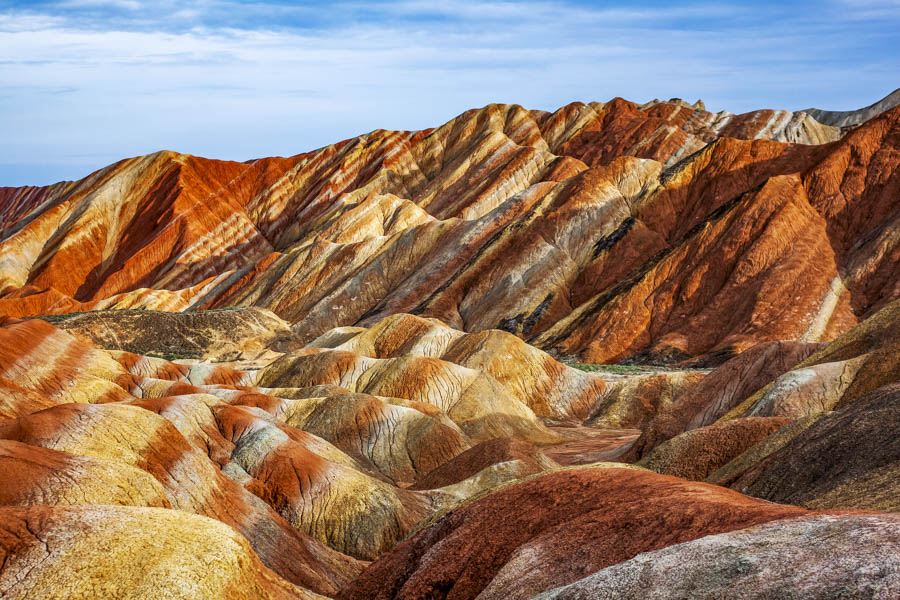
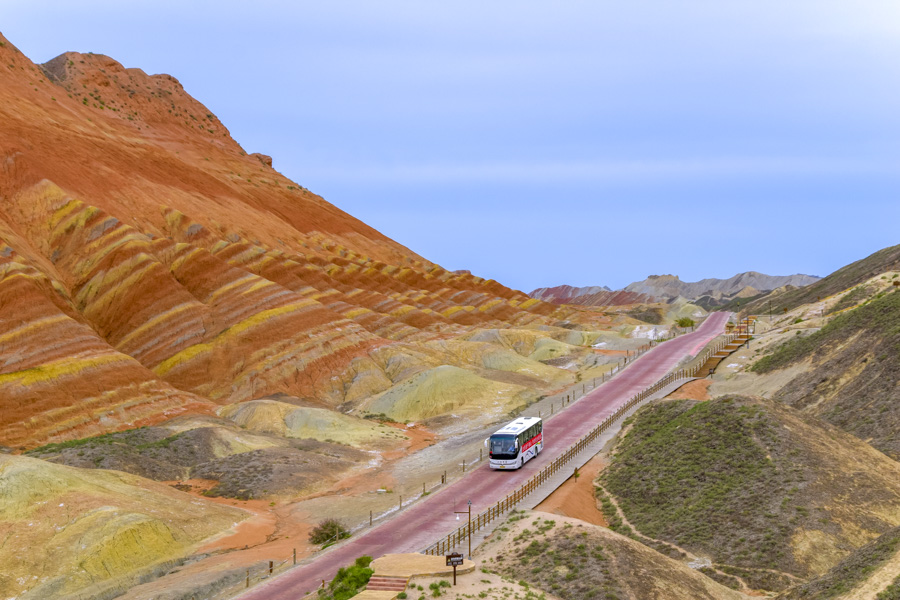
Stop by Zhangye UNESCO Global Geopark (张掖世界地质公园), approximately 40 kilometres (24.9 miles) from the city, and climb to the viewing platforms overlooking the mesmerising hills of Danxia, which appear to have been painted with broad brushstrokes in shades of ochre, red, yellow, and grey. As the light shifts, the stratified slopes change hues, transforming the landscape into a living geological painting.
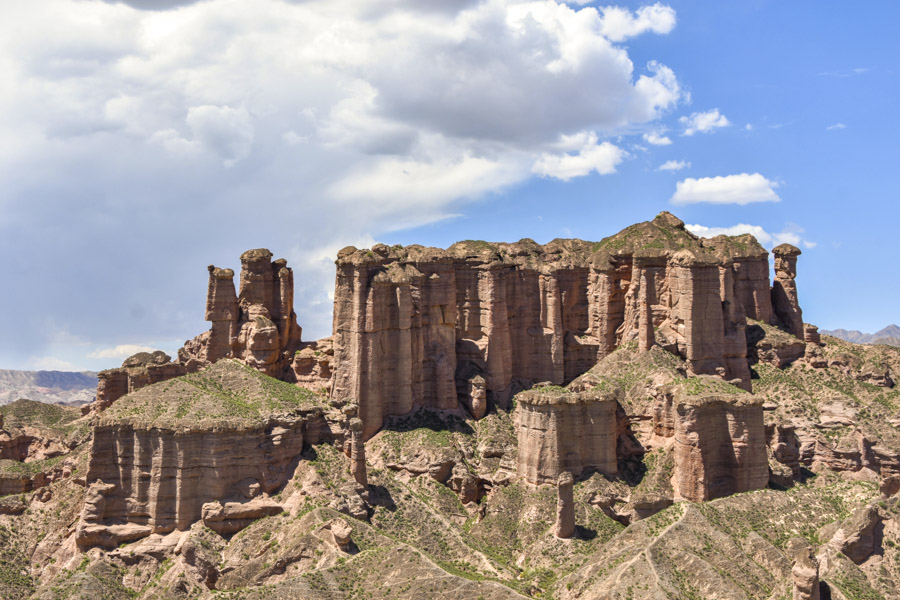
Continue your journey to Binggou Danxia Scenic Area (冰沟丹霞景区), approximately 53 kilometres (32.9 miles) from Zhangye. Here, the rocks take on whimsical shapes: wind and erosion have carved stone towers and palaces, transforming the mountainous landscape into something resembling a fantastical city.
For an outdoor adventure, head to Pingshanhu National Grand Canyon, approximately 57 kilometres (35.4 miles) from Zhangye. You can hike among the whimsical red-and-white cliff walls, deep gorges, and sharply sculpted rock formations. The landscape is particularly impressive in scale, and the trails allow you to descend deep into the canyon and examine the layered rocks up close.
Shopping in Zhangye
Take a piece of Zhangye home with you: local markets and shops offer produce, handicrafts, and unusual gifts. Head to the lively pedestrian Ming-Qing Street pedestrian area (张掖明清街), where as evening falls and the lights come on, the night market transforms the street into a bustling Eastern bazaar.
Among the local products worth bringing home are sweet Xiaohe Chinese dates, aromatic Mingle garlic, the famous Wujiang rice, and spicy Gaotai capsicum. Connoisseurs of authentic alcoholic beverages should look out for products made from local grapes, including traditional Zhang Wine.
Do not limit yourself to gastronomic purchases: look for folk handicrafts in souvenir shops. Traditional paper cuttings, local handmade embroidery, and cashmere clothing and household items all make excellent choices.
Food in Zhangye
Experience Zhangye through its local cuisine – hearty, often spicy, and deeply rooted in the culinary traditions of Gansu province.
Chinese Cuisine
Begin your gastronomic journey at Ganzhou Gourmet Street, also known as Ganzhou Night Market (甘州市场), at 376, Minzhu East Street (张掖民主东街376号). It is a convenient place to sample several iconic local dishes at once. Order beef xiaofan (牛肉小饭), a hearty dish of tiny pieces of dough – cut so finely that they resemble grains of rice – served in a rich beef broth. Alternatively, choose the legendary saozi noodles (臊子面) made with finely chopped meat and aromatic vegetables with a distinctive tangy flavour.
For the best beef xiaofan in town, stop by Jiao Datou Beef Rice (焦大头牛肉小饭). This is a popular local spot specialising in this dish. People come here for the perfectly clear yet robust meat broth and generous portions of tender beef.
If you want to try other regional specialities, visit Peng Xin Lamb National Restaurant (鹏馨羊羔肉). The main pride of its menu is the incredibly tender stewed lamb as well as their signature roasted lamb.
For a traditional Chinese breakfast, Grain Trade Restaurant (粮贸餐厅) is an excellent choice, serving exemplary saozi noodles, minced noodles and fluffy steamed baozi buns from early morning. For lunch or dinner, stop by Sun Ji Chao Pào Restaurant (孙记炒炮) to try their signature fried Chao Paozhang (stir-fried "firecracker" noodles / 炒炮仗), cooked over a high flame with meat and seasonal vegetables.
Vegetarian Restaurants in Zhangye
There are no specialised vegetarian restaurants in Zhangye, as the culinary culture of the Gansu region is traditionally based on meat dishes, primarily lamb and beef. However, finding vegetarian food is still relatively easy: thanks to the region’s well-developed Buddhist culture and abundance of vegetable dishes, vegetarian options are readily available at local establishments.
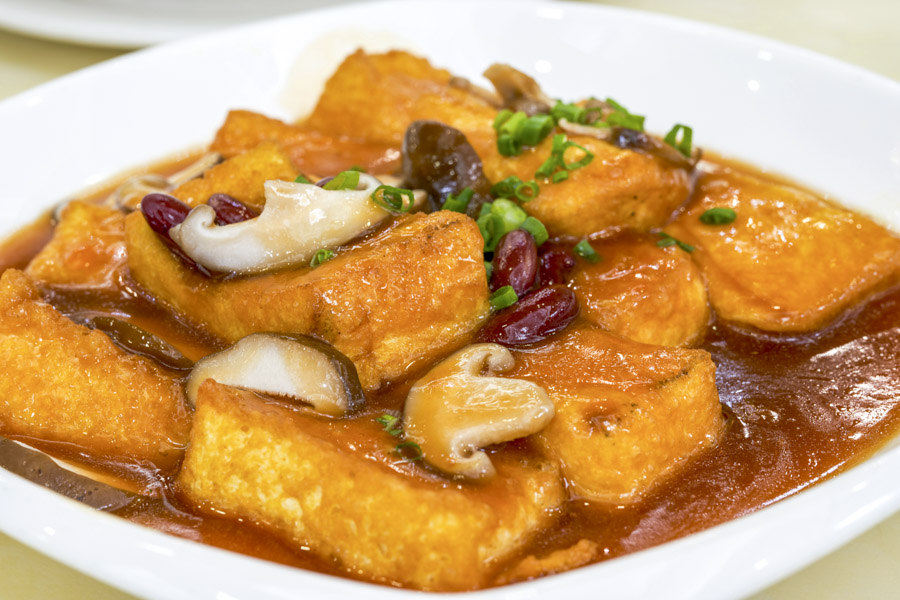
In the city’s cafés and restaurants, you should definitely try home-style fried tofu (Jiachang Doufu / 家常豆腐), which is very filling thanks to its soy protein, as well as classic braised aubergines with potatoes and peppers (Di San Xian / 地三鲜), known for their rich sauce and soft texture of the vegetables.
To have full control over the ingredients in your meal, it is best to order food where the chef cooks in front of you, as is common in local markets and street food areas. When speaking with a chef, you can use the phrase "Wǒ chī sù" (我吃素), meaning "I am vegetarian", and it is polite to say "Bú yào ròu, bú yào ròumò" (不要肉,不要肉末) to ensure that no meat or minced meat is added. You can also ask "Qǐng yòng zhíwùyóu chǎo" (请用植物油炒) for your food to be cooked in vegetable oil rather than animal fat. These phrases are worth printing out or saving on your phone.
Tea Houses, Bakeries, and Patisseries
Throughout Zhangye, street stalls and local bakeries sell traditional desserts and refreshing drinks that are highly popular with the city's residents. For a sweet accompaniment, locals strongly recommend refreshing apricot peel tea (Xingpi Cha / 杏皮茶), as well as a thick local yoghurt served with a variety of fruit toppings. Local baked goods are also popular, including traditional sweet steamed buns and crispy, buttery pastries filled with bean paste.
City Transport in Zhangye
Zhangye is quite compact in its central area, but some attractions are located far beyond the city. Buses and taxis are the most convenient options for travelling around the centre, while a car with a driver will be necessary for out-of-town routes.
Buses and Shuttles
City buses are the most budget-friendly way to get around Zhangye. There are 10 bus routes operating in the city. Most buses run from approximately 7:00 to 17:00, while route No. 1 operates longer – from 6:00 to 22:00. The fare is CNY/RMB 1 to CNY/RMB 2.
Tourist and intercity buses are used for trips to attractions outside the city. For example, the bus to Zhangye Danxia National Geological Park departs from Zhangye Bus Station. A one-way ticket costs around CNY/RMB 15 ($2.10, €1.90, £1.65).
Taxis and Ride-Hailing
Traditional taxis in Zhangye operate on fixed fares and meters. Boarding and the first 3 kilometres (1.86 miles) of a city trip will cost CNY/RMB 7, while each subsequent 1 kilometre (0.62 miles) costs around CNY/RMB 1.5. The fare increases slightly at night.
For greater convenience, use the national online service DiDi (滴滴出行) via a mini-programme in WeChat or Alipay. Hailing a taxi on the street or ordering a DiDi car online is generally easy to find, although waiting times vary according to the time and location.
Car Rentals with a Driver
If you wish to explore the area around Zhangye at your own pace, you can rent a car without a driver. The best and most popular alternative for trips to remote attractions is hiring a car with a local driver. You can book a car through the receptionist at the front desk of most city hotels.
Shared E-Bikes and E-Scooters
For quick trips around the city centre, the pay-as-you-go electric bike and e-scooter sharing network is ideal. They are parked in large numbers on pavements near shopping streets, parks, and public transport stops. To start a ride, simply scan the QR code on the handlebars using the Alipay or WeChat app.
How to get to Zhangye
Zhangye is convenient to visit as part of a journey through Gansu: the city is connected to other major regional centres by high-speed trains and normal-speed trains, as well as domestic flights.
By Air
The city's only airport is Zhangye Ganzhou Airport (张掖甘州机场) (YZY), located approximately 25 kilometres (15.5 miles) southeast of the centre. Year-round flights connect Zhangye with Xi'an, Lanzhou, and Guangzhou.
and Chengdu, while seasonal routes operate to Beijing, Shanghai, Chongqing, Dunhuang, Hefei, and Ürümqi. No international flights are available.
By Train
For most travellers, the train is the most convenient way to reach Zhangye. Zhangye West Railway Station (张掖西站) serves high-speed trains and is located just 3 kilometres (1.9 miles) from the city centre. Conventional trains mainly arrive at Zhangye Railway Station (张掖火车站), located approximately 8.5 kilometres (5.3 miles) from the central area.
High-speed trains connect Zhangye with Xi'an, Xining, Lanzhou, Jiayuguan, Dunhuang, and other cities across northwestern China. Check the current timetable when planning your journey, as routes and departure frequencies may vary.
By Long-Distance Bus
Intercity buses arrive at Zhangye Bus Station (张掖汽车站), located at No. 381, Xihuan Road (甘州区西环路381号), approximately 2 kilometres (1.2 miles) from the city centre. The bus station operates numerous routes across Gansu Province and neighbouring regions, including Jiayuguan, Jiuquan, and Xining.
Languages Spoken in Zhangye
The official language of China, including Zhangye, is Standard Mandarin (Putonghua, 普通话). In everyday communication, local residents may speak the Zhangye dialect, which belongs to the Lan-Yin branch of the Qinlong group within the Mandarin dialects of north-western China. The dialect is closely related to other local varieties spoken in Gansu and neighbouring regions. Other varieties such as Lanzhou–Yinchuan Mandarin, also known as Lan-Yin Mandarin (兰银官话) – a group of Mandarin dialects spoken across Gansu and neighbouring areas – may also be heard in the.
Some hotel stahh and tour guides may speak basic English, but fluent communication outside the tourism sector should not be expected. To make communication easier with local residents, save or print out the addresses of the hotels, shops, and attractions you plan to visit in advance. It is also useful to memorise a few simple phrases: Hello – Nǐ hǎo (你好) and Thank you – Xièxiè (谢谢).
Security in Zhangye
Zhangye is generally safe for travellers and well adapted for tourism.
The region has a dry climate and strong sunlight, so carry water, use sun protection and wear suitable clothing and footwear when exploring outdoors. At natural attractions, stay on marked paths and follow instructions from park staff. If you are visiting a remote area, check the weather forecast, ensure your phone is charged and avoid travelling alone where possible.
Although Zhangye is located in a remote area, the city offers all necessary medical care. Zhangye People's Hospital, affiliated with Hexi University (河西学院附属张掖人民医院), is a major public hospital with a 24-hour emergency department. Furthermore, you can take advantage of your stay to book Traditional Chinese Medicine (TCM) treatments at this facility.
Consider taking out travel insurance with medical cover for visits to the desert and other remote areas; it is a simple precaution that will give you peace of mind while exploring the region.