

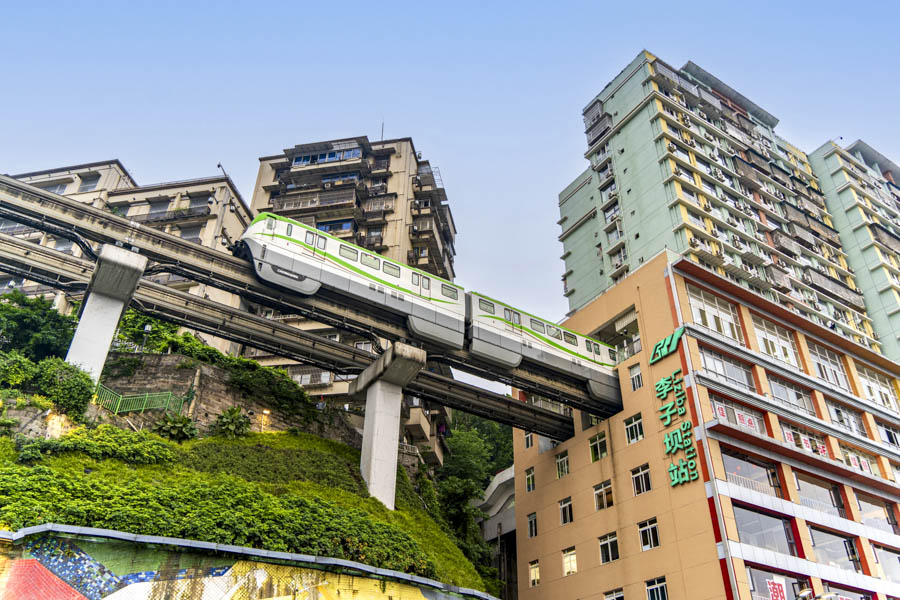
At Chongqing Liziba Station (李子坝站), the train running through a residential building turned it into China’s social media sensation. In this innovative megalopolis, you step out onto a simple street and find yourself on the upper floors of a tower. Sometimes referred to as the 8D city, to evoke a surreal, multi-dimensional urban experience, here you’ll find public squares built above shopping complexes.
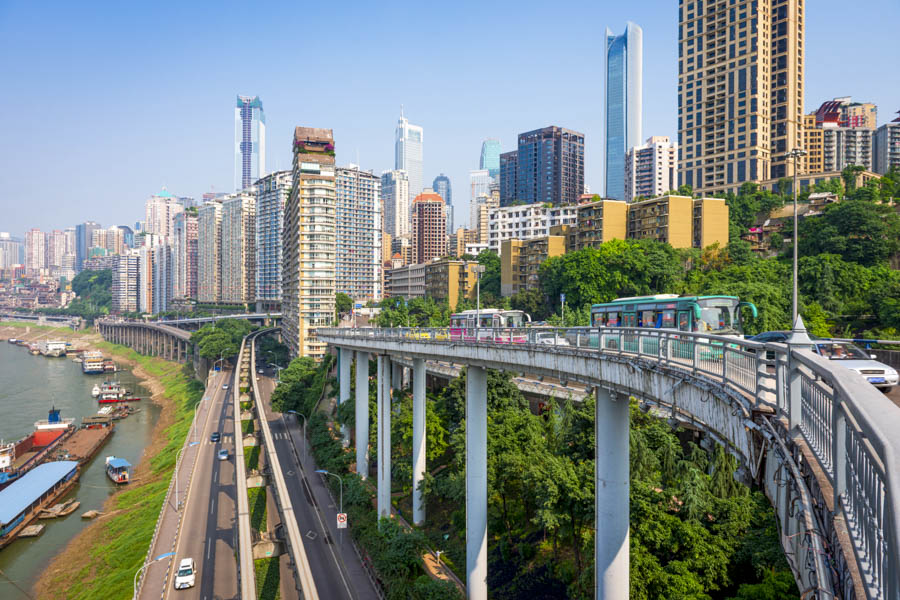
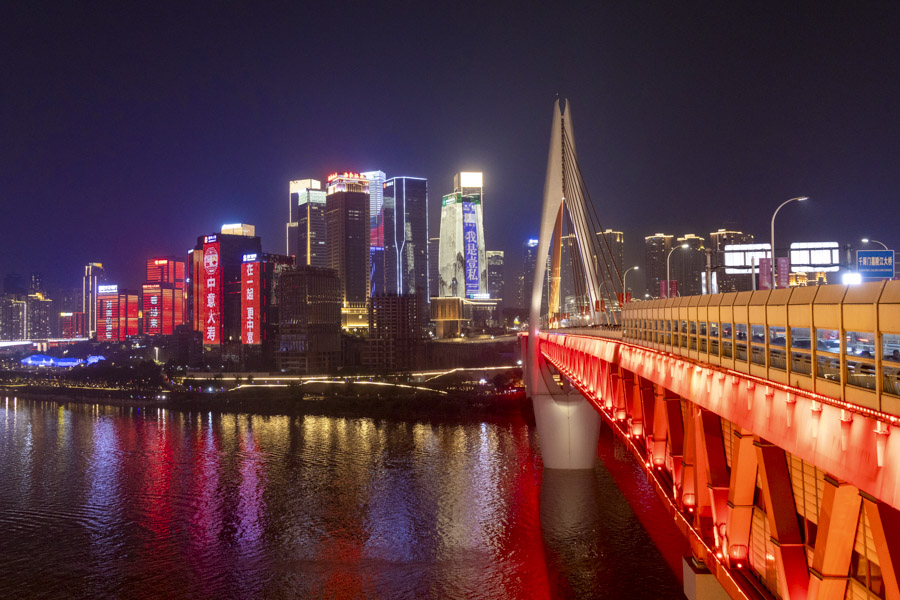
Perched at the intersection of the Yangtze (长江) and Jialing Rivers (嘉陵江) in Southwest China, this city has a challenging topography. Chongqing (重庆) is built on steep ground, with roads, stairways, bridges and rail lines threaded through slopes that would make a flatter city impossible. Nightfall brings out the harder edges of its towers and riverfront blocks, and Chongqing’s cyberpunk image rises. The city grew the way it did because of its terrain, layered upward across ridges and cliffside, as there was nowhere flat to go.
The Yangtze, Asia's longest and the world's third-largest river, begins its most dramatic passage right here. The land it carved through for thousands of years is the same land Chongqing has spent centuries learning to inhabit.
Sometimes nicknamed 'Little Hong Kong' for its nightscape and dense hillside skyline, Chongqing is a very different kind of city – roughly the size of Austria at about 83,000 square kilometres – . Larger by area and population with a distinct local character, Hong Kong remains wealthier and more internationally prominent, attracting jet-setters and high-net-worth residents.
It is also one of the fastest-growing cities on earth. Beneath all of that scale and momentum, though, is something older and quieter. Chongqing is foremostly a place shaped by two rivers, two mountain ranges, and thousands of years of people finding ways to live between them.
Our Chongqing travel guide is your starting point. Come and uncover a city that turns the familiar completely upside down, often quite literally.
Chongqing Tours
Chongqing tours are as varied as the city itself and appeal to different kinds of travellers in different ways. Those with a day or two can cover the city's most iconic sights. You can ride the monorail, wander the old town, and watch the rivers meet at dusk.
If you have more time, you can venture to UNESCO World Heritage sites and karst mountain scenery within a few hours from the city. And then there are the river travellers for whom Chongqing is the starting point for a Yangtze River cruise downstream through the Three Gorges. This one remains one of the greatest journeys in all of Asia.
Chongqing city tours are compact, simply because the main landmarks sit close together across the central peninsula. A well-planned day can take in Ciqikou Ancient Town (磁器口古镇) and the extraordinary internet sensation Liziba Station. Additionally, you’ll visit Hongyadong (洪崖洞), Chongqing, a themed stilt-house complex of shops and restaurants, along the Jialing River, with time left over for a night view.
Chongqing cultural tours go deeper, intertwining history, Ba-Shu’s decorative wooden-structure architectural heritage, and the staircase neighbourhoods. For a wider China trip, day trips to Wulong Karst or the Dazu Rock Carvings work especially well from Chongqing. They show the natural and historical side of the region beyond the city centre. Our 16-day Central China Grand Tour departing from Beijing celebrates Chongqing.
Day eight of that itinerary brings travellers into Chongqing by high-speed train. Following the historic town of Ciqikou, the final stops are at the remarkable Liziba Station and Hongyadong. The day completes at the port. From there, travellers board a Yangtze River cruise heading toward Yichang, a scenic hydropower city of gorges.
Best Time to Visit Chongqing
The best time to visit Chongqing is spring, from March to May, and autumn, from September to October. The weather is comfortable, and the air is clear enough to actually see the skyline and the city's outdoor spaces. These are the months when Chongqing tourism is at its most rewarding. Plus, most of the Chongqing landmarks and historical sites are easiest to enjoy at a relaxed pace.
| Season | Average temperatures (°C) | Average temperatures (°F) | Typical Pattern |
| Spring | 11 to 27 | 52 to 81 | Mild, changeable, light rain |
| Summer | 22 to 35 | 72 to 95 | Hottest and wettest season |
| Autumn | 12 to 28 | 54 to 82 | Cooler, calmer, best for walking |
| Winter | 6 to 13 | 43 to 55 | Humid, foggy, low season |
Summer, from June to August, brings a hot climate. Chongqing is one of China's so-called "three furnace cities", and July and August can push above 40°C (104°F). That said, summer evenings are brilliant for Chongqing river cruises, nightlife and exploring the lit-up riverfront. Just plan your Chongqing sightseeing for early mornings and after sundown.
In autumn the heat eases, the skies open up, and the mountains along the Yangtze turn deep red and orange. It is also the best season for a Yangtze River cruise. The first week of October is the Golden Week holiday, when travel to Chongqing accumulates and the city gets crowded.
Winter is perfectly good for museums, Chongqing hotpot restaurants, and the city's famous hot springs. Prices drop and crowds thin out considerably, which suits some travellers just fine.
History of Chongqing
Human presence in Chongqing dates back to around 20,000 years ago. It was long before the Ba people’s tribal state established its capital (now Youzhong District) in the 11th century BC.
The Ba (c. 11th century BCE–5th century BCE) were fierce fighters, skilled bronze workers, and enthusiastic singers. They were dancers who reportedly marched into battle accompanied by music. Their culture, known as Bayu, forms the deep root of everything that makes Chongqing distinct.
The city changed hands and names repeatedly over the centuries, moving through the Zhou (c. 1046 BCE–256 BCE), Qin (221 BCE–206 BCE), and Han (206 BCE–220 CE) dynasties. The name Chongqing itself dates to 1189, during the Song Dynasty, when Zhao Dun (趙惇), a local prince, was crowned emperor and the Southern Song court renamed the city in celebration of military successes. Chongqing means "double celebration", a name that has stuck through more than 800 years of dramatic transformation.
Under the Ming Dynasty (1368–1644) the city took on the shape that would define it for centuries. It had seventeen gates built according to the ancient Ba Gua diagram, nine open and eight sealed on the advice of geomancers. This was Chongqing culture at its most layered, practical governance tangled up with mysticism and tradition.
The most defining chapter in contemporary Chongqing history came during the Second World War. When the Japanese advance forced the Nationalist government to abandon Nanjing in 1937. Then Chongqing became the wartime capital of China. Within months the city's population swelled from under 250,000 to over a million.
That resilience became part of the city's identity in a way that is still felt today. Many of the Chongqing historical sites from this period, including former residences and bunkers, remain open to visitors.
In 1997, Chongqing was separated from Sichuan Province to become one of China's four direct-controlled municipalities. This move triggered an economic boom and accelerated the city's transformation into the ultramodern metropolis it is today.
The ancient and the futuristic have been colliding intrinsically here ever since, which is much of what makes Chongqing so worth exploring.
Things To Do in Chongqing
Many of the best things to do in Chongqing are ways of moving through the cityscape. These vistas enchant most of the travellers with Chongqing's most famous attractions. The planned Chongqing travel itinerary can cover an enormous amount of ground at a peaceful pace.
Walk on the Qiansimen Bridge (千厮门大桥)
Stretching across the Jialing River in the Jiangbei districts, Qiansimen Bridge is one of the best spots in the city. Running beside Hongya Cave, a complex of ancient wooden buildings, it gives one of the clearest views of the layered riverfront with the rainbow lighting after dark.
Hongyadong Folk Custom Scenic Area (洪崖洞民俗风貌区)
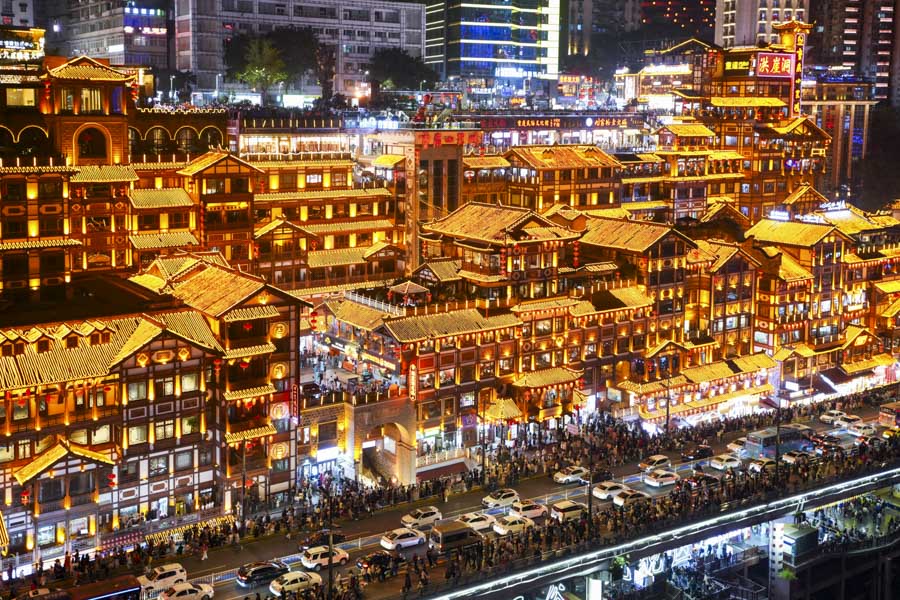
Built into the cliffside, Hongyadong is an 11-storey complex of traditional Ba-Shu stilted architecture and transforms after sunset. By day it is an interesting wander through themed floors filled with local crafts, restaurants and street food. By night, with the lights reflected on the river below, it becomes one of the most photographed places in all of China.
Yangtze River Cruise
Boarding a cruise from Chaotianmen Dock (朝天门码头), where the two rivers meet, is one of the most rewarding activities in Chongqing. The classic downstream route to Yichang (宜昌) takes four days, moving through the mist-covered peaks and ancient riverside settlements of Three Gorges. Even a short Two Rivers evening cruise of around 45 minutes gives a completely different perspective of the city.
Places to Visit in Chongqing
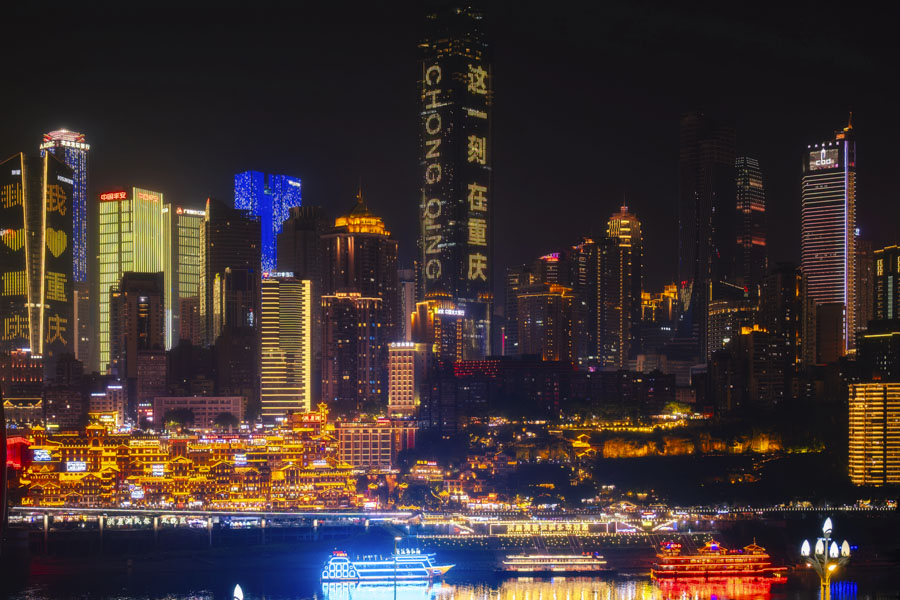
Yuzhong District (渝中区) is the geographic and cultural core of the city. It's a peninsula between the Yangtze and Jialing Twin Rivers and home to the majority of Chongqing attractions and the Yuzhong skyline (渝中天际线).
Within the district, the Jiefangbei Central Business District pulses around the Liberation Monument, an octagonal tower completed in 1947. One of the most memorable spots in Yuzhong is Kuixinglou Square (奎星楼广场), a public square which is actually a 22nd-floor rooftop.
Close by, Raffles City Chongqing (来福士广场) is the city's most dramatic piece of contemporary architecture, designed by Moshe Safdie. Inspired by the ancient Chaotianmen Gate, it consists of eight towers anchored by a glass skybridge called “The Crystal”. There, you’ll find an unbelievable high-altitude park, skywalk and swing perched 250 metres above the city.
The world’s longest outdoor escalator, with a length of about 905 metres (approximately 2,970 feet) and an elevation gain of more than 240 metres (about 790 feet), the Wushan Goddess Escalator (巫山女神电梯) carries visitors up to Wushan mountain.
Worth mentioning again is Liziba Station on Metro Line 2, where the train passes clean through the upper floors of a residential block. For the best external view, the small Langsheng Pavilion at Xindu Alley gives a cleaner angle than the station itself.
Landmarks in the surroundings of Chongqing
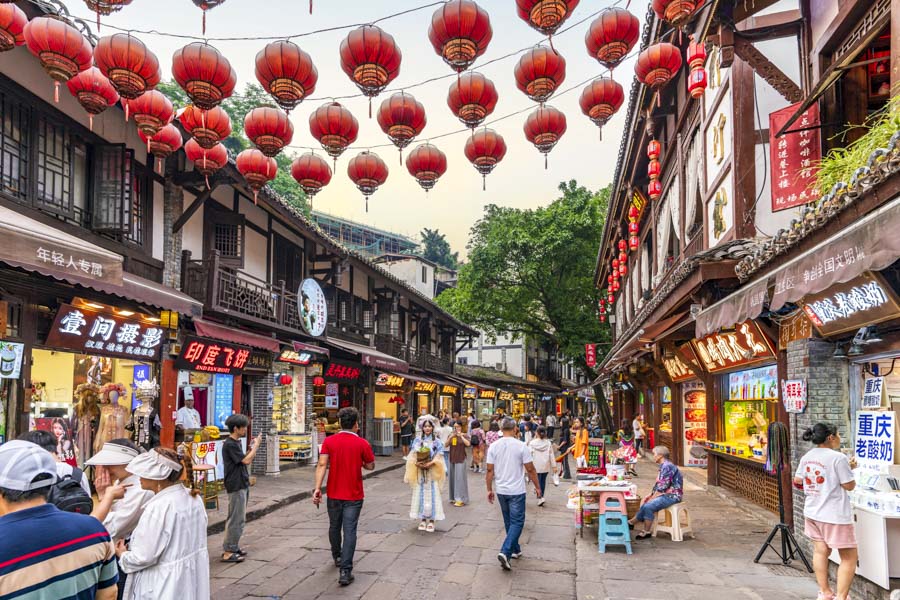
Beyond the heart of the city, Chongqing opens into a broader landscape of old port towns and religious sites. These are the places to leave the dense urban core behind and see how the wider municipality fits together.
In Shapingba District about 14 kilometres from the city centre, Ciqikou Ancient Town is one of the area’s most notable landmarks. Its cobblestone streets, wooden shophouses and riverside temples date back over a thousand years. The intact example of old Chongqing architecture is free to enter and reachable directly by metro.
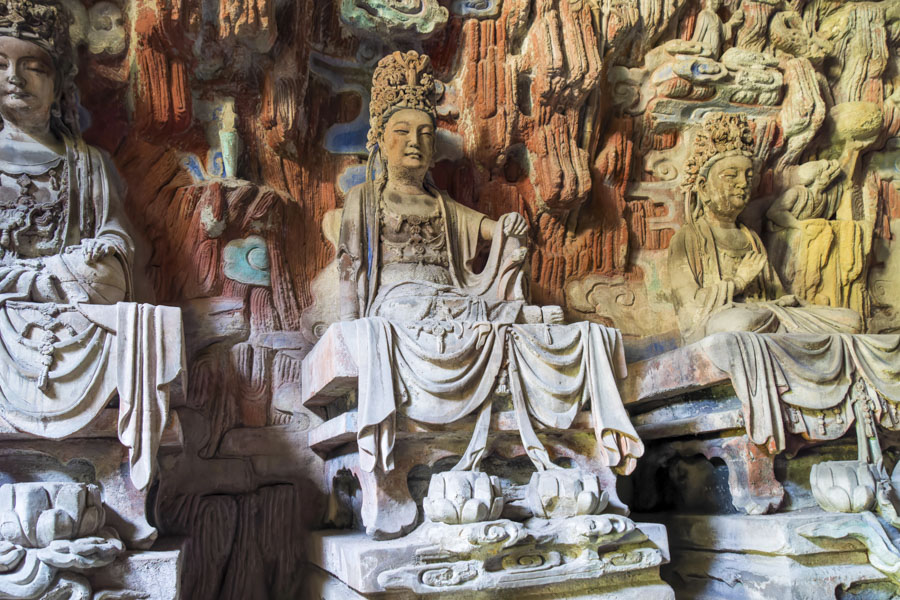
Around two hours from the city, the Dazu Rock Carvings (大足石刻) are one of two municipalities' UNESCO World Heritage Sites. One of the great artistic achievements of mediaeval China, it sits across five mountain sites. The carvings contain over 50,000 remarkable Buddhist, Taoist and Confucian figures. They are carved into cliff faces between the 7th and 13th centuries and depict various scenes from people’s daily life, legends and religious rituals.
Further out at roughly three hours from the city, Wulong Karst is a landscape that operates on a different level. UNESCO lists Wulong within South China Karst for its dramatic giant sinkholes, natural bridges and caves. The local park centres on the Three Natural Bridges, Furong Cave (芙蓉洞) and other large karst sites.
Museums in Chongqing
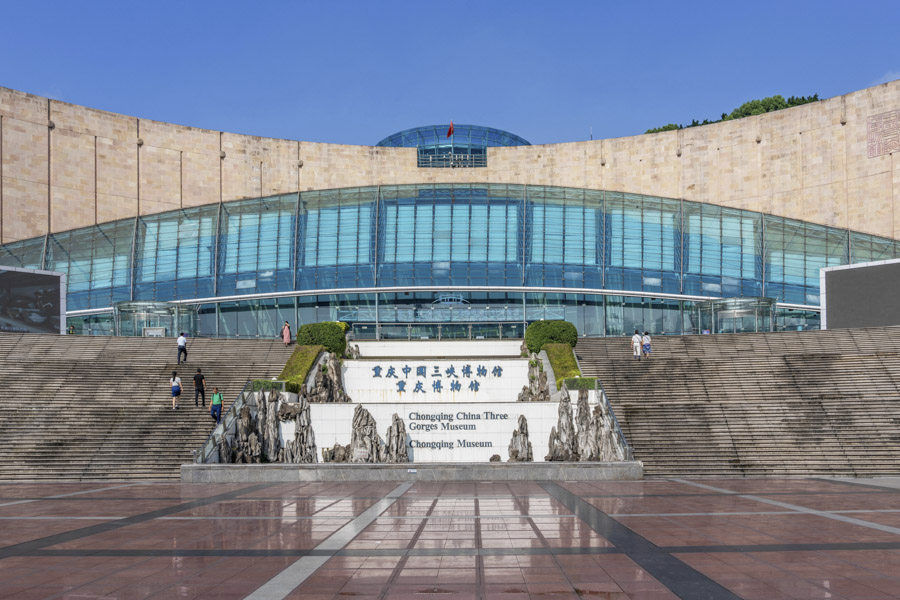
The China Three Gorges Museum (中国三峡博物馆) in Yuzhong District is the obvious starting point, with free entry and open six days a week, but closed on Mondays. Across ten exhibitions, it covers the ancient Ba-Yu civilisation and the history of the Three Gorges. Additionally, here you'll learn about Chongqing's transformation through the 20th century.
The Huguang Guild Hall (湖广会馆 - Huguang Huiguan) is one of the finest surviving examples of Qing Dynasty architecture. Built in 1759 by merchants from Hunan and Hubei, the temple halls, open courtyards and carved wooden theatres reveal who built this city and why.
The most unusual stop is the Baiheliang Underwater Museum (白鹤梁水下博物馆) (White Crane Ridge Underwater Museum) in the Fuling district, built around inscriptions carved into the bedrock of the Yangtze River. Visitors descend 40 metres (approximately 130 feet) by escalator to the bed of the Yangtze River, walking through a 146-metre (about 480-foot) underwater corridor. If your route follows the Yangtze eastward, the Three Gorges Migration Memorial in Wanzhou adds another layer.
For those interested in natural history, the Chongqing Natural History Museum (重庆自然博物馆) in Beibei District holds over 110,000 specimens. There, you’ll find Mesozoic vertebrate fossils and a well-regarded dinosaur exhibition.
The Hongyan Revolutionary History Museum (红岩革命历史博物馆) in Yuzhong District explores the wartime capital period in depth. It features relics and reconstructed scenes. Pair this one with the Chongqing American Volunteer Group (AVG) Museum, also known as the Flying Tigers museum. The AVG museum is specific, focused on wartime cooperation, photographs and relics from the War of Resistance.
The Bayu Plaques Culture and Art Museum (巴渝牌匾文化艺术博物馆) in Yuzhong is a small stop, rooted in calligraphy and inscriptions. The Baolin Museum (宝林博物馆) in Yubei is broader, with bronzes, ceramics, rare books and paintings drawn from a private collection. The Dayuanxiang Museum (大院巷博物馆) in Bishan is the furthest of the three but the most atmospheric, set in a converted factory. The museum is famous for its large holdings of Bashu artefacts, wood carvings and stone works.
Chongqing Theatres
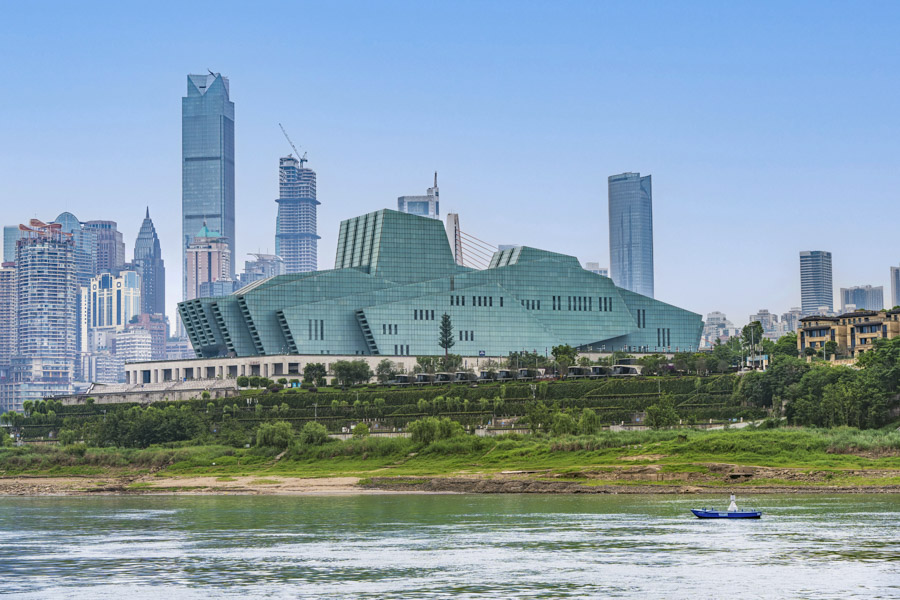
The Chongqing People's Auditorium (重庆人民大礼堂) was built between 1951 and 1954. Its circular dome rises 65 metres (roughly 213 feet) above People's Square and is modelled in style on the Temple of Heaven and the Summer Palace in Beijing. It seats over 4,000 people, functions as a major public venue, and costs just CNY/RMB 10 to enter outside of events.
The Chongqing Grand Theatre (重庆大剧院) sits on the Jiangbei bank overlooking the Yangtze River, handling the city's larger international programme. Its main coliseum-style hall, built for opera, ballet and symphony orchestras, seats 1,826 people. A smaller 938-seat theatre takes on drama and chamber performances. The museum's architecture evokes a 'glass space-time ship' that sparkles with a thousand lights at night, making it a mythical city landmark.
The Chongqing 1949 Grand Theatre (重庆1949大剧院) next to Ciqikou (磁器口) is one of the most ambitious performance venues in Southwest China. Its signature show, simply titled Chongqing 1949, places 1,500 audience members inside a 360-degree rotating auditorium. The production recreates the final days before the city's liberation through nearly 200 performers, holographic projections and scene effects.
The Chongqing Sichuan Opera Art Centre (重庆川剧艺术中心) in the Northern New Area is the city's dedicated home for Sichuan Opera. This is an art form that includes the famous face-changing technique where performers switch masks in under a second to the great amazement of the spectators.
Guotai Arts Centre (国泰艺术中心) features a red lattice exterior, making it one of the city’s most recognisable contemporary buildings. Shi Guangnan Grand Theatre, in Nan’an, is less photographed but more diversified in function. It’s a large professional hall used for opera, dance drama, ballet, symphonic work and gala performances.
Entertainment, Parks, and Shopping in Chongqing
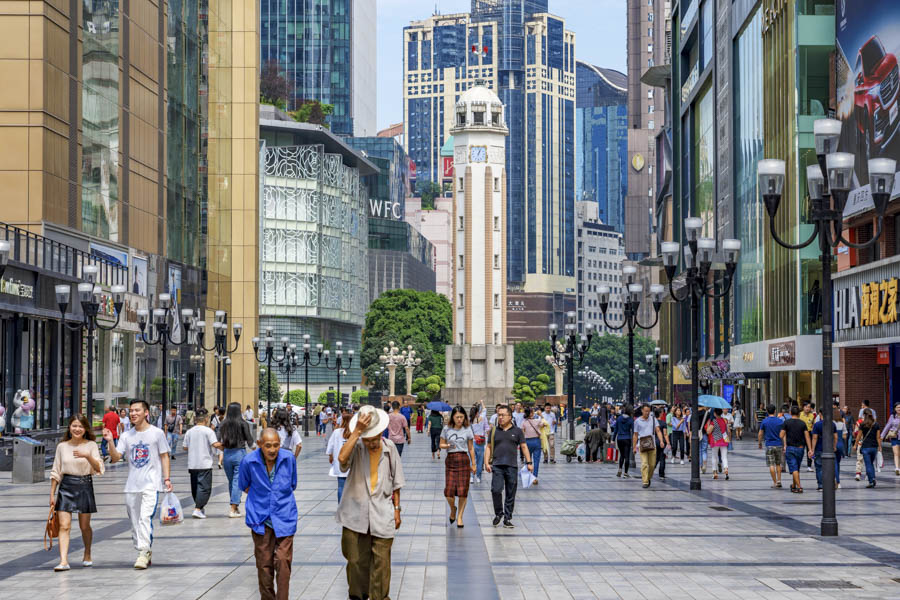
Chongqing has built a reputation as one of China's most entertaining cities after dark. The local government has invested heavily in making sure that reputation holds.
Entertainment in Chongqing
Every Saturday night, the Glamorous Chongqing drone light show launches from the Chongqing Planning Exhibition Hall (重庆规划展览馆) platform. They send 800 to 1,000 drones into the sky above the two rivers in an 18-minute choreographed display. The best viewing spots are Nanbin Road, Jiangbeizui Park and Chaotianmen Square. In June 2025 a special edition using 11,787 drones set a Guinness World Record for the largest aerial image ever formed by drones.
The official schedule for this is seasonal: 21:00 from May to September and 20:30 from October to April.
Summer is the busiest stretch; Chongqing nightlife extends itself with festivals, themed markets and late trading. Autumn usually comes with a large municipal run of cultural events across districts and counties.
In 2025, the city launched a dedicated Nightlife Festival, also known as the city's beer culture festival, with more than 200 themed activities. Chongqing’s autumn tourism campaign carried more than 1,000 cultural and travel events. The Spring Festival and Lantern Festival seasons bring singing, dancing and Sichuan opera back onto the calendar. The Dragon Boat Festival and the Mid-Autumn Festival all animate the city's public spaces in ways worth timing.
Parks of Chongqing
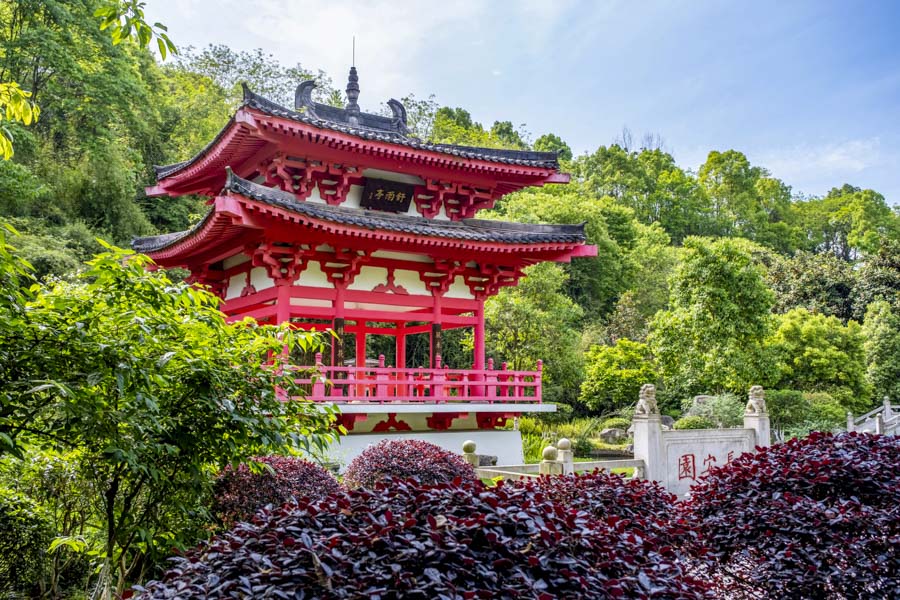
In a city built vertically across mountains and riverbanks, parks are part of the cityscape itself and appear in unusual positions. These are rooftops of skyscrapers, suspended above shopping floors, or tucked into hillside terraces between residential towers. Chongqing also delivers the other kind entirely, serene escapes where the city noise disappears and the mountains take over.
In the heart of Yuzhong District, Eling Park (鹅岭公园) sits on a narrow peninsula above the Yangtze River. Its steep paths wind through traditional pavilions, bonsai gardens and flowering trees.
Chongqing Garden Expo Park (重庆园博园) in Liangjiang New Area covers 3,300 mu (approximately 2.2 million square meters) of landscaped grounds around a lake. The park expo features 127 urban exhibition gardens. Over 660 plant species and five thematic buildings include the Bayu Garden (巴渝园) and the Chongyun Pagoda (崇云塔).
One of the most interesting Chongqing park attractions sits inside newer urban planning. Gateway Park at Raffles City (来福士天街/来福士门廊公园) is built on the roof of a 5-storey galleria yet connects naturally with the surrounding streets. It draws visitors organically from the pavement into a landscaped public space with fountains, picnic lawns and river views.
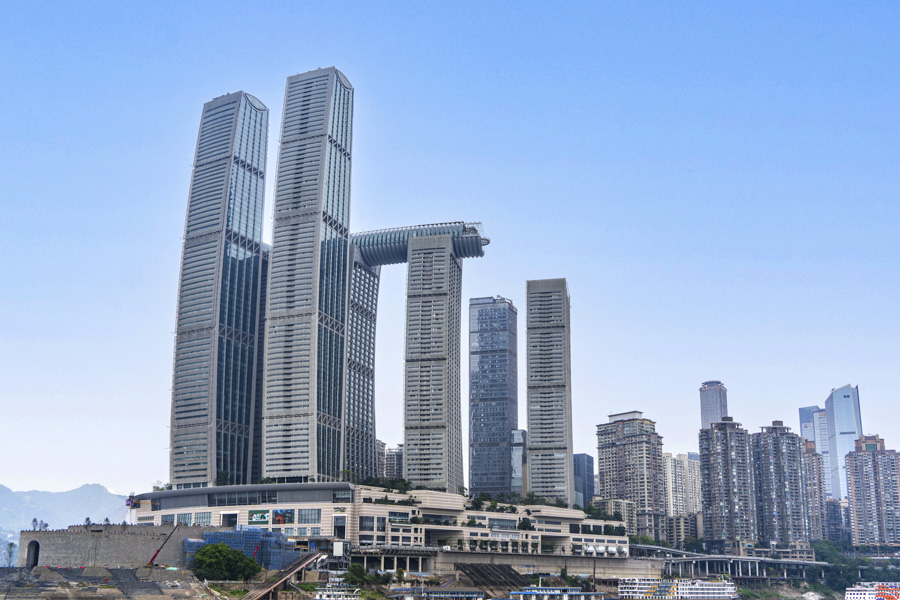
Yinian Rooftop Garden (益年屋顶花园) shows the same vertical logic, though designed as an accessible community garden for older residents. Fragrant Hill Insight Park (香山洞见公园) works at a neighbourhood scale, mixing wetland planting, play space, outdoor learning and community farming. In Dadukou, Langchao Park (浪潮公园), and Dadukou Park (大渡口公园) show how smaller parks now serve children’s activities and social life.
Geleshan National Forest Park (歌乐山国家森林公园) in Shapingba District, 16 kilometres (about 10 miles) west of Chongqing centre, is the go-to destination for Chongqing hiking trails. Known locally as the Emerald Fortress, it also holds historical significance as the site of the Hongyan Revolutionary Memorial.
Bijin Park (碧津公园) in Yubei District provides a classic Chinese garden experience, featuring a 4.3-hectare rowing lake and traditional pavilions. The park also has strong ties to Ba-Yu folk culture. Caiyun Lake National Wetland Park (彩云湖国家湿地公园) is in Jiulongpo District and is Chongqing's first national wetland park. It has 83 hectares of waterways and wildlife habitat, a surprising green space within the main city boundaries.
South Mountain Botanical Garden (南山植物园), the largest of its kind in Chongqing, raises over 1,600 plant species. Themed gardens on Tongluo Mountain include rose, camellia and endangered species collections.
If your schedule is too tight to visit the Chengdu Research Base of Giant Panda Breeding, although they are not comparable to it, Chunking Zoo (重庆动物园) is a possible alternative, as it is home to around 10 majestic giant pandas, while Chunking Wild Park (重庆野生动物世界) shelters about 20 giant pandas along with a diverse array of wildlife, from elephants to lions, offering children an enjoyable experience.
Below are the other important parks in Chongqing city’s neighbourhood with their main attractions:
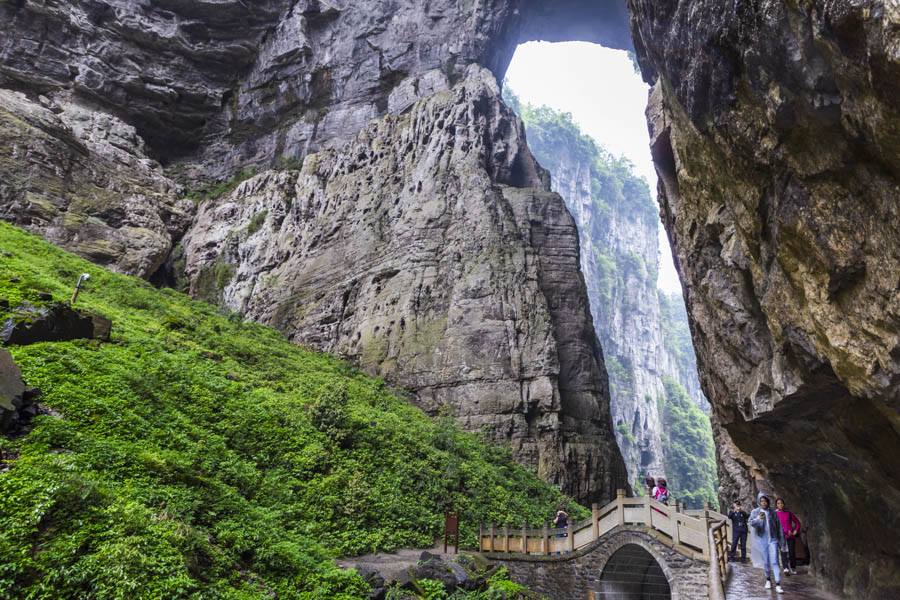
- Chongqing Wulong Karst National Geopark – the Three Natural Bridges (large karst bridges), plus caves and giant sinkholes (tiankengs).
- Yangtze Three Gorges National Geological Park – the dramatic Three Gorges scenery (the Qutang Gorge, Wu Gorge, and Xiling Gorge) along the Yangtze River.
- Qijiang National Geopark – including scenic views of Gujian Mountain, Laoying Mountain, and Cuiping Mountain.
- Qianjiang Xiaonanhai National Geopark – composed of three parks, Xiaonanhai, Bamian Mountain, and Yangtou Mountain – boasts sea, islands, and gorges, waterfalls and seismic geological relics.
- Yunyang Longgang National Geopark – the Longgang karst gorge system with caves and cliffs.
- Shuanggui Mountain – steep, forested mountain scenery, ancient woodland and canyon viewpoints and home to ancient temples.
- Baergai – notable for its primaeval forest, canyons, cliffs and peaks.
- Dayuandong – .an enchanting landscape composed of streams, lakes, gorges and peaks with dense forest and pure air.
- Qiaokouba National Forest Park – its scenic viewpoints include Yunzhuan Mountain, Qiaokouba, Anlan, and Shengdeng Mountain.
- Xuebao Mountain National Park Forest – a mountainous and wooded landscape with particularly spectacular panoramic views in autumn when the colour of the leaves changes from green to yellow and then to red.
Shopping in Chongqing
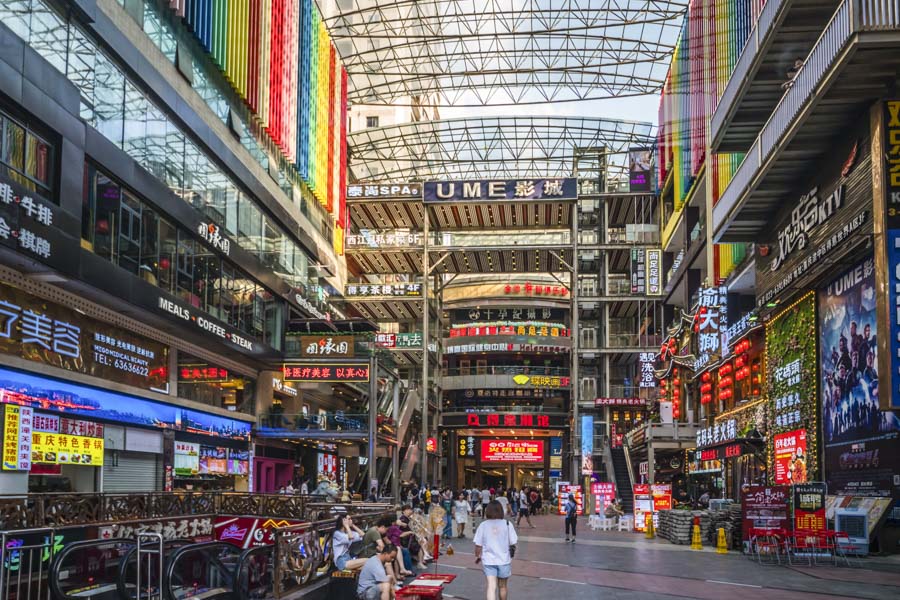
The shopping scene here revolves around distinct commercial districts, and Chongqing shopping is easiest when you keep it simple.
Anchored by the Liberation Monument, Jiefangbei CBD in Yuzhong District is the oldest and most central shopping area. A variety of malls and department stores carry international brands and luxury goods stocked with Chongqing specialities. The Chaotianmen Wholesale Market (朝天门批发市场) nearby is the city's largest garment market, where you can bargain and negotiate prices.
Guanyinqiao Pedestrian Street (观音桥步行街) in Jiangbei District has overtaken Jiefangbei in popularity among younger locals. The pedestrian area is one of the largest commercial streets in Southwest China, combining streetwear boutiques and international brands. Starfield Mall is the anchor here, with the best local and Korean-influenced fashion on its upper floors.
In Longfor Times City, four connected buildings across eight floors cover Uniqlo, Muji, bookshops, and cinemas. For premium shopping, Chongqing IFS houses over 350 luxury brands, including Louis Vuitton, Gucci and Prada. Raffles City's retail wing carries Burberry, Bottega Veneta and Yves Saint Laurent.
Shapingba Three Gorges Square has a student-heavy shopping culture and lower prices, and it offers stunning views of the Three Gorge Dam. The Nanping and Yangjiaping business districts remain important local commercial areas. Ciqikou, Chongqing and Hongyadong are better for snacks, souvenirs and atmosphere.
When it comes to what to shop for in Chongqing, the city has strong local specialities worth seeking out. Shu embroidery, one of China's four great embroidery traditions, makes for a genuinely distinctive gift. Fuling Zhacai pickles, made from mustard root and exported to over 50 countries, are easy to pack and authentic to the region. Most department store food floors in Jiefangbei and Guanyinqiao stock them.
Food in Chongqing
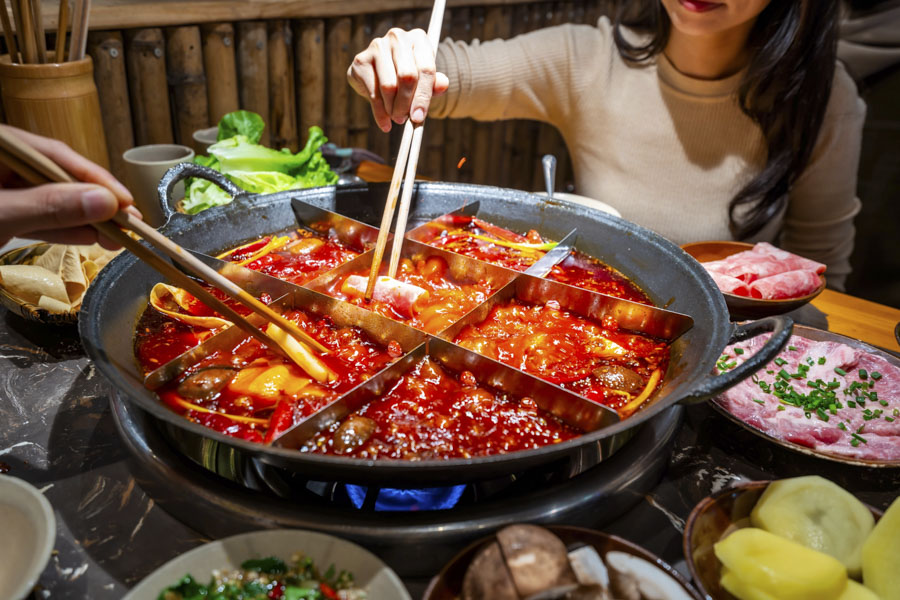
Chongqing is the city where hotpot was born, and noodles are a morning ritual. The city is known for chilli, peppercorn and beef tallow, but it also has gentle breakfasts, sweet snacks, and covered-bowl tea. Additionally, a quieter vegetarian side allures if you know where to look.
Chinese Cuisine
Chongqing food is foremostly concentrated on its famous hotspots. Pei Jie Old Hotpot in Jiefangbei has become a queue-for-it place for its beef-tallow broth, fresh tripe and old-school atmosphere. Yuzong Laozao Hotpot is another strong choice for a more traditional version, with an aromatic base and offal platters.
No. 66 Jianghu Cuisine is famous for bold Shapingba-style cooking, especially pepper chicken and its robust steamed dishes. In Qixinggang, Chunyang Old Tavern has been doing proper jianghu food with a drinking-house edge for more than thirty years. Its ginger rabbit and lard-fried crystal noodles show the city’s bolder, saltier flavours without relying on a hotpot.
For fish, Nie Facai Laifeng Fish in Jiefangbei is a good stop for thin slices of carp in bubbling red broth.
Mao xue wang, offal simmered and duck blood; and La zi ji, crispy fried chicken buried under a mountain of chillies, are pure table staples. For fresh Jiangtuan river fish cooked paper-thin in spiced broth, Nie Facai Laifeng Fish is a hidden gem.
For breakfast or a quick lunch, Huashi wan za mian is one of the names most closely linked to Chongqing noodles. Around Jiefangbei, Bayi Snack Street is practical for trying xiao mian, suan la fen and chaoshou in one walk.
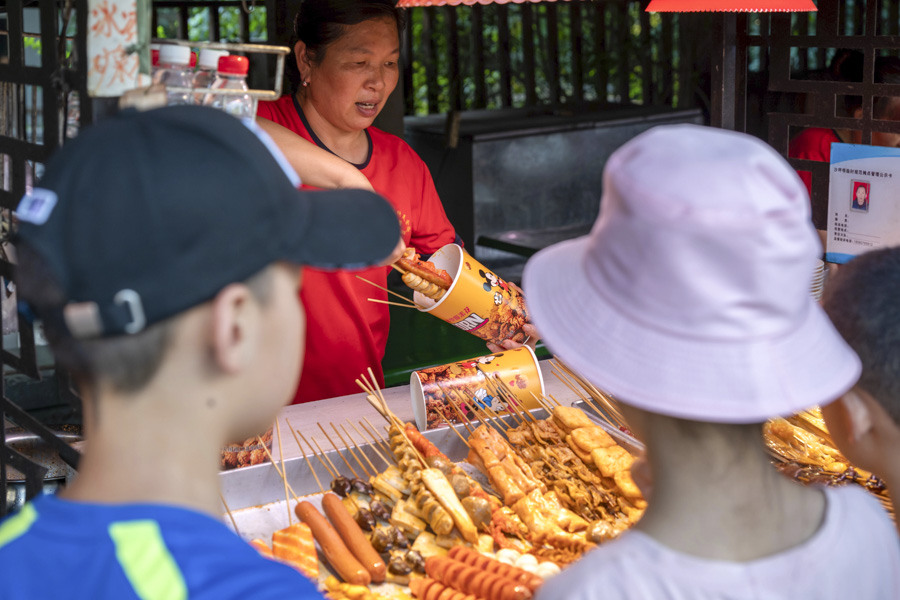
Street snacks such as suan la fen and bingfen are worth seeking out. Suan la fen are thick, chewy sweet potato noodles in a tangy, numbing broth. Bingfen is a cold konjac jelly dessert that becomes essential in the summer heat.
Vegetarian Restaurants
Rooted in Buddhist culinary traditions, vegetarian food in Chongqing additionally leans towards calm interiors. Fu He Kang Vegetarian House (福和康素食) in Ciqikou Ancient Town is one of the most atmospheric options. It follows strict Buddhist principles, using no five pungent flavours, no flavour enhancers such as MSG (monosodium glutamate) and no meat substitutes. The restaurant instead only relies on seasonal vegetables.
In Renren Suyang (人人素养) near Jiefangbei, meals are built around mushroom-based dishes and plant proteins.
Putisu Zen Vegetarian on Beibin Road uses organic ingredients cooked in olive oil with minimal seasoning. They serve spicy and sour Chiba tofu and fried rice with kale in a quiet setting. Huayan Temple Vegetarian Restaurant inside the temple grounds in Jiulongpo District offers a more rustic experience with generous portions in genuinely peaceful surroundings.
Tea Houses, Bakeries and Patisseries
In Chongqing, traditional teahouses are among the most authentic places in China. The city's tea culture is much older than its café culture.
The baba tea tradition (把把茶) is when locals set out bamboo chairs and tea sets in open courtyards and alleyways each afternoon. People's Park in Yuzhong District is one of the best places to experience it. Residents gather daily from mid-afternoon to drink lao ying tea, play cards and talk.
Changting Tea House, established in the 1920s inside People's Park, is one of Chongqing's most historic tea establishments. Once frequented by celebrated writers including Lao She and Cao Yu, Huangjueping Traffic Tea House, also dating from the 1920s in Jiulongpo District, is the city's oldest surviving tea house.
Founded in Chongqing in 1989, Qbakery (新沁园) has grown into a major Southwest China bakery chain with more than 600 branches. Portuguese egg tarts, strawberry tiramisu mousse cake, corn cheese bread and pineapple buns work best for everyday bread and a quick sweet stop.
LISA YOUGASHI / Pâtisserie Coin de Rue is one of the more interesting pastry names in Chongqing. Seasonal window displays and signature cake rolls, and their U-shaped Napolitans, are developed in around 30 flavours.
City Transport in Chongqing
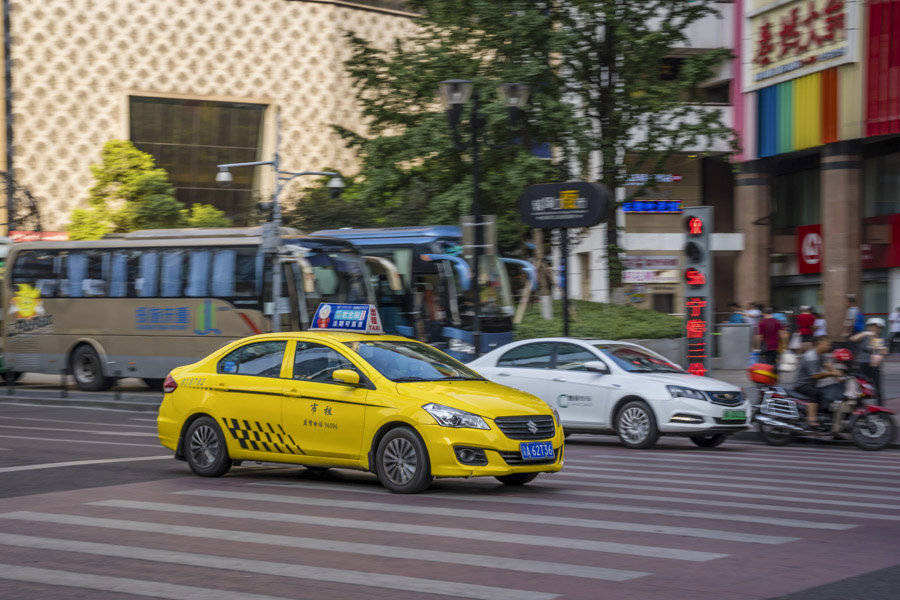
Shaped by its steep terrain, river crossings and urban layout, getting around Chongqing is an experience in itself. Chongqing transportation is extensive, modern and genuinely enjoyable to use. Over 55% of residents use public transport as their main way to travel. This puts Chongqing among China’s top cities for green urban mobility.
Public Transport
Buses and Shuttles
Chongqing has around 975 bus routes across the urban area, with the majority running on electric or hybrid engines. Fares are around CNY/RMB 1 to 3 for air-conditioned buses, payable by cash, transport card, Alipay or WeChat Pay. Buses run from approximately 05:30 to 22:00, with night routes continuing into the early hours.
For visitors, the sightseeing bus lines are the most practical option. Bus T480 runs a circular route through Yuzhong District, stopping at Jiefangbei, Hongyadong, Chaotianmen and the Huguang Guild Hall.
Day passes are available from CNY/RMB 30 (approximately $4.40 / €3.80 / £3.30).
Lines T002 and T003 connect Ciqikou Ancient Town with the Yangtze River Cableway and key heritage sites. Route 103 links Guanyinqiao to Ciqikou, and Route 215 runs between Nanping and Hongyadong.
Practical Chongqing travel tip:
Because of the hilly terrain, many bus routes run one way only, so the return stops may be on a different street. Thus, checking the exact stop name in Chinese or pinyin before boarding is highly recommended.
Metro
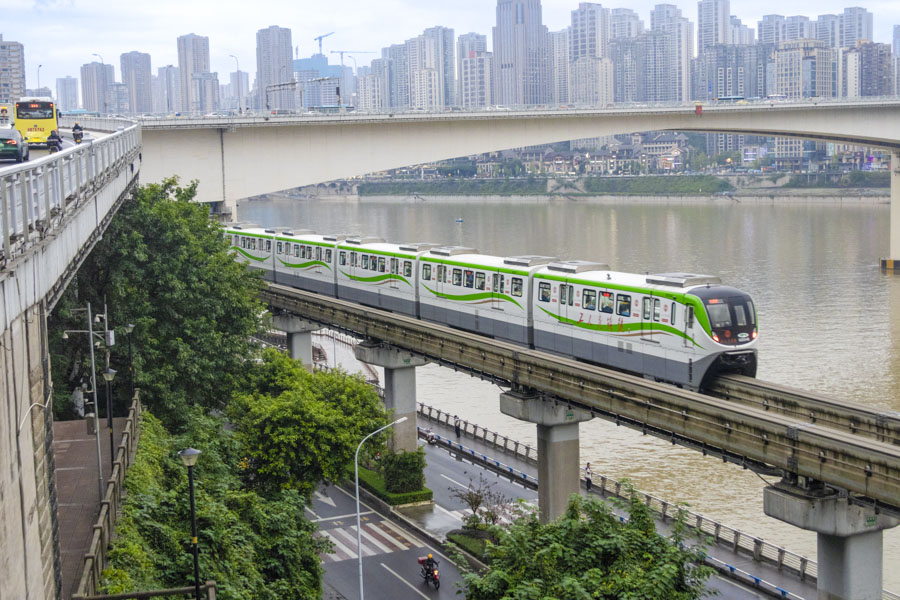
The Chongqing Rail Transit, known as CRT, is the fastest and most reliable way to navigate the city. The network covers the main districts, major rail stations, the airport and most of the places visitors actually use.
Fares are distance-based and generally run from CNY/RMB 2 to 10. Trains usually begin around 06:30 and finish around 22:30, depending on the line. As of 2026 it operates twelve lines covering 574 kilometres, with several more under construction.
A one-day travel pass costs CNY/RMB 18 (approximately $2.60 / €2.25 / £1.95) and covers unlimited rides across all lines. Lines 2 and 3 run as an elevated railway, together forming the longest and busiest monorail system in the world. The network also holds records for both the world's deepest metro station at Hongyancun, 116 metres (381 feet), and the world's tallest at Hualongqiao.
Announcements are bilingual, and stations are generally straightforward to use.
Other Transport Options
Taxis
Official Chongqing taxis are yellow and great backup when you’re carrying luggage or the route involves many changes. The daytime starting fare is CNY/RMB 10 (approximately $1.44 / €1.25 / £1.10) for the first 3 kilometres, with CNY/RMB 2 per kilometre thereafter. Between 23:00 and 06:00 the base fare rises slightly to CNY/RMB 11. Taxis can be hailed on the street, found outside major hotels and transport hubs, or booked by phone on 023-96096.
DiDi, China's ride-hailing app, is wide-spread and generally more affordable than flagging a taxi. Note that the period between 15:00 and 19:00 is a driver shift changeover time, making taxis harder to find.
Car Rental
Drive car rental is available at Chongqing Jiangbei International Airport and in the city centre through several major agencies. Driving in Chongqing is challenging even for experienced drivers, given the complex road network and steep gradients.
For most visitors, hiring a car with a professional driver is a more practical and stress-free option. Driver particularly makes sense for Chongqing day trips to Dazu Rock Carvings, Wulong Karst or other sites outside.
Other Modes of Transport
A few forms of transport in Chongqing are both functional and memorable. The Yangtze River Cableway, a useful crossing in the city, connects the two banks while giving you a bird’s-eye view of the city and the river. The main connecting route is between Xinhua Road and Shangxinjie.
When you want to cross the river without going back through the road network, ferries are another great option near Chaotianmen. They are slower than the metro but give a clear sense of the city’s river geography.
Public escalators form a unique part of the city's transport network. The most notable is the Lianglukou Crown Escalator, at 112 metres (367 feet) long. This one connects two neighbourhoods that would otherwise require climbing several hundred steps.
How to Get to Chongqing?
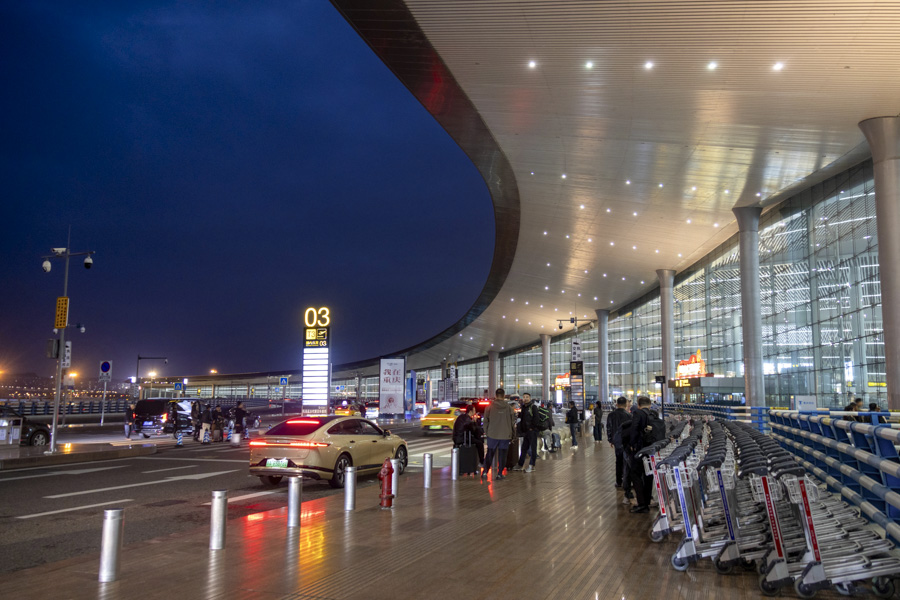
You can get to Chongqing by plane, high-speed train, Yangtze River cruise, long-distance bus, or overland road transfer. The city is well connected to the rest of China and a growing number of international destinations.
By Air
The main gateway is Chongqing Jiangbei International Airport (CKG), about 20 to 24 kilometres northeast of the centre. Direct international flights connect Chongqing to cities including London, Paris, Singapore, Sydney, Seoul, Dubai, Seattle, and others.
From within China, Beijing takes around 2.5 hours, Shanghai around 3 hours and Chengdu around 1 hour 50 minutes. The airport sits about 24 kilometres from the city centre and is connected to the metro via Lines 3 and 10. Airport shuttle buses also run to key points, including Jiefangbei and the main railway stations.
By High-Speed Train
Chongqing is one of southwest China’s major railway centres. Chongqing North and Chongqing West handle the majority of high-speed services. These stations connect the city to Beijing in 7 to 10 hours, Chengdu in 1 to 2.5 hours, Xi'an on the Silk Road, in 5 to 6 hours, and Guangzhou in 7.5 to 8 hours.
Chongqing East, opened in 2025, is the best choice for Wulong and also runs some services to Zhangjiajie, Changsha, Guangzhou and Xi’an. Shapingba is smaller but practical for Sichuan routes, especially Chengdu. If you are coming from Chengdu, Xi’an, Guilin, Changsha or Yunnan, high-speed rail is often the easiest option.
By River
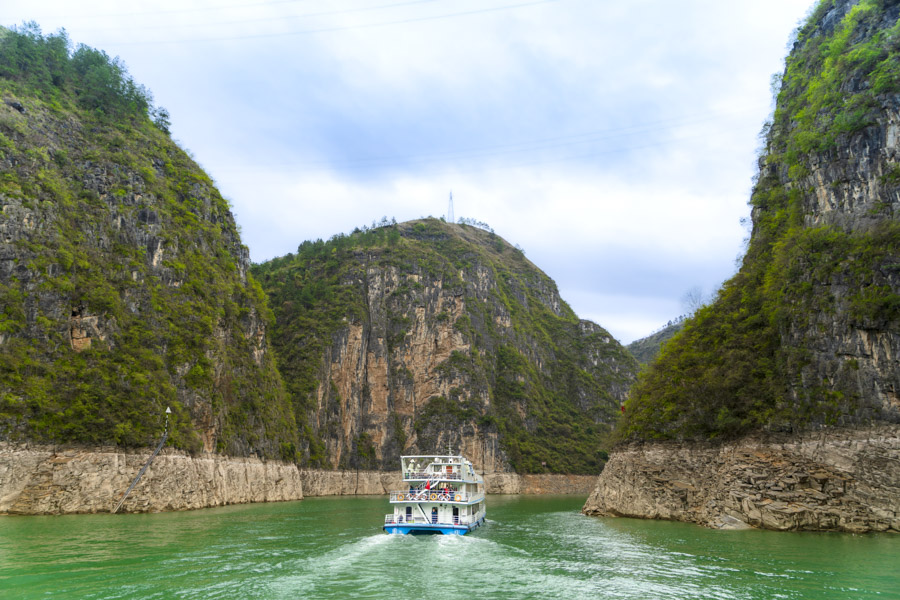
For those already travelling the Yangtze, Chongqing is the upstream starting or ending point for river cruises. The classic downstream route from Chongqing to Yichang takes 4 days, while the upstream journey from Yichang takes 5 days. Longer cruises from Shanghai to Chongqing run around 12 days. All cruise ships dock at Chaotianmen, right at the confluence of the Yangtze and Jialing Rivers in the city centre.
By Bus
Long-distance coaches connect Chongqing to surrounding cities and districts, with services departing from several terminals. This is the most practical option for reaching Wulong, Dazu and various towns within the municipality.
By road
Private transfer or self-drive is also possible from nearby cities. This tends to make sense for shorter regional journeys rather than cross-country travel.
Languages Spoken in Chongqing
The official language in Chongqing is Putonghua, or standard Mandarin, which is used in schools, transport, and formal settings. In daily life, however, many locals also speak the Chongqing dialect. English is not widespread across the city, but travellers can usually manage in major hotels, shopping malls, and transportation hubs.
What makes Chongqing linguistically interesting is its local dialect. The Chongqing dialect belongs to the Chengdu-Chongqing branch of Southwestern Mandarin. This group has around 90 million speakers across Sichuan, southern Shaanxi and western Hubei. It is mutually intelligible with standard Mandarin but noticeably different in tone, rhythm and vocabulary.
While Mandarin and the Chongqing dialect both use four tones, the pitch values are quite different. The Chongqing dialect carries an overall lower register. Another characteristic is the tendency to merge the n and l sounds, which is noticeable even to casual listeners.
The dialect's character was shaped significantly by the great migration waves of the Ming and Qing dynasties. Large numbers of settlers arrived from Hubei, Hunan and Jiangxi, mixing their own speech with what was spoken locally.
Because Putonghua dominates education, media and public life, younger urban speakers often sound closer to standard Mandarin. Even so, the local dialect remains one of the clearest markers of Chongqing identity.
Security in Chongqing
Chongqing is a safe city for travellers, including first-time visitors, solo travellers, couples and families. The city's core business districts and tourist attractions all benefit from 24-hour police patrols. The city boasts one of the most advanced public security systems in China.
The city operates an extensive network of surveillance cameras and a smart policing platform. This platform has contributed to significant reductions in crime over recent years. For visitors, this translates to a genuinely calm and well-ordered city even in its busiest areas.
Chongqing’s central districts, including Yuzhong, Jiangbei, Nan’an and Shapingba, are among the most convenient areas for visitors. There are strong transport links, a large number of hotels and a steady flow of people throughout the day. These are also the easiest places for first-time travellers to stay.
It's important to note that tap water is not recommended for drinking, so sticking to bottled water, widely available everywhere, is a must-do. In summer, the heat and humidity can be intense between 11:00 and 15:00. Thus, sun protection and staying hydrated matter more than most visitors expect. Street food is generally safe and a wonderful part of the experience.
In practical terms, Chongqing is a city where most visitors can travel comfortably and confidently. With normal awareness, sensible planning and trusted local arrangements, it is an easy place to enjoy.