


Tiāntán (天坛), meaning the Temple of Heaven and its surrounding park, is one of Beijing’s most thoughtful historic landscapes: a vast 273-hectare complex shaped around ideas of harmony between the human world and the wider cosmos.
Today, it is both a protected heritage site and a lived-in public space, where long perspectives, quiet groves, weathered stonework, and remarkable structures found nowhere else invite visitors to explore this unique setting in China.
Temple of Heaven Tours
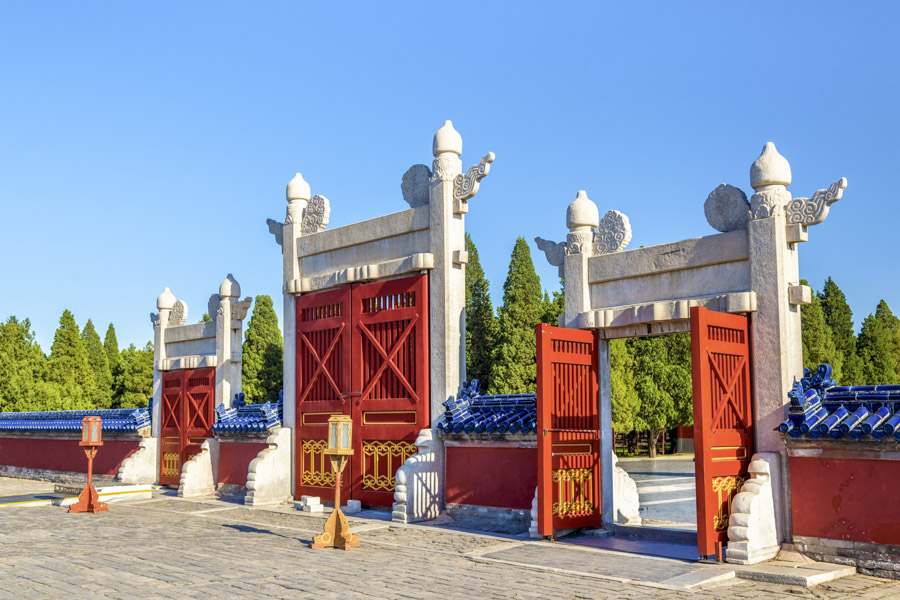
What is so special about the Temple of Heaven? If you are wondering about reasons to visit the Temple of Heaven, this is one: an encounter with memories preserved in wood and stone, where rituals once expressed a nation’s hopes for harmony and abundance.
When your tour includes this complex, entrance arrangements and site visits are handled as part of the itinerary, allowing you to concentrate on exploring.
Our Central China Highlights Tour offers a well-paced introduction to the country’s major highlights, with time in Beijing devoted to its landmark sights and cultural heritage. The final day includes a visit to the Temple of Heaven, a calm and memorable way to conclude your journey.
The 7-day Beijing and Shanghai Highlights Tour features a morning visit to the Temple of Heaven on Day 4, before you travel to Shanghai by high-speed train.
Both group and private options are fully customisable. Please tell us your preferred pace and interests when booking, and we will be pleased to tailor the visit to your liking.
Best Time to Visit the Temple of Heaven
The best time to visit the Temple of Heaven is during the shoulder seasons of spring (April to May) and autumn (September to October), when temperatures are mild, skies are normally clearer, and the park’s trees are at their most attractive.
For the quietest, most atmospheric experience, arrive at opening (early morning, 06:00 to 08:00) to watch locals practising Tai Chi and to enjoy a peaceful hour. Late afternoon (around 16:00 to 18:00) is another good window, with softer light and generally fewer visitors.
Summer (June to August) tends to be hot and often rainy, so it is wise to carry water, sun protection, and an umbrella. Winter can be cold, although it is far less busy.
Visiting the site at night will offer you another fantastic perspective of this must-see monument.
Opening Hours
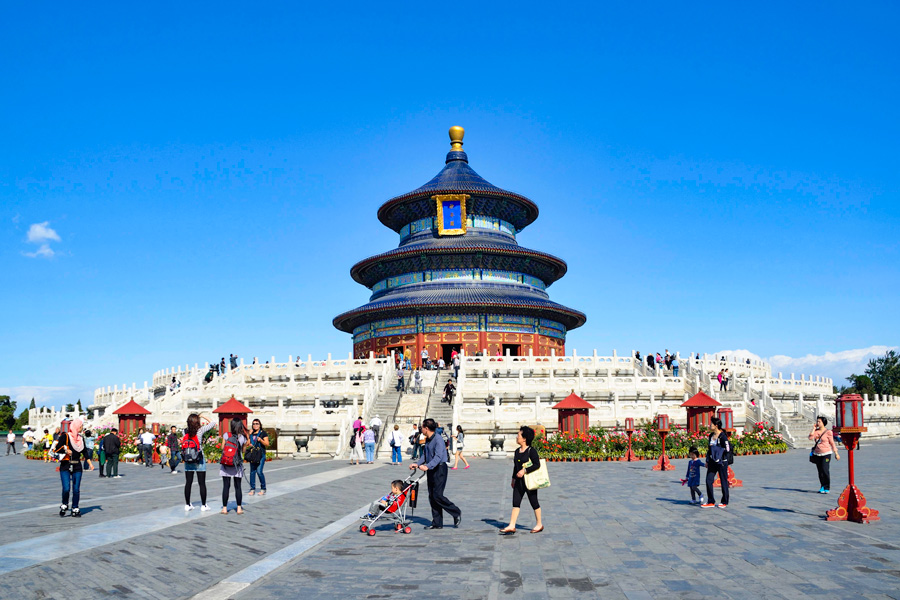
This incredible site, located at No. 7 Tiantan East Road in Beijing’s Dongcheng District, welcomes visitors year-round. In peak season (1 April to 31 October), Tiantan Park opening hours begin at 06:00; in the low season (1 November to 31 March), they begin at 06:30. Gates close at 22:00, with last admission typically around 21:00.
The principal ceremonial buildings, including the Hall of Prayer for Good Harvests and the Circular Mound Altar, open from 08:00 and close earlier than the park, generally at 17:30 (1 April to 31 October) and at 16:30 (1 November to 31 March).
Many inner attractions are closed on Mondays, except during national holidays.
We recommend checking the Temple of Heaven hours on the official website before you go, as schedules are sometimes adjusted for seasonal changes, maintenance, or special evening events.
Practical Additional Information
Tickets and Entrance Fees
Many visitors ask, “Do you need tickets for the Temple of Heaven in Beijing?” Yes, park admission is required, and a separate combined ticket covers the principal ceremonial buildings.
Tiantan Park tickets (as of January 2026):
- 15 CNY/RMB (approximately $2.10 / £1.65 / €1.85) in high season (1 April to 31 October)
- 10 CNY/RMB (approximately $1.40 / £1.10 / €1.25) in low season (1 November to 31 March)
Combined ticket, including the Hall of Prayer for Good Harvests and the Circular Mound Altar (as of January 2026:
- 34 CNY/RMB (approximately $4.80 / £3.75 / €4.20) in high season (1 April to 31 October)
- 28 CNY/RMB (approximately $3.95 / £3.10 / €3.45) in low season (1 November to 31 March)
Tickets can be booked via the official reservation platform or WeChat mini-program.
Carry documents used for booking for ticket pickup/QR check.
Suggested Routes and Durations: How Much Time Do You Need at the Temple of Heaven?
- Express itinerary (approximately 1 hour): From the North Gate to the Hall of Prayer for Good Harvests and the Echo Wall, then exit via the East or West Gates.
- Leisure itinerary (approximately 2 to 3 hours): From the East Gate to the Hall of Prayer for Good Harvests, the Imperial Vault of Heaven, the Echo Wall, and the Circular Mound, then exit at the South Gate.
- Extended itinerary (3+ hours): Same as the leisure itinerary, with time for museum visits, gift shops, and a relaxed stroll through the park groves.
Audio Guides
- Audio guides are available in multiple languages, including English and other major European and Asian languages.
- Rental desks operate at all four gates.
- The rental fee is 40 CNY/RMB (approximately $5.60 / £4.40 / €5.00), with a deposit of 50 CNY/RMB (approximately $7.00 / £5.50 / €6.30) per audio guide.
Food and Drinks
Cafés and restaurants are available inside the park:
1) Tian tan fu Drinking 天坛福饮 (Tiāntán fú yǐn) near East Gate: They serve coffee, tea, and seasonal snacks.
2) Temple of Heaven Blessed Drink 天坛味道 (Tiāntán wèidào) near the Echo Wall / Circular Mound: They propose noodles, rice dishes, drinks, and ice cream and other food.
3) Temple of Heaven Restaurant 天坛餐厅 (Tiāntán cāntīng): On the west side of the park, they offer fuller meals and breakfast.
4) Pick up the past time is a cafe proposing many cute Hall of Prayer for Good Harvests-shaped ice creams and drinks with different flavours.
Gifts
- On-site cultural and creative shops sell Temple-themed stationery, small crafts, candle night-lights shaped like the Hall of Prayer for Good Harvests, and other keepsakes.
- Memories of the Temple of Heaven 天坛拾光 (Tiāntán Shíguāng) is a cultural and creative space in Tiantan Park, combining a music-themed book bar, quiet reading areas, and immersive displays. Designed to reflect the Temple of Heaven’s living cultural heritage, it offers around 400 curated titles available for free reading. It also showcases Temple-themed products, including locally inspired ice creams with flavours such as douzhi, a traditional fermented mung bean drink from Beijing. Located about 300 metres (984 feet) inside the West Gate, it has become a popular spot for visitors seeking a relaxed cultural pause within the park.
Accessibility and Comfort
Paths are a mix of paved and stone surfaces. The main avenues are wide and gently sloped, although comfortable shoes are recommended.
For precise walking routes, step-free paths, and accessibility route information, we recommend using the official Temple of Heaven navigation map.
History of the Temple of Heaven
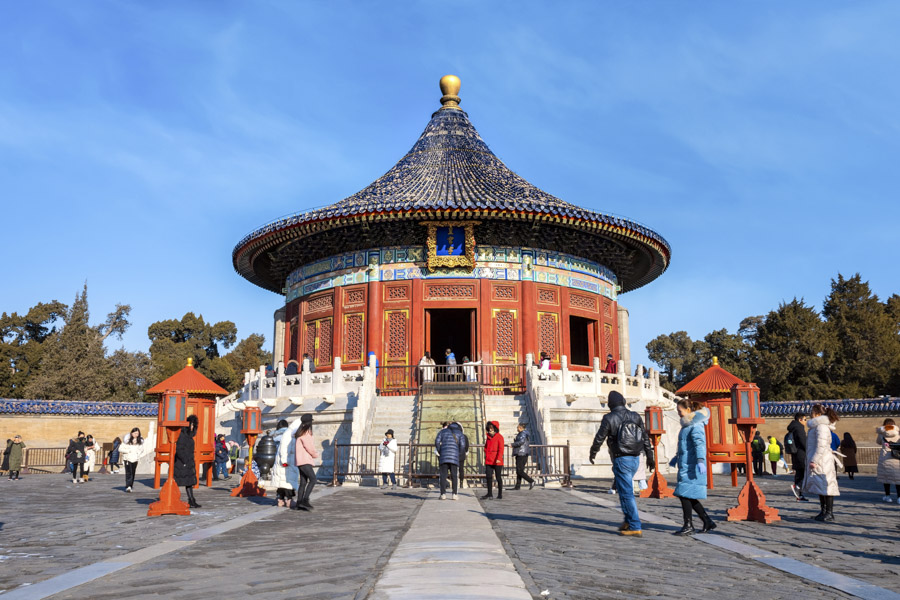
Begun under the rule of the Yongle Emperor of the Ming Dynasty in the early 1400s and largely finished by 1420, the Temple of Heaven was built alongside the Forbidden City (紫禁城): together they formed the ritual and political heart of Yongle’s newly planned capital. Subsequent emperors, notably Jiajing, who added the Circular Mound Altar in 1530, and Qianlong of the Qing Dynasty, whose mid-18th-century works helped shape the present 1749 layout, enlarged and reordered the complex.
The rituals initially devoted to Shang Di (上帝), a singular Creator God during the Shang Dynasty – understood theologically rather than mythologically – were later associated with Heaven (天, tiān), conceived as the supreme ruler of all things during the Zhou, Qin, and Han dynasties. Over time, this conception of Heaven became incorporated into the imperial cult codified by Confucianism, linking divine authority directly to the emperor.
The site’s purpose was explicit and repeatedly enacted: the emperor, known by the imperial title Son of Heaven, performed seasonal sacrificial rites, most notably the winter solstice ceremony and the annual harvest prayers. The ceremonial Border Sacrifice was performed annually by the emperor until 1911 A.D.
These rites involved strict ritual purity, fasting beforehand, prescribed music, special attire, and precisely arranged offerings. The ceremonies reinforced cosmic order and imperial legitimacy.
After the end of imperial rule in 1911, the Temple of Heaven’s ritual function ceased entirely.
In 1918 it was opened to the public as a park, marking a profound shift from exclusive ceremonial ground to shared civic space.
The Temple of Heaven was inscribed by UNESCO on the World Heritage List in 1998, thus becoming an invaluable jewel of Chinese heritage, among the most visited alongside the Forbidden City and the Summer Palace in Beijing.
Major Landmarks at the Temple of Heaven
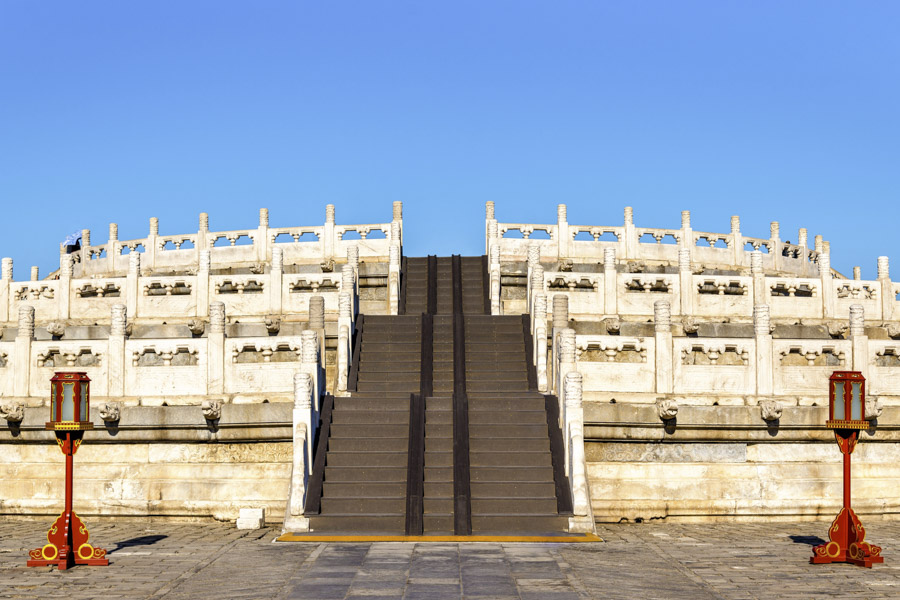
On the day of the great prayers, the court moved in the predawn hours, the emperor silk-robed in blue as attendants, banners, and ritual music marked his passage. He paused briefly, then advanced along the raised causeway to the open altar beneath the sky…
Today, travellers can follow much the same route to experience the ritual pathway for themselves.
| Landmark | Purpose and Function |
| Palace of Abstinence / Zhaigong (斋宫) | The Palace of Abstinence was the emperor’s ritual residence during the days of fasting before the ceremony. It contains the Beamless Hall and ancillary rooms where the emperor observed ritual purity and prepared for worship. |
| Dressing Terrace / Jufu Platform (Huangqian / Clothes-Changing Terrace) | Before the main rite, the emperor changed into formal ceremonial dress here and performed ritual hand-washing. It served as the final preparatory space between the Palace of Abstinence and the processional way. |
| Danbi Bridge (the Sacred / Divine Road) | This 360-metre-long (1,181-foot) raised causeway links the altars and stages the procession. It is divided into three lanes: 1) the central “Divine” way, reserved for the deity; 2) the imperial lane on the left, for the emperor; 3) and the lane on the right, used by court officials. The causeway slopes gently upward to symbolise ascent towards Heaven. |
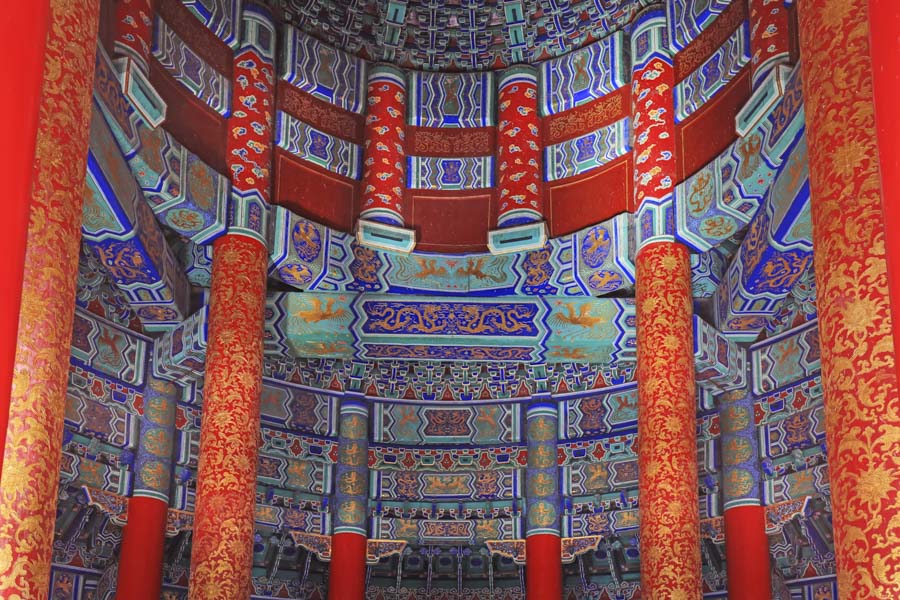
| Hall of Prayer for Good Harvests (祈年殿) | This is a triple-eaved, circular wooden pavilion with no nails (38.2 metres high, 24.2 metres diameter / 125.3 feet high, 79.3 feet diameter), representing Heaven, on a three-tiered square marble base, representing Earth, roofed in blue glazed tiles and crowned by a gilded knob. The hall’s numerology — its 28 pillars arranged as 4 (seasons) + 12 (months) + 12 (daily hours) — encodes calendrical and cosmological ideas, effectively making the structure a symbolic model of time and the heavens. Inside there are no idols but only the inscription “Heavenly Sovereign Shangdi” (皇天上帝). |
| Imperial Vault of Heaven (皇穹宇) and the Echo Wall | This smaller circular shrine, where the inscription “Heavenly Sovereign Shangdi” (皇天上帝) can also be found, housed God’s sacred tablets used in imperial rites. It is encircled by the famous Echo Wall, a smooth, curved masonry structure whose geometry and materials carry a whisper from one side to the other with remarkable clarity. Just outside the vault’s gates are the Triple Echo Stones: speaking on the first stone produces one echo, on the second two, and on the third three. Nearby stands the Dialogue Stone, from which a spoken word can be heard clearly some 36 metres (118.1 feet) away at the corners of the annexe halls. It represents a means for prayers to reach the heavens. |
| Circular Mound Altar (圜丘坛) | This altar is deliberately ordered around the number nine. Flagstones, balustrades, and steps appear in sets of nine or multiples of nine. The concentric rings around the central “Heart of Heaven” rise in sequences of 9, 18, 27, and up to 81, represented by stones. This numerology symbolises the nine layers of heaven and underlines the site’s cosmological purpose. |
When visiting the Temple of Heaven, it is essential to pay attention to the subtle details that embody its rich symbolism.
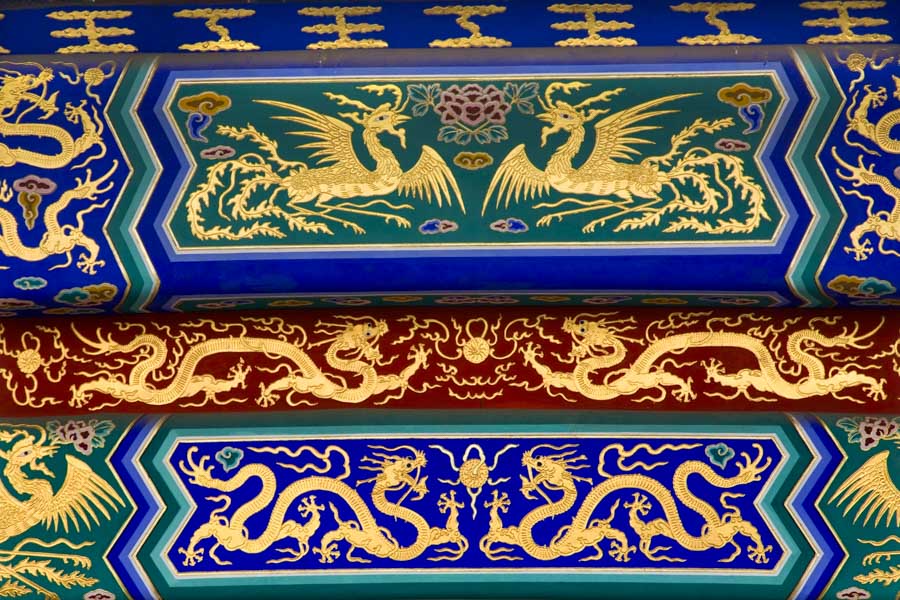
The entire grounds are divided by two walls. The wall to the north of the altar is in a semi-circle, while the one to the south is square, symbolising "the round heaven and the square earth". This creates an inner and outer altar, with the main buildings located within the inner altar enclosure. The vibrant colours that adorn the structures – such as deep blues, imperial yellows, and vivid reds – reflect the connection between the emperor and the heavens, with each hue carrying its own meaning.
As you explore the temple, admire the majestic five-clawed dragon motifs, which symbolise imperial power and the divine right to rule, recalling the emperor's prestigious position. The dragon, one of the twelve animals of the Chinese zodiac, represents not only imperial power but also good fortune and a pioneering spirit. Reflecting on these elements enriches the experience, allowing visitors to appreciate the profound cultural and historical significance of this remarkable site, often regarded as the highest academy of imperial devotion and cosmic order.
Other Notable Features to Look Out For
The Four Park Gates
The East, West, South, and North Gates serve as the principal entry points to the Temple of Heaven complex. Each offers a slightly different sense of arrival: the East Gate lies closest to the main ceremonial axis; the South Gate opens onto the broad central approach; the West Gate leads into quieter groves; and the North Gate offers a broader view back towards the city.
Long Covered Corridors
These sheltered walkways once guided ceremonial movement and today provide quiet, shaded routes through the park, linking open spaces and key ritual areas.
Pavilions and Rest Structures
Scattered throughout the park, pavilions such as the Double Circle Longevity Pavilion, also known as the Shuanghuan Wanshou Pavilion, with its two roofs visually merging into one, offer places to pause and reflect. It was commissioned by Qing Emperor Qianlong (1741 A.D.) for his mother's 50th birthday and has no function linked to the other worship structures.
Ancient Trees
Tiantan Park’s veteran cypresses and junipers are central to its atmosphere. Among them is the famed Nine-Dragon Cypress (Juniperus chinensis), a celebrated ancient tree commonly reported as being at least 600 years old. According to legend, during a visit to the Temple of Heaven, Emperor Qianlong heard a celestial voice in the Imperial Heavenly Vault and saw nine snakes, which he believed were guardians sent from Heaven, vanish beyond the wall. The emperor interpreted these snakes as incarnated in the cypress standing before him.
Along with the historic pine woods surrounding the precinct, these trees provide a living backdrop that connects visitors to centuries of history.
The Birds
Tiantan Park supports an active birdwatching community that dates back to 2002, when biologist Gao Wu established the park’s first bird-census route. The site is now monitored on citizen-science platforms such as eBird, and researchers at Beijing Normal University’s Key Joint Laboratory of Biodiversity Science and Ecological Engineering contribute to longer-term studies. Occasional viral sightings, such as an owl, have helped raise public interest in birds, urban wildlife and in conserving the park’s living landscape.
Surroundings
The Divine Music Administration (神乐署 / 神樂署, shén yuè shǔ), located a 14-minute walk from the East Gate, served as the ritual music academy during the Ming and Qing Dynasties (1368–1911). Today, it has been converted into a museum of ancient musical instruments.
Heritage and Conservation: Why is the Temple of Heaven Important?
The Temple of Heaven is a recognised masterpiece of architecture and landscape design. It was inscribed on the UNESCO World Heritage List in 1998 for its cosmic symbolism and its influence on East Asian architecture and urban planning.
Today the entire complex, with its ceremonial buildings, pine-wood parkland, and double walls, remains remarkably intact.
Conservation is ongoing. Since 2005, restoration work has addressed ageing timber, corrected earlier unsuitable repairs, and reinstated traditional materials, for example, by replacing concrete-tile patches with historically accurate fired tiles.
The site faces modern challenges, including pressure from urban development, air pollution, seasonal weather extremes and climate, and wider environmental stresses that affect its historic structures and parkland. Management aims to balance preservation and public access by protecting ancient buildings, maintaining the surrounding forested grounds, monitoring long-term impacts, and improving visitor facilities in ways that respect the historic landscape.
How to Get to the Temple of Heaven
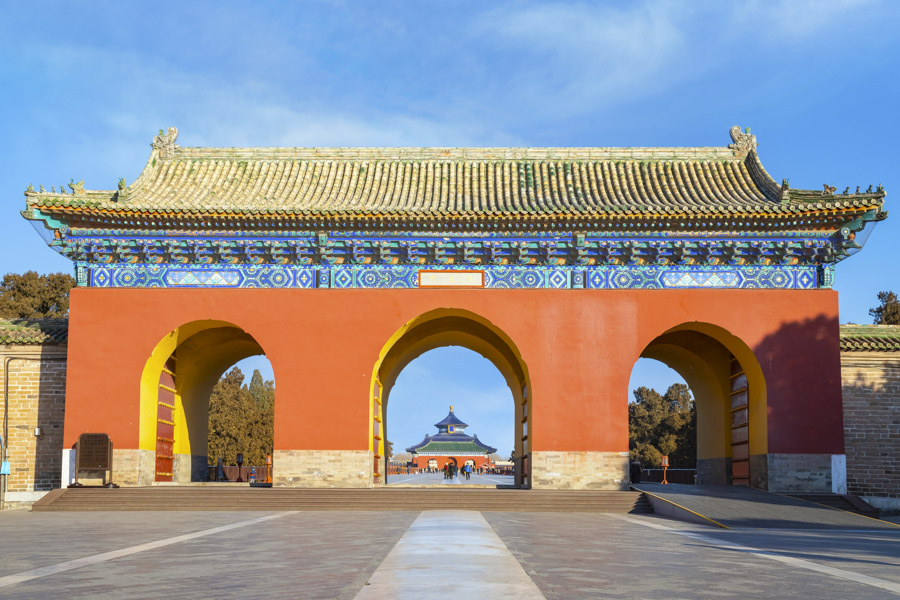
Getting to the Temple of Heaven is a bit like walking along a well-marked garden path: whichever mode you choose, the way unfolds simply and calmly.
| Temple of Heaven Address isa Type | No. 7 Tiantan Neidongli (天坛内东里7号), Dongcheng District, Beijing. |
| Temple of Heaven Address in Chinese | 北京市东城区天坛内东里7号 |
Entrances and First Impressions
Many visitors choose the East Gate because it provides the most direct approach to the Hall of Prayer for Good Harvests, but if your first point of interest is the Circular Mound, the South Gate is more convenient.
Public Transport from Airports
- Beijing Capital Airport (PEK) to Temple of Heaven: Take the Capital Airport Express subway to Dongzhimen, then transfer to the metro. Change to Line 2 and travel on to Chongwenmen station; from Chongwenmen station change to Line 5 and alight at Tiantandongmen station (Temple of Heaven East Gate).
- Beijing Daxing Airport (PKX) to Temple of Heaven: Take the Daxing Airport Express subway into the city (stops include Daxing Xincheng and Caoqiao). From Caoqiao station, transfer onto the city metro (Line 10 or Line 19) and then make an onwards connection to Line 5.
From Railway Stations
Beijing Railway Station, Beijing South, and Beijing West are all well connected to the metro network. A common route to the Temple of Heaven is to use a ring line to reach Chongwenmen station, then change to Line 5 and alight at Tiantandongmen station.
Metro
Main: Line 5 to Tiantandongmen station (Temple of Heaven East Gate) – take the station exit and walk north to the park’s East Gate.
Alternative: Line 8 (Tianqiao station) provides easy access to the West Gate.
Buses
Using Baidu Maps (百度地图) for real-time tracking and route planning is a common choice for travellers who obtain a local phone number while in China because the app offers real-time traffic updates and bus arrival reminders. However, the app’s interface and content are primarily in Chinese, so non-Chinese speakers may find it unfamiliar at first. Many visitors therefore either:
(a) Paste Chinese place names into Baidu Maps, or
(b) Type Pinyin for major landmarks.
Practical tip: copy and paste one of these Chinese place names into Baidu Maps (or into Amap).
| 天坛东门 | East Gate of the Temple of Heaven |
| 天坛南门 | South Gate of the Temple of Heaven |
| 天坛西门 | West Gate of the Temple of Heaven |
Taxis
Taxis and ride-hail services (for example, Didi) are widely available across Beijing and are convenient with luggage or for door-to-gate journeys. Show the driver “Tiāntán (天坛)” – it’s the quickest way.
Some Extra Tips for an Optimal Visitor Experience
Safety at night
Some travellers wonder, “Is Beijing safe at night?” Yes, Beijing is generally safe after dark in central areas, though normal city precautions apply: keep valuables secure, stick to well-lit streets, and use licensed taxis or ride-hailing apps for late journeys.
Security checks in the Temple of Heaven
Security checks are in place at all park entrances and ticket desks. Arriving soon after opening usually means shorter queues and quieter paths, giving you a more relaxed start to your visit.
Mind the Rules for Photography and Interaction
Some interiors and exhibits have restrictions on flash or large tripods. Observing signage and staff guidance preserves both the buildings and the experience for everyone.
We invite you to discover the wonders of the Temple of Heaven and Tiantan Park and hope your visit is delightful.