

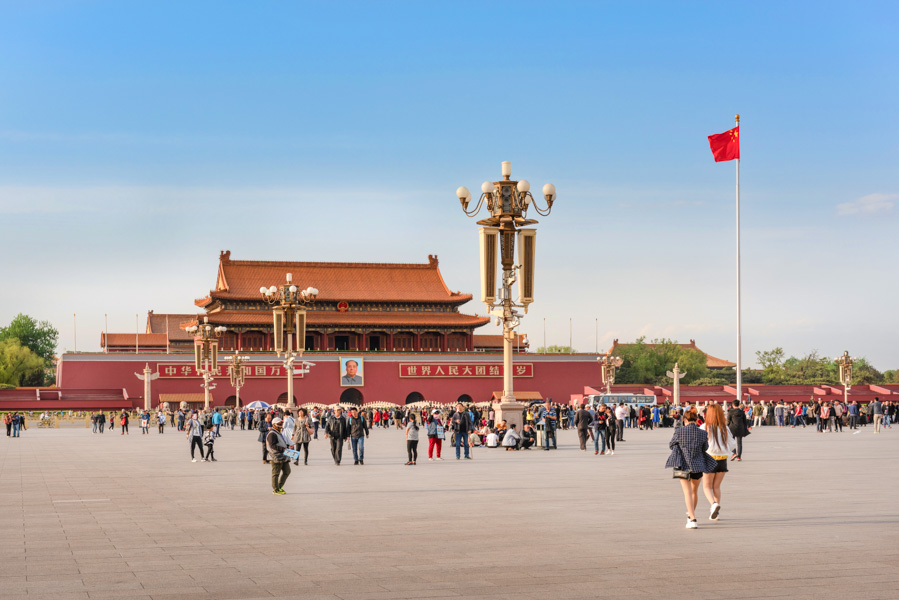
Tiananmen Square, or Tian’anmen Square (天安门广场), located at the very centre of Beijing, is one of the city’s most recognisable civic spaces. This vast open plaza lies along the north–south Central Axis of Beijing, a historic urban spine inscribed as a UNESCO World Heritage Site in 2024.
The square takes its name from the Tiananmen Gate at its northern edge, the ceremonial entrance to the Forbidden City, which is why it often serves as a natural starting point for visitors exploring Beijing’s historic centre.
Tiananmen Square Tours
Walking across Tiananmen Square is often a quietly reflective experience, creating a natural breathing space in a day of sightseeing before moving on to nearby attractions. Two representative tour programmes that include the square are the Ancient Capitals of China tour, a six-day highlights-focused introduction to Beijing and Xi’an, and the Central China Highlights Tour, an eight-day journey that presents the capital as the opening chapter of a cultural odyssey.
Best Time to Visit
Tiananmen Square Tiananmen Square is accessible year-round, though the character of a visit varies with the seasons. Spring (March–May) offers milder conditions and longer days, while autumn (September–November) is generally the most comfortable. Summer can feel hot and humid, particularly at midday, whereas winter is cold and quieter, suiting visitors who prefer fewer crowds.
The most atmospheric times to visit Tiananmen Square are at dawn and dusk, when the daily flag-raising at sunrise and the flag-lowering at sunset take place. Performed by the honour guard, these precisely choreographed military ceremonies are widely regarded as among the square’s most memorable moments, and many travellers arrange their visit to coincide with them.
As sunrise varies throughout the year, so does the timing of the ceremony. In mid-June, for example, it can take place as early as around 04:45, while in midwinter it typically occurs between 07:20 and 07:30. You may consult the timetable on our dedicated guide.
Note: Arrive 30–90 minutes before sunrise if you want a good viewing position, as queues may be longer for front-row spots on busy dates.
During the major national holidays, particularly National Day on 1 October, Tiananmen Square becomes the focal point for state ceremonies. In selected anniversary years, this may include large-scale events, and visitors should expect heightened security measures during this period.
Practical Information
Tiananmen Square location
Tiananmen Square sits on Beijing’s Central Axis in Dongcheng District, between Chang’an Jie (Chang’an Avenue) to the north and Qianmen Dajie (Qianmen Avenue) to the south.
| Address in Chinese | 北京市东城区东长安街 |
Tiananmen Square Reservation and Entry
Entry to the square is free and has required advance reservation since 15 December 2021. Visitors book a timed slot in one of four daily periods (flag-raising, morning, afternoon, and flag-lowering). Some valid bookings for adjacent attractions (for example, the Palace Museum or National Museum) may permit access to the square during the same time window. Bookings are usually handled through the official WeChat mini-programmes or a reputable operator like Advantour.
Tiananmen Square Opening Hours
Tiananmen Square is generally accessible from early morning until late evening. Rather than fixed daily opening hours, access is organised through timed reservation periods, which structure visitor entry across the day.
Note: Visiting times may be adjusted on days of official ceremonies.
Security Rules
All visitors are required to pass through security screening, including bag checks and metal detectors, and must present valid identification at entry checkpoints (a passport for foreign visitors).
Accessibility and Visitor Facilities
The open plaza of Tiananmen Square is broad, paved, and largely level, allowing relatively easy movement for wheelchair users and visitors with limited mobility. Step-free pedestrian crossings and underground passages connect the square with nearby metro exits; municipal accessibility maps and on-site signage indicate lift locations and step-free routes.
Accessibility in surrounding public buildings varies.
- The National Museum of China provides accessible routes and lifts and offers free wheelchair or stroller loans from the service desk with ID and a deposit; visitors with mobility needs are advised to contact the museum when booking.
- The Chairman Mao Memorial Hall (also known as the Mausoleum of Mao Zedong) operates an electronic reservation system via WeChat or the official website. It is necessary to book the visit by entering the name that matches the identification (passport) that will be presented. Priority entry is granted to senior visitors and those with disabilities, although electric mobility aids are restricted.
- The Great Hall of the People has designated accessible entrances and ramps for organised visits.
Basic visitor facilities – including public toilets and vendor kiosks – are found around the edges and entrances of the square rather than in the central open area. For fuller facilities, head to the nearby public buildings.
History of Tiananmen Square
Originally named Chengtianmen (“Gate of Accepting the Heavenly Mandate”) when it was constructed in 1417 during the Zhou Dynasty, the structure was later renamed Tiananmen (“Gate of Heavenly Peace”).
For centuries, the area that is now Tiananmen Square formed part of a tightly controlled imperial precinct, defined by walls, gates, and ceremonial routes designed to regulate visibility and access to power. In traditional Chinese political thought, authority was expected to be exercised with restraint; classical texts emphasised concealment, hierarchy and order, principles that were materially expressed in the enclosed design of Beijing’s imperial city.
That spatial arrangement endured until the mid-twentieth century, when the new government reimagined the site. In 1949, Tiananmen Square acquired lasting national significance as the place from which the founding of the People’s Republic of China was proclaimed. During the 1950s, extensive redevelopment cleared much of the former forecourt and substantially enlarged the plaza, creating a monumental space suited to mass gatherings and state ceremonies.
This physical opening of the site mirrored a broader shift in how authority and civic life were publicly presented.
During the Cultural Revolution (1966-1976), Tiananmen Square became a focal point for large-scale rallies and demonstrations promoting Mao Zedong’s vision.
Following Chairman Mao's death on 9 September 1976, his mausoleum was constructed in the centre of the square, further consolidating its role as a site of national remembrance and reverence, and embedding Mao’s legacy within the symbolic heart of the nation.
Major Landmarks at Tiananmen Square Not to Miss
Tiananmen Square is a vast historic space shaped by centuries of change. Its monuments reflect how power and collective memory have been centred in Beijing from the imperial era to the present. The landmarks along the Central Axis show how history and state symbolism are expressed through space and architecture.
Below is a list of features to see during your visit to the square:
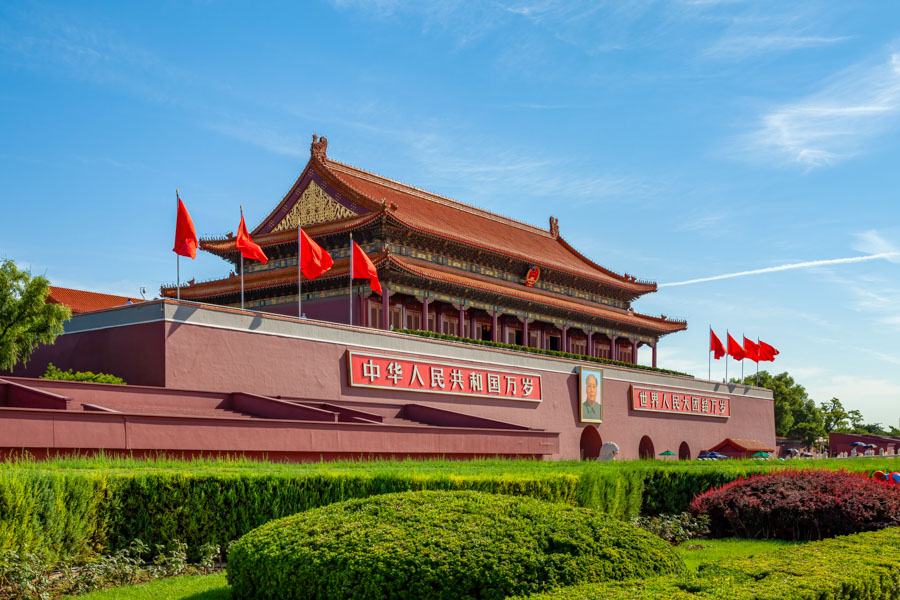
1) Tiananmen Gate crowns the northern edge of the square. Originally built in 1420 as the main ceremonial entrance to the Imperial City, it stood as the threshold to the emperor’s residence and the Forbidden City.
The name literally means “Gate of Heavenly Peace” and resonates with imperial ideas of the Mandate of Heaven (天命, Tiānmìng), evoking heavenly authority and imperial order.
In 1949 Mao Zedong proclaimed the founding of the People’s Republic from Tiananmen Gate’s balcony – the event that fixed the gate in modern national memory.
A large hand-painted oil portrait of Chairman Mao hangs on the façade, measuring roughly 6 × 4.5 metres (≈ 19.7 × 14.8 feet) and weighing about 1.5 tonnes (≈ 3307 pounds). Mounted in a reinforced frame, the portrait is carefully maintained and replaced or renewed ahead of National Day, ensuring it remains a striking symbol overlooking Tiananmen Square.
2) The National Museum of China (中国国家博物馆) stands on the eastern flank of Tiananmen Square, opposite the Great Hall of the People. Established in 2003 through the merger of the National Museum of Chinese History and the National Museum of the Chinese Cultural Revolution, it reopened in 2011 following a major renovation. The museum is among the world’s largest, with nearly 200,000 square metres (approximately 0.08 square miles) of floor space and a collection of over one million objects spanning Chinese history and culture.
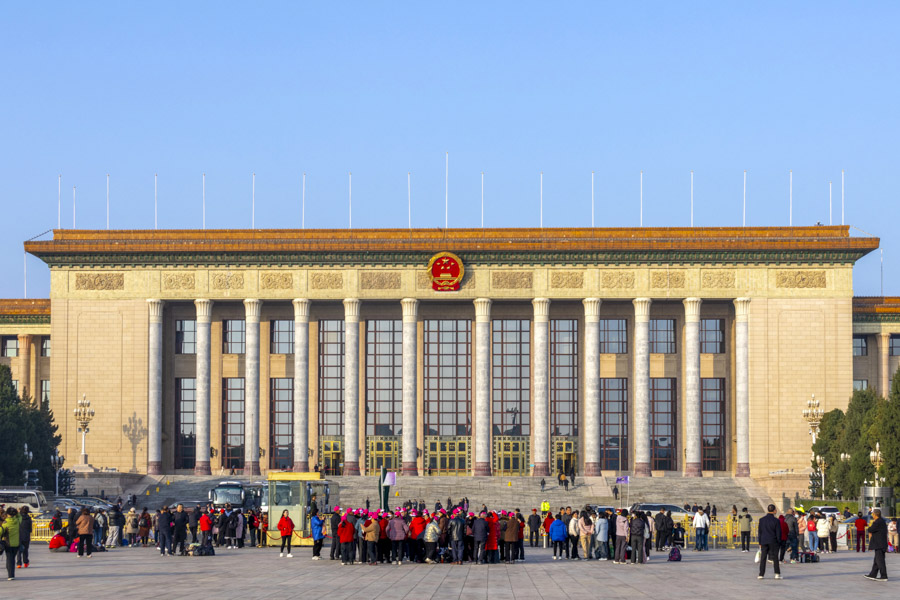
3) The Great Hall of the People (人民大会堂) dominates the western flank of Tiananmen Square. Completed in 1959 as one of the “Ten Great Buildings” marking the 10th anniversary of the People’s Republic of China, it hosts sessions of the National People’s Congress and major state functions. Visitors admire its monumental façade and vast halls, reflecting the square’s political significance.
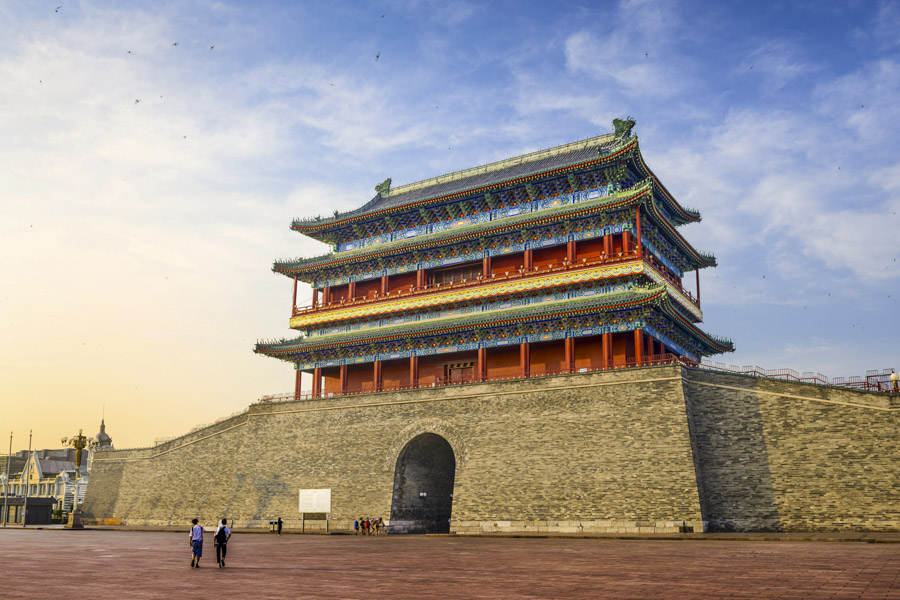
4) Zhengyangmen (正阳门), commonly called Qianmen, marks the southern end of Tiananmen’s central axis. The complex comprises a Gate Tower (城楼) to the north and an Archery (Arrow) Tower (箭楼) to the south; historically, they were linked by side walls and a large barbican. Today, Qianmen Dajie runs between the towers, and Qianmen Station occupies the site of the former fortification. A northward walk from the station brings you past the Archery Tower before the Gate Tower comes into view.
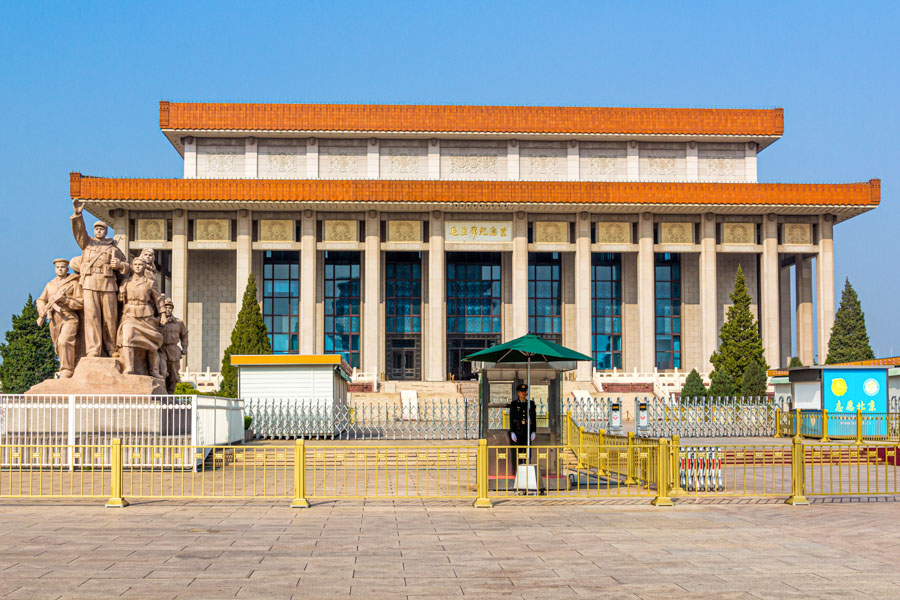
5) The Chairman Mao Memorial Hall (毛主席纪念堂), also known as Mausoleum of Mao Zedong, rests on the main north–south axis of Tiananmen Square. Construction began shortly after Mao’s passing in 1976 and was completed in 1977. The hall houses the embalmed remains of Mao Zedong and has become one of the square’s central features, underscoring his role in modern Chinese history.
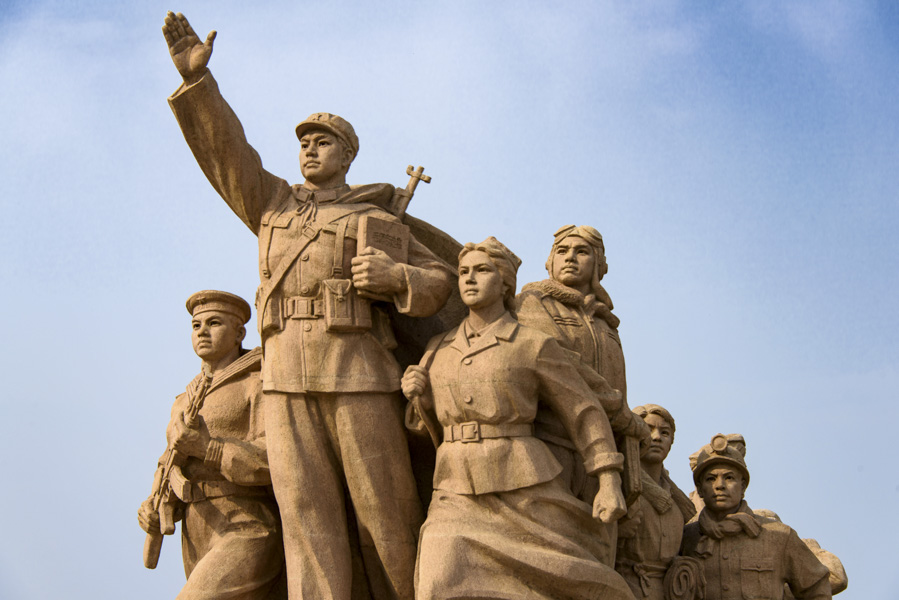
6) Sculptures at the Chairman Mao Memorial Hall. Four monumental sculptural groups are arranged around the Chairman Mao Memorial Hall, with two near the northern entrance and two on the southern side. Executed in clay, these compositions depict key moments in modern Chinese history, including the revolutionary period and socialist construction, as well as the unity of workers, peasants, soldiers, intellectuals, and youth.
7) The Monument to the People's Heroes (人民英雄纪念碑) rises just north of the Mausoleum of Mao Zedong. Conceived as a national tribute to revolutionary martyrs of the nineteenth and twentieth centuries, its foundation stone was laid in 1949, with construction formally carried out from 1952 and the monument inaugurated in 1958.
Rising to 38 metres (approximately 125 feet), the monument takes the form of an obelisk of granite and white marble. It bears a calligraphic inscription by Chairman Mao Zedong, with the commemorative text drafted under the direction of Zhou Enlai, the revolutionary statesman and first Premier of the State Council of the People’s Republic of China. The monument is further adorned with bas-reliefs depicting key episodes in modern Chinese history.
8) Huabiao (华表) are a pair of ornamental ceremonial columns that stand on the bridge over the Golden Water River, directly in front of Tiananmen Gate. Traditionally used in imperial China as markers of authority and moral guidance, these white marble pillars are richly carved with dragons and cloud patterns. Positioned symmetrically along Beijing’s Central Axis, the Huabiao frames the approach to the gate, reinforcing the grandeur of the square and its connection to the city’s historic imperial and ceremonial traditions.
Seasonal Displays and Special Decorations
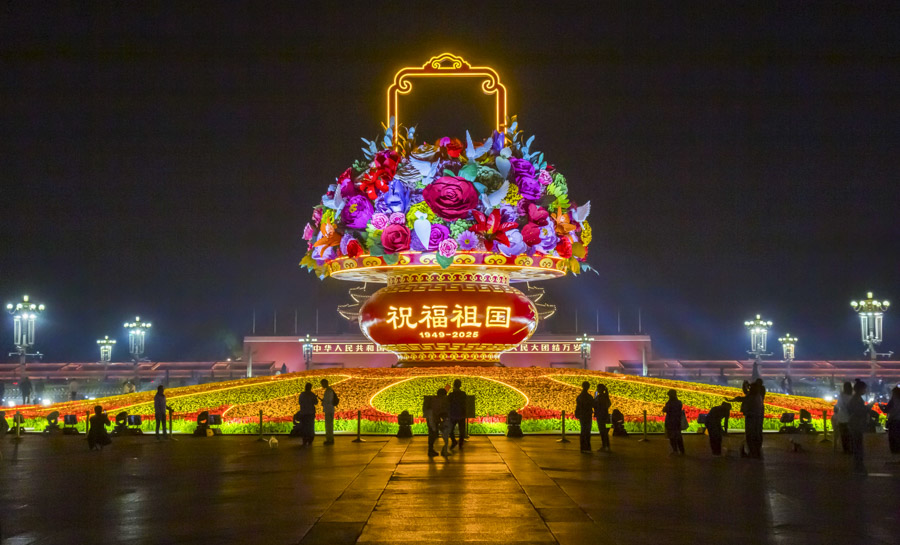
A striking seasonal feature of Tiananmen Square, the iconic “Blessing the Motherland” giant flower basket, typically 18 metres (approximately 59 feet) tall, celebrates China and complements the square’s monumental scale.
Floral displays in the square date back to 1984, with large three-dimensional flower compositions appearing in 1986. The current design, first introduced in 2011, has become a regular feature for National Day and other major occasions, often illuminated at night.
Explore the Surroundings of Tiananmen Square
Tiananmen Square sits at the heart of Beijing’s historic centre, with several major sights easily reached. A walk in any direction reveals layers of the capital’s cultural life, past and present.
- Forbidden City: directly north of the square, this vast imperial palace complex offers a deep immersion into court life, architecture, and ritual spanning five centuries. · Qianmen Street: south of the square, a restored historic avenue lined with traditional shops, local snacks, galleries, and time-honoured brands.
- National Centre for the Performing Arts: west of Tiananmen, this striking modern landmark hosts opera, concerts, and ballet in an iconic domed setting.
- China Numismatic Museum: a quieter stop for those interested in Chinese economic history, showcasing coins and currency from ancient times to the modern era.
Heritage and Conservation of Tiananmen Square
Conservation at Tiananmen Square forms part of a broader effort to care for a heritage landscape that continues to host official ceremonies, grand celebrations, large public gatherings, and everyday visits. As part of the Beijing Central Axis, highlighted by the UNESCO, this living approach is supported by a heritage planning and management framework that guides coordinated restoration, research, and routine maintenance, safeguarding the long-term integrity of the structures and sightlines that define the square’s character.
Visitors may notice carefully maintained façades, repaired paving, and interpretive signage as indications of this stewardship. Observing posted guidance – following marked routes and respecting site rules – contributes directly to its long-term care.
How to Get to Tiananmen Square?
Many travellers find the easiest way to reach Tiananmen Square is via Beijing public transport.
- Metro: Take Line 1 and alight at Tiananmen East or Tiananmen West stations. Follow the signs to the square. For the latest maps, schedules, and service notices, consult the official Beijing Subway website: www.bjsubway.com.
- Bus: Nearby transport hubs, such as Qianmen, connect multiple bus lines and metro services. Special night- and early-morning buses operate on selected lines for visitors attending the flag ceremonies*.
| Flag-raising ceremony (dawn) | Take Night Bus No.1, No.2, or No.17 to Tiananmen East or Square East, or Tiananmen West (No.1 only), and then walk to the square. The first buses depart around 23:20; the last buses arrive around 04:50*. |
| Flag-lowering ceremony (sunset) | Take Bus No.1, No.2, No.52, No.82, No.120, or Sightseeing Bus Line 2, then walk to the square. |
* Please note: Sunrise and sunset times vary throughout the year, which affects the exact timing of the ceremonies. Please check official schedules in advance to plan arrival.
Tips for an Optimal Visit
Know what to expect at security checkpoints: when entering Tiananmen Square, you will go through security, so it is helpful to be prepared. To make your entry smooth and quick, leave behind items like flammable materials, knives, pens, drones, or large filming equipment like tripods. Keeping your visit smooth will let you focus on the sights!
Enjoy the atmosphere at Chairman Mao Memorial Hall: at the Chairman Mao Memorial Hall, the atmosphere is both reflective and serene. You will need to store your bags, cameras, and water bottles in designated areas. Plus, silencing your phone will help maintain the tranquil environment, allowing you to fully appreciate this important site.
Follow behavioural etiquette: the square is a place of national importance, and displaying a sense of decorum can greatly enhance your experience. Speaking softly, avoiding running, and adhering to posted signs show respect for this iconic location. For further guidance on etiquette in China, feel free to explore our dedicated guide.
Dress comfortably: there’s no strict dress code for the square, but modest clothing is recommended when visiting memorial halls or attending ceremonies. Comfortable shoes will make it easier to cross the vast plaza and explore nearby attractions.
Travel light for a relaxed visit: to get through security more smoothly and spend less time in line, opt for smaller bags or pocket-sized items. This way, you will have more time to explore the square and take in all the amazing sights.
Move at your own pace, soak in the atmosphere, and appreciate the space around you – and may your time here become one of the memorable highlights of your journey through China’s capital.