

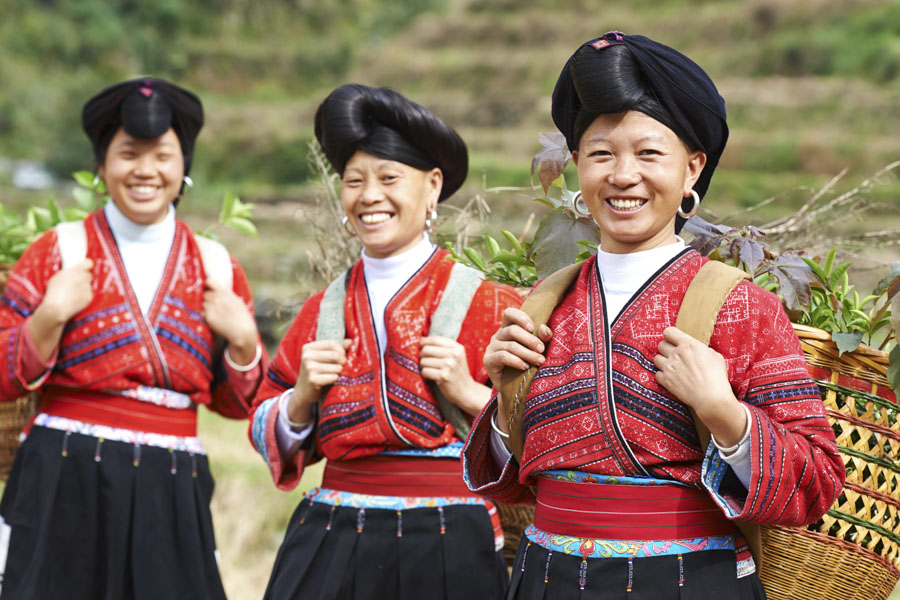
The Longsheng Rice Terraces (龙胜梯田 / 龙脊梯田) are not defined by scenery alone; the villages set among their slopes are part of what makes the landscape distinctive. They are home to the Yao (瑶族) and Zhuang (壮族) communities, whose customs remain closely tied to the surrounding hills. Wooden stilt houses step down the slopes, narrow paths run between courtyards, and traditional dress, local crafts, and community dances remain part of daily life rather than something arranged for visitors. What gives these places their character is the continuity of life still held within the landscape.
Yao and Zhuang Ethnic Minority Villages Tours
Yao and Zhuang ethnic minority villages around Longsheng offer some of the most memorable experiences in China. It’s a chance to see rural life and the region’s cultural texture up close.
Even on shorter routes from Guilin, a visit here shifts the pace: after river scenery and karst peaks, life among the terraces unfolds more slowly, set against layered fields and wooden houses. On longer journeys between China’s historic capitals and Guangxi, Longsheng becomes a natural contrast. Between cities like Beijing, Xi’an or Shanghai, time in the mountain villages shifts the focus back to craft traditions, local food and community life shaped by the agricultural calendar. This approach is typical of classic central China itineraries and their extended counterparts.
In some itineraries, the focus shifts to regional cuisine, where a stop in Longsheng is less about sightseeing and more about taste: from bamboo rice cooked over open fires to simple vegetable dishes prepared in village homes, as part of food-focused journeys across China.
In other itineraries, the terraces form part of a broader journey across China, paired with destinations such as Zhangjiajie or a Yangtze River cruise. In this context, Longsheng introduces a more unhurried way of experiencing the landscape, alongside a grounded, rural setting.
Best Time to Visit the Yao and Zhuang Ethnic Minority Villages
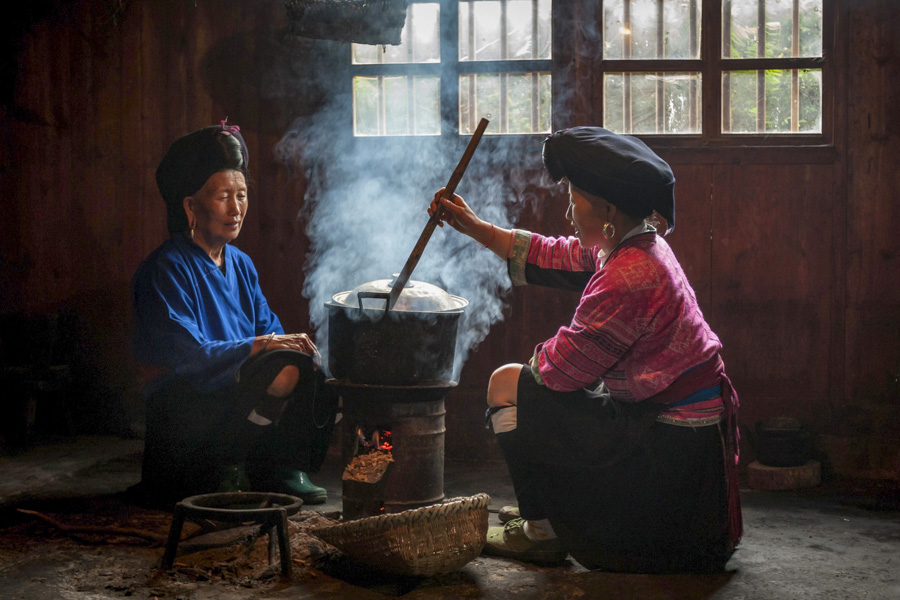
Across the year, the rice terraces of Longsheng change dramatically, and the season of your visit will strongly influence how the region looks and feels. Village life remains closely tied to the agricultural cycle, while local festivals continue to mark key moments in the calendar.
In spring (April and May)
As temperatures warm from about 10 to 24°C (50 to 75°F), water begins to fill the terraces in preparation for planting. The slopes turn into layered mirrors reflecting the sky and clouds, and the farming season gets underway in earnest. As spring deepens, the land is being prepared, and we witness rituals associated with the beginning of planting the young rice shoots by hand.
Summer (June to August)
With temperatures generally between 18 and 30°C (64 to 86°F), summer brings dense greenery. Young rice plants grow tall and lush, covering the hillsides in vivid green. The villages seem almost enclosed by the surrounding growth. It is a busy time in the fields, and many local festivals also fall during these months.
Autumn (September and October)
As temperatures moderate to roughly 12 to 26°C (54 to 79°F), autumn is often considered the most beautiful time to come. As the harvest approaches, the rice turns a rich shimmering gold, and the valleys take on warm colour. The terraces' textures and swirls almost look like a painting by Van Gogh. The harvest starts, and the villagers cut the ripe stalks by hand with a sickle. Then the rice is left to dry into bundles. Seasonal celebrations mark the close of the agricultural cycle and give thanks for the year’s yield.
In winter (December to February)
Winter is quieter, with average highs of about 10 to 16°C (50 to 61°F) and lows around 0 to 6°C (32 to 43°F). The terraces are partly bare, and snow occasionally settles on the slopes. The landscape then becomes unreal in its magical beauty, with an ethereal atmosphere. It is a more subdued season, shaped by calm village routines and preparations for Lunar New Year.
History of the Yao and Zhuang Ethnic Minority Villages
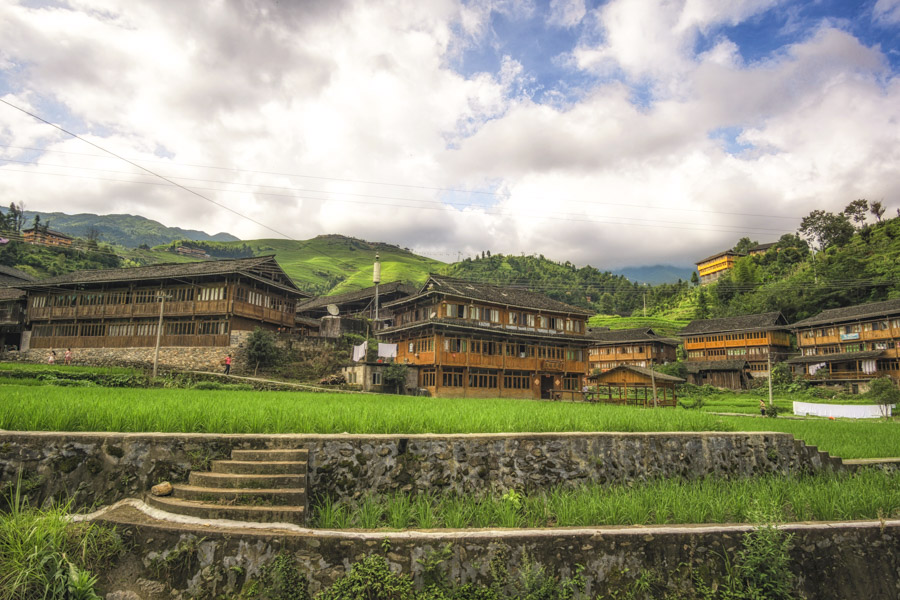
Longsheng’s terraced landscape is more than an example of mountain farming. It embodies centuries of labour, adaptation and handed-down knowledge within Yao and Zhuang communities, gradually turning steep slopes into one of China’s most remarkable cultural landscapes.
A major shift began in the late 20th century, when the Longsheng Terraces started to attract visitors. The first organised trips appeared in the 1980s, after independent travellers and researchers drew attention to the scenery. By the 1990s, tourism had become an important part of the local economy. Small family-run guesthouses opened in the villages, and, from the 2000s, trails and viewing platforms were installed, so residents could combine farming traditions with hospitality.
Architectural Heritage on the Longsheng Rice Terraces: Longji Ancient Zhuang Village
With a history of over 400 years, Longji Ancient Zhuang Village (龙脊古壮寨) is the most original and rustic village with very few guesthouses and hotels. It keeps its traditional identity, as it is less developed. When you stroll across its alleys, you can hear the sound of flowing water down from the mountains. It preserves the largest cluster of traditional stilted wooden buildings on stone foundations in the Longsheng terraces area. Five of these houses are over a hundred years old, and one is believed to be more than 250 years old. According to genealogical records and inscriptions on ancestral tombs the ancestors of the current residents bore the surnames Liao (廖), Hou (侯) and Pan (潘). Their shared history is commemorated in a carved motif on an old bridge: the symbol “Three Fish with One Head” (三鱼共首), expressing the closeness of their origins.
Rice is not the only crop grown here; villagers also cultivate monk fruit, passion fruit and bamboo, which they sell in the lanes.
If you want time to rest, meditate and escape the hustle and bustle of the city, this village is the perfect offthebeatenpath retreat, as it is far less frequented by tourists. You can wander alone through the rice fields, sit on a stone by the path and stay for hours, soaking up the sounds, scents and sights of the magnificent landscape.
Living Culture of the Zhuang Community: Ping’an Zhuang Village
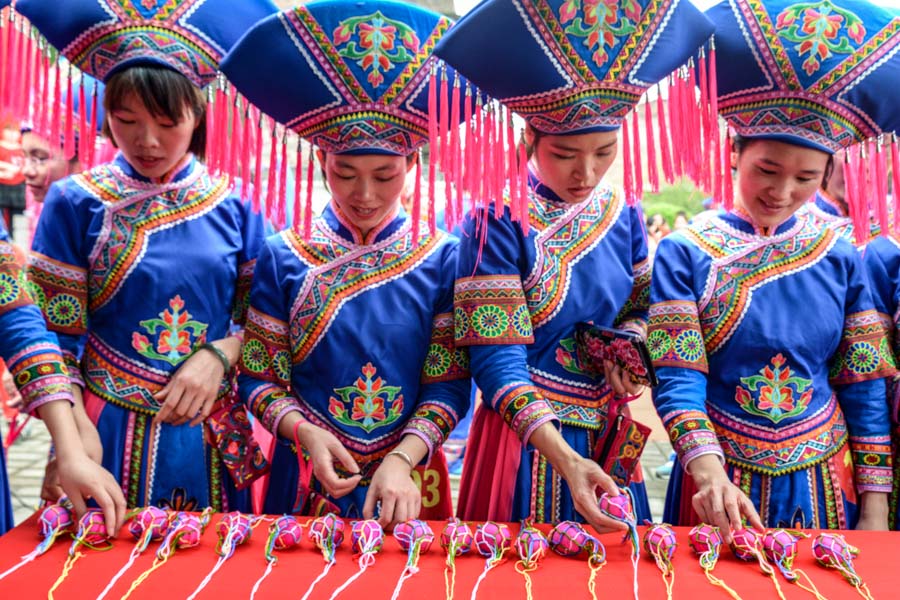
One of the best-known Zhuang villages in the terrace region is Ping’an Zhuang Village (平安壮寨). Its name means “peace” or “safety”. The village developed relatively more recently, during the late Qing dynasty (1644–1912) and the early Republican era (1912–1949), growing up around terraces that were already in place.
Traditional two- and three-storey wooden houses with broad balconies still define much of the village. From these balconies, the terraces open out in different directions, and the landscape shifts with every change in vantage point. Their scale is one of the first things visitors notice.
As visitor numbers have increased over the past decade, taller buildings have appeared, some rising to five or more storeys and combining timber with brick or concrete. Several have been adapted into guesthouses, offering comfortable stays and wide views over the terraces. Even so, many villagers continue their daily routines in older, more practical homes, cooking on wood stoves and maintaining long-established ways of life.
Traditional dress and bright jewellery remain visible in daily life, while bamboo baskets are still used in the fields. These practical objects also form part of the village’s distinctive visual identity.
Centuries of Terraced Farming Traditions: Dazhai Yao Village
At the centre of the Jinkeng Rice Terraces lies Dazhai Yao Village (大寨), recognised as one of the UNWTO Best Tourism Villages in 2022. It is among the largest settlements of the Red Yao in the area, a community named for the deep red tones of the traditional clothing still worn by many local women.
The colour is associated with joy and prosperity. One of the most distinctive garments is the women’s “flower dress”, which can take many months – sometimes up to a year – to complete by hand. Silver earrings and other jewellery traditionally accompany the costume.
Around 700 years ago, during the Yuan dynasty (1271–1368), the ancestors of today’s villagers migrated from the Dongting plains in Hunan Province to the mountains of Guangxi. They brought with them established farming practices suited to steep terrain, gradually shaping the hills into the terraced fields that define the landscape today. The Red Yao have lived here for centuries, maintaining ways of life closely tied to the land.
Today, the village is also connected to wider networks through modern infrastructure, including high-speed mobile coverage, which supports both daily life and the steady flow of visitors.
The World-Famous Long Hair Culture: Huangluo Yao Village
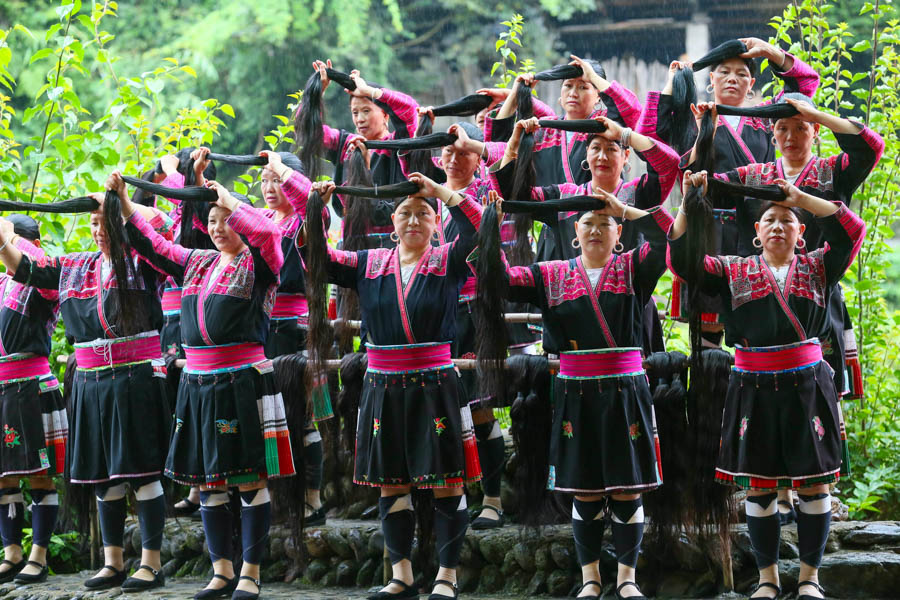
Famous for the tradition of women growing exceptionally long hair, Huangluo Yao Village (黄洛瑶寨) is one of the most distinctive Red Yao Villages in the region. The custom dates back to the Song dynasty (960–1279) with a history of more than a thousand years. In 2002, the village was recorded in the Guinness World Records as the “World’s Longest Hair Village”. As tourism developed in the region, the tradition became the basis for the village’s Long Hair Show, providing a new source of income for many local families.
Women’s hair can exceed 1.5 metres in length and may weigh close to a kilogramme. It carries cultural significance, with long hair traditionally associated with identity and continuity within the community. Its care is shaped by a set of long-standing practices, some of which are still observed today.
Villagers prepare a natural shampoo from fermented rice water, often combined with tea, fruit, and local herbs. The method varies between households, and the mixture is known for keeping the hair smooth, dark, and carefully maintained over time.
Huangluo’s residents traditionally wear clothing embroidered with flowers, trees, birds and animals, and silver earrings and bracelets are still worn daily. The village also regularly stages singing performances, bamboo-pole dances and group processions along mountain paths, often carrying umbrellas.
Things To Do in the Yao and Zhuang Ethnic Minority Villages
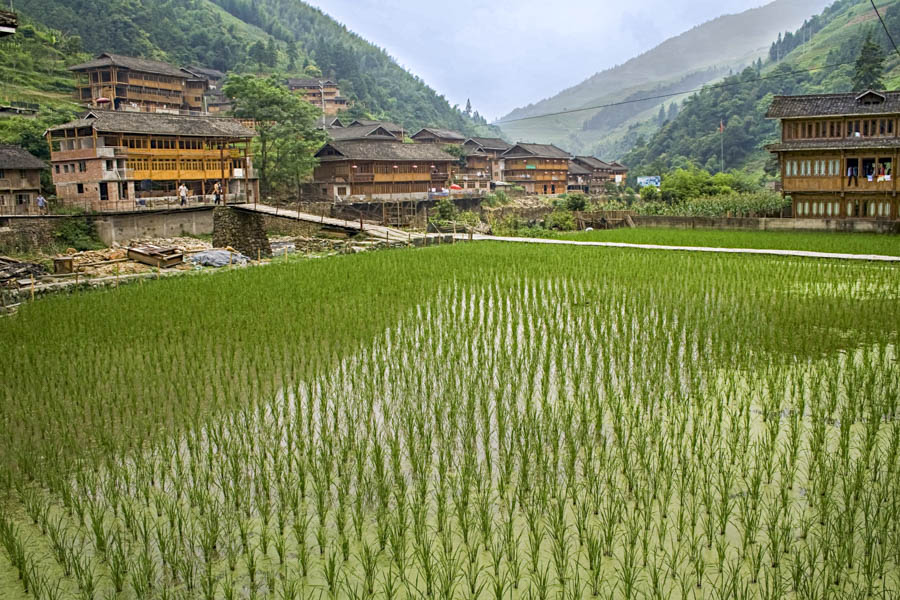
Beyond the visual drama of the Longsheng terraces and hiking to the various viewpoints, there is plenty here to hold your attention at a slower pace. Watching the villagers tend to their crops; discovering aspects of local life such as their culinary traditions; visiting small cultural sites; and attending local performances – all of this will greatly enrich your stay.
After climbing to the viewpoints, many visitors choose to rest with a foot massage in the Zhuang village below, where traditional Chinese medicine remains part of local practice.
You can also cross the Jinjiang River by stepping over the large stones set in the water to form a simple bridge.
Look closely at the symbols that appear on house façades, roof corners, beams, and stonework throughout the villages. A double-happiness sign at an entrance, or carved dragons and frogs near the fountains, reflects layers of local belief and custom that still shape the visual character of these settlements.
Some of the most rewarding moments in the villages come through everyday activities – learning local cooking, sharing meals, tasting tea, and trying weaving or indigo-dyeing.
Places to Visit in the Yao and Zhuang Ethnic Minority Villages
Museum in Huangluo Yao Village
China Long Hair Science and Technology Museum (中国长发科技馆)
One of the cultural attractions of Huangluo Yao Village is the China Long Hair Science and Technology Museum, devoted to the long-hair tradition of Red Yao women.
The museum traces the history of this practice over several centuries with displays of photographs, ethnographic materials and objects used in traditional hair care. Particular attention is given to natural treatments favoured by local women, including fermented rice water and herbal infusions. Exhibits also explore the broader social significance of long hair in Red Yao society and how the custom came to symbolise Huangluo itself.
The museum occupies approximately 2,700 square metres, and its main building rises over five floors. Admission is free.
On ordinary days, the square serves as a visitor space. During festivals, it becomes a gathering place for the wider community and one of the liveliest spots in the village.
Huangluo Yao Village Theatres
Huangluo Yaozhai Song & Dance Place (黄洛瑶寨歌舞场)
Cultural performances in Huangluo Yao Village take place at the Huangluo Yaozhai Song & Dance Place.
The stage features folk performances drawn from Red Yao songs and dances, with performers wearing traditional hairstyles and elements of local dress. Visitors are also invited to sample festive foods that often accompany celebrations, such as tangy oil tea (Youcha) and sweet sesame sticky rice cake (Zhima Mi Ba). After the performance, it is pleasant to wander among the nearby stalls, where local craftswomen sell bracelets, necklaces, hairpins and embroidered items.
Entertainment, Parks, and Shopping in Yao and Zhuang Ethnic Minority Villages
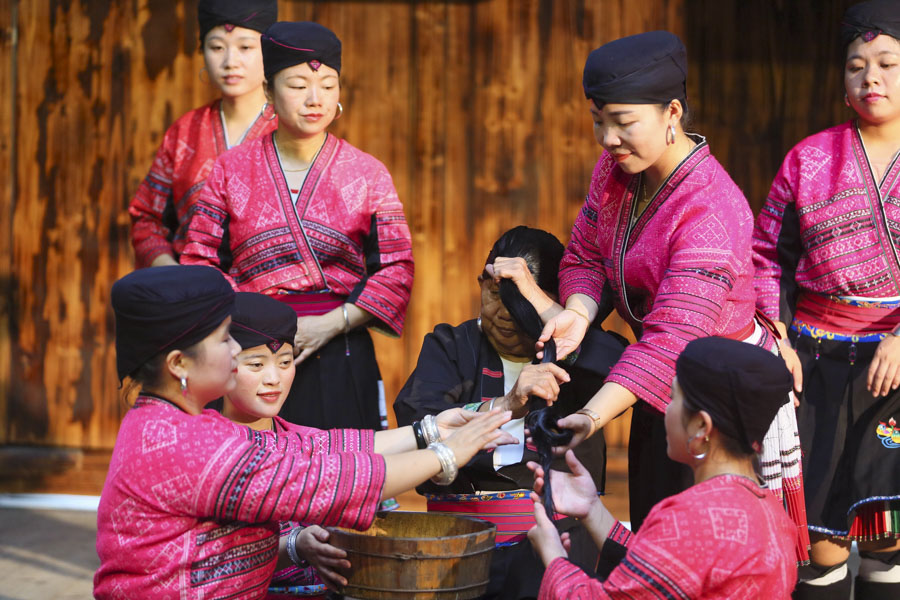
The Zhuang and Yao are deeply committed to keeping their customs alive. Throughout the year you can attend folk performances, stroll the rice terraces and enjoy panoramic viewpoints, then browse narrow village alleyways lined with local craft stalls.
Entertainment
Throughout the year, music, dance and seasonal celebrations keep cultural life in the Longsheng Rice Terraces area lively and visible. If your visit coincides with a local festival, you will see these traditions at their most vivid.
Festivals
The Sanyuesan Festival (壮族三月三) is one of the best-known Zhuang celebrations and falls on the third day of the third lunar month (in March). The day is marked by folk singing contests, lively dancing and traditional games that continue from morning into the evening.
On the same day, Yao villages celebrate the Long Hair Festival (长发节), associated with one of the most distinctive rituals in Red Yao culture. By the river, young women are permitted to cut their hair for the only time in their lives, at 18 years old, before entering adulthood. The ceremony proceeds slowly and with great care, as girls comb their hair with wooden combs in tradition passed down for centuries.
The Kaigeng Festival (开耕节), held at the beginning of the fourth lunar month (in April), marks the start of the ploughing season. The terraces teem with activity. Visitors can watch oxen drawing ploughs through the fields and later join festive meals shared by locals and guests.
Held around the 29th day of the fifth lunar month (late May or early June), the Danu Festival features drumming that symbolises the instrument the ancestor goddess Zuniang gifted her daughter. Participants pray for health, bountiful harvests and fertility for both people and livestock, then join in traditional songs and dances.
The Clothes Drying Festival (晒衣节), on the sixth day of the sixth lunar month (in June), is an important Red Yao occasion. Traditional garments are hung out in the sun, creating striking displays of fabric and embroidery, while songs, dances and craft fairs form part of the day’s programme.
The Panwang Festival (瑶族盘王节), celebrated on the sixteenth day of the tenth lunar month (in October), is the most solemn event in the Yao ritual calendar. Dedicated to the birthday of the mythological ancestor Pan Wang, it is marked by epic songs and ceremonial rites that lend the day a strongly ancestral atmosphere.
The Harvest Festival (丰收节) in October coincides with one of the most beautiful moments of the year in Longsheng. The terraces glow in amber tones, harvested rice dries in the open air, and villagers gather for communal meals. Songs, dancing and shared food turn the end of the farming season into a lively, deeply local celebration.
These festivals keep cultural life in the mountain villages vibrant throughout the year, offering visitors a chance to witness traditions that continue to shape community life.
Parks of Yao and Zhuang Ethnic Minority Villages
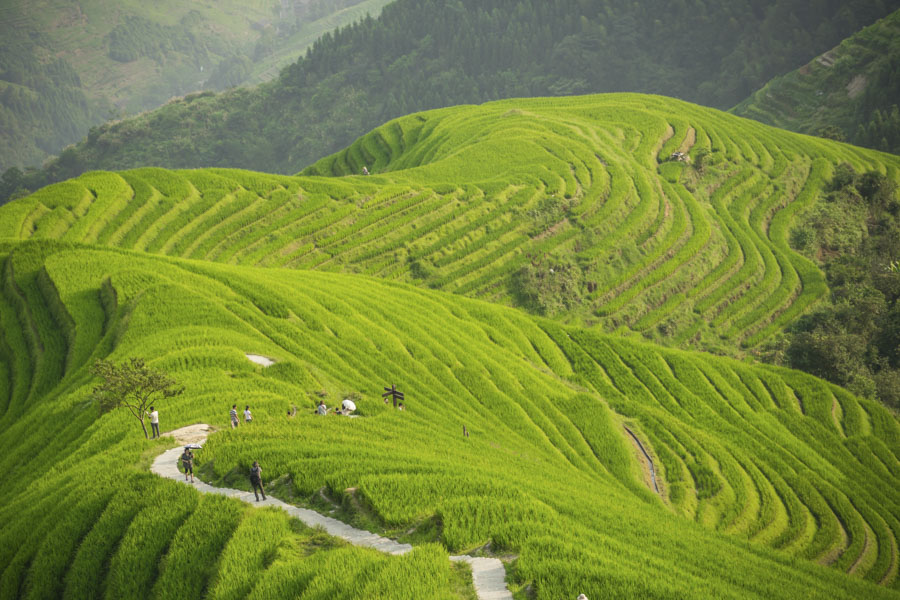
More than a scenic backdrop, the Longsheng Rice Terraces form an open-air cultural landscape in which villages and terraced fields belong together. The most rewarding way to experience it is on foot, following stone paths that wind from settlement to settlement.
Key viewpoints
In the area around Ping’an Zhuang Village (平安壮寨), trails lead to two main viewpoints:
- No. 1 “Nine Dragons and Five Tigers” (九龙五虎观景点)
- No. 2 “Seven Stars Accompany the Moon” (七星伴月)
From Dazhai Village (大寨), walking routes continue towards the main viewpoints of the Jinkeng Terraces (金坑梯田):
- No. 1 “West Hill Music” (西山韶乐)
- No. 2 “Thousand-Layers Terraces” (千层天梯)
- No. 3 “Golden Buddha Peak” (金佛顶)
Take a look at our comprehensive guide to the scenic viewpoints and hiking trails in Longsheng that you can explore during your stay.
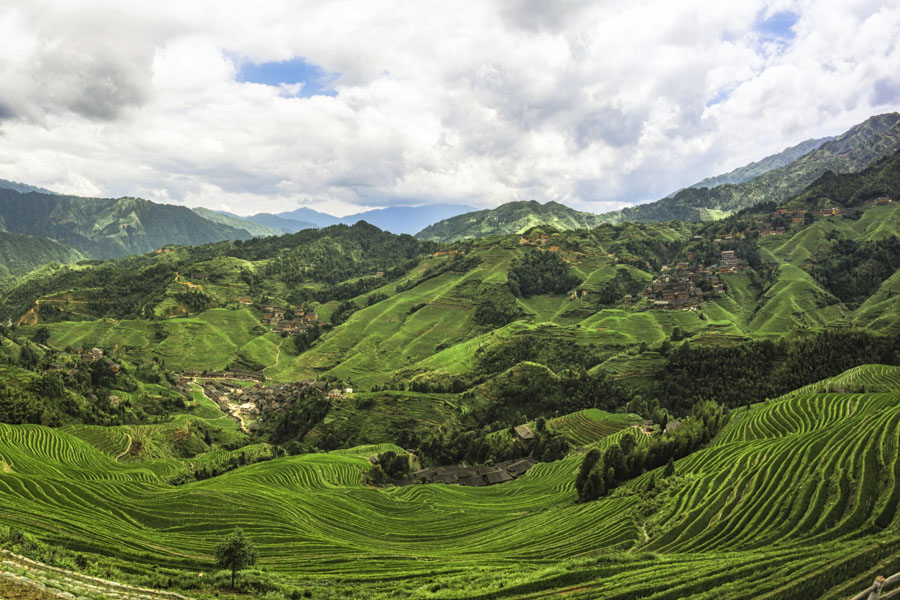
Shopping in Yao and Zhuang Ethnic Minority Villages
Gift shopping here feels closer to an encounter with local daily life than a stop at a polished tourist market. Along narrow lanes and beside village houses, residents sell food, textiles and small crafted items directly from stalls or at their doorsteps.
| Village | What to Buy |
| Longji Ancient Zhuang Village | Traditional handicrafts such as embroidery, handmade bags, textiles, bamboo goods and silver jewellery. |
| Ping’an Zhuang Village | Traditional local products known as the Four Treasures of Longji: Longji tea, Longji pepper, rice wine and glutinous rice. |
| Dazhai Yao Village | Embroidered scarves and bags, along with traditional jewellery. |
| Huangluo Yao Village | Dried wild mushrooms, wild honey, dried liquorice root, local jerky, and small gifts embroidered in the Red Yao style. And, of course, the famous shampoo with its secret recipe to look after your hair and keep it black. |
Food in Yao and Zhuang Ethnic Minority Villages
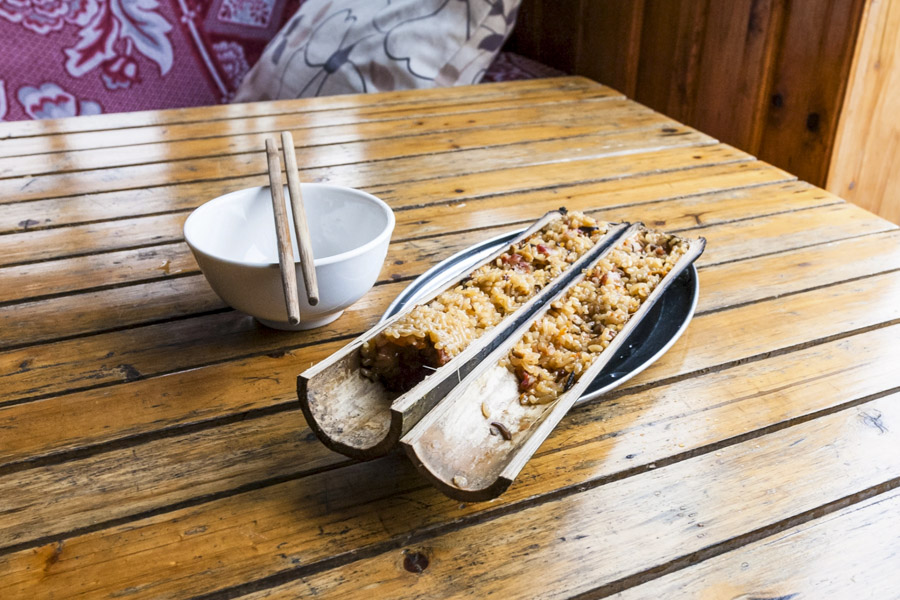
Meals in the Longsheng villages are simple, hearty and based on local produce. Rice, seasonal vegetables, poultry and freshwater fish form the basis of most dishes served in family-run restaurants and guesthouses.
Chinese Cuisine in Yao and Zhuang Ethnic Minority Villages
Some of the best-known dishes include:
- Bamboo tube rice – sticky rice cooked inside bamboo over an open flame, which gives it a light woody fragrance.
- Chicken bamboo rice – a variation made with chicken and spices, prepared in the same way inside a bamboo stalk.
- Smoked pork with rice – pork stewed with rice and mountain vegetables.
- Mountain stream fish – fish served grilled, steamed or stewed with local seasonings.
- Wild mushroom dishes – mushrooms prepared with spices, often in a sweet-and-sour sauce.
Must-Visit Restaurants in Yao and Zhuang Ethnic Minority Villages
A handful of small local eateries offer a good taste of the food served across the Longsheng villages.
- Yao Family Restaurant (瑶家饭庄), or Yaojia Restaurant, in Huangluo Yao Village serves local classics such as bamboo rice, bamboo chicken, pan-fried fish, tofu with stir-fried vegetables, and dried pork with bamboo shoots. It stands on the opposite bank from the China Long Hair Science and Technology Museum, just across the bridge over the river.
- Longji Yijing Meishe Terraced Field Restaurant (龙脊逸景美舍·梯田餐厅) sits among the terraces of Dazhai Village, overlooking the surrounding slopes. The menu features rice noodles, river fish, snails in spicy sauce and seasonal vegetables prepared in local style. It is a good place to stop for lunch after walking on the terraces. Address: No. 204, Group 3, Dazhai Village (大寨村三组204号).
- NongCun Café (Countryside Café) in Ping’an Zhuang Village offers bamboo-cooked dishes as well as lighter options such as an omelette with wild leeks, tofu dishes and fresh salads – especially welcome after a long walk. There’s a large sign saying ‘Countryside Cafe’ on the front of the building. You can’t miss it.
Transport in the Yao and Zhuang Ethnic Minority Villages
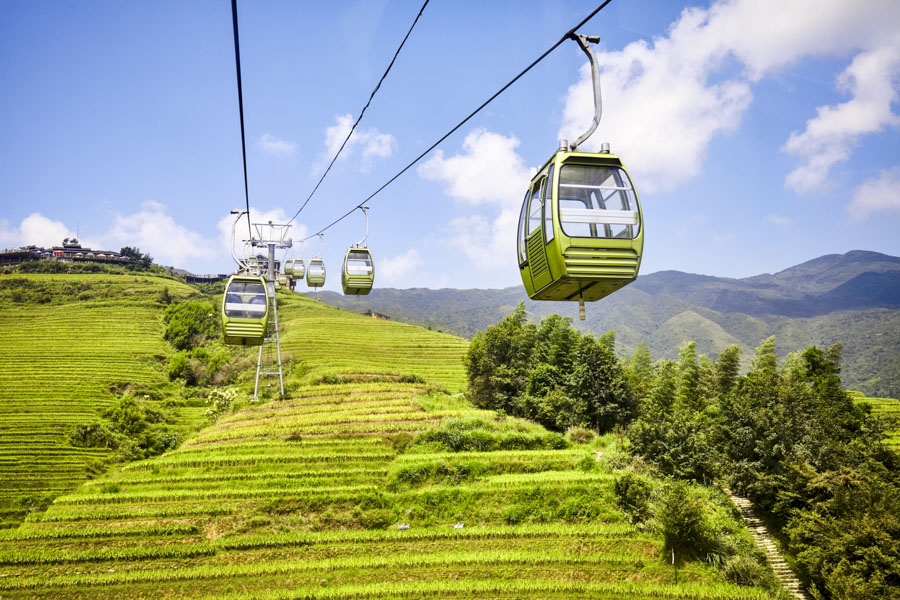
Getting around the Longji Rice Terraces area is dictated by the mountainous terrain. Vehicles are mainly used to reach the villages and trailhead; most movement within the area is on foot.
Public Transport
By bus between Ping’an Zhuang Village and Dazhai Yao Village
There is no direct route between Ping’an Zhuang Village and Dazhai Yao Village, but you can travel between them by local bus. Services run several times a day from the car parks of both villages to the entrance of the Longji Scenic Area.
The point where the two routes meet is Erlong Qiao (二龙桥), also known as Two Dragons Bridge.
The journey between the villages takes around 50 minutes.
The total fare is about CNY/RMB 20 (approximately $2.90 / €2.50 / £2.20)*, including CNY/RMB 10 (approximately $1.50 / €1.25 / £1.10)* from each village car park to the bridge.
Check the timetable locally, as services may vary by season.
Other Transport Options
Taxi
Taxis are a convenient way to travel between villages in the Longsheng Rice Terraces area. They can usually be found in the car parks near village entrances and at the scenic area entrance.
Cable Car
In the Jinkeng Terraces area, the Longji Cableway (龙脊索道) connects the car park at Dazhai Village with the Golden Buddha Peak viewpoint. The ride takes around 20 minutes and provides a quick way to reach one of the highest viewpoints without a long uphill walk.
The ride passes above the terraces, making their scale and pattern easier to grasp. With every metre of the ascent, the view shifts, opening onto new lines of the landscape. At the top, it is worth continuing on foot to follow the ridges more slowly and see how the terraces are laid across the slopes.
Sedan Chair
For visitors who find the steep stone stairways difficult, local residents offer transport by sedan chair. These woven bamboo seats are fixed securely between long poles and carried by experienced men familiar with the mountain paths. It is a practical solution for travellers with limited mobility or for anyone who would rather avoid the climb.
How to Get to the Yao and Zhuang Ethnic Minority Villages?
Reaching the villages from Guilin is relatively straightforward, though the journey takes time and offers great opportunity to discover the region.
By Bus
Public buses run either to Longsheng County or directly to the Longji Rice Terraces Scenic Area:
From Guilin North Bus Station (桂林汽车客运北站) to Longsheng Bus Station:
On arrival in Longsheng County, change to a local bus for your chosen village in the Longsheng Scenic Area. The total journey takes around 2.5 hours.
From Qintan Bus Station (桂林琴谭客运站) to Longsheng Bus Station:
After arriving at Longsheng Bus Station, continue by bus to one of the villages. The total journey takes around 3 hours.
From Qintan Bus Station to Longji Rice Terraces Scenic Area
A direct bus service runs to the villages. Journey time: approximately 3 hours.
By Taxi / Didi
Didi, the Chinese equivalent of Uber, operates in Guilin and makes it possible to travel directly to the Longsheng Rice Terraces and specific villages.
Journey time: around 3 hours, depending on traffic.
Advantage: door-to-door travel from your hotel, with no need to change vehicles.
Cost: roughly CNY/RMB 250 (approximately $37 / €32 / £27.50)* per car, plus an optional toll of about CNY/RMB 50 (approximately $7.30 / €6.30 / £5.50)*.
*Note: Prices and conversions are indicative and may change without prior notice.
It is best to secure the return journey in advance.
Ride-Sharing Options
Many travellers choose to share minivans or private cars. These door-to-door transfers are arranged for several passengers heading to the terraces at the same time. They are often more convenient than public buses and may also save time.
Trips can usually be arranged via WeChat; vehicles commonly pick up passengers from their Guilin hotel and drop them at the car park of the chosen village.
Languages Spoken in Yao and Zhuang Ethnic Minority Villages
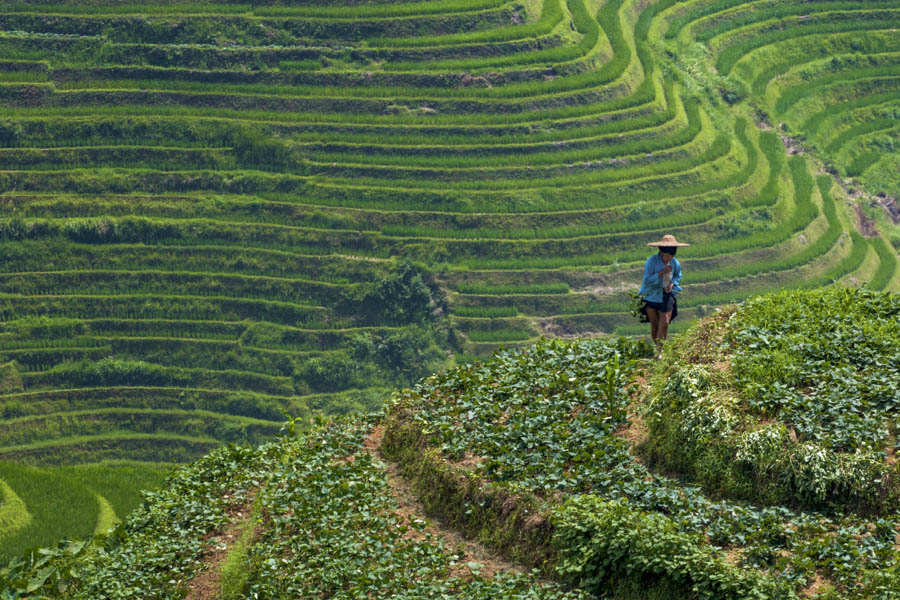
Linguistic diversity remains an important part of life in these mountain communities. Besides Standard Mandarin, local residents use regional speech varieties that are central to their cultural identity.
Dazhai and Huangluo Yao villages speak the Younian dialect (优念话), which belongs to the Northern Pinghua branch, also known as Guibei Pinghua (桂北平话), within the Sino-Tibetan language family. The dialect has many vivid locally rooted expressions. For example, a single word may describe both snoring and the sound of a drum, illustrating the way language is shaped by lived experience.
In Ping’an Zhuang Village and Longji Ancient Zhuang Village, local varieties of the Zhuang language (壮语) are spoken. These belong to the Kra–Dai language family, and local forms are often grouped under the broader label of Northern or Guibei Zhuang (桂北壮语). Standard Zhuang is tonal, with six tones, and, as in Mandarin, meaning changes with pronunciation.
English is limited in the villages. You can usually manage basic conversations in guesthouses, cafés and other visitor services, but it is not commonly used in daily life. It is worth preparing a few key phrases in translation or downloading an offline translation application before arrival.
Security
These mountain villages are generally peaceful and welcoming for travellers, though the local setting and infrastructure call for a little practical care.
Everyday Environment
These are working communities, not theme parks. Expect farm tools in courtyards, food and laundry drying outdoors, and animals in the lanes. It is best to remain aware of your surroundings, especially in narrow passages.
Wooden Buildings
As many of the buildings are wooden, basic fire safety is important. Avoid open flames outside designated areas and keep smoking well away from residential structures.
Stairs and Walkways
Steep steps and significant elevation changes are common throughout the villages. Even short distances may involve a climb, so it is wise to allow extra time and energy if you have luggage.
Communication and Access to Assistance
Mobile coverage in the mountains can be unreliable, especially in more remote parts of the villages. It is useful to save offline maps in advance, along with the address of your guesthouse in Chinese and the owner’s contact details before you explore.
Food and Water
Food is generally safe, but travellers with sensitive stomachs should choose established eateries and freshly cooked dishes. Guesthouses and restaurants usually provide bottled or boiled water.
Clothing and Weather
Pack warm layers or thermal underwear for cool mornings and evenings. Mountain weather is changeable; bring lightweight waterproofs in case of heavy rain. Also, be sure to wear comfortable shoes for walking on the terrain.