

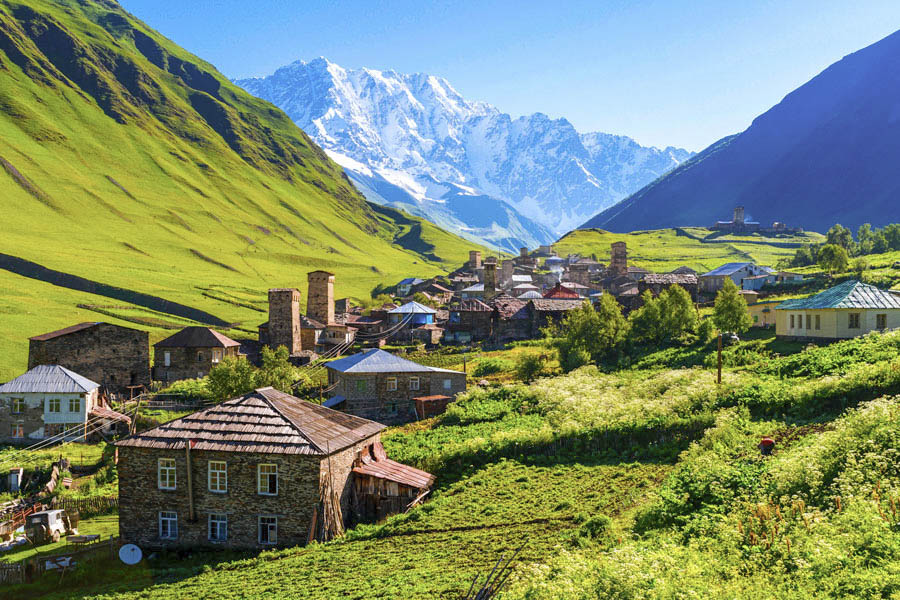
The memory-filled vacation in Georgia is found not in large hotels but in family guesthouses nestled between giant mountains that rise like ancient sentinels. Some overlook the startling slopes of Kazbegi; others are perched high above the valleys of Tusheti. Stay in one, and you will leave knowing the country differently. Its landscapes, the people, and the traditions.
Mountain guesthouses in Georgia range from simple village homes to stylish boutique properties. What they have in common is warm hospitality, homemade food, local knowledge, and a genuine sense of place. Many are run by families who have lived in these regions for generations and are eager to share stories, recipes, and advice on touring the surrounding area.
Why Stay in a Mountain Guesthouse in Georgia?
Staying in a Georgian mountain guesthouse is a chance to experience Georgia beyond its major tourist attractions. Countryside guesthouses offer a more personal introduction to local life. Hosts may recommend little-known hiking routes, prepare regional dishes using ingredients from their own gardens, or invite guests to taste homemade wine, cheese, and preserves.
The setting is just as captivating as the cordiality. Popular guesthouses sit above snow-capped peaks, in mediaeval villages amid alpine meadows, or in deep river valleys. Merely waking up to the Caucasus Mountains outside your window or enjoying dinner on a terrace can easily become the highlight of the day.
Mountain guesthouses also provide a practical base for exploring Georgia's mountain regions. From trekking and horse riding to cultural discoveries and seasonal festivals, they place travellers close to the landscapes and traditions that make the country's highlands so distinctive.
Mountain Guesthouses in Kazbegi: Views of Mount Kazbek
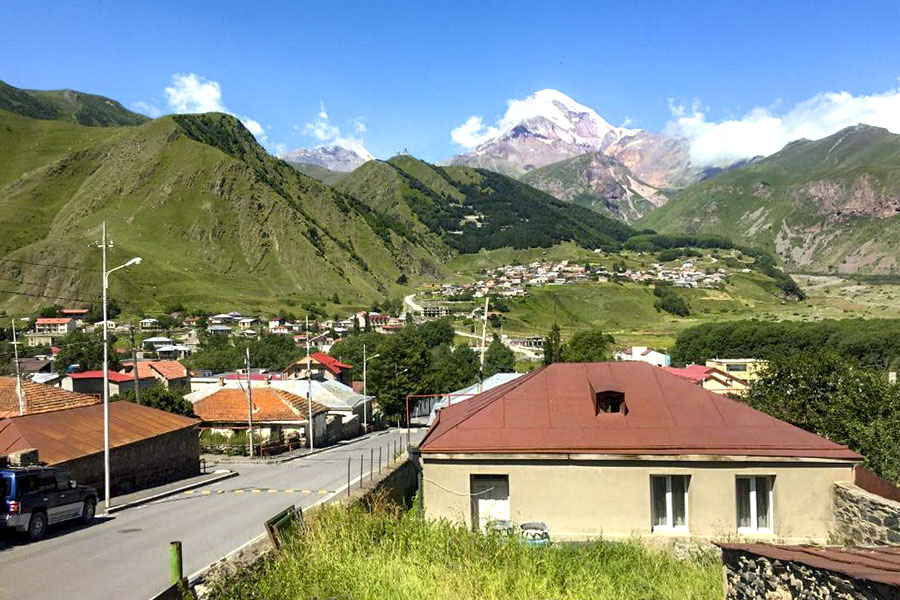
Kazbegi in the country’s north-east is one of the best destinations to visit and is home to the sought-after mountain guesthouses in Georgia. They are typically located in Stepantsminda, on the western side, where travellers can marvel at wonderful views of Mount Kazbek. For example, on clear mornings, the summit floats above the skyline; evenings, on the other hand, bring blazing shades and shifting clouds across the valley.
You can expect a warm welcome and mountain cuisine. The local khinkali are known as Mokhevuri. What sets them apart from the usual kind is that they are seasoned with thyme and onion rather than fresh herbs. Lamb dishes and the local cheese are part of the daily diet. When this arrives at dinner, a conversation over that table can stay with you longer than a day spent on the mountain.
Then, look out for wool felt-making workshops. In the old days in the mountains, wool felt was used for the nabadi (ნაბადი), the traditional wool overcoat (also known as burka). It was also used for tent coverings, bedding, and floor rugs. Wool felting in Kazbegi remains a living craft today. Local masters make accessories, clothing, and decorative objects.
Lodgings range from simple budget guesthouses to comfortable boutique-style properties. Travellers seeking traditional housing may consider options such as Shushabandi Guesthouse. And numerous other families operate hotels that offer mountain views and easy access to the area's hiking trails and natural attractions.
Return each evening to a guesthouse, where the Caucasus Mountains are never far from view. And this is the real appeal of Kazbegi.
Mountain Guesthouses in Tusheti: Georgia's Most Remote Stays
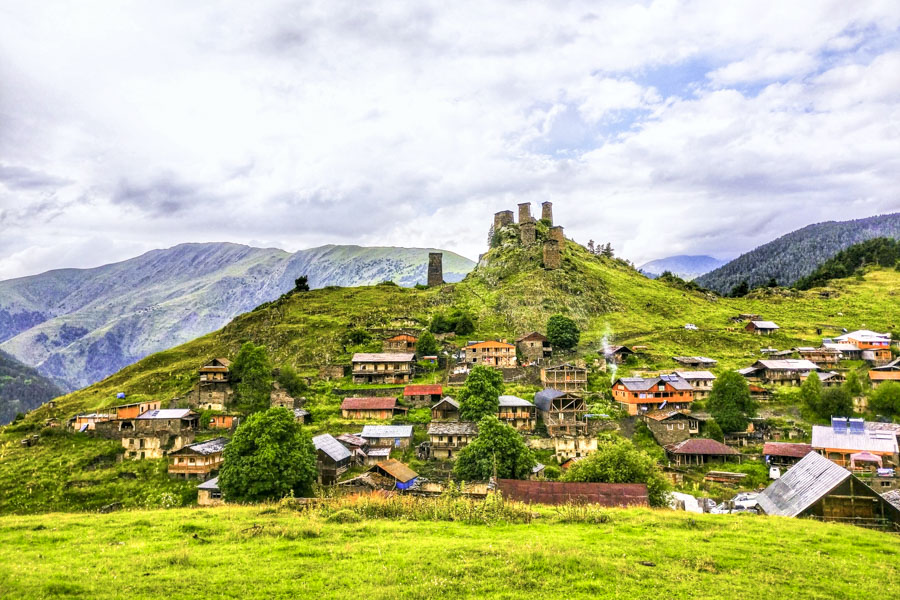
The road into Tusheti feels like climbing into the sky. The mountain ridges and alpine meadows in the higher north-east of Georgia take your breath away. So does the masonry – because how exactly did people build on these steep summits using only shale, with no mortar to hold them together?
Travellers generally stay in Omalo (ომალო), the administrative centre of Tusheti, where they find the main Georgian guesthouses: Nabadi, Shina, Lilelo, North Homestay and others. Look closely at the vernacular architecture of Tusheti, and you will notice that these are traditional stone buildings – those same dry-stone, mortar-free constructions – with wooden fretwork balconies.
From Omalo, travellers hike or drive farther into the region to the villages of Diklo (დიკლო, 10.5 kilometres / 6.52 miles away) and Dartlo (დართლო, 15.4 kilometres / 9.57 miles away). Watchtowers, ruined fortresses, the remnants of houses. No permanent residents are left today.
Tusheti surprises when you think nothing could be inhabited higher than Upper Svaneti. The tiny village of Bochorna (ბოჭორნა) rises at 2,345 metres above sea level and is possibly the highest inhabited settlement in Georgia. From Bochorna, you can see Dochu (დოჭუ), at 2,050 metres. A few dozen houses clustered on a slope so steep that each building sits at a different level than the one beside it. According to historical sources, the people of Dochu were the ones required to spot an approaching enemy first, engage them, and die, buying time for the villagers below. The houses are still there, but nobody lives in them now.
Twenty-eight kilometres from Omalo, the village of Tsaro (წარო) holds an ancient crypt, a national heritage site. The traces of antiquity are at every turn.
Visit a shepherd family in Tsovati Gorge (წოვათის ხეობა) if you can and learn about their daily life. Try gudi (გუდი), the Tushetian cheese; kaurma (კაურმა), the meat dish; gordila (გორდილა), boiled dough; and khavitsi (ხავიწი), cheese cooked with cornmeal and wheat flour in clarified butter.
While you are staying in a guesthouse, ask about the bridal dress. Ethnographer Nugzar Idoidze notes that women were married in dark colours – and frequently in black. The male mortality rate in Tusheti was high for many centuries, so the wedding dress – ubianebi (უბიანები) – was a form of advanced mourning. Such were the customs of a place where even celebrations carried the weight of what came before.
Mountain Guesthouses in Svaneti: The Tallest Peaks in Georgia
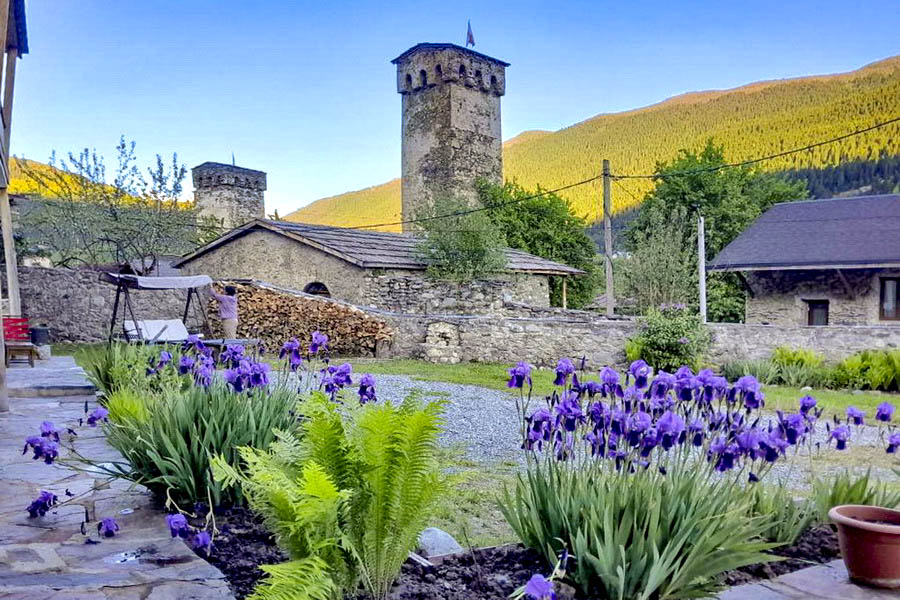
You arrive by marshrutka along roads that cling to the edge of gorges or by a small plane that drops into Mestia between the peaks of the north-western Greater Caucasus. And from the moment you step out, you are aware that this place is special. The towers tell you that immediately. There are more than three thousand of them still standing across Upper Svaneti. Some date back to the ninth century. Staying in a mountain guesthouse here means waking up inside that history every morning.
Svaneti guesthouses are usually family-run. Rooms are simple. Walls are thick stone. In the evenings, your host will likely bring out kubdari (a local meat pie) alongside chacha (a Georgian brandy) distilled somewhere on the property. Conversation tends to happen through gestures, shared food, and the occasional translated phrase from a teenage daughter who learnt English at school in Mestia.
This is also where the stories come out. If you ask the right questions – or sometimes if you just sit long enough – you will hear things that do not appear in any guidebook.
You might learn about the mahvshi (მახვში), the community leader who implemented the Christian rules in life, settled disputes between families and, in times of war, led the village's fighters. Or you might end up talking about Lamproba, the spring festival held on 1 February, in which torches are lit across the hillsides. Here, the versions multiply. And nobody seems to mind. Some say the fires were a way of counting potential warriors: one torch per fighting man. Others say they burn for the dead, to warm the souls of ancestors through the last of the winter. The official version, however, links the festival to prosperity – increasing the harvest, livestock and population – and to prayers for good weather.
The villages beyond Mestia, such as Ushguli, are among the loftiest continuously inhabited settlements in Europe. The families who host there do so because it is one of the few reliable sources of income in a village that electricity only reached in recent decades. That context changes how a stay feels. You are not a tourist passing through. You are a guest in the older sense of the word.
Mountain Guesthouses in Racha: A Quieter Alternative
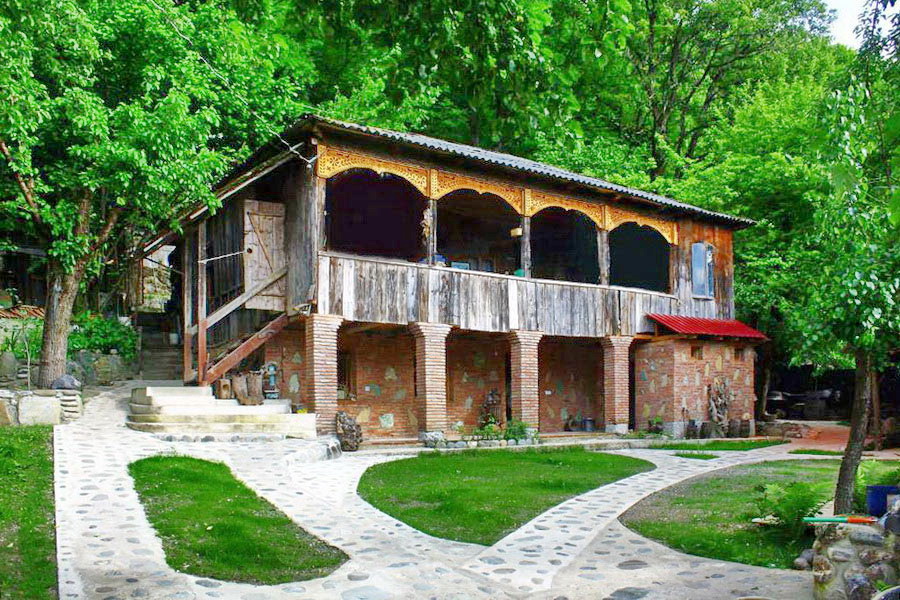
Unlike Kazbegi and Svaneti, Racha receives relatively few foreign visitors. Georgians seem to keep it for themselves. The region is picturesque in spring, summer and autumn – especially in autumn colours. And unlike Tusheti, Racha is easy to reach. A kind of middle ground, tucked between Upper Svaneti and South Ossetia of northwestern Georgia, perfect for a quiet holiday.
The main town of Oni (ონი) has hotels, but staying in a Rachan guesthouse is the chance to sleep in an oda (ოდა), a century-old wooden carved house. Gallery Guesthouse in the centre of Oni is one such place – restored, but a vivid example of the wooden architecture that is slowly vanishing from the region; the locals are working hard to preserve and bring it to visitors' attention. These oda houses are closed to the public. For now, while they still stand, travellers have a unique opportunity to see them.
The Kolkhian oda emerged in the second half of the nineteenth century across Racha, Samegrelo, Guria and parts of Adjara. Today, they survive in the municipalities of Oni and Ambrolauri. For instance, in the village of Gogolauri (გოგოლაური), four houses are brick. The rest are wooden, beautiful, and visible from the road. Look at the balcony arch carved with leeches, rams, vines and fantastical birds – ornaments the owner believed would ward off bad luck.
And of course, as in any mountain guesthouse in Georgia, everything here is homemade – including the wine. Lower Racha has a long tradition of winemaking. Yet do not pass through Racha without seeing oda because these houses are masterpieces of Georgian folk architecture.
Mountain Guesthouses in Adjara Highlands
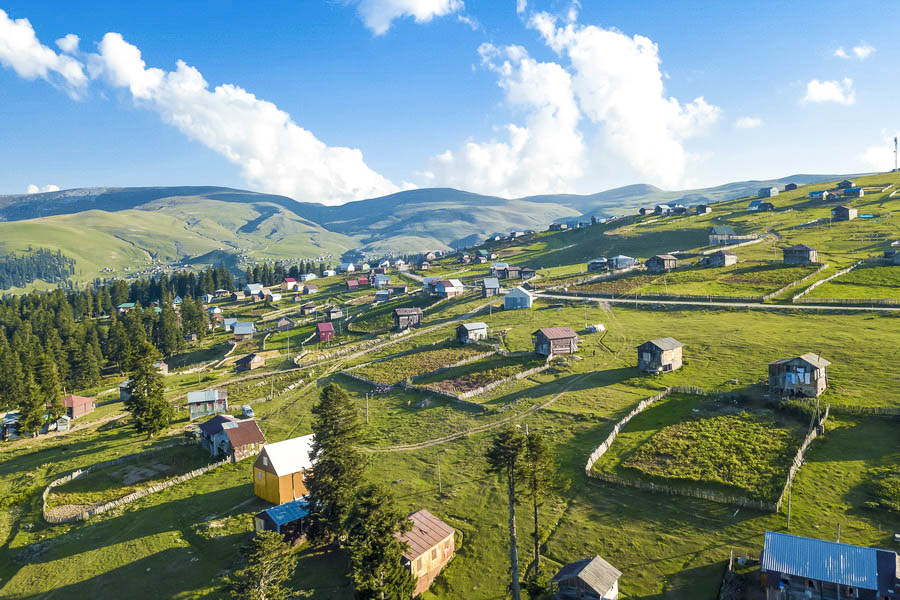
Visitors to Adjara in south-western Georgia often stay in comfortable hotels in Batumi and go no further than the sea and the beach. But a family guesthouse in the Adjara highlands without modern comforts and technology is four things at once: stunning nature reminiscent of a rainforest, an introduction to local customs, access to astonishing sights, and regional food.
A week based in the Georgian family guesthouse in Shuakhevi (შუახევი, about 70 kilometres / 43.5 miles from Batumi) or Khulo (ხულო, about 88 kilometres / 54.68 miles from Batumi) puts everything within reach: Kintrishi and Mtirala National Parks, Machakhela Gorge, Mount Chirukhi, Merisi Gorge and its waterfalls, the Beshumi Resort, and the Green Lake. The 300-year-old Khabelashvili wooden bridge alone is worth the journey.
But the most extraordinary thing is getting to know people along the way. Travellers consistently remark on the Adjaran hospitality. Ask for directions walking through a village, and you will likely be invited in for coffee before you have finished the sentence. If there is a newborn in the house, they may pass a burning matchstick around you before you cross the threshold to protect the child from the evil eye. This is how you become acquainted with local traditions. And a guest is always an occasion for the people here.
Make sure you visit the Chirukhi summer yayles (ჩირუხის საზაფხულო იაილები) – wooden huts on alpine meadows among conifer-covered mountains wrapped in mist. The ambience is mystical. From early May, livestock herders move here with their families and stay until autumn. It is a rare chance to spend time with them because nothing spells belonging as much as sharing a meal with kind locals.
Then there is the highland cuisine. Borani (ბორანი), sinori (სინორი), kaimagi (კაიმაღი) – and, surely, Adjarian khachapuri, the boat-shaped one with the egg.
A guesthouse in this part of Georgia is a way to see an entire region. More than that, it is a way to meet its people.
Mountain Guesthouses in Guria: Georgia’s Forgotten Corner
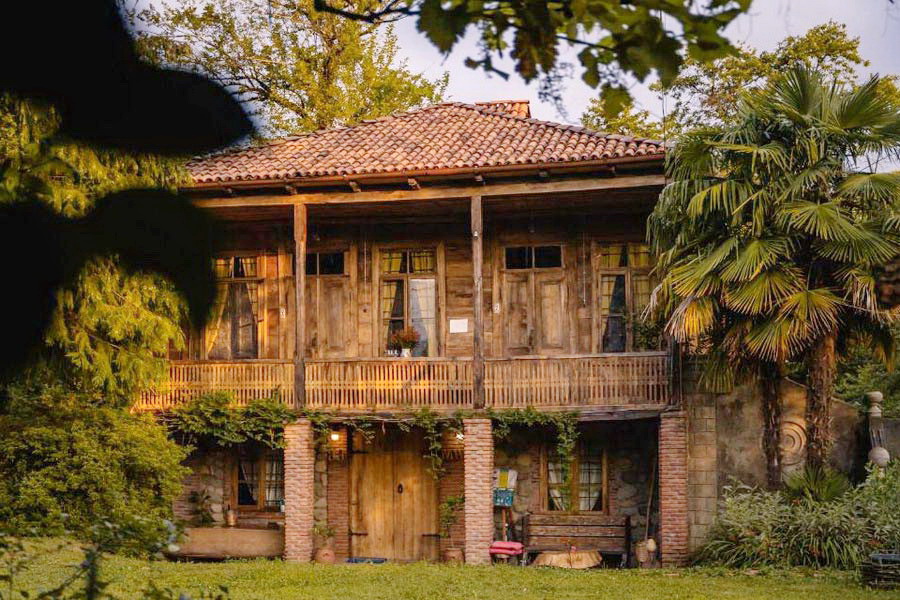
Tourism in the Guria highlands is less developed than in other parts of Georgia. Yet there are a handful of Georgian guesthouses for travellers exploring this unnoticed corner of the country. Menabde Winery, in the village of Shemokmedi, is a 2-hectare organic farm producing Chkhaveri and Sakmiela grape varieties and also includes a restaurant where the wine produced there can be tasted. And Komli Rustic Historic Guest Farmhouse in Tsitelmta is on the Tea Route of Western Georgia and is ideal for enjoying ecotourism. Those guesthouses are two of the best. Part of their charm lies in the fact that both are housed in traditional oda buildings mentioned earlier. Stay at Menabde, and you will get a glimpse into traditional Gurian life.
Guria is situated in western Georgia between the Caucasus foothills and the Black Sea coast. Cool forests, mineral waters, alpine meadows, and sandy beaches are all within the same region.
Perhaps the best time to visit mountainous Guria is around 19 August. That is the date of the doghi (დოღი) – a riders' festival held in Bakhmaro, a mountain resort village at 1,950 metres above sea level. The festival wraps up with horse races, and riders come from across Georgia to compete. Horses have long held a special place in the culture of this region. Georgian horse riders made a name for themselves as far away as the American West in the early twentieth century. This is the real thing for anyone drawn to living folklore.
Guria's cuisine is another pleasant surprise. The regional bean dish, cooked in a clay pot called ketsi (ლობიო კეცზე), is outstanding – and always eaten with mchadi (მჭადი), cornbread flatbreads. There are local wine and tea plantations. You will find a Georgian tea brand, Gurieli (გურიელი), in almost every supermarket in the country.
Whether you are planning your first trip to Georgia or your fifth, a night in a mountain guesthouse changes what the country means to you. Book early for Tusheti, where the season is short. Everywhere else, the door is open longer than you might expect.