

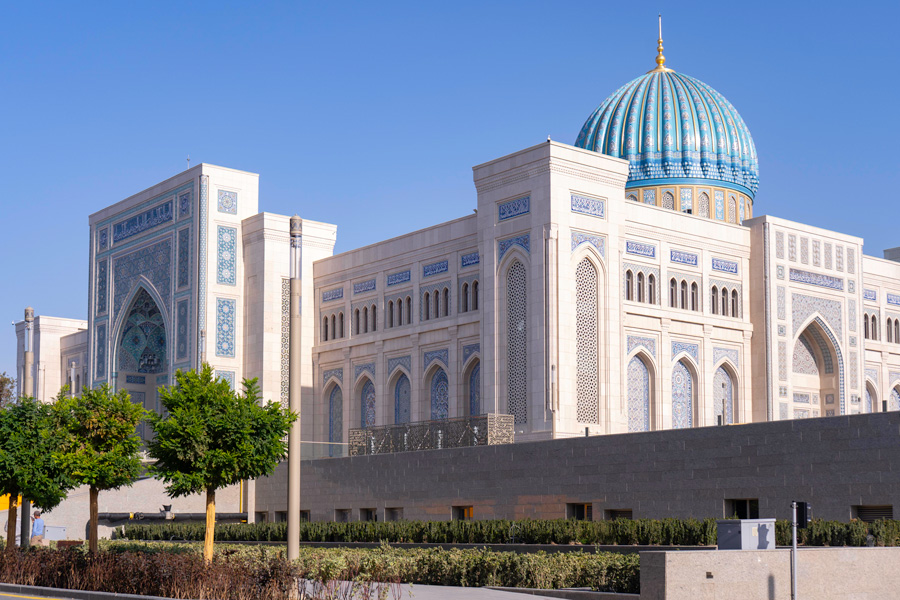
Address: 47 Karasaray St., Almazar District, Tashkent
Phone: +998 97 122 71 54
Hours: Open daily from 10:00 to 22:00
The Islamic Civilization Center in Tashkent stands among the most ambitious recent architectural and cultural projects in Central Asia. Created as a national centre for presenting Uzbekistan’s religious, historical and cultural heritage, it brings together scholarship and advanced museum technology. Digital interpretation and elements of artificial intelligence are used not as spectacle, but to clarify context and widen access to the country’s Islamic legacy.
The complex rises in the heart of the old city, beside the Khast-Imam ensemble – a site that has drawn Muslim pilgrims for centuries. This setting is deliberate. Placed next to one of Tashkent’s most revered historic quarters, the Center enters into a quiet conversation with its surroundings – where scholarship meets living faith, and renewal stands beside memory.
History
Uzbekistan is a secular state, yet most of its population are Sunni Muslims. Islam reached this region in the 8th century and, over the course of more than a millennium, shaped a remarkably rich cultural landscape. Architectural monuments, manuscript traditions, and the works of scholars, artists and craftsmen all emerged within this context. Many of the country’s enduring customs and social traditions developed under its influence, forming patterns of thought and daily life that remain visible today.
The Islamic Civilization Center was created to preserve, study and present this legacy in a coherent and accessible way. The initiative was proposed by the President of the Republic of Uzbekistan, Shavkat Mirziyoyev. A symbolic foundation stone was laid on 15 June 2018, during the festival of Ramadan Khait. Construction continued for almost eight years and involved around 4,000 specialists – a scale that reflects the ambition of the project. According to publicly available information, the cost is estimated at US$150–160 million.
The development of the Center’s academic concept brought together hundreds of Uzbek and international scholars, art historians and religious figures. In the years leading up to its opening, a substantial collection was assembled. It includes archaeological finds dating back some 80,000 years, alongside rare manuscripts, works of art and sacred relics, many regarded as invaluable.
Of particular significance is the Usman Quran – also known as the Osman Quran or the Samarkand Kufic Quran – an early manuscript traditionally dated to the 7th century. Previously housed in the Muyi Muborak Madrasah of the Khast-Imam complex, it has now been transferred to the Center, where it serves as the principal focal point of the Quran Hall. In the interest of preservation, visitors may not approach the manuscript closely or photograph it directly; however, the hall features numerous copies and multimedia materials allowing the history and character of the manuscript to be explored in depth.
Architecture and Design
The architectural concept brings together traditional forms and contemporary engineering. Its visual language draws on the great historic cities of Uzbekistan, echoing their proportions, ornament and spatial logic while interpreting them on a monumental modern scale.
The building is defined by four themed portals, each rising to approximately 34 metres (112 ft). The principal eastern portal references the Ulugbek Madrasah on Registan Square in Samarkand, with its commanding façade and measured geometry. To the west, the portal reflects the architectural character of Bukhara’s religious monuments. The northern entrance weaves together artistic traditions associated with Khiva, Shakhrisabz and Karakalpakstan, while the southern portal takes inspiration from Kokand, Tashkent and Termez. Together, they form a carefully composed architectural map of the country.
Above the main hall rises the central dome – the visual and symbolic focus of the ensemble – reaching a height of more than 60 metres (197 ft). Its scale anchors the structure within the skyline of the old city, while also recalling the long-standing importance of domed space in Islamic architecture.
The interior extends over more than 40,000 square metres (430,500 sq ft), while the surrounding grounds cover some 10 hectares (24.7 acres). It is in these landscaped areas that the architectural narrative continues. The gardens draw inspiration from those associated with Amir Timur, the 14th–15th-century ruler whose court fostered monumental architecture and refined landscape design. Historical sources describe a series of carefully planned gardens created under his patronage. The Center plans to recreate miniature versions of nine of them, preserving their historical names and layouts, so that the grounds echo a tradition of formal garden design deeply rooted in the region’s past.
Exhibition Halls
The principal exhibition spaces are arranged on the first floor, where the narrative unfolds in chronological order.
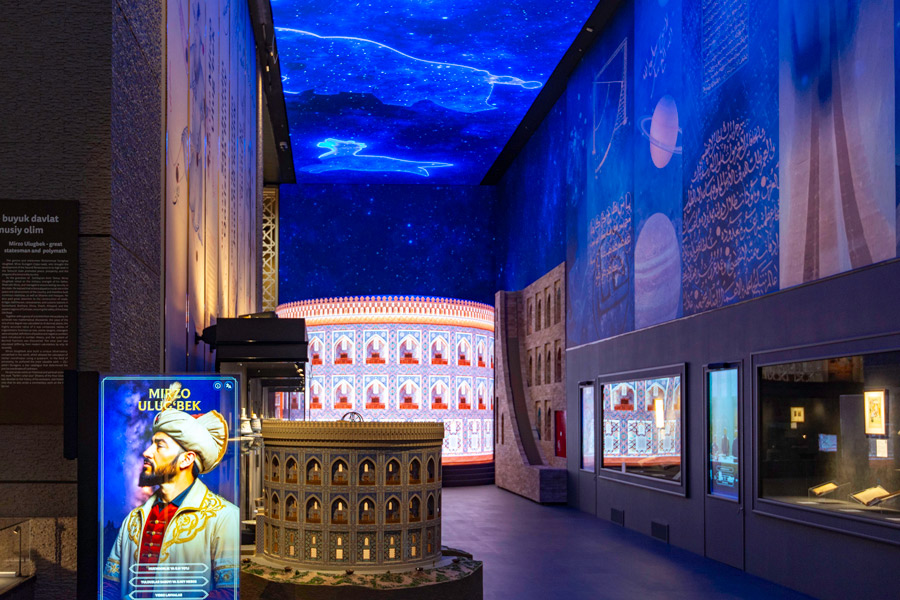
Visitors begin with the pre-Islamic heritage of the region – from ancient times to the 7th century AD – before moving into the period often described as the First Eastern Renaissance of the 8th to 13th centuries, a flourishing era of scholarship and scientific inquiry. The route then continues into the Second Renaissance of the 14th to 16th centuries, an era associated with major advances in science, art and statecraft. The final section turns towards modern history, presented under the concept of “New Uzbekistan” and the idea of a new cultural renaissance.
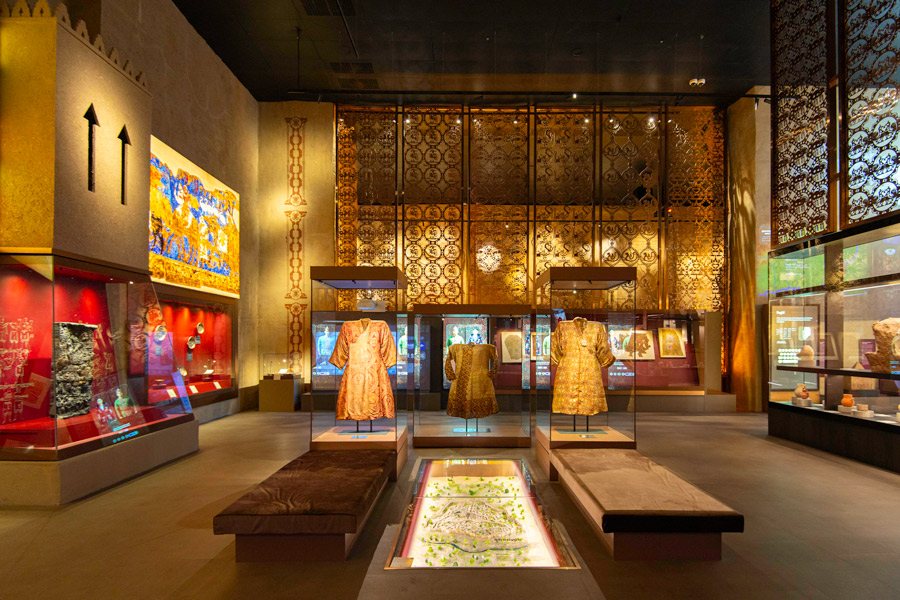
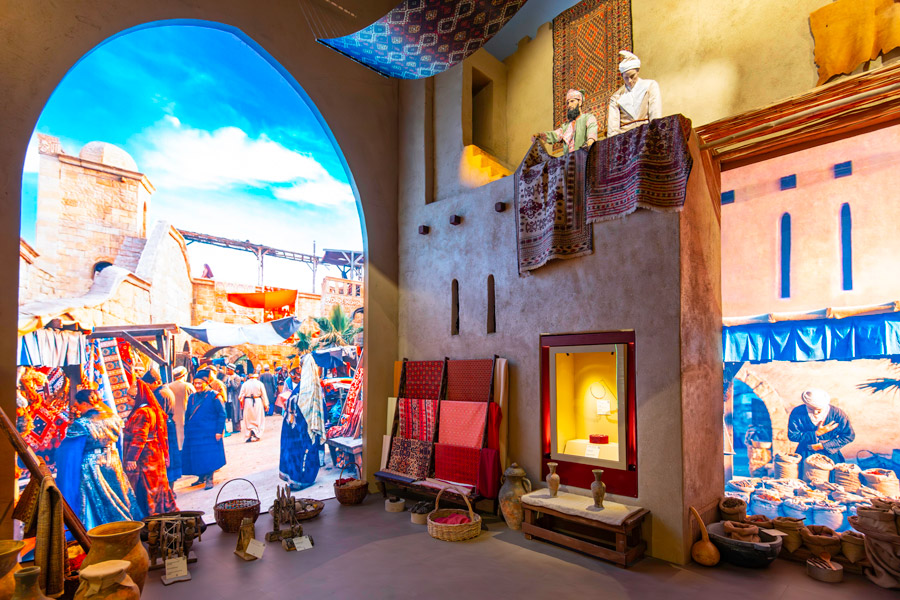
Throughout the galleries, traditional displays are complemented by advanced museum technologies. Immersive installations, multilingual LED screens, and digital reconstructions of historic buildings place artefacts within their original settings. Animated portraits of past scholars – created with the help of artificial intelligence – help visitors follow the story behind the objects on display.
Visitors can also explore virtual exhibitions, interactive “time capsules” and educational laboratories designed for deeper engagement. One of the most notable features is an interactive map of the Silk Road – the vast trading network that functioned for over 1,500 years and played a formative role in the economic, scientific and cultural development of the region. Here, trade routes appear as visible arteries of exchange rather than abstract lines on a map.
On the second floor, a 460-seat conference hall supports academic events and public lectures. Nearby are a reading room and a substantial library housing tens of thousands of volumes, including rare manuscripts. The lower level contains a children’s museum, where cultural heritage is presented in formats designed to be accessible and engaging.
The interiors are enriched by the work of Uzbek master craftsmen. Carved wooden doors and furnishings, ganch decorative elements (ganch – carved ornamental plasterwork), ceramics, embroidery – including suzani – calligraphy and miniature painting bring texture and continuity to the spaces. Together, these details ensure that the building’s contemporary scale remains grounded in established artistic traditions.
Hall of Fame Gallery
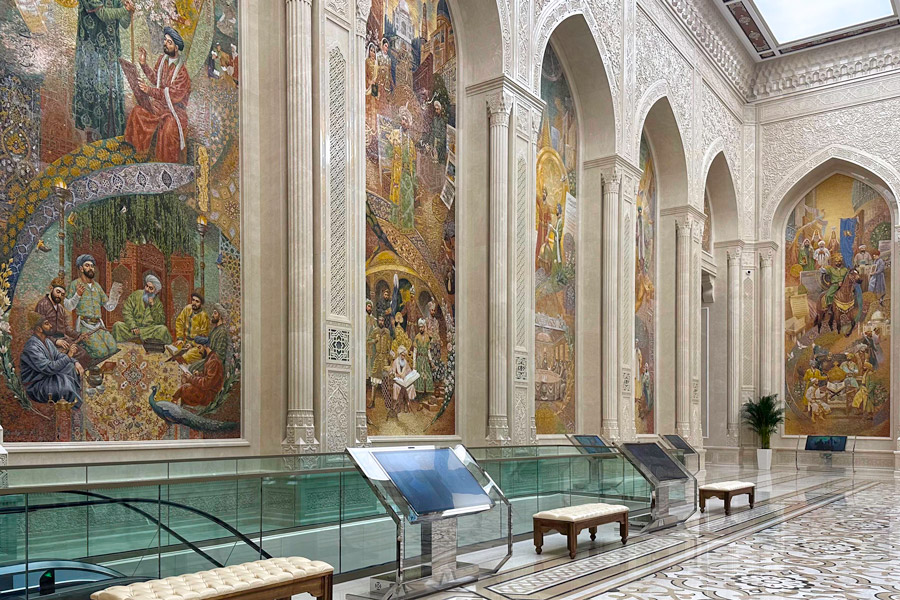
The Hall of Fame Gallery occupies a spacious hall on the ground floor, where most visitors begin their exploration of the Islamic Civilization Center. Designed in a restrained palette of light tones, the space sets a calm and dignified atmosphere. It is dedicated to the great scholars and thinkers of the Islamic world whose work shaped intellectual history far beyond the region.
Among those represented are Avicenna (Ibn Sina), the physician and philosopher; Al-Khwarizmi, whose writings laid foundations for algebra; Al-Biruni, the polymath and observer of the natural world; and Al-Farabi, the philosopher often described as the “Second Teacher” after Aristotle. Their achievements in medicine, mathematics, philosophy and the sciences are presented as part of a shared scholarly tradition that flourished across Central Asia and the wider Islamic world.
These historical figures appear on monumental mosaic panels that line the walls. Executed on an impressive scale, the compositions draw attention for their technical complexity. According to the Center’s curatorial materials, the technique used has no direct equivalent elsewhere in Central Asia, underscoring the gallery’s intention to combine homage with artistic innovation.
The Holy Quran Hall
Covering around 1,200 square metres (12,900 sq ft), the Holy Quran Hall is conceived as the spiritual and symbolic centre of the complex. It is here that the original Uthman Quran is displayed – one of the oldest surviving manuscripts of the Quran, traditionally dated to the 7th century and associated with the third caliph, Uthman ibn Affan. According to long-standing tradition, the caliph was killed while reading the sacred text, and marks believed to be his blood are said to remain on its pages.
Following Uthman’s death, the manuscript is recorded in various sources as having been kept in Kufa, Baghdad and Damascus. A widely accepted account holds that in the late 14th century Amir Timur transferred the manuscript from Baghdad to Samarkand. It remained there – housed for a period in the Bibi-Khanym Mosque – until the 19th century, when it was sent to St Petersburg. In 1924 it was returned to Tashkent, where it has since been preserved. Today, the manuscript is inscribed on UNESCO’s Memory of the World Register, reflecting its global historical significance.
The hall itself is designed on a monumental scale. Above the location where the manuscript will be installed hangs a vast chandelier weighing approximately 50 tonnes. It is set with around 1.6 million Swarovski crystals, creating a carefully controlled interplay of light across the space. The walls are clad in pink Portuguese marble, and large handwoven silk carpets display verses from the Uthman Quran woven directly into their design.
Alongside the manuscript, the hall presents other handwritten copies of the Quran dating from the 10th to the 18th centuries. Together, these works trace the evolution of calligraphic style and manuscript tradition across centuries, placing the celebrated relic within a broader and deeply rooted scholarly heritage.
The Collection
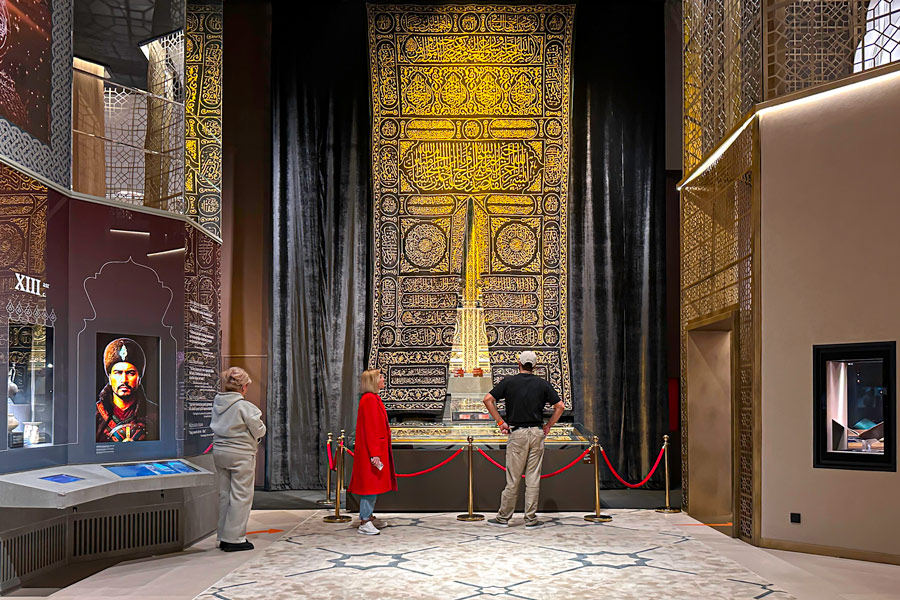
At the heart of the museum complex lies its collection – a carefully assembled body of religious relics, archaeological discoveries, works of art and rare manuscripts that together trace the intellectual and spiritual history of the region.
A number of objects have been transferred from leading museums across Uzbekistan. Others, historically connected with Central Asia, have been acquired by the state at international auctions or provided through collaboration with foreign institutions. Where original artefacts remain abroad, high-precision scientific replicas have been produced using modern technology, allowing visitors to encounter works otherwise beyond the country’s borders.
Among the religious relics, particular attention is drawn to a fragment of the kiswa, the ceremonial cloth that covers the Kaaba in Mecca. The example displayed here dates to 1859 and was commissioned during the reign of the Ottoman Sultan Abdulmejid I. The exhibition also includes historic keys to the Kaaba, dating from the 13th century, presented as rare survivals of Islamic ceremonial craftsmanship.
The Hall of Pre-Islamic Heritage introduces a far deeper chronological horizon. Archaeological finds illuminate tens of thousands of years of human presence in Central Asia. Among the most significant are stone tools and arrowheads dating back approximately 80,000 years, discovered at the Obi-Rahmat site – among the earliest known traces of human activity in the region. Gold jewellery and artefacts from the 1st millennium BC, associated with the culture of ancient Bactria and formerly held in the United Kingdom, reflect the sophistication of early civilisations.
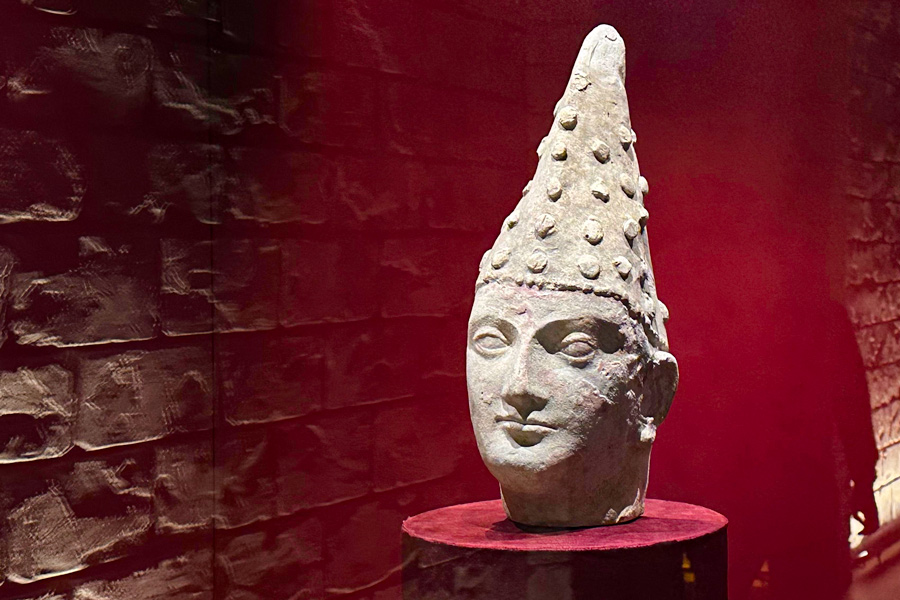
Also on display is the well-known “Head of the Kushan Prince”, dated to the 1st–2nd centuries AD and unearthed in the 20th century at Dalverzin-Tepa in Surkhandarya. It has become an emblematic image of early artistic achievement in what is now Uzbekistan. Nearby stands a striking sculpture of a deer, around 3,000 years old (1st millennium BC). Long preserved in private collections in the United Kingdom, it recalls ancient beliefs of the peoples of Turan, for whom the deer symbolised abundance and vitality.
The First Renaissance Hall presents artefacts from the flourishing intellectual culture of the 8th to 13th centuries. Ancient coins, finely crafted objects and architectural models offer material context, while manuscripts occupy a central place. Among them is a copy of Imam al-Bukhari’s Al-Jamiʿ as-Sahih (“The Authentic Collection”), one of the most authoritative compilations of hadith included in the Kutub al-Sitta (“The Six Books”). Also exhibited is a 17th-century manuscript of Al-Farabi’s philosophical treatise Ara Ahl al-Madina al-Fadila (“The Virtuous City”), reflecting the enduring transmission of classical thought.
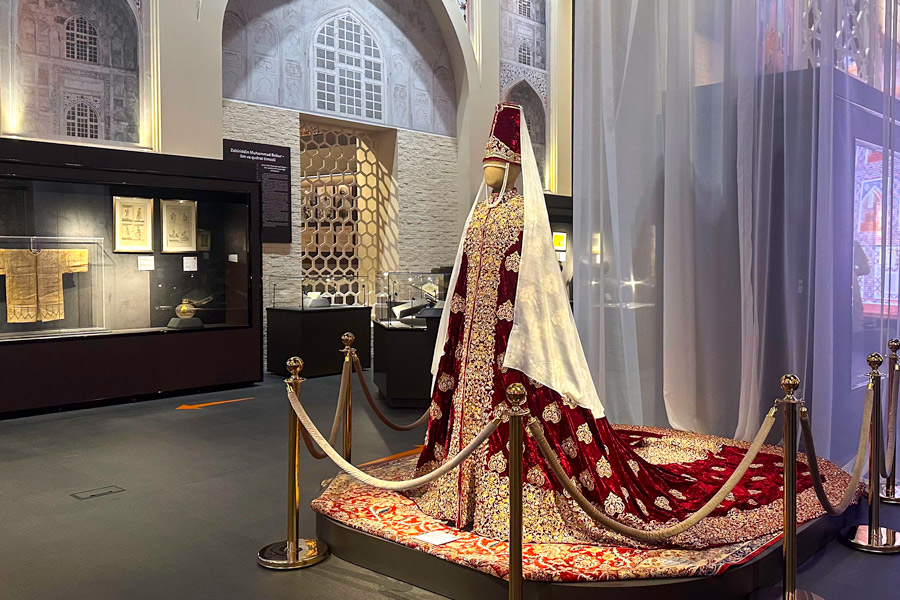
The Second Renaissance Hall turns to the era of Amir Timur and the Timurid dynasty. Exhibits from this period include the 14th-century “Turkmen Decree of Amir Timur”, a silk chapan from the first half of the 15th century, and original miniatures from the 15th–16th centuries created in Bukhara and Shiraz. These works represent the refinement of Eastern miniature painting – an artistic tradition recognised by UNESCO as part of the intangible cultural heritage of humanity – and provide a visual counterpart to the political and cultural ambition of the Timurid court.
Research and Education
The Islamic Civilization Center functions not only as a museum, but also as a research and educational institution. Its scholarly departments focus on the study of manuscript heritage, the history of Islam in Central Asia, and the restoration and digital cataloguing of rare sources. In this respect, the building is conceived as a working academic space as much as a public exhibition venue.
The complex also includes offices for international organisations such as UNESCO, ICESCO, TURKSOY and IRCICA. Joint educational initiatives are planned in cooperation with these partners, including the establishment of a school of oriental miniature painting with the participation of TURKSOY – a project intended to support the continuation of traditional artistic practice.
Visitor Experience
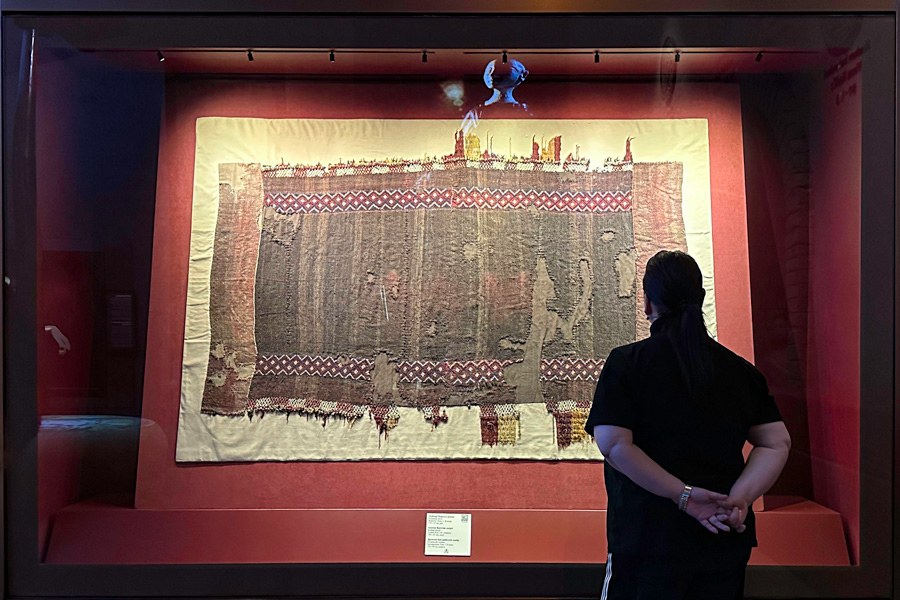
For visitors, the experience extends beyond viewing artefacts in display cases. Immersive halls and multimedia installations allow guests to move through digital reconstructions of historic Uzbek cities, while interactive screens present scientific discoveries in the voices of the scholars themselves – recreated through digital technologies.
Among the more hands-on features are virtual archery simulations and an installation demonstrating how air is fed into a traditional tandoor oven using bellows. In the “New Uzbekistan” gallery, visitors can interact with Humo AI, a digital assistant designed to answer questions about the Center and the broader history of the country.
After exploring the exhibition spaces and library, many visitors pause at the on-site café or browse the museum shop. In the evening, a holographic light show is projected onto the façade of the building, offering a visually striking conclusion to a visit – and reinforcing the Center’s ambition to present heritage through contemporary means.
Visitor Information and Rules
- As of April 2026, visits to the Islamic Civilization Center in Tashkent are usually organised as guided group tours. A standard tour lasts around two hours, and movement through some areas may be regulated to manage visitor flow.
- Tickets are issued for a specific time slot and are valid for one person only, with no re-entry on the same ticket.
- Visitors are advised to dress modestly. Exhibits should not be touched without permission, flash photography is not allowed, and independent third-party tours require prior approval.
- Visitors are also not allowed to bring their own water or drinks inside the centre, but bottled water can be purchased on site.
- Backpacks should be left at the entrance; storage lockers are provided for visitors.