

When the bright, brassy call of the karnay and surnay (traditional ceremonial wind instruments) rises above a neighbourhood – a mahalla – and the steady rhythm of the doira, a traditional frame drum, carries through the streets, everyone understands at once: there is a wedding today. An Uzbek wedding, known as nikoh-tui, announces itself in sound long before the guests gather.
Music, in this tradition, is more than celebration – it is invitation. According to long-standing custom, anyone who heard the instruments was considered welcome. In rural areas especially, this understanding still holds. A passer-by may be ushered in as an honoured guest. A wedding in Uzbekistan has never been solely a private family occasion; it is a community event, shared with relatives, neighbours and friends.
Family and Marriage in Uzbek Culture
In Uzbek culture, the family has long been regarded as the foundation of social life. Respect for elders shapes daily conduct, and important decisions are often discussed at family councils known as maslahat.
Historically, two types of family structure prevailed: small and large. A small family consists of a husband, wife and their children – today the most common arrangement. In earlier generations, however, large families played a central role. Known as katta oila or bir qozon (“one cauldron”), they typically brought together three generations under one roof, sharing household duties and resources. Such households can still be found, where parents, married sons and grandchildren live side by side.
Because family ties are considered fundamental, marriage marks a decisive stage in life. It is understood not simply as the union of two individuals, but as the joining of two families. An Uzbek wedding publicly affirms this new bond and unfolds through a sequence of rituals lasting several days, each rich in symbols of prosperity, continuity and respect.
The Nikoh-Tui Ceremony
Nikoh (or nikah) is the Islamic marriage ceremony, comparable in its religious significance to a church wedding. During the ritual, a prayer known as the khutbai nikoh is recited, from which the ceremony takes its name. In some cases, the religious rite and the festive celebration are held on the same day; in others, the nikoh is performed earlier, followed later by a large public banquet.
The nikoh usually takes place at the bride’s parental home. The groom, the mullah and other male relatives sit in a circle, with a bowl of water – nikoh suvi – placed in the centre. As the imam recites the prayer, he outlines the rights and responsibilities of both spouses. Particular emphasis is placed on the groom’s duties: he is expected to provide for his wife’s well-being, to treat her with care and not to abandon her for extended periods. After the prayer, the couple drink from the bowl of water, sealing their union before both community and faith.
At the same time, a quieter ritual may unfold. An elderly woman, traditionally one with many children, discreetly stitches a white thread into the groom’s robe and another into the bride’s clothing. The gesture symbolises the intertwining of two destinies and the hoped-for strength of their bond.
In the past, particularly in rural areas, marriages were often conducted solely according to religious custom, without civil registration. Today, the mullah will usually request proof of official registration before performing the nikoh.
Preparing for an Uzbek Wedding
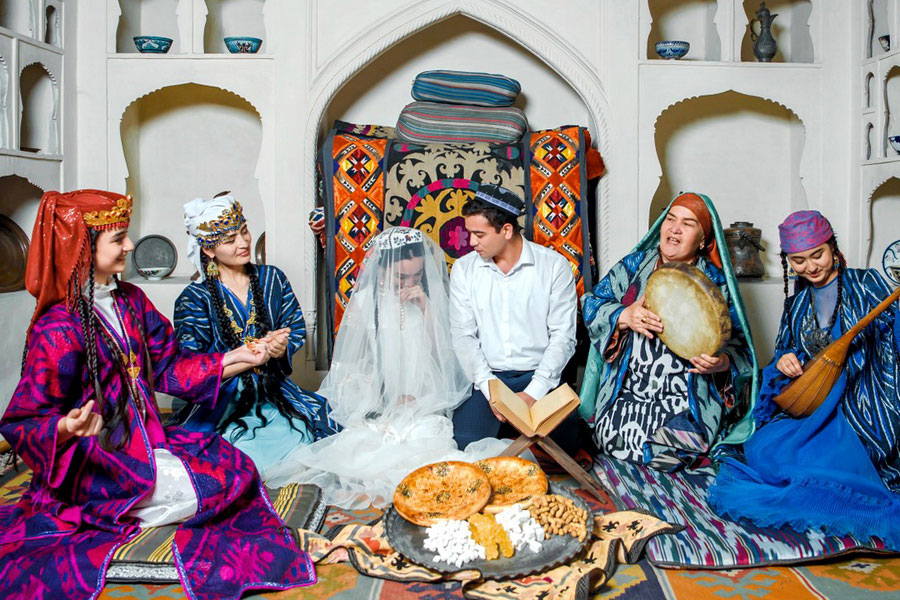
The wedding cycle begins with matchmaking and engagement, known as fatiha-tuy. From that moment, preparations for the main celebration may continue for several months.
After the engagement, the bride becomes fatiha qilgan qiz – a betrothed girl – and the groom’s family begins to show care and goodwill. Gifts and sweets, known as shirinlik, are regularly sent to her home, symbolically wishing her a sweet married life.
Before the wedding, a maslahat is held at the groom’s house. During this family council, financial readiness is assessed and responsibilities are distributed among relatives and members of the mahalla. Traditionally, the groom’s family might build a new house for the couple or at least renovate a room to prepare for their future life together.
Meanwhile, the bride’s family assembles the dowry, called sarpa. This includes carpets, embroidered textiles, blankets, pillows, fabrics, clothing, shoes and jewellery. In earlier times, many of these items were handwoven and embroidered over years by several generations of women. Today, most pieces are purchased, yet they are chosen with equal care, reflecting both aesthetic pride and family honour.
Modern dowries often include furniture and household appliances as well. One or two rooms in the groom’s home are set aside and fully prepared, forming the couple’s first shared space.
On the eve of the nikoh-tui, a bachelorette gathering known as qiz bazmi is held, followed by qiz uzatish to‘yi, the bride’s farewell evening. It is an emotional occasion. Friends sing long, gently melancholic songs as the young woman prepares to leave her childhood home.
The Bride and Groom’s Attire
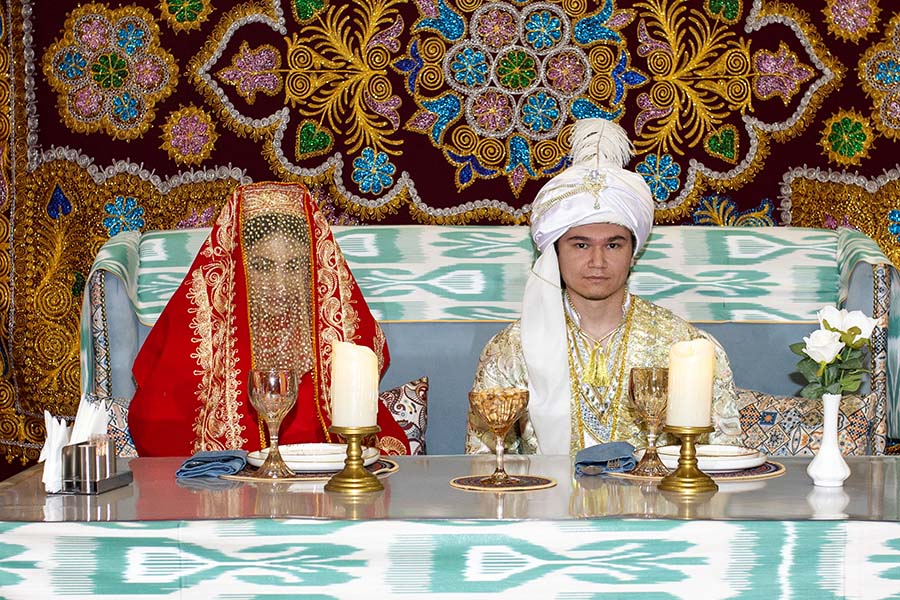
Traditional wedding clothing in Uzbekistan has long been notable for its richness and layered construction. The bride wore ishton trousers, a white shirt and makhsi boots covered with leather galoshes known as kovush. A light white veil covered her face, over which a festive outer garment was draped. Jewellery set with precious and semi-precious stones formed an essential part of her attire, signalling the prosperity of her family.
The groom’s dress was equally ceremonial. He wore a silk or brocade chapan robe, a white cap, a waist sash and boots.
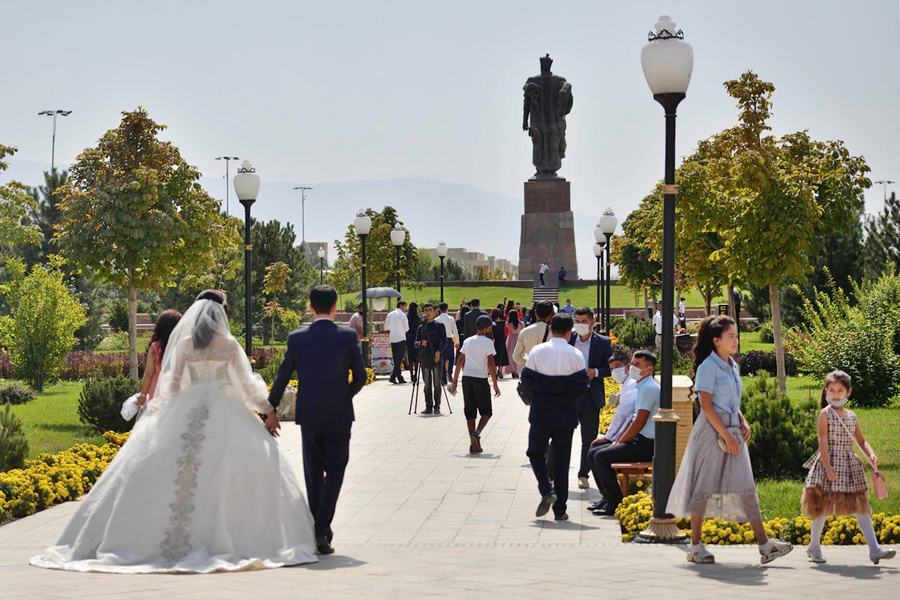
Today, most couples opt for European-style clothing: a white wedding dress and a classic suit. Yet many incorporate Uzbek elements – embroidered fabrics, traditional robes, national patterns – maintaining a visible link to heritage within a contemporary framework.
Wedding Day Traditions
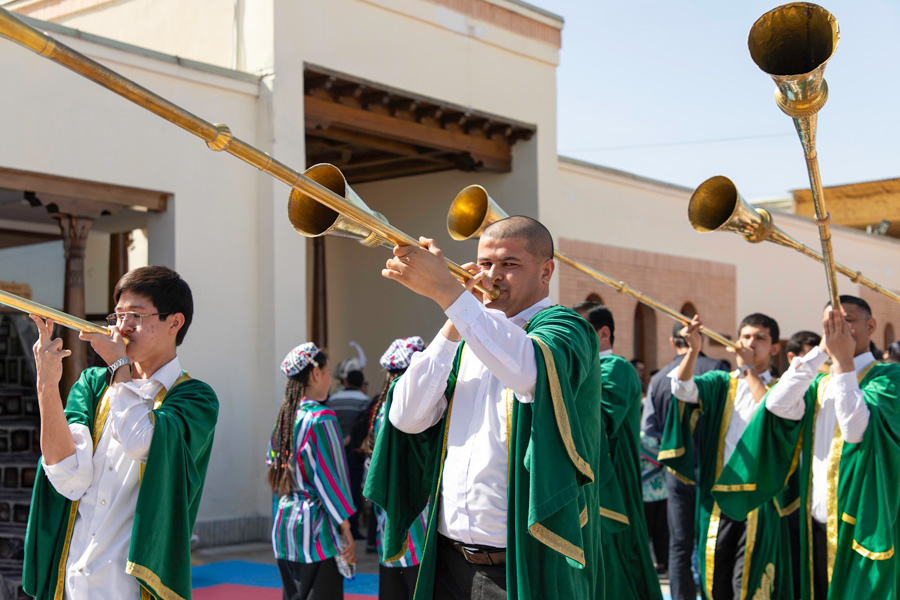
The wedding day begins early with a festive morning pilaf served at both the bride’s and groom’s homes. Increasingly, this meal is held in cafés or restaurants rather than in private courtyards, easing the practical burden on families. Afterward, the groom, accompanied by friends, relatives and musicians, proceeds to the bride’s house.
Rituals at the Bride’s Home
Upon arrival, he is welcomed with another feast. Pilaf once again takes centre stage. By tradition, the groom treats his unmarried friends, with the wish that they too will soon marry.
An important figure throughout the day is the yang – usually the bride’s sister-in-law – who accompanies her and helps guide her through the rituals. Among them is soch sipatuv, when the groom gently strokes the bride’s hair three times; oina ko‘rsatar, during which the couple look at each other in a mirror; and qo‘l ushlatuv, the joining of hands.
A burning lamp may be passed around their heads for spiritual purification, and small children are placed briefly on their knees as a symbolic wish for future offspring. These gestures unite the couple both symbolically and socially.
The Bride’s Departure
The farewell to her parents is accompanied by words of gratitude and the singing of Yor-yor songs. At the groom’s home, she is greeted with further songs and ritual gestures.
Before crossing the threshold, the bride – sometimes together with the groom – walks around a fire several times. This act of purification is widely understood to echo ancient Zoroastrian traditions that have endured in Central Asia for centuries.
The bride then performs ostona salom, bowing at the doorway in respect for her new home and future. Flowers, sweets and money are scattered above her, wishing prosperity and happiness. A white pathway, payandoz, is often laid to the entrance, symbolising a favourable beginning.
Inside, a separate room awaits the newlyweds. The walls are decorated with suzani embroidery and carpets bearing motifs associated with fertility and protection. A curtain known as chimildiq is hung near or above the bed, symbolically sheltering the new family. By custom, it is removed forty days after the wedding.
The Wedding Banquet
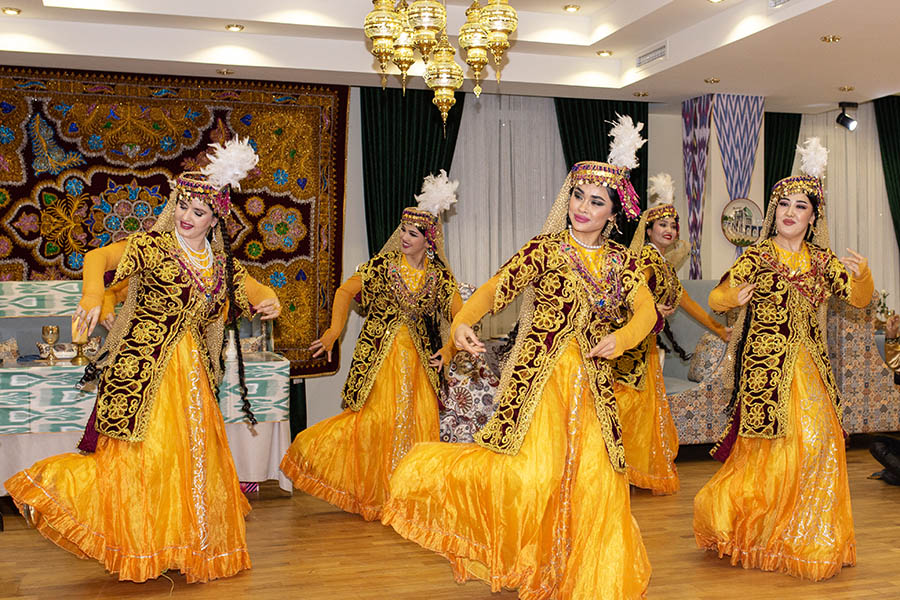
The evening banquet forms the central public celebration of the nikoh-tui. While it was once held in private homes or mahalla courtyards, it now usually takes place in specially decorated wedding halls known as tuykhona.
Guest lists can number in the hundreds – relatives, neighbours, colleagues and friends. Tables are laden with pilaf, salads, sweets, bread and tea. Music and dancing continue well into the evening. Traditional songs such as Ulan are performed alongside modern compositions. In earlier times, folk singers and epic storytellers were invited, and festivities might include bonfires and kurash wrestling matches.
Post-Wedding Rituals
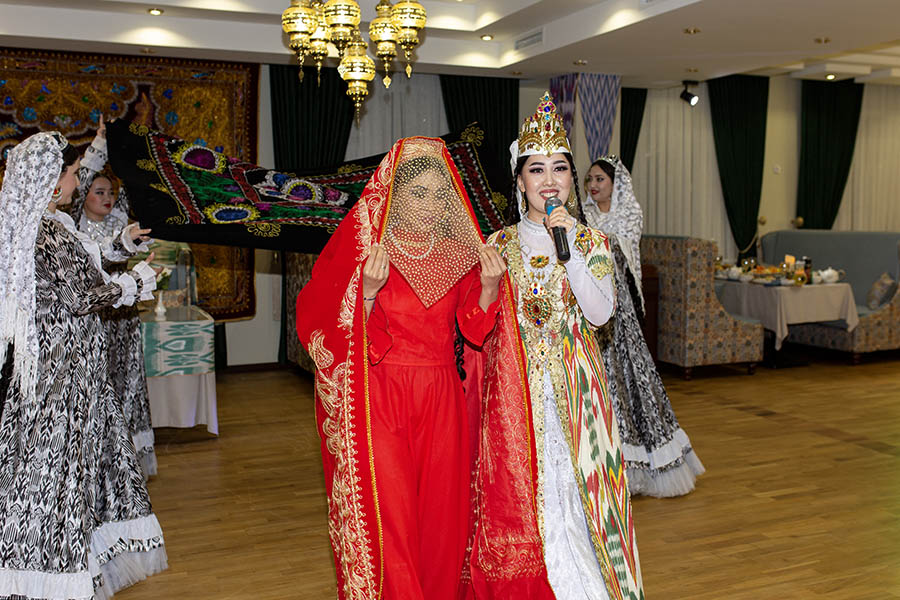
One of the most significant post-wedding ceremonies is kelin salom – the welcoming of the new daughter-in-law. Held the morning after the nikoh-tui, it marks her formal introduction to her husband’s extended family.
Dressed in traditional clothing and veiled, the bride greets each relative with a low bow. Women sing the kelin salom song, while she remains silent. In return, she receives gifts and blessings for a long and harmonious life. The ceremony concludes with bet ochar, the unveiling of her face.
In some regions, additional household rituals follow. The bride may dip her hands in flour and begin kneading dough, or pour oil into the hearth – symbolic acts expressing hopes that she will manage her new household wisely and never lack sustenance.
Uzbek Weddings Today
Contemporary Uzbek weddings combine modern formats with enduring customs. White dresses, banquet halls and professional videographers coexist with nikoh prayers, Yor-yor songs and the bows of kelin salom. Many rituals are now performed symbolically or incorporated into the banquet itself.
One defining feature of modern celebrations is their scale. In recent years, the state has introduced regulations limiting guest numbers – often to around 200–250 people – in response to the growing grandeur of wedding events.
Yet despite changing settings and contemporary influences, the essential meaning of the Uzbek wedding remains constant. It continues to be understood as the union of two families, a deeply social occasion and a living tradition – one that still begins, as it has for generations, with the resonant call of the karnay and surnay carrying through the mahalla.