

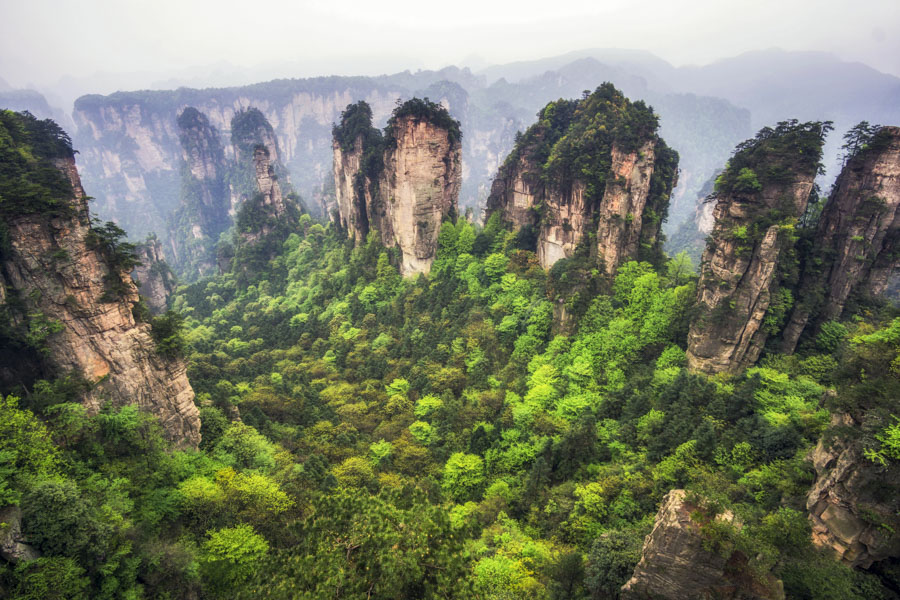
Yuanjiajie Scenic Area (袁家界, Yuánjiājiè) lies in the north-west of Zhangjiajie National Forest Park, about 11 kilometres (6.8 miles) from Wulingyuan District and 38 kilometres (23.6 miles) from central Zhangjiajie. It forms part of the wider Wulingyuan Scenic Area, which is home to some of Hunan Province’s most distinctive mountain landscapes.
The scenic area covers roughly 1,200 hectares, at an average elevation of approximately 1,074 metres. Thousands of quartz sandstone pillars, shaped over time by weathering and erosion, rise almost vertically from deep gorges. The plateau drops away into a steep chasm, and natural stone bridges connect neighbouring peaks above the ravines. At dawn or after rain, mist gathers in the valleys, blurring the contours of the cliffs, until the whole landscape resembles a chain of rocky islands floating in a sea of foam.
Yuanjiajie Scenic Area Tours
There are several ways to visit Yuanjiajie as part of an organised tour, with each itinerary placing the area in a slightly different context.
The four-day adventure in Zhangjiajie brings together the region’s main natural highlights, including Zhangjiajie National Forest Park, Tianzi Mountain, the Zhangjiajie Grand Canyon and its glass bridge, and Tianmen Mountain, home to the natural arch known as Heaven’s Gate. Yuanjiajie is the key stop on the second day and one of the first major natural highlights on the route.
As part of a broader exploration of China, the ten-day panoramic tour of the country’s central regions highlights imperial Beijing, historic Xi’an with the Terracotta Army, and Zhangjiajie, which becomes the main natural counterpoint to the historical cities earlier in the journey. Yuanjiajie takes centre stage on the seventh day.
Explore our dedicated China tours page to discover all our trips, with a range of themes to suit every taste.
Best Time to Visit the Yuanjiajie Scenic Area
April–May and October–November are generally the best months to visit Yuanjiajie. In spring, fresh greenery covers the mountains, and temperatures usually hover within a comfortable range of 12 to 20°C (54 to 68°F). After periods of rain, the misty conditions that create the area’s signature peaks’ floating effect. Many photographers wait for a short window after a storm, when mist still lies low in the valleys but the sandstone pillars begin to emerge through it.
Autumn offers a clearer, crisper view. Rainfall is usually lighter, visibility improves, and the contours of the pillars look sharper against the sky. The most rewarding period is often from mid-October to early November.
The best hours to visit Yuanjiajie are before 10:00 and after 16:00, when the viewing platforms are usually more spacious at viewpoints. An early start also gives you softer morning light and a smoother experience on the elevator, shuttle buses and viewing routes.
During China’s major national holidays, Yuanjiajie is livelier and can feel busier, especially at the Chinese New Year, the May Day holiday from 1 to 5 May, and the National Day Golden Week from 1 to 7 October. The main viewing platforms, the Bailong Elevator and nearby hotels are in particularly high demand. If your travel dates fall during a holiday period, it is worth booking accommodation and tickets well in advance.
Practical Information
DISCLAIMER: Ticket prices are listed in local currency and may change without prior notice. Exchange rates are provided for reference only and may fluctuate. As a tour operator, Advantour is not responsible for errors, omissions, later price changes, exchange-rate differences, or services provided by third parties. Travellers should check fares, terms and conditions, availability, and booking details with official suppliers or authorised booking platforms before making a reservation.
The entry ticket for Zhangjiajie National Forest Park includes access to Yuanjiajie and use of the park’s internal eco-shuttle buses.
| Visitor Category | CNY/RMB | USD / EUR / GBP |
| Adults (18–59) | 239 | $35 / €30 / £26 |
| Teenagers (14–17) & Seniors (60–64) | 122 | $18 / €16 / £14 |
| Seniors (65+) | 39 | $6 / €5 / £4 |
| Children under 14 | Free* | - |
Insurance of CNY/RMB 3 is included with paid tickets. For free tickets, visitors are advised to pay the insurance fee separately.
A single journey to the top of the plateau on the Bailong Elevator costs 65 CNY/RMB (about $10 / €8 / £7). Children under 120 centimetres (3 feet 11 inches) in height may travel free of charge.
Entry Times and Visitor Flow
The park is open daily from 07:00 to 18:00 from March to November and from 08:00 to 17:00 from December to February.
Admission tickets are valid for four consecutive days. You should book each visit in advance, either online or at the ticket office at one of the park’s five entrances. During busier travel periods, advance booking helps ensure a smoother entry experience.
Nearby Attractions
Within Zhangjiajie National Forest Park, the Golden Whip Stream is well worth adding to your route. This scenic trail follows the bottom of the gorge and offers a gentler contrast to Yuanjiajie’s high viewpoints. Other sights within the wider Wulingyuan Scenic Area include the Tianzi Mountain Nature Reserve, Yangjiajie and the Suoxiyu Scenic Area.
If you have time, plan a separate day for the Zhangjiajie Grand Canyon and Tianmen Mountain. Nearby highlights include the Yellow Dragon Cave, with its underground chambers, and the Baofeng Lake, which sits among steep cliffs.
History and Legends of the Yuanjiajie Scenic Area
From an Ancient Homeland to a National Park
Long before Zhangjiajie became known internationally, this part of north-western Hunan was a remote mountain region, inhabited mainly by the Tujia, Bai and Miao peoples. Their traditions and ways of life still help shape the local cultural landscape today. In 1982, the Chinese government established Zhangjiajie National Forest Park here, the country’s first national forest park. Ten years later, in 1992, the Wulingyuan Scenic and Historic Interest Area was inscribed on the UNESCO World Heritage List, bringing the region much wider international attention.
How Yuanjiajie Got its Name
The name Yuanjiajie is traditionally linked to the late Tang dynasty (618–907). According to local legend, after the failure of Huang Chao’s rebellion, a general surnamed Yuan fled imperial troops and took refuge in the Qingyan Mountains, now the Yuanjiajie scenic area. The steep, difficult terrain helped him remain hidden from his pursuers. It is said that he settled there, cultivated the land, and never returned to the world beyond the mountains. The place later became known as Yuanjiajie — often understood as “Yuan Family Boundary” — preserving the story of his refuge in local memory.
The Legend of Shadao Gully
The valley between Yuanjiajie and nearby Huangshi Village is known as Shadao Gully. It lies just below the "First Bridge Under Heaven" and has its own local legend.
Long ago, a young girl lived in Yuanjiajie with her grandparents. Having lost her parents early in life, she helped with difficult household work from a young age. One day, after returning from gathering firewood without her sickle, she was told not to come home until she had found it. She went back into the forest alone at dusk, as the light was fading and the woods grew darker. In the darkness, she slipped and fell into the gorge.
Local tradition says her soul became the Daodao bird (刀刀鸟), whose mournful cry can still be heard at night. In memory of the girl and the lost sickle, the valley became known as Shadao Gully (砂刀沟), or Sand Knife Gorge.
The Mountains That Inspired James Cameron’s Avatar
Local Tujia and Miao legends have long given these mountains a sacred quality, with stories of immortal spirits living among the peaks. For centuries, the image of mountains poised between heaven and earth has appeared in Chinese poetry and painting, and in 2009 it reached a global audience on screen. The Qiankun Pillar (乾坤柱), also known as the South Sky Pillar (南天一柱), is widely associated with the floating Hallelujah Mountains on Pandora in the film Avatar. In January 2010, it was officially renamed Avatar Hallelujah Mountain.
After the film’s release, Yuanjiajie became known to a much wider international audience and is now one of the most recognisable images associated with Zhangjiajie. However, the film was not shot on location in the park. Instead, the creative team used photographs and panoramic views of Yuanjiajie as visual references and then created the world of Pandora through computer-generated imagery.
Must-see Sights in the Yuanjiajie Scenic Area
Start at the Enchanting Terrace viewing platform (迷魂台), one of the best places to take in the full scale of Yuanjiajie. From here, hundreds of sandstone pillars rise from the gorge below. Some appear as narrow spires others like ancient towers or pagodas. After rain, clouds settle among the peaks, adding layered depth to the landscape reminiscent of a classical Chinese landscape painting.
Next, head to a viewpoint overlooking Avatar Hallelujah Mountain (阿凡达哈利路亚山). When mist gathers around the middle of the 150-metre monolith, the summit can seem almost detached from the ground beneath it. Its older name, Qiankun Pillar, comes from traditional Chinese cosmology: “qian” relates to heaven, while “kun” refers to earth. Suspended between sky and ground, the pillar is thought to give physical form to that connection.
Pause at First Bridge Under Heaven (天下第一桥). Look down into the gorge, which drops around 357 metres, with stone pillars rising on both sides. This natural stone bridge, linking two neighbouring peaks, was shaped by thousands of years of erosion and is widely regarded as one of Zhangjiajie’s most remarkable natural formations.
Then visit the Backyard Garden (后花园), a secluded valley where you can admire imposing old trees and unusual rock formations. The result is a verdant setting, with jade-coloured tones that evoke the atmosphere of an imperial garden.
From there, follow the steps down to the Hanging Waterfall (天悬白练) and stop at the base of the cliff. The water falls from a height of more than 200 metres, descending almost directly overhead. In the rainy season, spray can drift for dozens of metres; in clear weather, rainbows may appear in the mist; and in drier periods, the flow thins to a fine thread. Poetically, its name is often rendered as “White Silk from Heaven”, which suits the pale stream against the cliff face.
Finally, make time for Yuanjiazhai (袁家寨子), the Tujia ethnic minority fortified village set on the plateau. It is the only surviving private building in the Yuanjiajie area built in traditional Tujia style, with carved gates, red lanterns, and corn cobs hanging beneath the roof. Inside, an exhibition introduces Tujia life and history, and hosts may welcome visitors with music and homemade wine. It adds a human dimension to Yuanjiajie, showing the plateau not only as dramatic scenery but also as a living cultural landscape.
Best Things to Do in the Yuanjiajie Scenic Area
Yuanjiajie can be explored in several ways. Taking the high-speed Bailong Elevator, enjoying short walks between viewpoints, or doing longer mountain hikes. Some visitors focus on the main overlooks, while others use the area as part of a longer day through Zhangjiajie National Forest Park.
Take the Bailong Elevator to the Plateau
The Bailong Elevator (百龙天梯) is the fastest way to reach the Yuanjiajie Plateau. Listed by Guinness World Records as the world’s highest outdoor lift, it rises 335 metres (1,100 feet) up a vertical cliff in less than 1.5 minutes. From the glass cabin, you can see the stone pillars known as Heavenly Soldiers Gathering (神兵聚会), one of the clearest first views of Yuanjiajie’s dramatic vertical landscape.
Enjoy Yuanjiajie Walking Trails
You can see Yuanjiajie’s main viewpoints in a couple of hours or spend much of the day here by adding a hike from the bottom of the gorge. Below are three route options, depending on how much time you have and your preferred pace.
Route 1 — Classic Sightseeing Itinerary
This is the most compact way to see Yuanjiajie’s key highlights.
Difficulty: Easy
Duration: 1.5 to 2 hours
Type: One-way
East Gate → shuttle bus to Bailong Elevator Lower Station → Bailong Elevator to the plateau → shuttle bus to Enchanting Terrace Station → walk to Backyard Garden → Enchanting Terrace → Avatar Hallelujah Mountain → First Bridge Under Heaven → shuttle bus to the national park exit or onwards to Tianzi Mountain (天子山).
Note: Between Avatar Hallelujah Mountain and the First Bridge Under Heaven, there are two parallel trails: an upper path and a lower path. Both reach the same destination, but the lower path gives a better view of the bridge from below, making it easier to appreciate the span across the gorge.
Route 2 — Hiking Itinerary via the Golden Whip Stream
This is a more demanding route, with a long climb from the bottom of the gorge to the Yuanjiajie Plateau.
Difficulty: High, with a long and steep ascent
Duration: 4 to 5 hours
Type: One-way
East Gate → shuttle bus to Jinbianxi stop (金鞭溪) → entrance to Golden Whip Stream → walk 2.5 kilometres (1.6 miles) along the valley floor to Qianli Xianghui (千里相会, “A Thousand Miles to Meet You”) → climb Luancuan Slope (乱窜坡), a steep stone staircase taking around 2 hours → reach Backyard Garden at the top of the plateau → Enchanting Terrace → Avatar Hallelujah Mountain → First Bridge Under Heaven → shuttle bus to the national park exit.
Note: This route covers only the first section of the Golden Whip Stream. To walk the full gorge, you will need to return to the steps, descend again to the valley floor, then continue along the stream for the remaining 5 kilometres (3.1 miles).
There are four rest areas along Luancuan Slope.
Route 3 — Take the Lift up, Hike Down via the Golden Whip Stream
This combined route saves energy on the ascent while still allowing you to experience both the plateau viewpoints and the gorge trail.
Difficulty: Moderate
Duration: 4 to 5 hours
Type: Combined route
Take the Bailong Elevator up to the plateau and explore Yuanjiajie’s main highlights: Backyard Garden, Enchanting Terrace, Avatar Hallelujah Mountain and First Bridge Under Heaven. From there, descend Luancuan Slope into the gorge and finish with an easier walk along the Golden Whip Stream back to the East Gate.
How to Reach the Yuanjiajie Scenic Area?
You can get to Yuanjiajie via any of the five entrances to the Wulingyuan Scenic Area, but the East Gate and South Gate are the closest options for this part of the park.
Option 1 — From the East Gate
The East Gate is the most convenient entrance for Yuanjiajie and is located in the centre of Wulingyuan District. Many hotels in Wulingyuan are within walking distance, so the route is straightforward: scan your ticket at the entrance, then take the park shuttle bus to the Bailong Elevator.
Option 2 — From the South Gate
The South Gate is the closest entrance to Zhangjiajie city centre, and it’s a good choice if you want to start with a walk along the Golden Whip Stream. The journey to Yuanjiajie takes longer than from the East Gate, but the approach is generally more gradual, taking you through the lower gorge scenery.
You can travel to both the South Gate and East Gate from Zhangjiajie city centre, starting at Zhangjiajie Central Bus Station (张家界中心汽车站). There is usually no need to buy a ticket at the ticket office: go straight to the boarding area and pay the fare to the driver during the trip.
| Destination | Opening Hours | Distance / Travel Time | Fare |
| South Gate | 06:30 to 19:00 | 30 km / 1 hour | CNY/RMB 11 |
| East Gate | 06:30 to 19:00 | 38 km / 1 hour | CNY/RMB 20 |
Option 3 — By Shuttle Bus from Tianzi Mountain
This option suits travellers who begin the day by taking the Tianzi Mountain Cableway up to He Long Park. After exploring the local rock formations and viewpoints, you can continue towards Yuanjiajie by park shuttle bus. The bus departs from the Tianzi Mountain car park and travels along the upper mountain plateau, passing through the Yangjiajie scenic area before reaching the plateau.
Tips for Visiting Yuanjiajie Scenic Area
Choose footwear carefully: in winter, paths around Yuanjiajie can be icy, and after rain the stone steps may be slippery at any time of year. Go for shoes with non-slip soles.
Dress for changing temperatures: even in summer, the Yuanjiajie Plateau is cooler than the lower parts of the park. In autumn, the temperature can vary noticeably between morning and afternoon, so bring a light jacket. A raincoat, drinking water and sun protection are also worth packing.
Follow the safety guidance: Stay behind the railings on the viewing platforms, hold onto your phone securely when taking photos, and keep children close to you near cliff edges.
Bring a small snack: at the top of the plateau, you will find a KFC and several snack stalls serving simple food such as fried eggs, tofu and barbecue. Prices are usually higher than in the city, so carrying a light snack can be useful.
Keep food out of sight: wild monkeys are often seen near the First Bridge Under Heaven and can become bold around snacks and bags. Keep a respectful distance and do not feed them. It is best to keep food and loose items inside your rucksack, as monkeys are quick to notice rustling sounds and food smells.
Give the mist time to clear: fog and low cloud are part of Yuanjiajie’s atmosphere, especially after rain. If the viewing platform is covered in grey haze, wait for a while before moving on. Conditions can change quickly, and 15 minutes can be enough for the peaks to reappear.
Download an offline map: Zhangjiajie National Forest Park and the wider Wulingyuan Scenic Area cover a large area, and path junctions can be confusing. If you are travelling independently, save a map before you go. Apps such as Maps.me or AllTrails can help on the trails.
Plan for sunrise if you can: for views above the clouds, it is best to stay overnight in Wulingyuan District and enter the park as soon as it opens.