

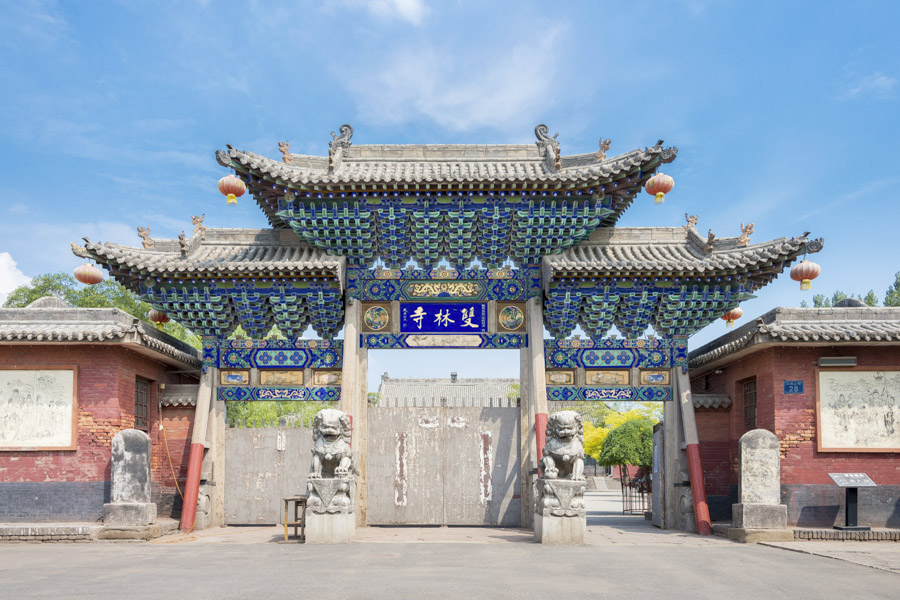
Located in the fields of Qiaotou village, Shuanglin Temple in Shanxi province is around 7 kilometres southwest of Pingyao. Among the famous Shanxi temples, a high wall and a single gate lead into three courtyards and ten halls. Builders founded the monastery in 571 AD, then Ming (1368–1644) and Qing (1644–1912) Dynasty craftsmen rebuilt the wooden structures you walk through now.
Under the Song dynasty (960–1279), it became Shuanglin Si (“double forest”), named for the Buddha reaching Nirvana beneath two trees. UNESCO added Shuanglin to the Ancient City of Pingyao listing in 1997. This UNESCO World Heritage Site also includes the walled city and Zhenguo Temple.
More than 2,000 Chinese sculptures from the 12th to 19th centuries, such as Buddhas, Bodhisattvas (referring to an enlightened being who has made a vow to attain Buddhahood), and warrior guards, line the halls behind the railings. Painted settings of towers, rivers, mountains, rocks, and cloud banks push the scenes forward. Locals call the place the “Oriental Treasure House of Painted Sculptures” and also “A Museum of Ancient Statues”. Spend an hour here and you will see Buddhist art at Shuanglin Temple, compressing centuries of Chinese Buddhist heritage.
Shuanglin is steeped Chinese culture which has a long history that runs for more than a thousand years. Local Chinese people still come to pray, while visitors come for the attractions.
Shuanglin Temple Tours
Among other cultural sites in Shanxi, Shuanglin Temple’s location allows it to be part of Pingyao tours. Most travellers stay inside Pingyao Ancient City to keep the days simple during these China tours. You can cover the old town on foot, then take the short drive out to Qiaotou village to visit Shuanglin Temple without rushing.
Roughly 20 minutes by car from the ancient walled town, Shuanglin Temple rewards slow looking. Most Shuanglin Temple tours focus on the ten halls across three courtyards, where more than 2,000 painted clay figures line up in guarded tableaux. Guides tend to frame the visit through the sculpture themes you can see in the temple.
Our 10-day Central China Essential Tour places Shuanglin on the classic Beijing-Pingyao-Xi’an line. In Pingyao, we arrange the high-speed train, a local guide and driver meeting you at the station and transferring you to the hotel. That afternoon, you visit Shuanglin Temple before the next day’s walk through Pingyao’s key sites. Then, our tour continued by bullet train to Xi’an with a station transfer and hotel drop-off. A wider Shanxi province route also fits a natural wonders tour in China.
Best Time to Visit Shuanglin Temple
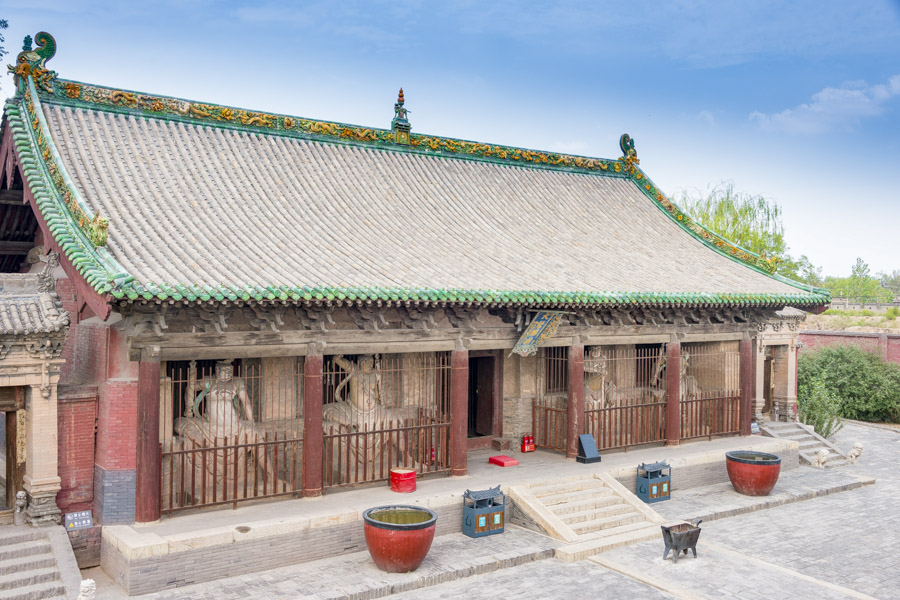
Plan your visit around light and crowd flow, not around a calendar or climate. Shuanglin sits a short drive from Pingyao in Shanxi province. If you want time with the sculptures, arrive early, or go late afternoon and work quickly through the key halls before closing.
Season matters less than timing, but it still shifts the feel. May to October brings the warmest days and the highest visitor numbers in Pingyao and at the temple. November to March stays quieter, with fewer people in the halls and a slower pace for looking and photography.
For comfortable walking and clear light, aim for spring and autumn, especially March to May and September to November.
Most visitors spend 1.5 to 2 hours on site. That gives you enough time to see the main halls and study the painted clay figures at your own pace.
Shuanglin Temple Opening Hours
Opening hours change by season and by local notices. Recent notices for Shuanglin list 08:00 to 18:30, with ticket checks stopping shortly before closing.
Some also note seasonal ranges, roughly 08:00 to 18:00 in colder months. Check on the day you visit Shuanglin Temple.
Practical Additional Information
Shuanglin Temple sells its own ticket, separate from the Pingyao Ancient City pass. Current local notices list CNY/RMB 35 for full price (approximately $5, €4.50, £4) and CNY/RMB 15 for a discount ticket (approximately $2, €1.80, £1.60) for visitors who qualify and show valid ID.
Buy at the entrance or use the official Pingyao ticketing channel. The scenic area uses QR entry, so keep the ticket QR ready on your phone.
If you book ahead, many travellers use WeChat or Alipay mini programmes. Name-that-match ID tickets apply in Pingyao’s main sites, including Shuanglin, so it is recommended to carry your passport.
History of Shuanglin Temple
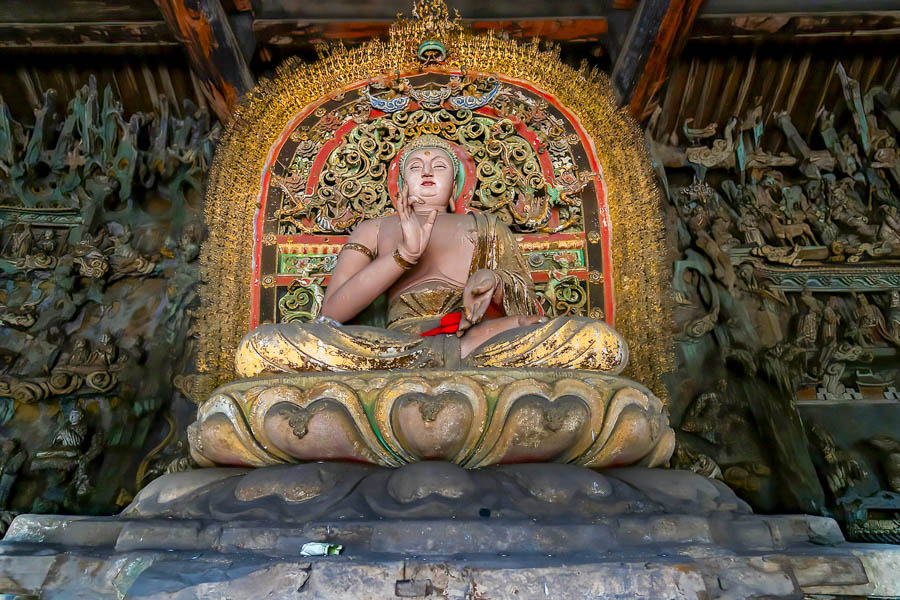
This Chinese Buddhist temple kept its painted clay figures in place, hall after hall, through centuries of damage and repair. Shuanglin Temple’s history runs from the Song through to the Qing, sharing Pingyao's rise and fall.
Buddhism in China
Buddhism entered China during the Han dynasty, moving along trade routes that later writers grouped under the Silk Road. Temples first worked as places for worship, translation, teaching, and patronage. They helped spread images and stories through sculpture and mural cycles.
Rulers sometimes backed monasteries, then turned against them when court politics and finances shifted. Chinese Buddhist heritage grew under pressure as well as support. In 845, Emperor Wuzong launched a comprehensive campaign affecting Buddhist institutions, leading to the closure of numerous temples and encouraging the reintegration of monks and nuns back into lay life.
Shuanglin under the Song Dynasty
The history of Shuanglin starts with a reconstruction under Northern Qi in 571 AD, though some sources place earlier origins. The temple first carried the name Zhongdu. Under the Song dynasty, the authorities renamed it Shuanglin, meaning “double forest”. The name comes from Buddha reaching Nirvana beneath two trees, which framed the place as a memorial site as much as a monastery.
Ming and Qing Eras
The buildings you see today come from the Ming and Qing, when local rebuilding shaped the compound into a walled, almost fortress-like complex. For centuries, artisans modelled more than 2,000 figures, described as some of the finest examples of Buddhist sculpture. Among the top ancient Chinese sculptures, here you'll find modernist Buddha figures, Bodhisattvas, and guardian kings.
The UNESCO Protection
During the 20th century Shuanglin Temple faced severe threats during the Cultural Revolution (1966 to 1976); however, part of the collection was protected by villagers. In recent years, local heritage teams have shifted from rescue to documentation, starting a digital preservation project. It started in March 2021 with Zhejiang University to record architecture, murals, and selected painted sculptures.
UNESCO inscribed Shuanglin Temple in 1997 as a component of the Ancient City of Pingyao World Heritage Site. This links the temple’s survival to the broader story of Pingyao’s religious life and merchant-era wealth.
Architecture of Shuanglin Temple
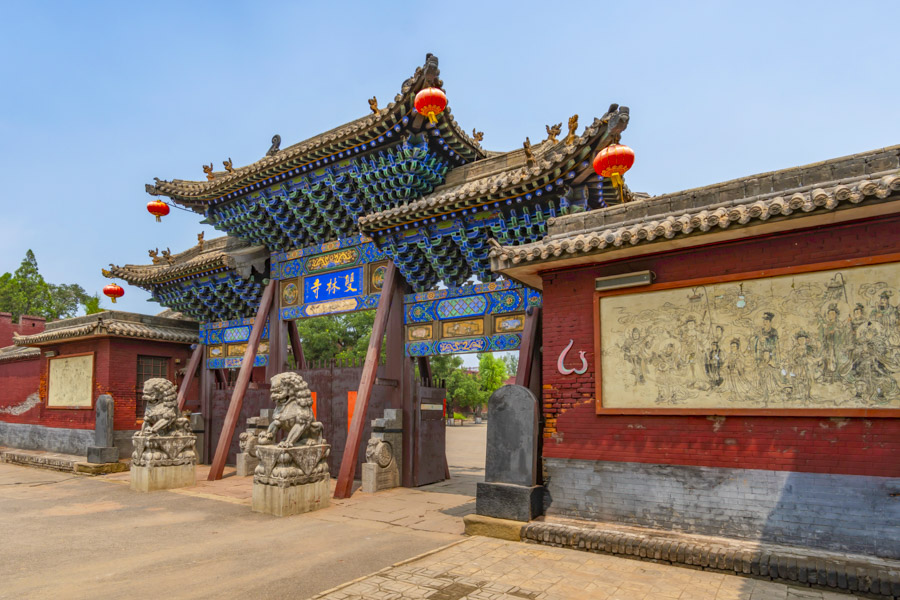
Shuanglin Temple follows typical Buddhist architecture of North China. With a straight, symmetrical plan, it runs along a main axis and keeps the most important spaces deeper inside the compound. It covers about 15,000 square metres, with buildings in a strict sequence guiding visitors from the public edge to inner courts.
A high perimeter wall, built in the Ming dynasty, gives the site a closed, defensive look. It turns the temple into a self-contained Chinese temple precinct rather than an open park. Inside, the west side carries the ceremonial core, and ten main halls line up across three courtyards, arranged to control pace.
Each courtyard works as a pause between halls: you step out into light, reset your orientation, then move on. The east side holds supporting buildings, including scripture storage and service spaces, linked by secondary paths. This split between west and east keeps ritual movement clear while giving daily temple life its own routes.
The layout carries clear symbolism. The south-to-north progression mirrors a ritual ascent. Initially one enters through the gate, passing through threshold spaces that traditionally “guard” the precinct. Then approach the central worship buildings and finally reach the rear halls that sit furthest from the secular world.
The strong axis also expresses order in the Confucian sense, such as hierarchy, alignment, and controlled movement. All this is built into timber frames, courtyards, and gates rather than explained on a signboard.
This Shuanglin Temple architecture also serves a practical purpose. The buildings line up in a straight sequence, so you can move hall to hall without doubling back. The courtyards break up the enclosed spaces with daylight and air.
Things not to Miss at Shuanglin Temple
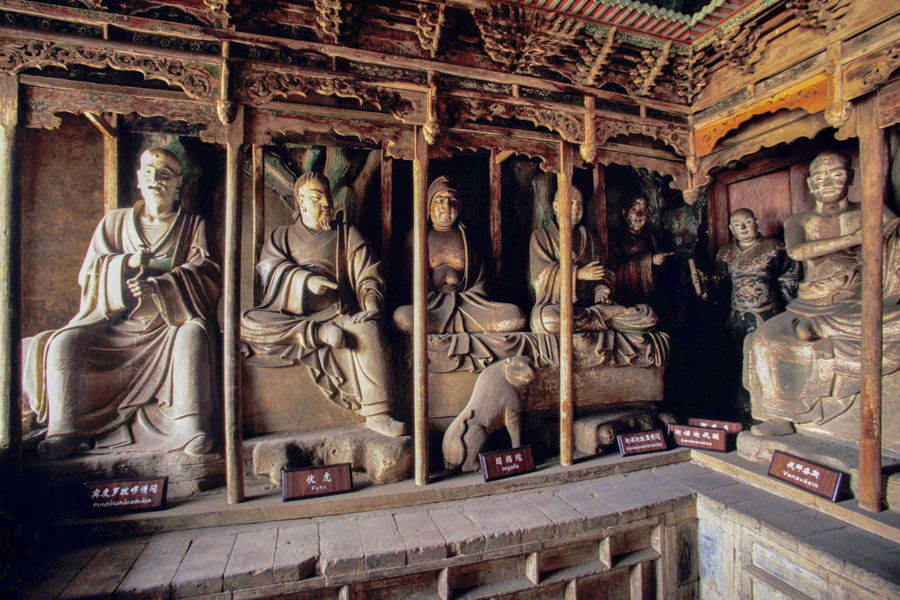
Shuanglin’s best work sits indoors, where several halls stage a central Buddha statue group. Move hall by hall, then stop when a figure catches your eye. The site earned its reputation through the Shuanglin Temple statues and the way each hall stages them as a complete scene.
Hall of Heavenly Kings 天王殿
Start here for scale and theatre. Four painted guardian kings, each about three metres tall, stand at the entrance with their identifying objects. They hold a sword, pipa, umbrella, and snake. Look at the pupils set in the eyes for the hard, direct stare.
Sakyamuni Hall 释迦殿
The main group centres on Sakyamuni, regarded as the historical Buddha and the founder of Buddhism, flanked by Manjushri, the bodhisattva of wisdom, and Samantabhadra, the bodhisattva of compassion. Walk the walls and follow the relief sequence that narrates episodes from Sakyamuni’s life in sculpted panels.
Hall of the Arhats 罗汉厅
This hall rewards time. A central Guanyin figure, the bodhisattva of mercy, anchors the room, with eighteen arhats, which are enlightened beings, arranged on either side. Each face carries its own temperament. Guides often point out the “mute” arhat, with brows drawn down and lips sealed, plus figures posed as drunk, sick, or dwarfed.
Precious Hall of Mahavira 大雄宝殿
This is the tallest and most prominent hall in the compound. Inside, focus on the Trikaya, the “Three-Bodied Buddha” grouping. This grouping typically includes:
Dharmakaya: The truth body, representing the ultimate reality.
Sambhogakaya: The bliss body or celestial body, reflecting the enjoyment of enlightenment.
Nirmanakaya: The physical body, manifesting in the world.
It's a standard centrepiece in Chinese Mahavira halls, with Manjushri and Samantabhadra in attendance.
Hall of One-Thousand Buddhas 千佛殿
The hall enshrines Weituo (Skanda), a protector figure that many guidebooks single out as a Ming-period masterpiece. Around him, rows of small figures pack the space, and the hall builds the sense of a crowd rather than a single altar. In the Thousand Buddha Hall, rows of Buddhist statues pack the space. They show how sculptural art can carry mood through small shifts in facial expressions.
Hall of Bodhisattvas 菩萨殿
This hall runs on repetition and rhythm. The walls have roughly 480 bodhisattva figures, with hundreds of small variations in stance and gestures.
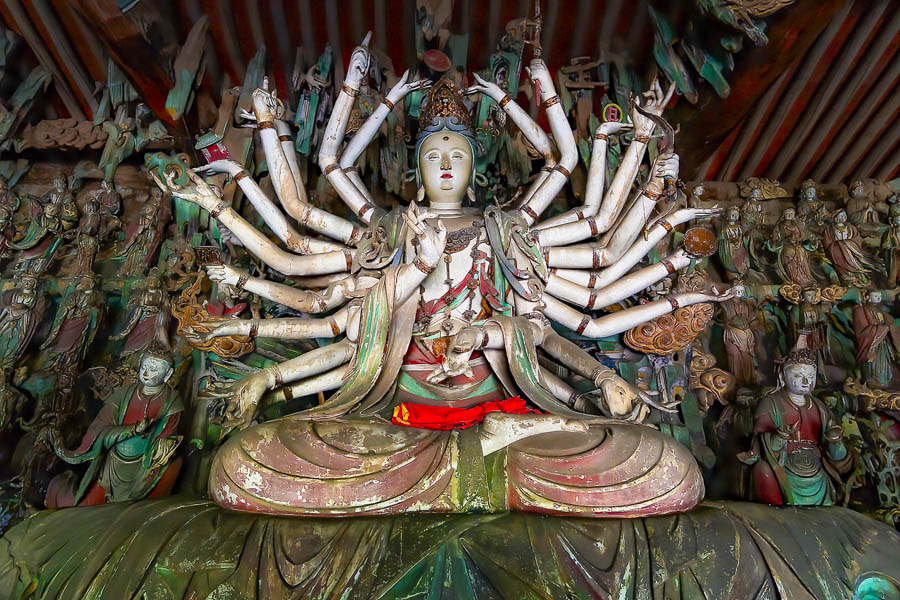
The coloured Bodhisattva decorated with several arms
The thousand-armed Guanyin dominates the Bodhisattva Hall. Step back far enough to read the full spread of arms, then move in for the jewellery, paint layers, and the way the figure holds the space like a living screen.
How to Get to Shuanglin Temple?
Shuanglin Temple sits in Qiaotou village, roughly 6 to 7 kilometres southwest of Pingyao Ancient City, in Shanxi province. Most people visit Shuanglin Temple as a short side trip from the walled town, then return to Pingyao for the rest of the day.
Public bus: the simple local option
Take Pingyao Bus 108 and get off at Shuanglinsi / Shuanglin Temple (双林寺).
You can usually board from practical hubs such as:
- Pingyao Railway Station
- Pingyao Bus Station
- North Gate of Pingyao Ancient City
- Pingyao Gucheng (high-speed) station.
At the North Gate stop, you may need to flag the bus down. Expect around 20 to 30 minutes on the road, depending on where you start.
Taxi or ride-hailing: quickest door-to-door
A taxi from the old town gates usually takes about 15 to 20 minutes. It is advisable to agree on the fare before you set off, and consider asking the driver to wait if you want an easy return. Many travellers arrange a round trip for roughly CNY/RMB 60 (approximately $9, €8, £7).
From Pingyao Gucheng (high-speed) station, a taxi can reach the temple in about 10 minutes; bus 108 also runs from the station.
Tips for an Optimal Visitor Experience
Timing your visit. Late morning brings the coach groups. Consider aiming for opening time, or come after 16:00 and keep a tranquil pace through the ten halls. You will see Chinese religious beliefs in practice here, with incense, bows, and quiet prayer in front of the figures. Many travellers treat this as a short, focused stop on a Pingyao stay, so the site can feel busier than you expect.
Embrace the light. The halls are dim, and your eyes need a few minutes to adjust. Give yourself time to read faces and hands on the Shuanglin Temple statues rather than rushing from plaque to plaque. For Shuanglin Temple photography, bring a lens or phone mode that handles low light well and keep your movements slow.
Adhere to Photography guidelines. Rules vary by hall and by staff on duty. Some areas may restrict indoor photos, while others might allow them but require the flash to stay off. It’s best to approach each hall with a mindset of “no flash, no tripod, no leaning in” and to kindly follow any posted signs and staff instructions.
Contribute to maintaining a quiet respect. Railings and barriers protect fragile painted surfaces. Please refrain from touching the clay and be mindful of your belongings in tight doorways. Speaking softly when locals pray contributes to a respectful atmosphere.
Be aware of special ritual days. Around major Buddhist festival dates, locals come to burn incense and chant, especially in spring and autumn. Dates shift with the lunar calendar, so it is advisable to consult your hotel in Pingyao or a guide about Shuanglin Temple events before you pick a day.
Consider the benefits of a guide. Engaging a knowledgeable guide can significantly enrich your understanding: one hall emphasises guardians, another compassion, and another disciplined discipleship. They help you connect the statues to the wider story of Buddhist temples in China.
Why Shuanglin Temple Belongs on Your Pingyao Itinerary
Shuanglin Temple ties Chinese history and culture to a living religious site. The visit to Shuanglin Temple highlights its status as one of China's historic temples. The temple sits beyond “a quick attraction near Pingyao”. It records how Chinese people pictured protection, compassion, discipline, and judgement inside a working Chinese Buddhist temple.
Long after you leave the courtyards, a sustained visual language linking art, worship, and daily life stays with visitors. This ranks among the must-see temples in China near a major heritage town, without the noise of the headline sites.