

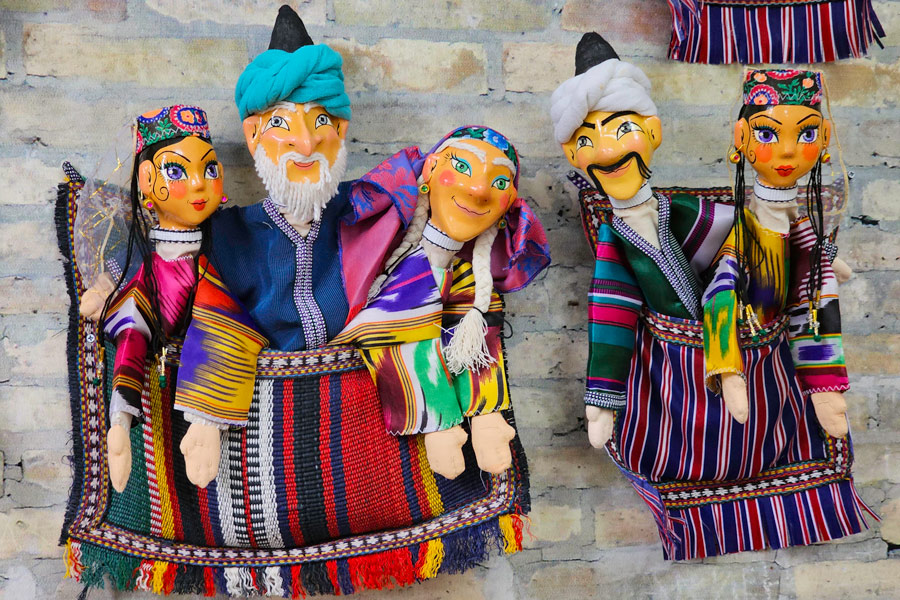
Uzbek dolls may look like simple children’s toys at first glance, but they carry the weight of centuries of tradition. These finely crafted figures are not just playthings – they’re storytellers. Through expressive faces, stylized poses, and detailed costumes, artisans bring to life characters from folklore, glimpses of daily life, and echoes of traditional city culture. Each region leaves its own mark: Samarkand’s dolls follow one artistic language, while those from Bukhara or Fergana speak in another. Every doll, in essence, is a portrait of place.
These puppets once came alive on the stages of street theater, where performers told folktales, acted out comic sketches, and gently poked fun at social life. For many towns, puppet shows were a familiar part of the urban fabric – entertaining, yes, but also preserving stories, symbols, and social insight across generations. Some troupes still carry on the tradition today, offering small-scale performances inspired by classic characters.
In recent decades, the role of Uzbek dolls has grown far beyond the stage or the toy shelf. Designers now use them as whimsical interior accents; collectors value them as standalone works of folk art. What began as a tool for storytelling has become a symbol of craftsmanship and cultural continuity, one that bridges past and present through evolving aesthetic forms.
The History of Puppetry in Uzbekistan
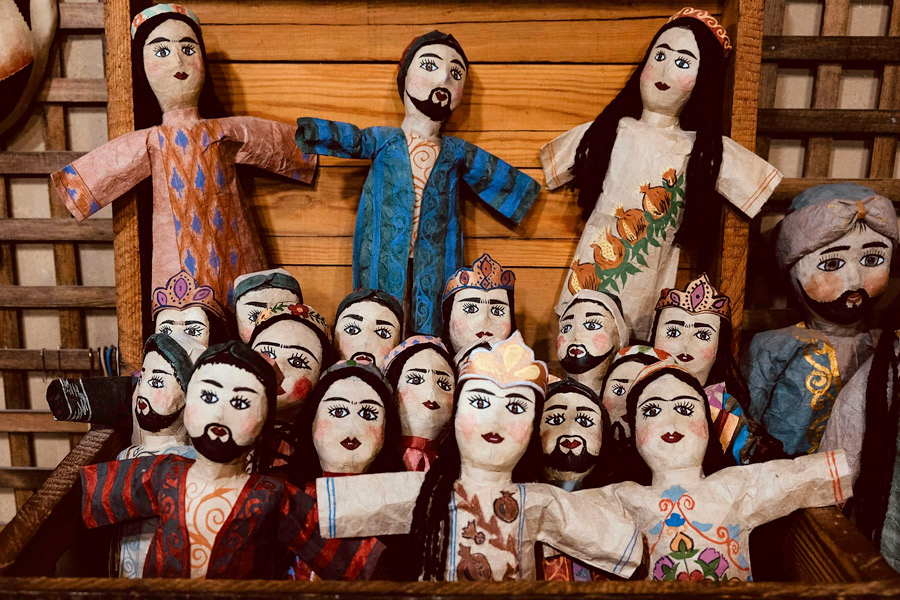
The story of puppetry in Uzbekistan reaches deep into antiquity. Its roots are often traced back to the 6th–4th centuries BCE, during the Achaemenid Empire, when early theatrical performances featured masks – objects that many scholars believe served as precursors to the puppets we recognize today.
By the time the Silk Road began to flourish, puppet theater had spread widely across Central Asia. Some researchers suggest it even influenced the evolution of China’s baixi (百戏) variety shows and may have later echoed in Japan’s bunraku (文楽) puppet tradition.
In the 8th century, with the rise of the Arab Caliphate, puppet performances nearly vanished. Religious restrictions discouraged the depiction of human faces, halting a practice that had once been widespread. But by the 14th century, during the reign of Amir Timur and the Timurid dynasty, puppetry experienced a revival. The arts were actively supported, and puppet theater reached new creative heights.
Over the following centuries – particularly during the era of the three Uzbek khanates – puppet theater began to take on its familiar form. A core repertoire of characters emerged, and performances became a regular feature of bazaar life and town squares. Traditional shows involved three participants: the korfarmon (narrator), the kugirchokboz (puppeteer), and a musician. Storylines were often satirical, poking fun at everyday vices and social absurdities.
These shows also cemented a beloved cast of characters. One of the most enduring is Khoja Nasreddin, the witty trickster-philosopher whose tales are now listed by UNESCO as part of the Intangible Cultural Heritage of Humanity. He remains a familiar figure on puppet stages, especially in Khiva. But perhaps the most iconic is Palvan Kachal – a bald, clownish jester with the soul of a philosopher, often compared to characters like Russia’s Petrushka, Italy’s Pulcinella, or Britain’s Punch.
The 20th century brought major change. While traditional puppet-making declined, institutional theater flourished. The State Puppet Theater was established in Tashkent in 1939, and remains active today, located near the Kosmonavtlar metro station. During this Soviet-era revival, Uzbek puppets were mass-produced. Factories even issued figures like “Tahir and Zukhra”, based on a classic love story, in paired sets.
By the late 20th and early 21st centuries, traditional puppet theater began to reassert itself. Small troupes embraced a flexible, improvisational style – actors sang, voiced multiple characters, and often created their own puppets and sets. Some performances now blend live actors with puppets on the same stage, using both small-scale figures and oversized forms as tall as a person.
Today, the craft of hand-making Uzbek puppets has returned to prominence. Cities like Tashkent, Bukhara, and Khiva have reestablished themselves as key centers of this living tradition – one that continues to blend storytelling, satire, and artisanal skill with timeless human expression.
Types of Puppet Theater in Uzbekistan
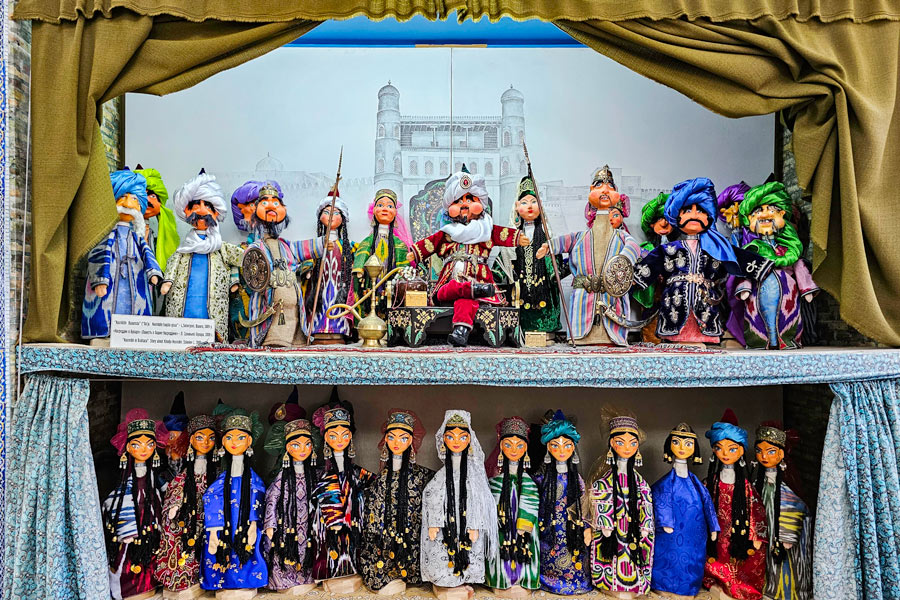
Traditional puppet theater in Uzbekistan takes several distinct forms, ranging from glove and rod puppets to marionettes, shadow plays, and hybrid performances where live actors and puppets share the stage.
Among the most common formats are chodir jamal and chodir khayal. Chodir jamal performances are simpler in structure and typically feature glove or stick puppets. These shows were staged in public squares and bustling bazaars, using a small screen as a stage and relying heavily on folklore and improvisation. At the heart of these lively sketches was Palvan Kachal, the iconic bald jester, often joined by his spirited wife Bichahon (also known as Bikyahon) and a cast of colorful supporting characters.
More elaborate productions belonged to the tradition of chodir khayal, a refined form of puppet theater using marionettes. These performances drew on historical episodes, epic legends, and classical folk tales. In the medieval period, chodir khayal was regarded as a high art form – sophisticated and intellectual – and was performed primarily at royal courts for noble audiences.
The Many Faces of Uzbek Dolls
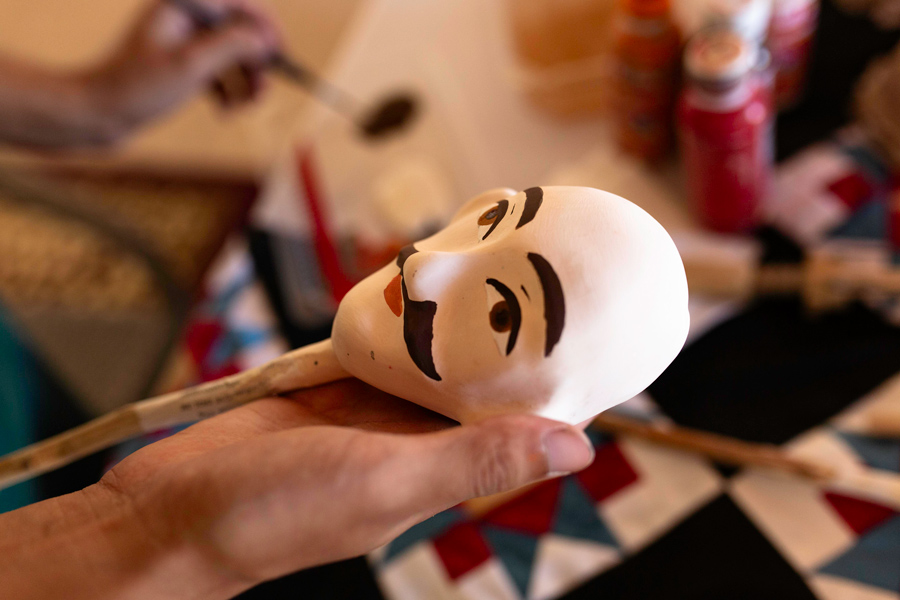
The characters brought to life through Uzbek dolls reflect the layered fabric of traditional society. Within these miniature figures, one can find women and men, children, wealthy bais (landowners), humble batraks (laborers), skilled artisans, traveling musicians, and wandering Sufi dervishes – all rendered with remarkable attention to social nuance and cultural symbolism.
Each doll is a fusion of disciplines – painting, ceramics, embroidery, and metalwork. Costume plays a central role, with each figure dressed in regional attire that mirrors the diverse styles found across Uzbekistan. Dolls from the Fergana Valley often wear garments made of khan-atlas, the glossy silk fabric emblematic of the region. In contrast, Bukhara dolls are distinguished by richly embroidered chapan robes, often accented with gold thread.
In Surkhandarya, doll costumes feature tall ceremonial headdresses, dense textiles, and ancient ornamental motifs. Dolls from Khiva typically wear feathered skullcaps and costumes adorned with metal coin pendants. Female figures sometimes include full traditional ensembles, including the paranja (burqa), which was part of formal attire for Muslim women until the early 20th century.
Many Uzbek dolls are made in pairs or small sets. Popular themes include couples – bride and groom, husband and wife, or family groupings. These intimate compositions are more than decorative; they embody wishes for domestic harmony, prosperity, and lasting connection.
The Craft Behind Uzbek Dolls
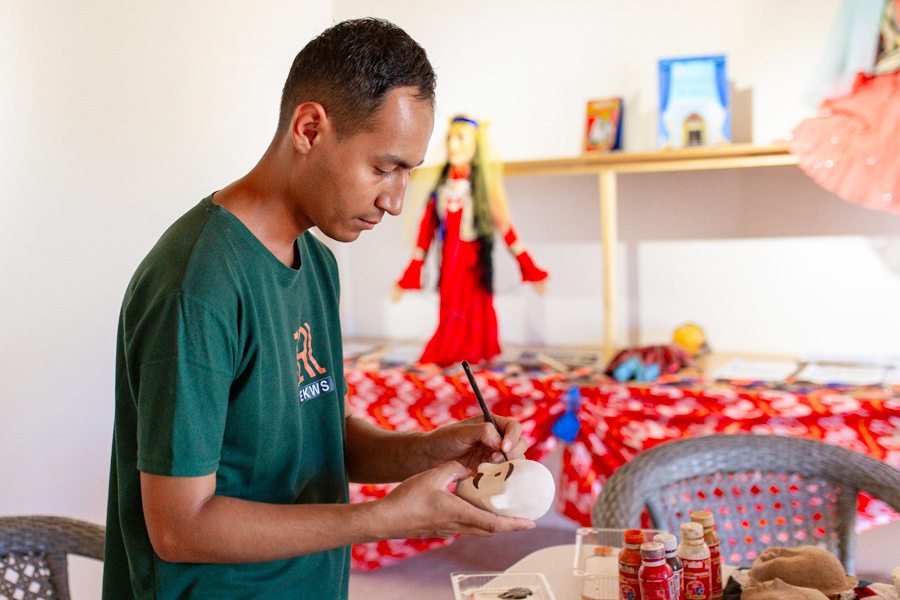
Each handmade Uzbek doll is the result of meticulous, hands-on craftsmanship – every stage is done by hand, and no detail is left to chance. The construction process draws on a variety of materials: clay, papier-mâché, and wire are commonly used for the body’s frame, while fabrics, metal pieces, and decorative stones bring the costumes to life. Depending on the complexity, a single figure can take weeks (or even months) to complete. Some become rare collector’s items, especially those that showcase advanced techniques or unusually refined detail.
The heads are typically made from clay or papier-mâché, and no two are ever exactly the same. Hand modeling allows artisans to shape distinctive features and subtle expressions, while the face painting often employs techniques borrowed from miniature art.
Every artisan brings a different sensibility to the work. Some aim for realism, others favor stylization or even light caricature, but nearly all agree: the expression sets the tone for the entire figure.
Wire armatures are often used inside the body, making the dolls slightly poseable. The clothing is sewn by hand, usually from traditional Uzbek textiles such as adras or atlas. In some pieces, rare antique fabrics from the 19th and early 20th centuries are incorporated, adding historical depth to the design.
Female dolls are frequently adorned with full sets of traditional jewelry: tilla-kosh (forehead diadems), heavy amulet pendants known as tumor, and other ornate elements. In higher-end works, artisans may use real silver, along with coral, turquoise, and other semi-precious stones, lending each doll a quiet sense of inherited grandeur.
Where to Experience Traditional Uzbek Dolls – Theaters, Museums, and More
Handmade Uzbek dolls can be found in nearly every major city, where the tradition continues to evolve in theaters, workshops, and artisan studios. In Tashkent, visitors can attend performances at the State Puppet Theater, explore seasonal festivals and craft fairs, or visit the International Caravanserai of Culture, which has long hosted exhibitions devoted to dollmaking.
Another stop in the capital is the Navruz Ethnographic Park, home to the workshop of master craftswoman Nasiba Akhmedova. There, she creates expressive dolls dressed in meticulously crafted traditional Uzbek costumes – each one capturing the spirit of regional identity.
In the ancient city of Khiva, the puppet tradition remains especially strong. Within the Ichan-Kala fortress, visitors will find a small puppet theater and the Jeyhun workshop-studio, founded by local artisan Mansur Kuryazov. Here, the legacy of handmade dolls is kept alive with a distinct Khorezmian flair.
Bukhara also holds a special place in the world of Uzbek puppetry. Just steps from the historic Lyabi-Hauz ensemble lies the Puppet Museum, established by artist Iskandar Hakimov. This intimate space offers guided tours, insights into the history of puppet-making, and demonstrations of the production process. The museum also features a striking photo gallery – portraits of dolls and their makers, where echoes between faces, gestures, and expressions often reveal something deeply shared.