

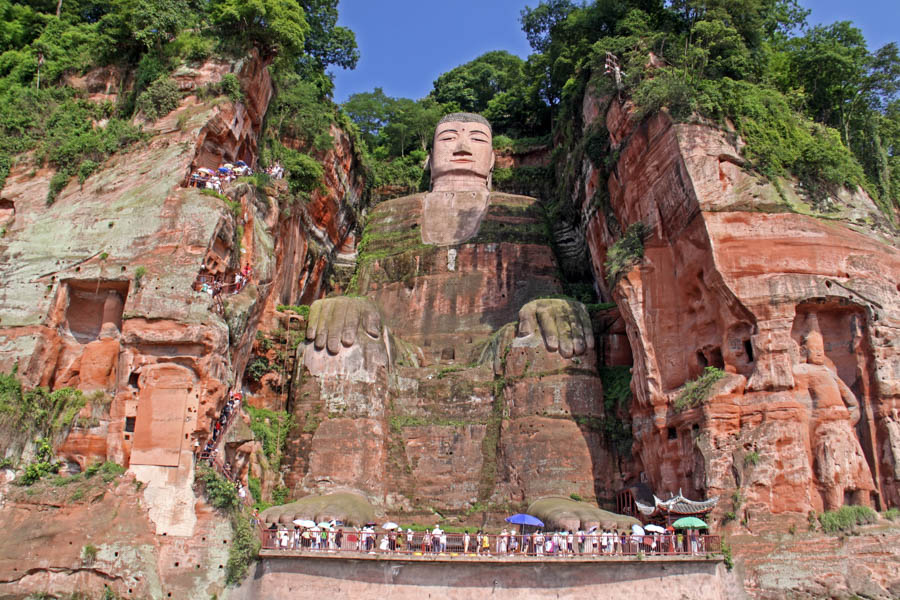
Engraved over 1,300 years ago, the Leshan Giant Buddha (乐 山 大 佛) is the same size as the 25-storey building. This 71-metre (233-foot) figure is the tallest cliffside stone sculpture and the largest Buddha statue in the world. Its head is level with the mountain, its feet rest by the river, and its vast form seems to hold the cliff and water. Also known as the Lingyun Giant Buddha (灵云大佛), this giant sits at the intersection of the Min, the Qingyi, and the Dadu rivers.
Located near the city of Leshan in the Sichuan Province (四川省), China, the world's biggest Buddha is carved in the classical Tang Dynasty Buddhist architectural style. Since 1996, the site has been protected as part of the UNESCO-listed Mount Emei Scenic Area, including the Leshan Giant Buddha Scenic Area. Begun in the Tang Dynasty in the 8th century, locals affectionately call it “Buddha Grandpa”, protecting Leshan for centuries.
According to legend, the monk Haitong (海通和尚) began the project in the hope that the Buddha would calm the dangerous currents. These currents had caused repeated boat accidents at the river junction. Today, this vast riverside sculpture remains both a place of pilgrimage and a landmark of Chinese civilisation.
The Leshan Giant Buddha Tours
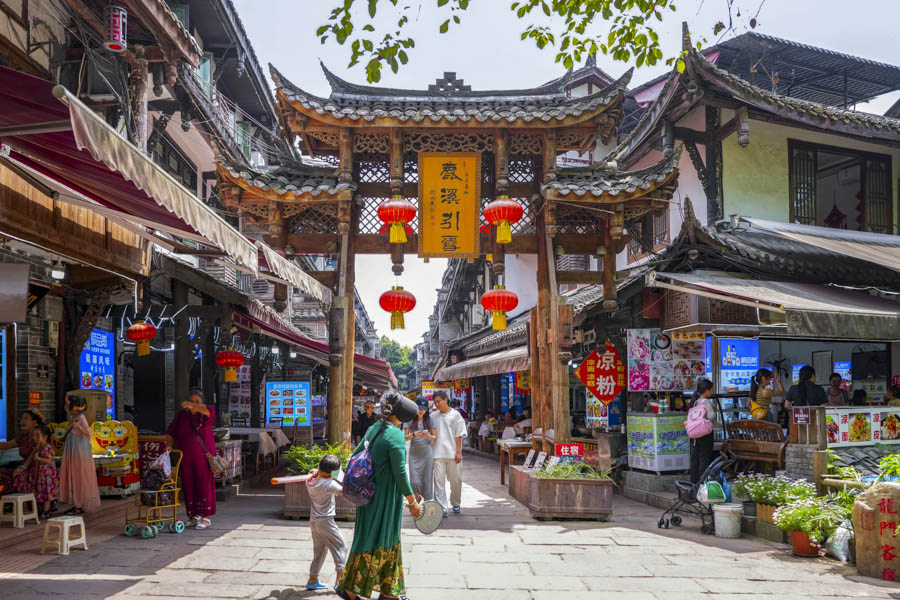
In practical terms, Leshan Giant Buddha tours can be arranged as a part of wider Sichuan journeys. A day trip from Chengdu, or a two-day route combining Leshan with another UNESCO site, Mount Emei, just 30 minutes away. Chengdu sits roughly two hours from Leshan by road, making it a natural base for the visit. Places such as Huanglongxi Ancient Town or the Oriental Buddha Park are other detouring options.
Our 16-day Central China Grand Tour takes you through the heart of the country. On our tour, we combine the Giant Buddha with a Yangtze River cruise and the region's greatest landmarks.
A visit to the Leshan Giant Buddha is highly recommended when it is part of a full day with transport arranged in advance. This especially works if you want to cover Chengdu highlights and one major heritage site. Group tours tend to focus on efficiency and fixed timing. Private tours usually allow more flexibility at viewpoints, Buddhist temple stops, and walking sections.
On a boat ride, first you see the full scale of the monument from the water and then move through the scenic area itself. So, our 11-day Central China Cultural Treasures Tour places Leshan between Chengdu and Shanghai. This tour includes both a scenic cruise and the option to walk the steps for panoramic views. Furthermore, our 10-day Central China Discovery Tour combines Chengdu’s Giant Panda Base with Leshan in a single day.
Best Time to Visit the Leshan Giant Buddha
The best time to visit the Leshan Giant Buddha is during spring and autumn. These are the months when Sichuan's subtropical climate finds its balance. Temperatures float comfortably between 14°C and 23°C. Rainfall is manageable, and the surrounding landscape looks genuinely alive rather than waterlogged or bare.
Spring brings cool air and fresh colour, though early mornings by the river can still be foggy. Autumn is often the more comfortable choice, with calmer conditions and a better chance of avoiding the visitor flow.
| Season | Months | Typical Average High | Typical Average Low |
| Spring | March to May | 14°C to 22°C (57°F to 72°F) | 9°C to 17°C (48°F to 63°F) |
| Summer | June to August | 25°C to 27°C (77°F to 81°F) | 20°C to 22°C (68°F to 72°F) |
| Autumn | September to November | 14°C to 23°C (57°F to 73°F) | 9°C to 18°C (48°F to 64°F) |
| Winter | December to February | 8°C to 9°C (46°F to 48°F) | 3°C to 5°C (37°F to 41°F) |
Summer is also excellent, but it comes with two drawbacks: heat and rain. From late June to August, rainfall rises sharply, and the site is busier. Winter is quieter, and that can be appealing, but it is also cold and damp, especially near the river and on exposed paths.
If you want a calmer visit, arrive as early as possible, ideally right when the gates open. Weekday mornings are usually the best window, while weekends and Chinese public holidays are the busiest. There is another good slot later in the day, after 4 pm, when lines begin to ease and move through the site. Around 17:00 to 17:30, the softer light can also make the red sandstone look at its best.
Opening hours are seasonal. From 1 April to 7 October, the site opens from 07:30 to 18:30. From 8 October to 31 March, it opens from 08:00 to 17:30.
Practical Additional Information
The hiking route enters from the North Gate, passing carved sandstone walls and arriving first at Lingyun Temple (灵云寺). From there, the famous Nine Bends Plank Road (九曲栈道) descends the cliff face on the Buddha's right side. The road has 9 distinct symbolic turns, 278 stone steps, and narrows to just 0.6 metres (1.97 feet) at its tightest point. This means only one person can pass at a time.
The descent brings you down to the foot platform at river level, where the true scale of the statue finally registers. Exit is made via the Lingyun Plank Road on the left cliff, leading back to the South Gate. Set aside 2 to 3 hours for the full Leshan Buddha hiking trail. You need more during peak seasons when queues on the plank road can last several hours.
The boat tour, by contrast, takes around 30 minutes and departs from two wharves along the Min River. It gives you the panoramic frontal view that no amount of cliff-side hiking can replicate.
Tickets and Entrance Fees
Entrance to the scenic area costs CNY/RMB 80 ($12 / €10 / £8.70) for adults. Half-price tickets available for students and seniors between 60 and 65. Visitors over 65, children under 1.2 metres (3.94 feet), and people with disabilities enter free of charge.
Leshan Buddha tickets can be booked up to 30 days in advance through the official WeChat Mini Program by searching "大佛旅游". The Leshan Buddha boat tour is ticketed separately at CNY/RMB 70 ($10 / €8.80 / £7.60) per person. This is well worth adding, as it offers the only way to see the statue in its full, unobstructed scale from the river.
History of the Leshan Giant Buddha
In 713 AD, during the Tang Dynasty, a Buddhist monk, Haitong, arrived at the confluence of the three rivers in Sichuan. The waters here were notoriously treacherous, claiming boats and lives with grim regularity. Locals blamed river spirits, and Haitong had a different solution.
He believed that carving a giant image of Maitreya into the Xijuo Peak hillside would calm the waters and protect those who travelled to them. According to Buddhist scripture, when Maitreya descends to the world, peace follows. Haitong knew exactly what he was building, as the statue reflected the deep philosophical significance of Maitreya in the Tang Dynasty.
He spent over 20 years collecting alms to fund the project. When corrupt officials attempted to seize the funds, Haitong declared that he'd take his eyes before a single coin of Buddha's money. After he proved it by gouging out one of his own eyes, the officials felt ashamed and ran away, and the construction went on.
Haitong died before the statue was finished. His followers carried the project forward through two more generations, supported at different stages by local governors. The work took 90 years in total, finally completing in 803 AD.
As a remarkable side effect, the enormous volume of stone was removed from the cliff and deposited into the river below. This unintentionally altered the currents and made the waters genuinely safer for navigation. So, it turned out that the Buddha actually worked.
The Leshan Giant Buddha history stretches well beyond its construction. During the Song Dynasty the protective wooden pavilion went to ruins, as did the moss-covered Leshan Buddha statue. Mongol invasions during the Yuan Dynasty destroyed the pavilion permanently.
In 1996, the site was inscribed as a UNESCO World Heritage Site in China. The giant Buddha in Leshan was recognised as part of the Mount Emei Scenic Area World Heritage listing. The scenic area includes later Buddhist structures, associated temples, and even Han Dynasty cliff tombs. Yet the monument carries the force of ancient Chinese stone carving on a scale that remains hard to understand until you see it.
Architecture of the Leshan Giant Buddha
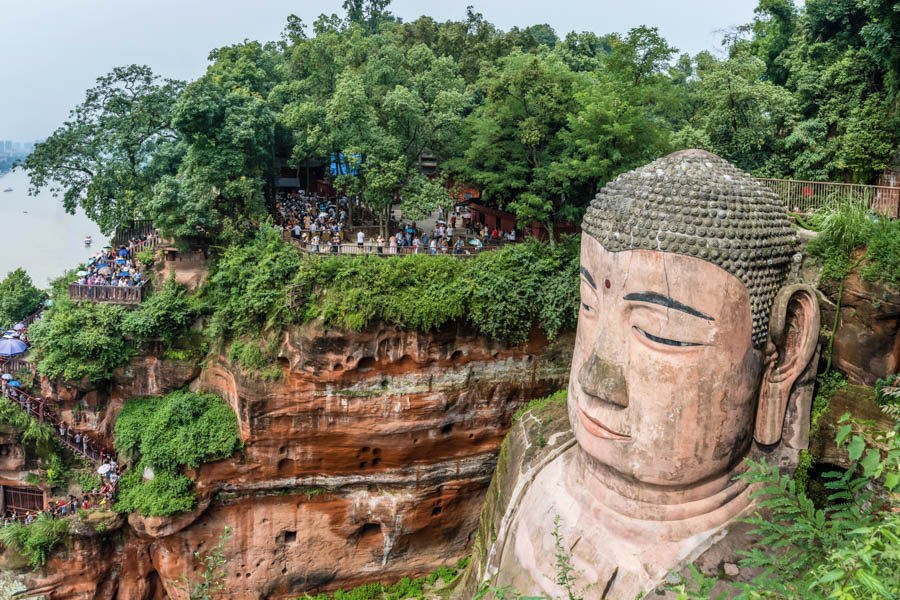
To stand at the base of the biggest Buddha statue is to comprehend something viscerally. There is a reason the local saying goes: "The mountain is a Buddha, and the Buddha is a mountain". The statue is built so naturally into the landscape; it feels like it always belonged there.
How tall is the Leshan Giant Buddha?
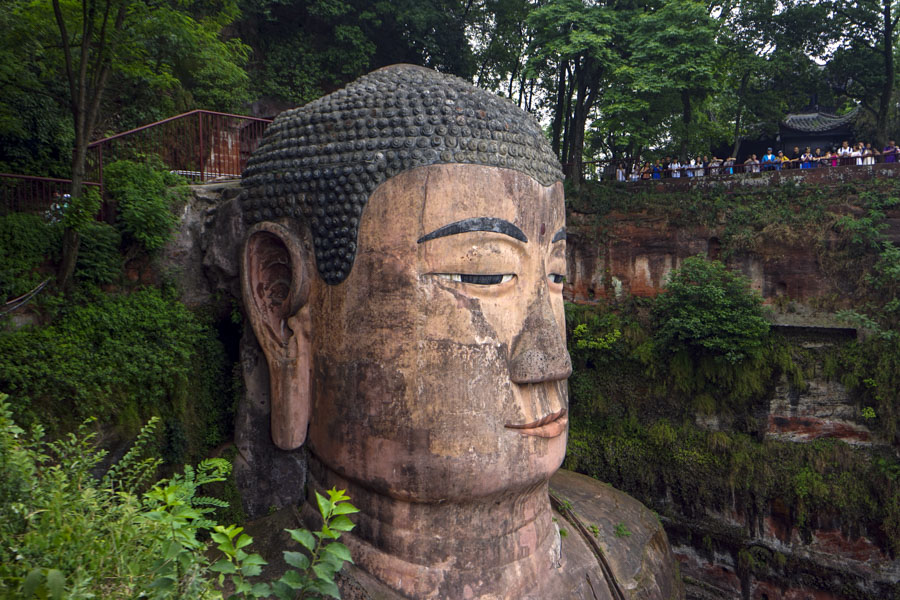
Carved from the red sandstone face of Lingyun Mountain or on the hillside of Xijuo Peak, according to UNESCO, the tallest Buddha statue in the world is 71 metres (233 feet) tall. The head is nearly 15 metres (49.2 feet) tall, stretching 10 metres (32.8 feet) wide, adorned with 1,021 inserted spiral coils of hair. Each one is fitted so precisely into the stone that it appears to grow from it naturally.
The shoulders spread 28 metres (91.9 feet), wide enough to serve as a basketball court. Each instep is 8.5 metres (27.9 feet) across and can hold over a hundred people standing comfortably. The ears, crafted from wood and covered with clay, stretch 7 metres (23 feet) in length and are hollow enough to fit two people inside.
Every proportion of the body conforms to the classical Buddharupa standards of Tang Dynasty sculpture. This gives the figure a serenity and balance that feels deliberate and deeply considered rather than merely monumental.
The symbolism embedded in the design is equally intentional. The hands resting open on the knees represent peace and protection. The merciful facial expression, solemn yet approachable, reflects the qualities of Maitreya himself. This Giant Buddha statue in China is the Buddha of the Future, whose arrival is said to bring harmony to the world.
Ancient engineers built a sophisticated drainage system directly into the figure. The system concealed channels within the hair, collar, chest, and behind the ears to divert rainwater and prevent erosion. Several layers of the coiled hair contain hidden cross-drains, and cavities behind the ears connect through the shoulders to the back of the statue.
The system still functions today, an engineering miracle within one of the world's greatest ancient Chinese stone carvings. That is why this large Buddha sculpture should be read as both a religious image and a work of engineering.
Top Things to do at the Leshan Giant Buddha Scenic Area
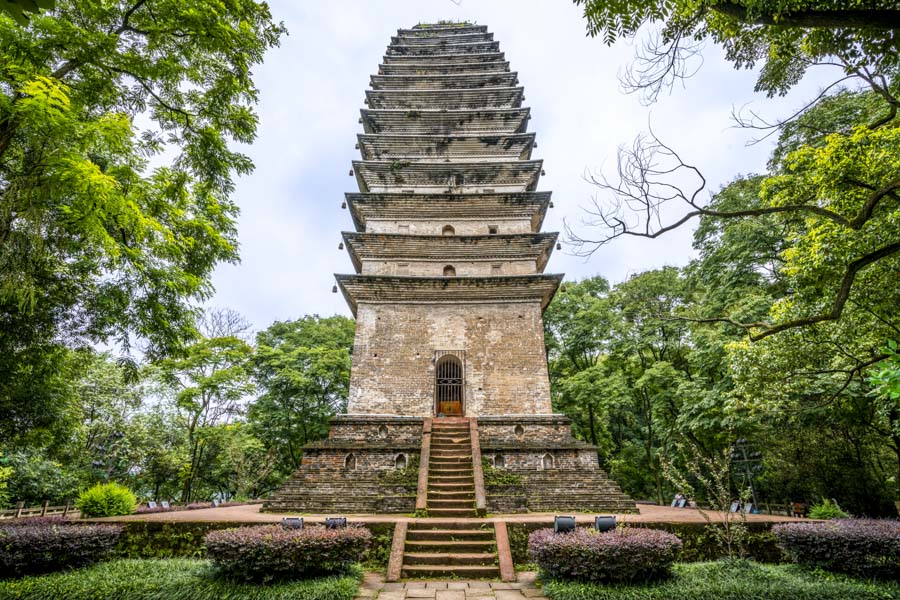
To visit the Leshan Giant Buddha properly, you should consider treating this one as a route, shaped by rhythm and memory.
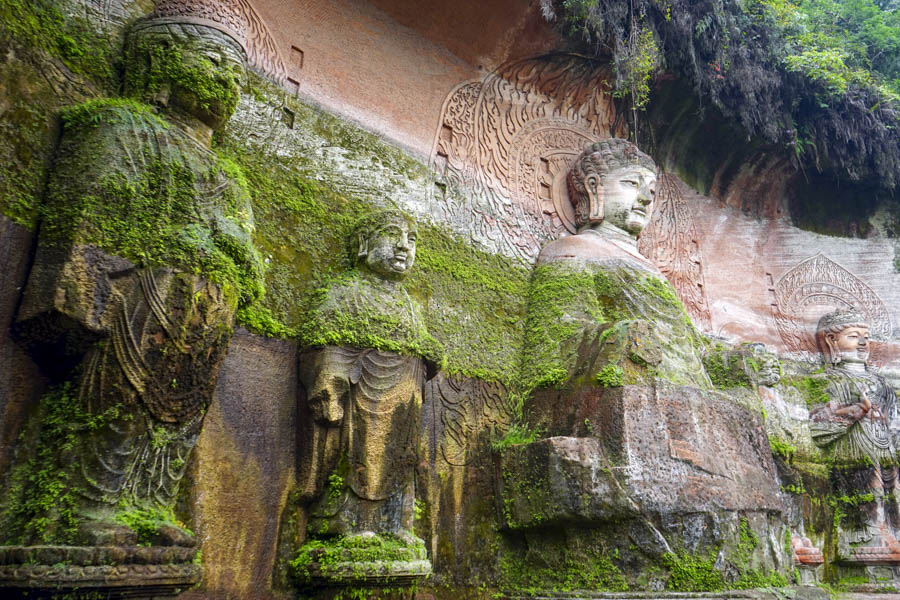
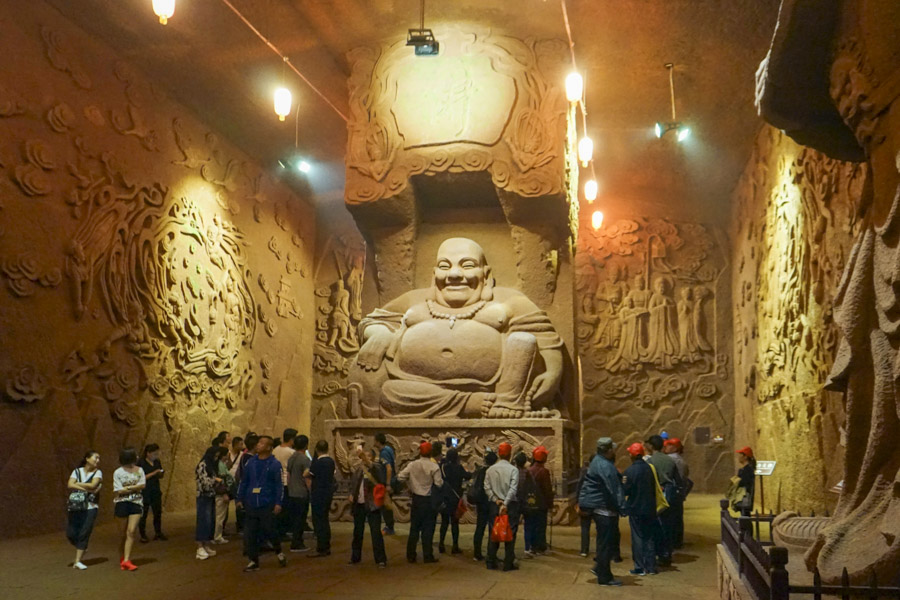
Start with the so-called modern art caves at the entrance, in the Oriental Buddha Park. This is the most theatrical part of the approach, built in the 1990s, but it is still worth your time. The cave chambers and giant figures create decent Buddhist imagery before you reach Lingyun Mountain. The Ten Thousand Buddha Cave is the key stop here, with dense rows of figures and painted ceilings.
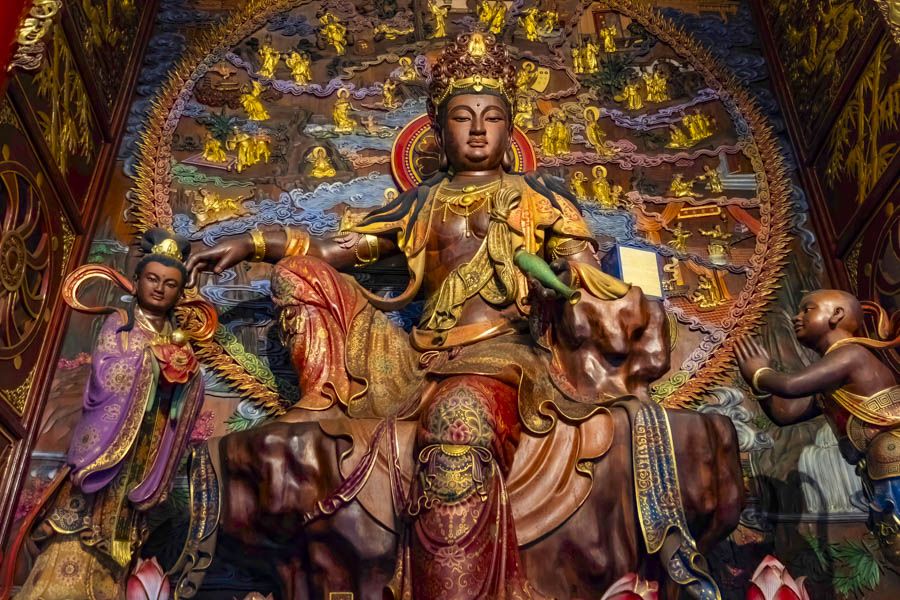
Then make your way to Lingyun Temple, the main Leshan Buddha temple above and behind the statue’s head. The temple predates the Buddha itself, though what you see today is largely Qing reconstruction. Its three-part layout of the Hall of Heavenly Kings, Mahavira Hall, and Scripture Hall gives the upper section a calmer mood.
The old trees, incense, crimson walls, and green-tiled roofs slow the pace before the route turns dramatic again. If you have time, look out for nearby Lingbao Pagoda, one of the area’s oldest surviving landmarks.
Not far from there lies a small but important stop, Haishi Cave (海石洞) , linked to the Haitong. With Haitong's image outside, facing the giant figure, people believed he lived in this cave once. It is one of the few places in the scenic area where the legend feels personal rather than monumental.
After that comes the section everybody remembers: the Nine Bends Plank Road, better known now as the scary cliff stairs. This is the descent cut into the rock beside the Buddha, narrow in places, steep throughout, and one-way once you begin. The path gives you the closest reading of the statue, from the ears and shoulders down to the immense feet.
Another Leshan giant Buddha fact is that near the exit you don't need to rush past the red Haoshang Bridge (好上桥). The bridge is calmer than the Buddha area but stays with you. Built as a free crossing and reflected in the water below, it links the scenic zone to the temple side around Wuyou Mountain. Among the many religious sites in China, few end with a bridge this graceful.
How to Get to the Leshan Giant Buddha
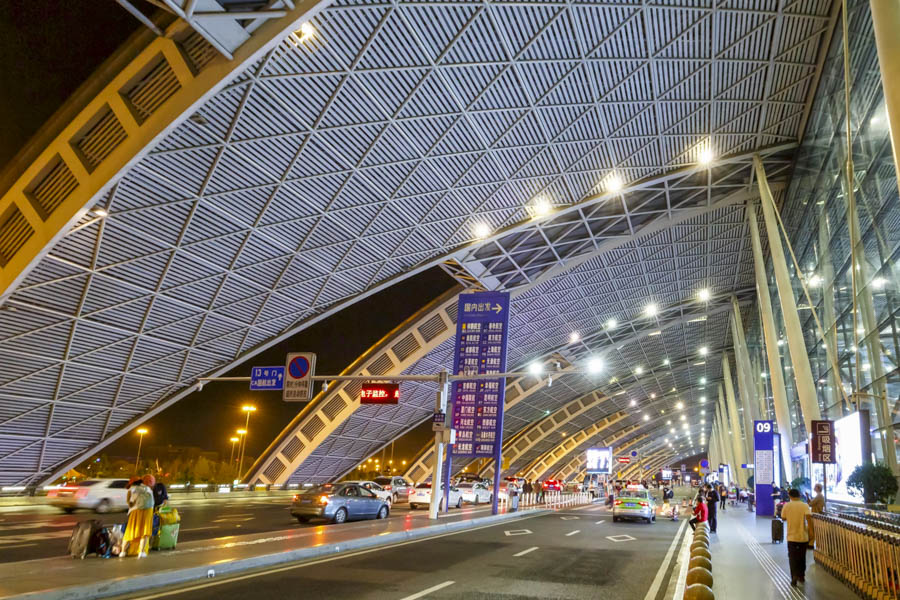
The Leshan Giant Buddha sits around 150 kilometres south of Chengdu; it works best as a day trip from Chengdu. The simplest public option is the high-speed train to the Leshan Buddha location. The bullet train runs regularly from Chengdu East and Chengdu South to Leshan Railway Station. The journey times are usually between 46 minutes and 1 hour 16 minutes.
If planning the route feels like too much work, a Leshan Giant Buddha tour inside a longer itinerary can make more sense. Our 16-day Central China Grand Tour will take you to the Giant Buddha with a Yangtze River cruise along the region's major landmarks.
From Leshan Xiaoba Tourism Station, Bus 3 or Bus 605 will take you directly to the scenic area in roughly 45 minutes to 1 hour. A taxi gets you there in around 15 minutes. Chengdu Shuangliu Airport (CTU) also has direct rail connections to Leshan, with some journeys taking around 40 to 50 minutes.
From Chengdu’s Xinnanmen Bus Station (乐山肖坝旅游站), long-distance buses leave frequently for Leshan Xiaoba Tourism Station. This road journey takes about two hours. From Xiaoba Station, visitors usually transfer to Bus 13 or take a short taxi ride onwards to the Buddha area.
If you are coming from Mount Emei, there are direct tourist buses to the scenic area in about 45 minutes. The rail hop between Leshan and Emeishan itself is very short, around 15 minutes, followed by a local transfer.
Tips for an Optimal Visitor Experience
The first thing to know is that this visit is more physical than many people expect. If you choose the walking route, visiting the Leshan Giant Buddha, you should be prepared for long stair sections. Additionally, there are uneven stone paths and the narrow one-way descent beside the statue.
This excursion is unsuitable for travellers with limited mobility, knee problems, vertigo, or anyone uncomfortable on steep steps. In such cases, the Leshan Buddha boat tour is the optimal option and still provides the full frontal view.
Wear proper walking shoes, as the Nine Bends Plank Road is steep, narrow, and uneven in places, and some sections feel so vertical. There is no shortcut once you start the descent. In warmer months, bring sun protection and water. If rain looks possible, pack a light umbrella or rain jacket, as the paths can turn slippery.
Buy your tickets in advance through the official WeChat Mini Program by searching "大佛旅游". On-site tickets are available, but during peak periods the queues at the gate add unnecessary stress. Keep in mind the daily visitor cap of 26,000 people, which does sell out on busy days.
It also helps to decide in advance how much of the site you want to cover.
The main scenic route suffices for many visitors, but the Reclining Buddha and the Oriental Buddha Park require extra time and an extra ticket. If that interests you, plan for it before you arrive rather than making the decision at the counter.
Near the top, around Lingyun Temple, you will find one of the most convenient scenic spots of the route. It is the right place to catch your breath before the descent.
A good Leshan Giant Buddha travel guide should leave room for that pause. The largest Buddha in the world is one of those sites that improves when you stop trying to rush through it.
Leshan Giant Buddha is one of the major stops for a comprehensive Sichuan journey. To experience it entirely is to understand the destination as an entire landscape. At the mountain head level, feet above the river, and with the old paths circling around it, the Buddha is now facing thousands of tourists.