

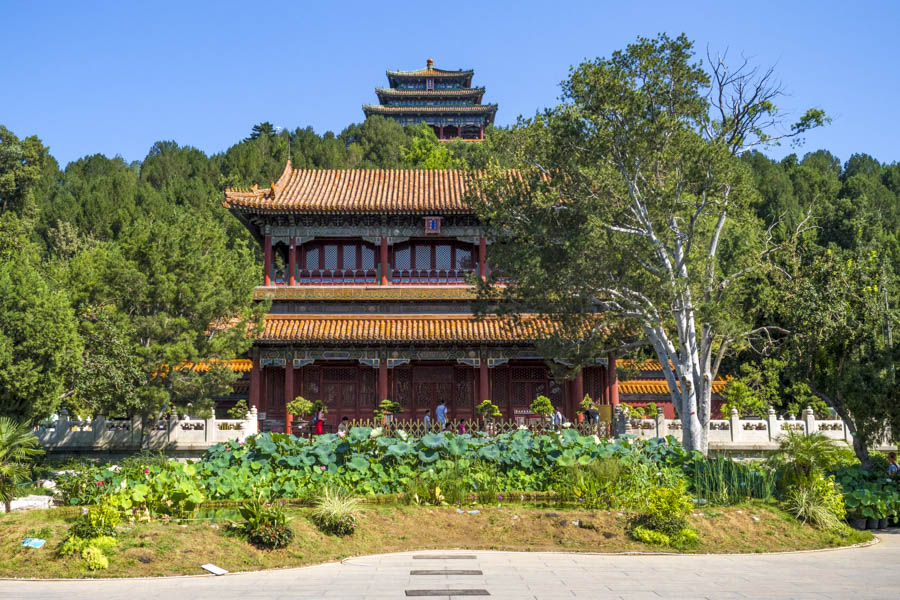
Jingshan Park (景山公园) is Beijing’s remarkable man-made ceremonial high point on the city's historic Central Axis, inscribed on the UNESCO World Heritage List, shaped by imperial planning, feng shui, and a strong sense of urban symmetry. Immediately north of the Forbidden City, it forms part of the same grand north–south composition, with the island-set Beihai Park to the west and the wider historic Shichahai area not far away, with its hutong alleyways that preserve a gentler, lived-in character.
At the heart of the park rises Jingshan Hill (景山), an artificial elevation standing about 45.7 metres (150 feet) high, whose name is commonly translated as “Prospect Hill”, referring to its elevated vantage point. The long-standing English name “Coal Hill” is often explained through local belief, suggesting that coal may once have been stored here.
The ascent finds its natural conclusion at Wanchun Pavilion, where the view of the Forbidden City from Jingshan Park opens out in one of the most iconic panoramas in all of Beijing.
Covering about 23 hectares (57 acres), Jingshan Park has a surprisingly spacious, wooded character despite its central location. There is enough planted area and unhurried atmosphere here to make it genuinely well suited to slow wandering and “nature bathing”.
Jingshan Park Tours
Jingshan Park is included in several of our Beijing itineraries, each designed to suit a different pace and appetite for exploration.
If you are after a focused introduction to the city, the 4-day Best of Beijing Tour is a wonderful place to start. It combines the grandeur of the Forbidden City and the tranquil heights of Jingshan Park with visits to the Summer Palace, the Temple of Heaven, the Mutianyu section of the Great Wall, and the charming waterside lanes of the Shichahai area.
Those with a little more time may find the 6-day Ancient Capitals of China Tour more to their taste. Alongside Jingshan Park, the journey takes in Qianmen Street, Tiananmen Square, the Forbidden City, the Summer Palace, the Temple of Heaven, and the Great Wall, continuing on to the legendary cradle of the Silk Road, Xi’an.
For those keen to venture further, our longer China journeys tend to trace a well-loved path through Beijing, Xi'an, and glittering Shanghai. These fuller itineraries bring together imperial majesty, old-city character, and carefully chosen cultural moments, forming a richer, more panoramic sense of this endlessly fascinating country.
Best Time to Visit Jingshan Park
Spring (April and May), with average temperatures from 10 °C (50 °F) to 25 °C (77 °F), brings flowering trees that soften the geometry of the hill, and many consider it the finest time to visit Jingshan Park. Autumn (October and November) comes with clearer skies, temperatures from 8 °C (47 °F) to 26 °C (78 °F), and with them some of the most vivid views over the golden rooftops of the Forbidden City.
Summer is lush and vibrant, though heat and humidity can make midday climbs less than comfortable for some travellers, with daytime highs up to 33 °C (77–91 °F). Winter, by contrast, is quieter and more contemplative; after snowfall, the park yields some of Beijing’s most striking frames, so it is not uncommon to find photographers stationed on the hill, waiting patiently for the perfect shot of the snow-dusted Forbidden City below.
Weekdays are generally calmer, and visiting outside peak holiday periods, such as the Golden Week of China’s National Day, helps to encounter smaller crowds.
Time of Day
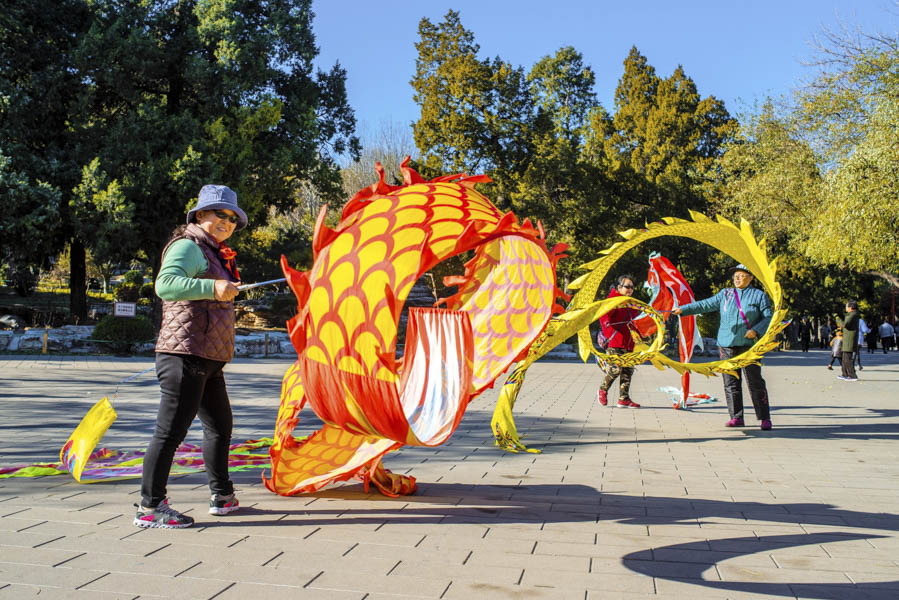
Early morning is when the park belongs to locals, with Tai Chi, singing, and dancing filling the quieter corners before the day properly begins. In warmer months, the hour before sunset is worth lingering for, as the light settles across the palace complex in long, warm tones.
Jingshan Park Opening Hours
The Jingshan Park opening hours vary slightly by season, allowing visitors to experience the park from early morning through to the evening. Open daily, Jingshan Park hours are:
| Peak season: April 1 to October 31 | 06:30 to 21:00 | Last entry at 20:30 |
| Low season: November 1 to March 31 | 06:30 to 20:00 | Last entry at 19:30 |
Early visits may be particularly appealing for those wishing to experience the park alongside local residents, while the later closing time in warmer months allows for unhurried evening walks.
Practical Information
Entry Gates
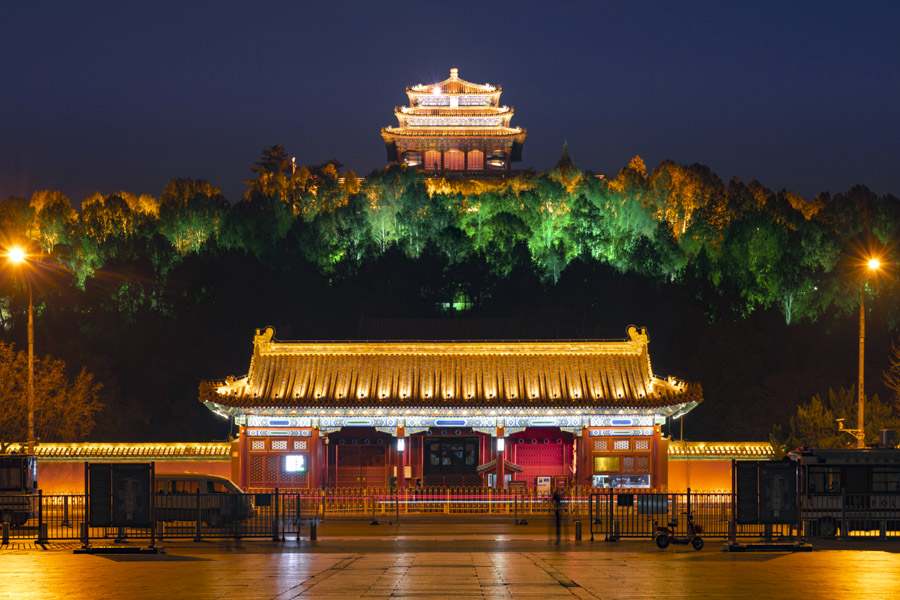
Jingshan Park has four entrances – south, east, west, and north – though the north gate is currently closed to visitors. Most arrive through the South Gate, which faces the Forbidden City's Gate of Divine Might across Jingshan Front Street.
Jingshan Park Tickets
The standard Jingshan Park ticket price is CNY/RMB 2 (approximately $0.30 / £0.20 / €0.25)* per person. Children below the age of 6, or under 1.2 metres (4 feet) in height, enter free of charge. Young visitors between the ages of 6 and 18 pay CNY/RMB 1 (approximately $0.15 / £0.10 / €0.12)*. Senior visitors aged 60 and above are admitted free of charge with valid identification. Holders of the Annual Pass for Beijing's Parks (北京市公园游览年票) may scan and enter directly.
Ticket prices change during two cultural seasons. During the Peony Cultural Festival (typically mid-April to mid-May) and the Summer Culture Season (mid-July to mid-August), the standard adult Jingshan Park entrance fee rises to CNY/RMB 10 ($1.45 / £1.10 / €1.25).*
*Note: Prices may change without prior notice. Conversions are approximate and for reference only.
Payment Methods
Since 2024, the mandatory online reservation system has been abolished. Jingshan Park tickets can be purchased on the day at any of the three open gate windows. Advance booking remains available through the WeChat mini-programme, which offers English-language support for those who prefer to plan ahead.
Beijing is a predominantly cashless city, and mobile payment via apps such as WeChat Pay and Alipay is the norm. Bear in mind that WeChat Pay requires a Chinese phone number to set up, which may not be practical for short-stay visitors. In that case, simply purchasing at the gate window in cash remains a perfectly straightforward option.
Suggested Routes
1) The Full Circuit (South Gate to East Gate)
Allow 2 to 2.5 hours
This is a rewarding route for first-time visitors, combining historical depth with some of the finest perspectives in central Beijing. Enter through the South Gate and turn right. A short walk brings you to a spot on the eastern slope associated with the Ming Emperor Chongzhen. From here, follow the signed path up the hillside to reach the ridge, where all five pavilions are arranged in sequence from east to west: Zhoushang, Guanmiao, Wanchun, Jifang, and Fulan.
The central Wanchun Pavilion, set at the summit, commands the most impressive panorama. The Forbidden City stretches southward in its full symmetrical immensity, while the Drum Tower, Bell Tower, and Olympic Park trace the axis to the north. Descend via the western path and, if you have reserved in advance, proceed to the Shouhuang Hall, the ancestral hall complex of the Qing emperors, before exiting through the East Gate.
Please note: Shouhuang Hall is not included in the standard park ticket.
2) The Accessible Garden Route (South Gate loop)
Allow 1 to 1.5 hours
Families with strollers and visitors who prefer a gentler pace will find the flat garden paths of the lower park accessible and genuinely rewarding. Enter through the South Gate, where wide, smooth paths lead through the park’s renowned peony gardens, at their most spectacular in April and early May, when some 20,000 blooms from over 500 varieties fill the lawns before Shouhuang Hall. The lower pavilions and ancient cypress groves provide shaded resting spots throughout.
Please note: wheelchair and stroller hire is available at the South Gate Visitor Service Centre. The path to the summit pavilions involves numerous flights of stairs; visitors are advised to plan their route accordingly.
Visiting at Night
Jingshan Park at night is one of the least crowded ways to experience the heart of imperial Beijing. The park rewards an evening visit, particularly on Fridays and Saturdays when the Forbidden City is illuminated until 20:00. The view from Wanchun Pavilion of the palace rooftops glowing against a darkening sky is one of the most atmospheric sights in Beijing. Aim to arrive by around 17:30 to catch the sunset, then stay on as the lights come on below.
Please bear in mind: beyond 19:00, the paths within the park become less lit, so a small torch is worth bringing, and a careful descent is advisable.
History of Jingshan Park
The story of Jingshan Park reaches back nearly a thousand years to the Jin Dynasty, when earth excavated from nearby waterways was first piled up to form the beginnings of this hill. By the time the Yuan Dynasty established Beijing as its capital in the 13th century, the site had become part of the imperial garden complex, serving as the rear garden of the palace throughout the Yuan, Ming, and Qing dynasties.
The hill took its present form during the Ming Dynasty, particularly under the Yongle Emperor (1402–1424), who shaped it into five peaks using soil excavated from the moats of the Forbidden City. Carefully positioned along the city's Central Axis, it served both as a designed landscape and as a feng shui shield against the cold northern winds.
The park also served as the royal family's private grounds for leisure and training, where emperors and their sons practised horsemanship and archery. Legend has it that the young Qianlong Emperor once impressed his grandparents by shooting three arrows in perfect succession. As emperor, Qianlong later added five glazed-roof pavilions to the hill's peaks, each housing a bronze Buddha statue in accordance with Buddhist cosmology.
One of the park's most tragic historical associations dates to 1644, when the Chongzhen Emperor, the last ruler of the Ming Dynasty, died on the eastern slope of the hill. A commemorative site marks this moment.
The grounds were opened to the public in 1928, and the park was formally established in 1949. Today it remains one of Beijing's most cherished green spaces, drawing locals and visitors alike.
Major Landmarks at Jingshan Park Not to Miss
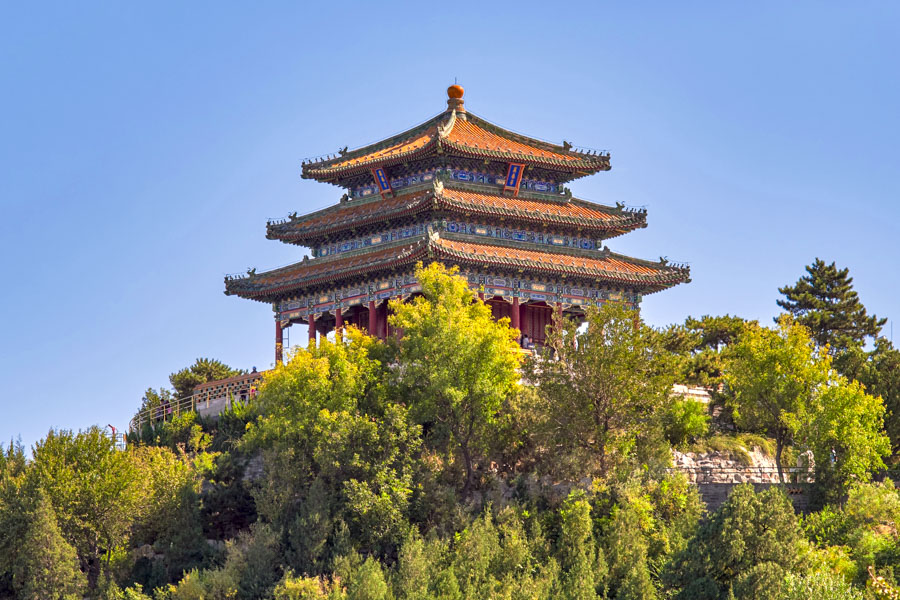
From Qiwang Tower at the south gate, the path rises towards Jingshan’s five ridge-top pavilions, arranged symmetrically along the crest with Wanchun Pavilion at the centre and highest point.
As you move from the eastern and western pavilions towards the middle, the views open up gradually until the summit reveals a broad panorama over the Forbidden City and Beijing’s Central Axis.
North of the summit, the atmosphere changes, with the Shouhuang Hall Complex, Guande Hall, and some of the park’s oldest trees creating a more reflective corner of the park.
Qiwang Tower
The first building you encounter upon entering through the South Gate is Qiwang Tower (绮望楼), a two-storey structure with a golden-glazed roof, sitting at the foot of the hill. It served as the place where students of the Jingshan Official School paid homage to Confucius. Today it functions as a cultural exhibition space for calligraphy, painting, and porcelain. It is a wonderful and quiet introduction to the park before the climb begins.
The Five Pavilions
The five pavilions crowning Jingshan's ridge are the park's most iconic sight and the image that draws visitors up the hillside. They were built during the Qianlong reign, in 1750, as part of the wider works completed around 1749–1751.
Arranged from east to west, they are:
- Zhoushang (周赏亭, All-Round View Pavilion)
- Guanmiao (观妙亭, Wonder Appreciation Pavilion)
- Wanchun (万春亭, Pavilion of Everlasting Spring)
- Jifang (辑芳亭, Pavilion of Gathering Fragrance)
- Fulan (富览亭, Eye-Feasting Pavilion)
The outermost two, Zhoushang and Fulan, are identical in form: circular, double-eaved pavilions rising 11.75 metres (38.6 feet). Their roofs are clad in peacock-blue glazed tiles with purple crystal-glazed edging.
Guanmiao and Jifang face one another as matching octagonal pavilions, slightly taller at 12.05 metres (39.5 feet), their emerald-green tiles offset by warm yellow trim.
At the summit stands the Wanchun Pavilion, the grandest of the five: a square, triple-eaved structure reaching 15.38 metres (50.5 feet), roofed in imperial yellow. The view it commands – of the Forbidden City spreading southward in its full symmetry – is the reason most visitors come to the park.
Each pavilion once housed a bronze Buddha; together they were known as the “Five Gods” or “Five Flavour Gods”, representing sweet, pungent, bitter, sour, and salty. In 1900, four were taken away by the Eight-Nation Alliance, and one was destroyed during the Cultural Revolution. Today, only one of the statues has been restored.
The pavilions are only part of the story. At ground level, Jingshan preserves a series of imperial buildings that carry their own distinct weight of history.
Shouhuang Hall Complex
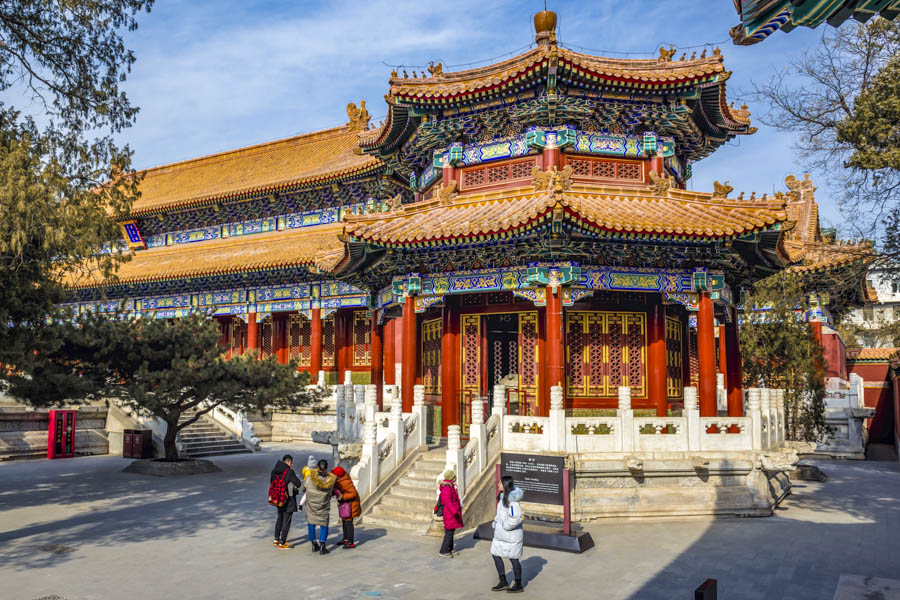
Set to the north of the central peak, the Shouhuang Hall Complex (寿皇殿, Hall of Imperial Longevity) is one of the park’s most architecturally significant yet less visited areas.
First established during the Ming Dynasty, it was extensively rebuilt by the Qianlong Emperor in 1749, where its scale and grandeur surpassed that of its predecessor. It once housed the portraits and memorial tablets of eight emperors and their empresses, from the Kangxi to the Guangxu reign, and served as the principal site for Qing imperial ancestral worship. Shouhuang Hall Complex is described by Beijing municipal sources as the second-largest ancient building complex on the Central Axis after the Forbidden City.
The approach establishes a ceremonial tone before the buildings come into view. Three four-column archways mark the outer precinct, each three bays wide in classical imperial proportion. Beyond them, a pair of stone lions flank the path leading to the Shouhuang Gate, where three doorways open into the inner courtyard, the central one traditionally reserved for the emperor.
Within the walls, the complex comprises the main hall, flanking side halls, stele pavilions, and the remains of the imperial kitchens. The main hall faces south, nine bays wide and three deep, its eaves bearing a plaque inscribed with its name. Bronze deer and cranes stand on pedestals in the courtyard, and a glazed-tile pavilion survives beside an ancient well.
Guande Hall
Historically rich Guande Hall (观德殿) stands in the eastern part of the park. Built in the Ming dynasty, it was originally used as a place for the emperor to watch archery practice. In the Qianlong era, after Empress Xiaoxianchun died in 1748, the hall was repurposed as a temporary mortuary space.
The Ancient Trees
Jingshan’s ancient trees deserve a moment of their own. Within Jingshan Park there stand some of its most storied living monuments, including the pair known as the 二将军柏 (Èr jiàng jūn bǎi). These venerable trees were named by the Kangxi Emperor, who is said to have admired their upright bearing and associated them with the virtues of loyal generals.
Nearby grows another curiosity: the 槐中槐 (Huái zhōng huái), sometimes called the “mother-and-child pagoda tree” or “Scholar-Within-Scholar Tree”, where a younger tree has taken root within the hollow trunk of an older one.
These trees are enduring reminders that this landscape has been tended, observed, and appreciated across centuries of imperial and public life.
Many other ancient structures await visitors with an interest in history, including the coffins of Qing dynasty nobles in the Guandedian (Visiting Virtue Hall) and the memorial tablet for Confucius in Xiwanglou (Hope Tower).
Heritage and Conservation
In July 2024, UNESCO inscribed the Beijing Central Axis as a World Heritage Site. This axis comprises fifteen components, forming a 7.8-kilometre (4.8 miles) ceremonial spine running from Yongdingmen Gate in the south to the Bell and Drum Towers. This ensemble speaks volumes about the ideal spatial order of the traditional Chinese capital, encompassing palaces, altars, ceremonial structures, and historic roadways.
The designation reinforces ongoing conservation efforts. Since 2011, numerous restoration projects have been undertaken across the axis. Within the Jingshan Park, the most significant is the rehabilitation of the Shouhuang Hall Complex. Restoration began in 2013, and the complex has since partially reopened.
Festivals, Exhibitions, and Entertainment
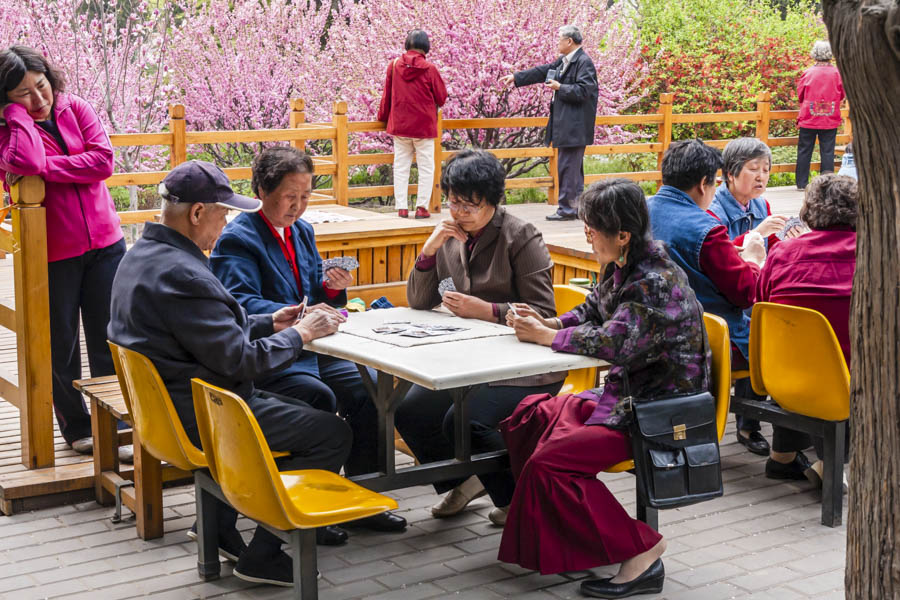
Jingshan Park rewards visitors in every season, but it is perhaps most alive in spring, when the lower grounds swell with blossom and the grounds reawaken after one more winter.
Spring Flower Displays
From late March, the first blossoms come into flower across the lower grounds, a gentle overture to what follows.
The main event is the annual Peony Cultural Festival (北京牡丹文化节), typically held from around 10 April to 10 May, celebrating a flower long cherished in Chinese culture as a symbol of beauty, prosperity and honour.
Jingshan has been a site of peony cultivation since the Yuan Dynasty, and the garden it has accumulated over those centuries is the largest of its kind in Beijing. At peak bloom in late April, roughly 20,000 plants (including century-old specimens descended from imperial stock) fill the lawns before Shouhuang Hall in colours ranging from deep crimson to ivory white. Over 500 varieties are represented, among them rare cultivars with no counterpart elsewhere in the city.
Exact dates shift slightly from year to year depending on growing conditions, and the park announces the official opening of the season on its WeChat channels in early April.
Seasonal Exhibitions and Cultural Events
Beyond its floral displays, Jingshan Park hosts a recurring programme of exhibitions and cultural events across the seasons. These include specialist showcases such as the Beijing Bonsai Exhibition (北京市盆景展) and the Beijing–Tianjin–Hebei Bonsai Art Joint Exhibition (京津冀盆景艺术联展).
Heritage-themed displays, including palace-style intangible cultural heritage exhibitions, and occasional cultural-creative markets are also staged within the grounds, sharing traditional aesthetics and craftsmanship with visitors. These events are generally modest in scale, sitting comfortably within the park’s historic atmosphere.
Everyday Life and Local Entertainment
Part of Jingshan Park's particular charm lies in its daily rhythms. On many mornings, the lower paths fill with residents practising Tai Chi, dancing in small groups, or singing. On weekend afternoons, the south side of the hill becomes an informal stage for kuaiban (快板), a traditional northern Chinese form of rhythmic storytelling performed with bamboo clappers. With roots in street entertainment, kuaiban combines rapid-fire verse, comic timing, and the crisp percussive sound to produce something between poetry recital and stand-up comedy. Performers and audience alike tend to be regulars, and the atmosphere is often described as one of genuine community. No programme, no tickets – simply find the gathering and take a listen.
Calligraphy master classes and traditional music performances may also appear periodically throughout the year.
How to Get to Jingshan Park?
Jingshan Park is easily accessible from central Beijing and makes a convenient stop after the Forbidden City, with a short underground crossing at Jingshan Front Street bringing you directly to the south gate.
The nearest metro access is via Line 8 to National Art Museum Station. From there, visitors can transfer to a short bus ride (for example, Tram 109 or Bus 58) or walk for 10–20 minutes to one of the park’s entrances.
For buses and trams:
| Gate | Tram | Bus | Tourist Shuttle |
| South gate (opposite the Forbidden City) | 101, 103, 109, 124 | 58 | 1 or 2 |
| East gate | 111, 124 | 58 | |
| West gate (near Beihai Park’s east gate) | 5, 58 |
For ridehailing apps such as DiDi, it is best to pin a specific entrance, for example, “South Gate, Jingshan Park”, rather than simply the park name, as this makes it easier for drivers to locate you.
Tips for an Optimal Visitor Experience
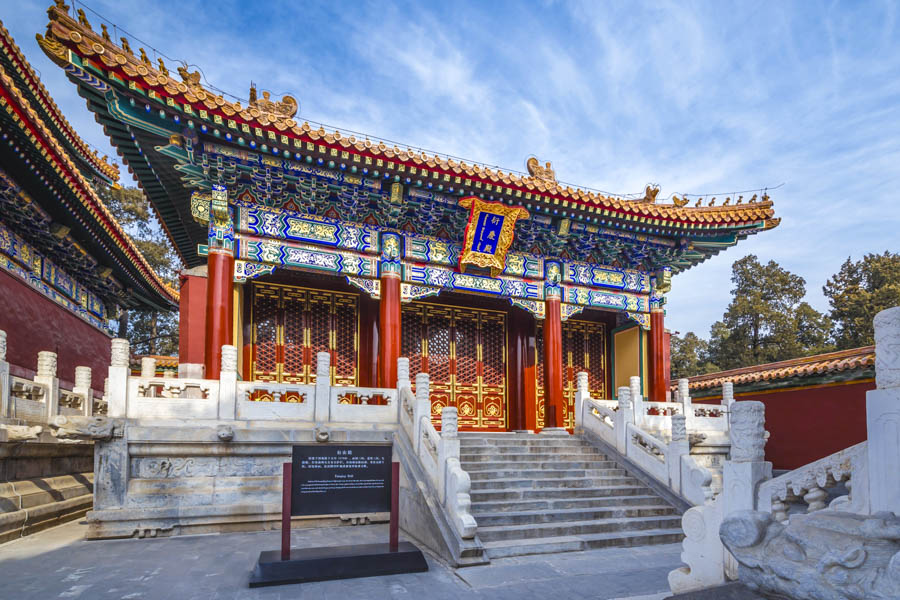
Start your visit at the South Gate.
For most visitors, the south gate is the most natural place to begin, especially if you are arriving from the Forbidden City. It places you directly on the park’s central axis and close to the main route up the hill. Near this entrance, you will also find the visitor services point, which can be helpful for directions and general information.
How Long Does It Take to Climb Jingshan Hill?
The ascent to the summit is pleasantly short and manageable, usually taking around 10 to 15 minutes at an easy pace. The paths are well maintained, and the climb is steady rather than strenuous. It is worth allowing extra time to pause along the way and enjoy the changing views through the trees.
Take Your Time on the Way Down
The path descending past Fulan Pavilion offers a quieter, more reflective experience. The slope gently encourages a slower pace, making it a lovely opportunity to linger among the trees and take in the surroundings.
If you are deciding between Beihai Park or Jingshan Park, the latter lends itself to a shorter visit centred on elevated views, while Beihai offers a more expansive, waterside setting. The two lie only a short distance apart, and together they reflect different aspects of Beijing’s historic landscape. Yet Jingshan Park has a particular appeal: a measured ascent, a moment of stillness beneath the pavilions, and a clear, commanding view across the Forbidden City. For a concise yet resonant experience of the city’s imperial past, it remains a quietly rewarding choice.