

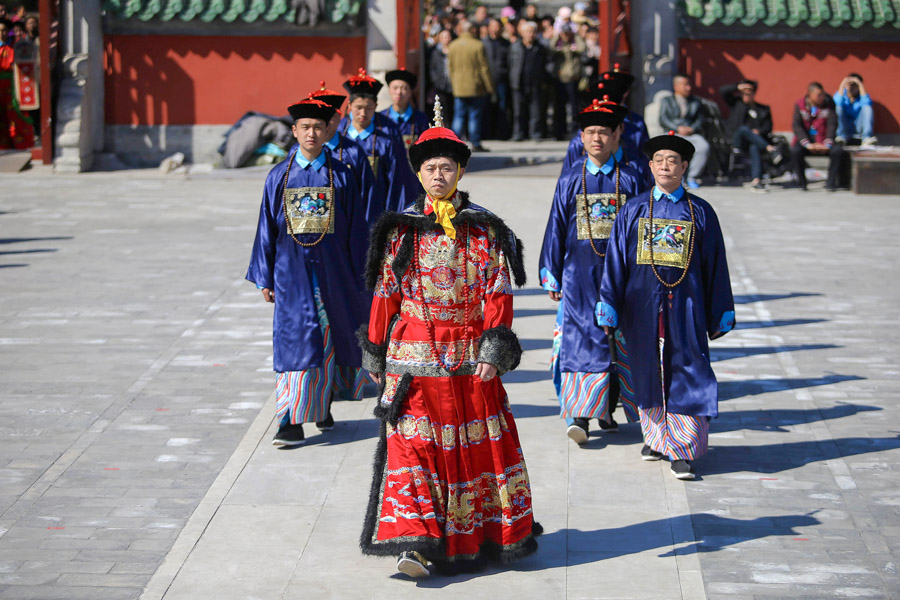
Chinese national clothing embodies centuries of history, expressed through texture, pattern, and vivid colour. Across the country, regional styles of dress evolved over time, while imperial dynasties introduced changing fashions in silhouette, ornamentation, and the finer details of appearance. It is closely linked to elements of Intangible Cultural Heritage recognised by UNESCO, such as traditional textile techniques, embroidery practices, and ethnic minority costumes, which together reflect the diverse cultural identity of the nation.
This overview traces a broad historical panorama of Chinese costume – ranging from early ritual garments to the refined wardrobes of court elites and the sumptuous robes of the supreme ruler himself.
From Neolithic Roots to Early States
In early communities, prior to the emergence of large settlements and the first dynasties, clothing served both practical needs – providing protection against cold and wind – and a nascent desire to express group identity. Even at Palaeolithic hunter-gatherer sites – such as the Peking Man Site at Zhoukoudian (周口店) dating back 18,000–11,000 B.C. near modern Beijing, which is inscribed on the UNESCO World Heritage list – archaeologists have discovered bone artefacts with pierced holes, likely used for stitching animal skins. Additionally, ceramic finds and rock paintings further suggest that early people were capable of producing simple garments which played a meaningful role in rituals and sacrifices.
Over time, as agriculture and settled life became established, communities began to develop weaving skills. In Neolithic cultures, for instance, the Hemudu culture (河姆渡文化) flourished around 5500 BC–3300 BCE along China’s eastern coast. Archaeologists have discovered the remains of an important cloth manufacture site, along with artefacts such as ceramic spindles. Evidence indicates that weaving and sewing techniques were evolving well before the formation of early Chinese states.
Dress Traditions of the Ancient Dynasties
With the rise of early civilisations, clothing increasingly assumed social significance. Under the Xia (2070–1600 BCE), Shang (1600–1046 BCE), and Zhou (1046–256 BCE) dynasties, as well as during the Spring and Autumn Period (770–481 BCE) – the first part of the Eastern Zhou dynasty – ritual hierarchy was strongly emphasised. Formal outfits, including crown attire known as mianfu (冕服) and ceremonial belts called hubo (笏帛), signified rank and status, establishing key aesthetic principles of early Chinese dress.
Archaeological evidence indicates that a recognisable cut was already widely adopted, featuring a crossed collar that wrapped from right to left, along with an outfit structured around an upper garment paired with a lower element. In the Xia era, elite dress favoured rich colours, particularly prominent shades of black. During the Shang period, refined white ensembles were highly prized. Under the Zhou, the colour palette expanded significantly, incorporating both dark and light tones. Over time, ritual elements and distinctive tailoring details played a crucial role in shaping what would later become the traditional clothing of the Han people – known as hanfu. This garment has been worn since the reign of the Yellow Emperor, who, according to the legend, is said to have invented it, while his wife, Leizu, is credited with the invention of silkworm breeding.
Clothing in the Imperial Era
After the empire was unified under Qin Shi Huangdi of the Qin dynasty (221–207 BCE), one form of hanfu became especially widespread: the shenyi (深衣).
The upper garment is a flowing blouse with a crossover neckline and large sleeves, made of four pieces of fabric, representing the four seasons. Shenyi's lower garment is a long, flowing skirt made of twelve pieces of fabric, representing the twelve months of the year.
This tradition continued under the Han dynasty (202 BCE–220 CE): women paired the upper part of the robe with ruqun skirts, while men wore it with long trousers. Shenyi's design was heavily influenced by the social society, moral values, and philosophical thoughts of the time (Confucianism). It became the standard dress of scholars and government officials and served as the visual representation of social rank.
With the fall of the Han, between 220 CE and 581 CE, clothing evolved significantly due to regional fragmentation. Diverse styles emerged during the Three Kingdoms period (220-280 CE), with women wearing very elegant skirts or dresses. These garments were generally long, adorned with intricate embroidery featuring floral motifs and auspicious animals. Outfits were embellished with various accessories, including combs and hairpins made of gold and silver set with precious stones such as jade.
These changes set the stage for the elaborate styles of the Sui (581-618 CE) and Tang (618–907 CE) dynasties. Dress underwent noticeable transformations: silhouettes became more voluminous, fabrics lighter and richer in silk, skirts rose higher, and upper garments grew shorter. Women wore ruqun (襦裙) fastened with belts beneath the bust and adorned themselves with long, flowing shawls known as xiapei (霞帔). Meanwhile, men preferred yuanling pao (圆领袍) with rounded collars. The colour palette was bright and saturated, often employing combinations of hues, while patterns leaned towards floral motifs and densely worked designs.
During the Song dynasty (960–1279 CE), Confucian and Taoist aesthetics promoted a more restrained and rational style. Forms were simplified, silhouettes became more streamlined and practical, and softer, natural tones came into vogue. Lightweight outer capes known as beizi (褙子) appeared in both men’s and women’s versions. An important innovation was the emergence of a new women’s skirt form, the mamianqun (马面裙), made from a single piece of fabric gathered into multiple folds. This design allowed for considerable freedom of movement, contributing to its popularity in later periods.
The Yuan dynasty (1271–1368 CE), a period of Mongol rule and intensified ethnic mixing, brought visible changes to national dress. The era is marked by the combination of established Han clothing forms with new influences from the northern steppes. The long sleeveless garment bijia (比甲), designed by Empress Chabi, became widespread, featuring characteristic side slits that were practical for riding horses while shooting arrows. Court ceremonial wear included the jisün, also known as zhisunfu (质孙服), a single-coloured silk robe embroidered with gold thread.
The Ming dynasty (1368–1644 CE) signalled a renewed emphasis on Han aesthetics. Under the founder of the dynasty, the Hongwu Emperor, clothing regulations returned to norms closer to Tang styles and earlier forms of hanfu, favouring rounded collars and stricter cuts. Yet the early decades after the fall of the Yuan did not immediately erase Mongolian influence: some members of the court and elite continued to retain elements of earlier dress for a time.
Under the Qing dynasty (1644–1912 CE), clothing shifted sharply under the new political order. Men, following Manchu court regulations, were required to wear long, straight robes – most commonly changshan (長衫) or changpao – with a more formal cut, straighter lines, and without wide sleeves. Bright silk textiles gradually gave way to more muted cotton garments, and the earlier expression of status through tailoring details was increasingly replaced by class uniformity.
Transformations from Late Empire to Republic
After the 1911 revolution and the fall of the Qing dynasty, the new government abolished hierarchical dress rules, allowing individuals of any status to wear what they chose. Regulations largely applied only to civil service uniforms. In major cities such as Shanghai, affluent men increasingly adopted Western clothing, including business suits. However, new fashions did not simply displace established forms: Manchu-style robes such as changpao and magua (马褂) continued to be worn. Women also dressed in Qing-influenced styles, favouring form-fitting cheongsam dresses (长衫). Designers introduced Western materials such as velvet, lace, and light chiffon, combining them with silk and brocade. Art Deco motifs, crisp geometric designs, and expressive floral patterns became prominent in fashion.
With the founding of the People’s Republic of China in 1949, earlier styles were replaced by a new state aesthetic – the Mao suit. This standardised outfit became a symbol of collectivism and equality: visible distinctions of status receded, and clothing adopted a utilitarian, socially coded character. Only after the reforms of the 1980s did traditions begin to re-emerge more openly, as clothing again became a tool of self-expression in many cities. Some individuals embraced Western tailoring, while others turned to wardrobes shaped by tradition. Gradually, interest in classic forms, the use of silk, and elements of historical tailoring was revived.
Chinese Contemporary Currents and Urban Fashion
Contemporary Chinese fashion is an evolving dialogue between heritage and innovation. By the late 20th and early 21st centuries, global cultural currents significantly influenced traditional Chinese clothing. Western styles gained popularity in cities, with many people opting for garments made from modern materials, including T-shirts, jeans, baseball caps, and trainers. However, contemporary Chinese fashion often showcases a confident synthesis: stand-up collars, pankou knot buttons (盘扣), and motifs such as dragons, cranes, or floral designs are integrated with Western casual wear, sports aesthetics, minimalism, and street-style elements. Rather than preserving tradition unchanged, designers are revisiting clothing in China. They reinterpret familiar silhouettes by combining materials and incorporating bold, eclectic details that bridge past and present.
Traditional and Modern Chinese Fashion: A Dialogue of Forms
Rather than replicating historical costumes, many young designers are turning to traditional dress as a foundation for creative reimagining. Cropped jackets echoing ancient tailoring, skirts that draw on classic shapes, and subtle symbolic motifs now serve as design accents in everyday fashion. One notable example is the qipao (or cheongsam) – a form-fitting dress that evolved in early 20th-century Shanghai from earlier Manchu styles. Today’s versions preserve signature details like mandarin collars or knotted fastenings, but they are rendered in softer fabrics and more relaxed cuts, blending elegance with urban practicality.
Influential Chinese Fashion Designers on the Global Stage
A growing number of Chinese designers are earning international recognition, presenting collections at major events such as Paris and Shanghai Fashion Week. Their work blends elements of national identity with contemporary aesthetics, creating distinctive voices in global fashion.
Among them is Zhang Quan (张权), the founder of the streetwear brand Melting Sadness. His whimsical designs, featuring cartoon-like characters and zodiac motifs, have brought playful reinterpretations of global brands like Adidas and Crocs to the Chinese market.
Guo Pei, one of China’s most celebrated couturiers, is renowned for her sculptural silhouettes, elaborate embroidery, and references to imperial iconography. Her collections, showcased in venues from Beijing to Paris, often unfold as immersive performances where the runway resembles a stage and the garments resemble works of art. She was also featured in the acclaimed Golden Thread exhibition, which traced the evolution of decorative dress from North Africa to East Asia.
Other influential figures in Chinese fashion include:
- Uma Wang, celebrated for her architectural minimalism and textured layering, which blend modern aesthetics with traditional elements.
- Masha Ma, a graduate of the prestigious Central Saint Martins (CSM), a London art and design college, merges European streetwear with Asian precision, creating unique and innovative styles.
- Xander Zhou, whose unisex, sci-fi-inspired designs have helped define the experimental edge of Chinese menswear.
Chinese Urban Fashion: Streets as a Style Laboratory
In cities like Beijing, Shanghai, Hong Kong, and Guangzhou, street fashion has become a creative force in its own right. Young people pair oversized outerwear and trainers with details drawn from folklore or traditional embroidery, crafting looks that are deliberately eclectic and proudly individual. This visual language – born on the streets and shared online – has become a space of experimentation, influencing both domestic brands and high-end labels. Streetwear in China now functions as a cultural movement with its own codes, drawing from both global trends and deeply local sources of inspiration
The story of Chinese clothing is an expressive cultural narrative that preserves memory through taste, craftsmanship, and concepts of beauty. While forms, fabrics, and rules have shifted over time, a pursuit of harmony and respect for tradition have endured. Today, these motifs remain visible in museums, craft workshops, and city streets, suggesting that cultural continuity does not vanish – it simply takes on new forms.