

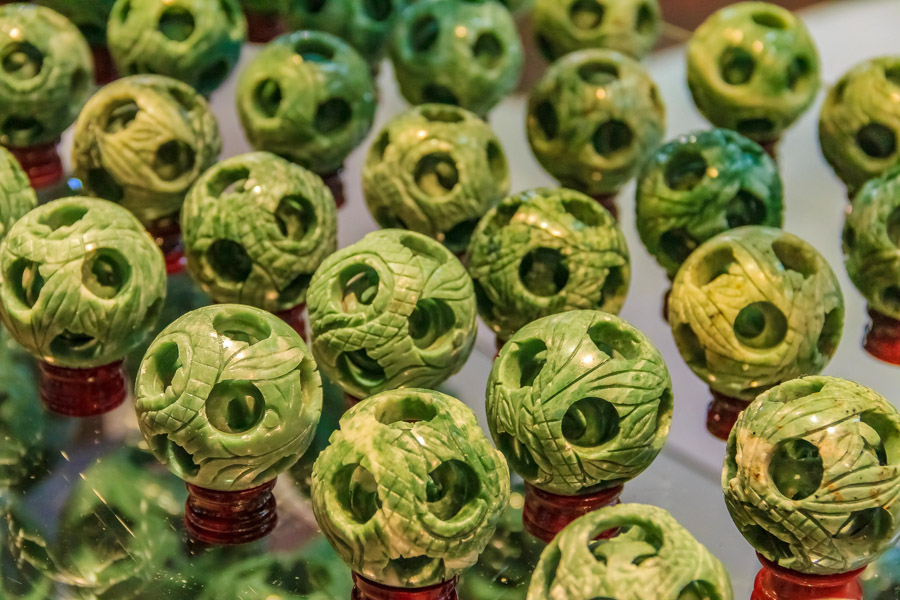
Creating objects from jade is a discipline that demands extraordinary patience, steady hands, and an eye for the smallest shifts in texture – and over thousands of years, Chinese artisans have refined this craft to remarkable perfection.
Traditional Methods and Tools Used
The process begins with a rough block of stone, which is cut, shaped, and gradually coaxed into form. Only then does the slow, meticulous carving begin, followed by hours of smoothing and hand-polishing.
In earlier centuries, craftsmen prepared their own abrasives, a powder from crushed quartz, almandine belonging to the garnet group, or corundum mixed with water. This gritty paste was applied to the jade, which was then polished with a leather rag or even a simple bamboo stick. Water dripped continuously onto the surface, washing away loosened particles as the stone yielded, millimetre by millimetre, to the artisan’s intent. Complex pieces could take weeks or months to complete; even the smallest amulet required countless passes of the hand, which made every object profoundly valuable.
Despite the introduction of modern tools, the heart of the craft has changed very little. Contemporary carvers still reveal jade’s natural beauty through the same steady rhythm of abrasion and polish – a patient dialogue between the material and the maker that has endured for millennia.
Integration of Jade in Traditional Chinese Art Forms
In early Chinese ritual culture, jade held a place of honour among sacred materials, shaping both ceremonial practice and symbolic expression. During the Shang and Zhou dynasties, artisans carved elegant dagger-axes (ge, 戈) from luminous stone – objects created not for combat but for ceremony. Used in sacrificial rites, these finely polished blades signalled authority and spiritual standing; their form and material underscored the gravity of the moment and the rank of the one who held them.
Jade also entered daily ritual life in subtler ways. Amulets, rings, pendants, bracelets, and brooches served as protective charms, believed to guard their owner from misfortune and unseen forces. Small as they were, these pieces carried the same symbolic weight as grand ceremonial objects: each one was a quiet promise of safety, harmony, and the benevolent presence of the divine.
Notable Jade Artisans and Their Contributions
Jade carving remains a living craft, shaped today by artists whose innovations push the material into new expressive territory. Among the most influential are Wang Jun Yi and Wallace Chan, two figures whose work has helped redefine what modern jade sculpture can be.
Wang Jun Yi (王俊懿) is one of the leading voices of the contemporary movement. Exposed in the past at the Louvre Museum, in Paris, in France, and the National Museum of China, in Beijing, he often pairs jade with gold, silver, or titanium alloys, creating pieces so finely rendered that they seem to blur the line between sculpture and living form. His celebrated series Ice Butterflies is a clear example: miniature creatures that appear weightless and almost real, their wings capturing the cool translucence of the stone.
Equally groundbreaking is the work of Wallace Chan (陈世英), the jeweller and sculptor based in Hong Kong, whose experiments have expanded the technical and artistic vocabulary of jade carving. He is the creator of the Wallace Cut, an internal carving technique that produces a multidimensional, mirrored effect – an illusion of shifting reflections within the stone. In 2002, Chan also patented a polishing method that deepens the colour and luminosity of jade. His jade cicada, a symbol of harvest, purity, nobility and rebirth, in Stilled Life, perched on a carved bamboo leaf, shows how traditional symbols can be reimagined through contemporary craftsmanship and a masterful command of the material.
Examples of Famous Jade Carvings and Their Stories
Among the many masterpieces carved from authentic jade, a few stand out with extraordinary clarity. One of the most remarkable is the Anshan Jade Buddha in Liaoning Province’s Jade Buddha Palace–a single, monumental block of stone transformed into a figure standing 7.95 metres (26.1 feet) tall, 6.88 metres (22.6 feet) wide, and 4.10 metres (13.5 feet) thick, weighing 260.76 tonnes (574,900 pounds). Buddha Shakyamuni is carved on the front; on the back, a bas-relief shows Bodhisattva Guanyin crossing the sea. Discovered in 1960 and enshrined within a purpose-built temple in 1996, it remains the largest jade Buddha in the world and draws thousands of visitors each year.
Another extraordinary treasure comes from Mancheng, in Hebei Province, where archaeologists uncovered the jade burial shrouds of Liu Sheng (劉勝), Prince of Zhongshan of the Western Han dynasty (202 BC–220 AD), son of Emperor Jing of Han (漢景帝), the elder brother of Emperor Wu of Han (漢武帝), and his wife Dou Wan (竇綰). Each suit is assembled from hundreds of small jade plates, carefully stitched together with threads of gold. The suit of Liu Sheng comprises a total of 2,498 jade pieces, with the gold threads weighing around 1,100 grams. These rare funerary garments – once believed to protect the body and soul in their passage to the next world – are now housed in the Hebei Museum, where their intricate construction can be studied in detail.
Equally legendary is the Heirloom Seal of the Realm, carved from the revered Heshibi, a sacred ceremonial bi disc. For centuries, the seal was regarded as the ultimate emblem of imperial legitimacy, passed from one dynasty to the next as the material proof of the Mandate of Heaven. Its disappearance at the dawn of the Ming dynasty (1368–1644) turned it into one of China’s most enduring mysteries – a lost symbol of supreme authority whose absence only deepens its historical aura.
Modern Interpretations and Fusion in Contemporary Art
Modern artisans continue to push the boundaries of jade craftsmanship, turning this ancient material into objects of remarkable beauty. Beyond jewellery – always in demand and never out of fashion – jade appears in decorative pieces such as vases, figurines, boxes, and wall plaques. Craftsmen carve mountain landscapes, floral scenes, mythical creatures, and intricate geometric motifs, using the stone’s natural texture as part of the composition.
Many contemporary artists experiment with mixed materials, pairing jade with gold, silver, or other metals. The results range from collectible tableware to refined writing sets, each piece balancing tradition with modern design. This synthesis of old and new shows how a stone known for its durability can remain endlessly adaptable in the hands of imaginative creators.
Jade in China is a vessel of history, artistry, and enduring cultural spirit. Each piece embodies the patience and skill of generations of carvers, while contemporary masters continue to explore its expressive possibilities. The stone speaks through attentive hands, creating a timeless conversation between human creativity and nature. As you wander through this world, the allure of jade unfolds not only in its beauty, but in the traditions it preserves, the lives it has touched, and the quiet poetry engraved in every curve and surface.